
Next phase of AI about driving outcomes, not experiments: OpenAI's Pragya Misra
Synopsis
She said it was no longer about just deploying ChatGPT at scale but about going to a company's board and CEO, asking what the hardest problems they were trying to solve were, and working with them to solve those specific problems so that they could report the results to shareholders and investors.

Listen to this article in summarized format
 ET Online
New Delhi, The next phase of AI will be about driving outcomes rather than experiments, with firms defining specific problems and measuring how much AI contributes to solving them, OpenAI's head of public policy and strategy for India, Pragya Misra, said on Wednesday.
Citing an example, Misra said online car marketplace Cars24 used OpenAI's models for nearly a million conversation minutes a month through a customer agent that helps sellers list their cars, and it now reports that nearly 12 per cent of its lost sellers are returning because of it.
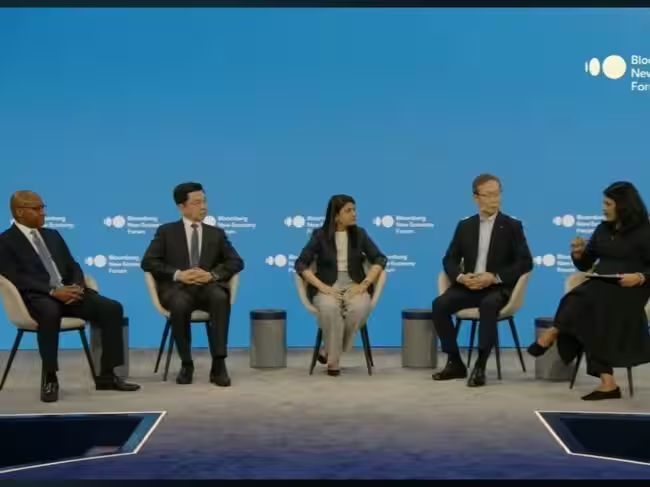
"The next phase... for AI is really going to be not experiments but actually driving outcomes," Misra said at the Bloomberg New Economy Forum 2026.
She said it was no longer about just deploying ChatGPT at scale but about going to a company's board and CEO, asking what the hardest problems they were trying to solve were, and working with them to solve those specific problems so that they could report the results to shareholders and investors.
"It's really something that you can put down in your shareholder report and say, here is how I've been able to move the needle, right from the top," she said.
Misra said one of India's leading healthcare companies had been deciding whether to buy a customer relationship management (CRM) system or build its own. About three weeks into a pilot of OpenAI's Codex coding tool, its chief information officer decided to build it in-house.
"That was costing them close to 80 lakhs of rupees. And they decided to build their CRM solution using Codex with all of their engineers prioritising this for like a week," she said.
She said the company was now using the CRM it built itself, and it is being adopted across the organisation.
Misra said OpenAI's mission was for artificial general intelligence (AGI) to benefit all of humanity, and that requires the cost of serving AI to keep falling. She said Luna, the cheapest of the GPT-5.6 models OpenAI launched alongside Sol and Terra, was almost as cheap to serve as open-source models.
"We want AI to be as much as we use electricity today, where intelligence should be available really to everyone," she said.
Misra said enterprises' concerns centred on accountability, audit trails and where their data sits. To address them, OpenAI offers data residency and local inferencing in India and has made its models available on Amazon Web Services (AWS), she said. PTI
Add  as a Reliable and Trusted News Source
 Add Now!
Read more news on
(Catch all the Technology News News, and Latest News Updates on The Economic Times.)
...more
Add Comment
Elevate your knowledge and leadership skills at a cost cheaper than your daily tea.
The ABCD of the US mid-term elections – Part 1: Why it matters across the globe Onion inflation at 108%? Yes, but not really. What is different this time? Curbing rupee bets: What the RBI’s new rules mean for the hedge-now-or-wait question Brinjal, buffalo, bacteria: Inside India’s pay-for-nature system Homebuyers wait as NCLT panel picks holes in unfinished Jaypee projects The NBFC saga - Part 3: How one default in 2018 changed the way RBI reads risk Four rules made HDFC Bank a compounder. All four have stopped. Can the new CEO rewrite them? What is the real impact of 13x jump in cash transfers to women? The NBFC saga - Part 2: Line drawn in 2006 is reason for the headlines today Airlines Q2 turbulence: Fewer passengers, rising fares and a crude shock










Subscribe Now