
Not Nvidia. Not Micron. If I Could Buy and Hold Only 1 Artificial Intelligence (AI) Semiconductor Stock Through 2030, This Would Be It.
Taiwan Semiconductor offers a good way to benefit from the AI chip revolution without having to choose which chip designer will win the competition.
By Adam Spatacco –
Key Points
- Nvidia and Micron face growing competition in their parts of the chip industry.
- Taiwan Semiconductor benefits from demand for many different types of chips.
- TSMC's near-monopoly position and attractive stock price make it a strong choice for long-term investors.
Over the past four years, semiconductor stocks have been among the biggest winners of the artificial intelligence (AI) revolution. Nvidia (NVDA -3.91%) has become the leading maker of AI accelerator chips, while Micron Technology (MU -4.53%) is benefiting from unusually high demand for memory chips.
Both companies have good long-term growth opportunities. However, growing competition could make their investment stories more complicated over the next few years. Also, as AI technology develops, it is becoming harder to know which types of chips will lead the market.
Fortunately, one semiconductor company could benefit from almost every major development in the AI chip industry: Taiwan Semiconductor Manufacturing (TSM -1.96%).
Image source: Getty Images.
Nvidia and Micron both face competitive risks
Nvidia has a very strong competitive advantage thanks to its graphics processing units (GPUs), networking equipment, and CUDA software. However, Advanced Micro Devices is investing heavily in its Instinct accelerator chips. Some of Nvidia's biggest customers are also designing their own chips.
Broadcom has become an important partner in the market for application-specific integrated circuits (ASICs). One important example is its work with Alphabet on tensor processing units (TPUs). Meanwhile, Microsoft and Amazon are also building their own chip businesses. Their products include Maia, Trainium, and Inferentia.
Another possible source of competition is the partnership between Space Exploration Technologies and Intel on Terafab. Terafab is Elon Musk's plan to build a semiconductor manufacturing business. It could eventually make SpaceX less dependent on outside chip suppliers. It is still unclear whether the project will reach large-scale commercial production. However, it shows that more companies want to control several stages of semiconductor production themselves through vertically integrated businesses.
NVDA Nvidia
NASDAQ · As of 4:00 PM ET 11/25/26

Key data points
Micron faces a different set of challenges. The growth of generative AI has created a major increase in demand for memory chips. In the next few years, memory-heavy technologies such as humanoid robots and self-driving cars could create even more demand.
However, Micron competes with Samsung and SK Hynix in the high-bandwidth memory (HBM) market. Memory prices have also gone up and down in cycles in the past. This makes memory makers vulnerable to changes in supply, demand, and profits.
Both Nvidia and Micron could continue to do very well. But there is another way to invest in the semiconductor industry without choosing one particular chip designer or memory maker.
MU Micron Technology
NASDAQ · As of 4:00 PM ET 11/25/26
Key data points
Taiwan Semi is the best chip stock without a bet on one design
Unlike Nvidia and AMD, Taiwan Semiconductor Manufacturing (TSMC) mainly makes chips that other companies design. Its customers include businesses that make GPUs, custom AI accelerator chips, smartphone processors, and car chips.
This means TSMC can benefit if Nvidia stays in control of the AI accelerator market. It can also benefit if AMD gains more market share or if custom ASIC chips become more popular. That is because TSMC makes chips based on all these competing designs.
Interestingly, Taiwan Semiconductor can also benefit from the memory market's current growth cycle. The company does not make regular dynamic random-access memory (DRAM). However, it is working with SK Hynix to make logic base dies for the next generation of HBM4 memory products.
TSMC also makes advanced packaging technology. One important example is its chip-on-wafer-on-substrate (CoWoS) platform, which helps connect AI processors with HBM memory. As demand grows for more advanced memory setups, TSMC gains more business opportunities beyond its traditional chip manufacturing work.
One of the strongest parts of TSMC's competitive position is its huge share of the market. Industry estimates suggest that Taiwan Semiconductor controls about 73% of the global pure-play foundry market. Its nearest competitor has only 6%.
TSMC is not technically a monopoly, but it has many of the same advantages. Its manufacturing skills, advanced technology, large production capacity, and customer relationships are very difficult for competitors to match on a similar scale.
TSM Taiwan Semiconductor Manufacturing
NYSE · As of 4:00 PM ET 11/25/26
Key data points
Taiwan Semi stock has an attractive price
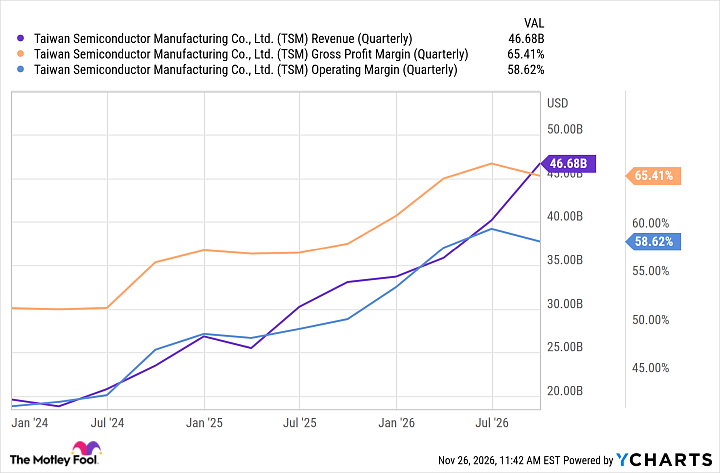
In the third quarter, Taiwan Semiconductor reported revenue of $46.7 billion, up 41% from the same period a year earlier. Its gross margin was nearly 65%, while its operating margin grew to about 59%.
TSM Revenue (Quarterly) data by YCharts
Company leaders expect revenue to reach $53.3 billion in the fourth quarter. That would mean 58% growth compared with the same quarter last year. These results show how TSMC is using its large manufacturing capacity to turn very strong demand for semiconductors into high profits.
Even with these strong results, Taiwan Semiconductor stock trades at a forward price-to-earnings (P/E) ratio of 15.7. This looks like an attractive price for a company growing this quickly, earning such strong profits, and holding such a leading position in its industry.
Instead of trying to guess which chip designer or memory maker will win over the next few years, investors could consider owning the company that makes many of the industry's most popular chips.
TSMC's business model works with many different chip designs. It also has strong advantages over competitors and a reasonable stock price. These qualities make it an attractive semiconductor stock to buy now and hold through the end of the decade.