
Jensen Huang: How the Nvidia scandal exposed the risks of Asia's big AI bet
Jensen Huang’s surprising return as head of Nvidia shook the company’s share price in New York and sent shockwaves through the AI industry around the world.
The effects were especially strong in Asia, where the story showed just how much the region depends on this technology.
Stock markets focused on technology in Japan, South Korea and Taiwan had a week full of sharp rises and falls. Markets jumped after Nvidia’s share price rose by nearly a trillion dollars, but then fell as worries about political and government checks made investors less confident.
Nvidia is a "symbolic bellwether" for the AI industry, which is quickly becoming important to places such as South Korea, Taiwan, Singapore and Malaysia, says Dylan Loh, a lecturer in international studies at Nanyang Technological University.
These economies have made AI a major goal. They are investing in everything from chip-making and data centres to overseas business deals. They are also becoming more dependent on Nvidia’s success.
Nvidia is everywhere
Nvidia has some of the world’s most powerful advanced chips and a huge amount of money behind it. This has made the company known as "the bank of AI". Its boss, Jensen Huang, is also a well-known supporter of AI.
Together, the company’s technology and Huang’s public profile have made Nvidia central to the AI industry in many ways.
Nvidia was able to grow quickly partly because it pays other companies to make its chips instead of spending huge amounts of money building its own factories.
It sends most of its chip production to TSMC, a major chipmaker in Taiwan.
This means Taiwan is at risk if demand for AI technology changes, says Paul Cavey, who runs the research company East Asia Econ in Taipei.
"The surge in [Taiwan's] real economic growth since 2024 has been because of the big increase in AI related exports".
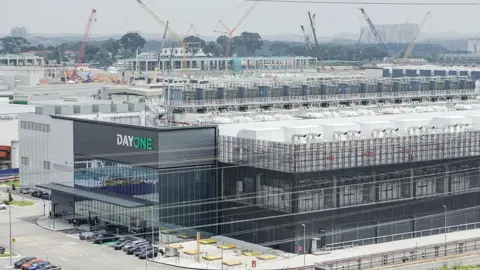
Earlier this year, Huang said Nvidia planned to invest around $150bn (£114.4bn) a year in Taiwan. He made the announcement at an event celebrating the company’s planned headquarters on the island.
South Korea and Japan are also affected by the AI industry, although to a smaller degree, Cavey says. Companies in these countries supply important parts, including memory chips and testing equipment. Samsung and SK Hynix are among the companies making components for Nvidia’s processors.
Nvidia also provides financial support and major loans to companies in the AI supply chain.
 Getty Images
It is hard to overstate how important Nvidia, led by Huang, has become to the region’s AI industry. Its chips are used in data centres, help run AI systems and support companies that make cars and electronic products.
"Asia isn't just a customer base for Nvidia. It is an indispensable engine of the company's AI dominance because of East Asia's semiconductor manufacturing and memory ecosystems," Loh says.
The data centre industry in the Asia-Pacific region depends largely on Nvidia chips. It is growing faster than ever, according to research group CBRE. Investment has increased steadily in recent years, reaching a record $11.6bn (£8.85bn) in 2025.
In South East Asia, the Singapore-based AI company Megaspeed had become the region’s biggest buyer of Nvidia chips before it was accused of secretly moving them to China. Megaspeed says it "conducts legitimate and lawful business" and has "retained external legal counsel to conduct a thorough internal investigation".
The US has said it plans to stop Megaspeed Ltd from doing business in the United States.
Singapore also showed this week how important AI has become to the region. The country raised its economic growth forecast for this year again, as technology helped its economy grow.
Google, Microsoft and Oracle, some of the world’s biggest technology companies, also plan to increase their spending on infrastructure in the region by about 60% this year, CBRE said.
Demand has also grown quickly for neoclouds. These are special data centres built to support AI, the research group said.
Loh told the BBC that Nvidia has become "hugely important" to economies that are making big bets on AI. They are spending huge amounts on its chips, and more of their factory work now depends on its technology.
Huang's return carries risks
In many countries, people celebrated the news that Huang was returning to lead Nvidia.
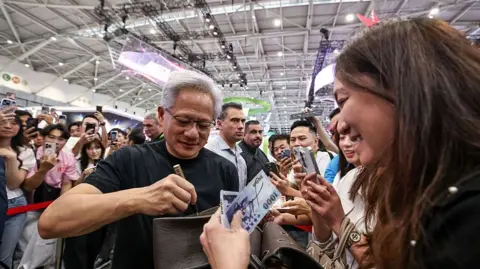
In Taiwan, where Huang was born and where people have a strong enthusiasm for him known as "Jensanity", investors jokingly called his return a "one man saves the village" story.
People posted messages on social media and on Line, a messaging app. Some wrote "Old Huang is back," while investors said things like "Daddy is back to save my life" and "the humanitarian corridor is open."
But some people said the episode should also make Taiwan look more closely at how well it has built a chip supply chain that does not depend on China. They also said the risks of depending so heavily on Nvidia need to be managed better.
Asia’s technology industry has faced growing pressure from the US in recent years. The governments of both Joe Biden and Donald Trump have made rules on selling Nvidia’s most advanced chips to China stricter.
The US appears to be increasing these efforts again. Just last week, Washington announced new rules that will mean closer checks on data centre operators in Singapore, Malaysia, Thailand, Indonesia and Brazil.
The latest move does more than limit the sale of powerful chips to China. It also limits access to the computing power inside them. Chinese companies currently rent this computing power from data centres in other countries to train AI systems.
 Getty Images
This could hurt South East Asian countries, which have spent billions building data centres for Chinese companies. The Financial Times reported that Nvidia has already stopped sending chips to the region. However, it is not clear whether this is only temporary while the company works out how to follow the new export rules.
Nvidia did not immediately reply to the BBC’s request for comment.
There is also growing criticism from both major US political parties of President Trump and Nvidia. This came after Trump said he had "made the deal" to "convince" the company’s board to bring Huang back.
Huang is also due to answer questions from Congress next week. Democrats are preparing to take control of both the US House of Representatives and the Senate in the New Year, which could bring more risks for him.
"Jensen's return may resolve the immediate leadership crisis, but it does not resolve the legal and political overhangs," said Charu Chanana, chief investment strategist at Saxo Bank.
Investors were already worried about the trillions of dollars being spent on AI and the huge role Nvidia plays in the industry. These worries were already causing uncertainty in stock markets around the world.
Some people fear that Nvidia and its well-known leader have helped AI grow, but that having so much influence in one company also creates a risk.
This is especially worrying now because Huang’s future is still uncertain. Changes affecting him could also affect economies that depend heavily on the AI industry.
"I would say the President and White House would love to brush this over and say its fine but I believe Democrats in Congress will definitely be probing", said Ray Wang, founder of the San Francisco-based research company Constellation Research.
"The story is not over yet... Jensen coming back is probably the biggest, baddest return ever. The question is what will happen next?"
Additional reporting by Benny Lu, BBC Chinese