
Terence Tao Validates Riemann Hypothesis Personally: "AI Generating Mass Proofs Equals Power Plants Dumping Nuclear Waste"
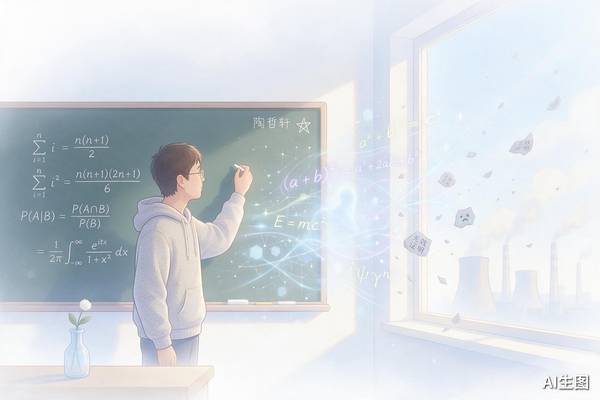
Just days before the announcement of a proof of the Riemann Hypothesis, Terence Tao shared his latest thoughts on AI and mathematics at an event at Harvard University.
AI companies generate large numbers of mathematical proofs that are very hard to understand when testing their models. It is like power plants producing nuclear waste!
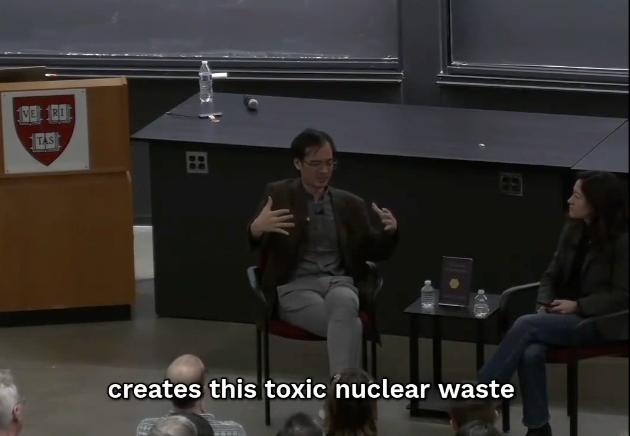
But Tao is not completely against using AI in mathematical research. He believes that AI companies and human mathematicians should work together to produce results that are easier to understand.
In fact, Tao himself is following the AI-generated proof of the Riemann Hypothesis and trying to understand it.
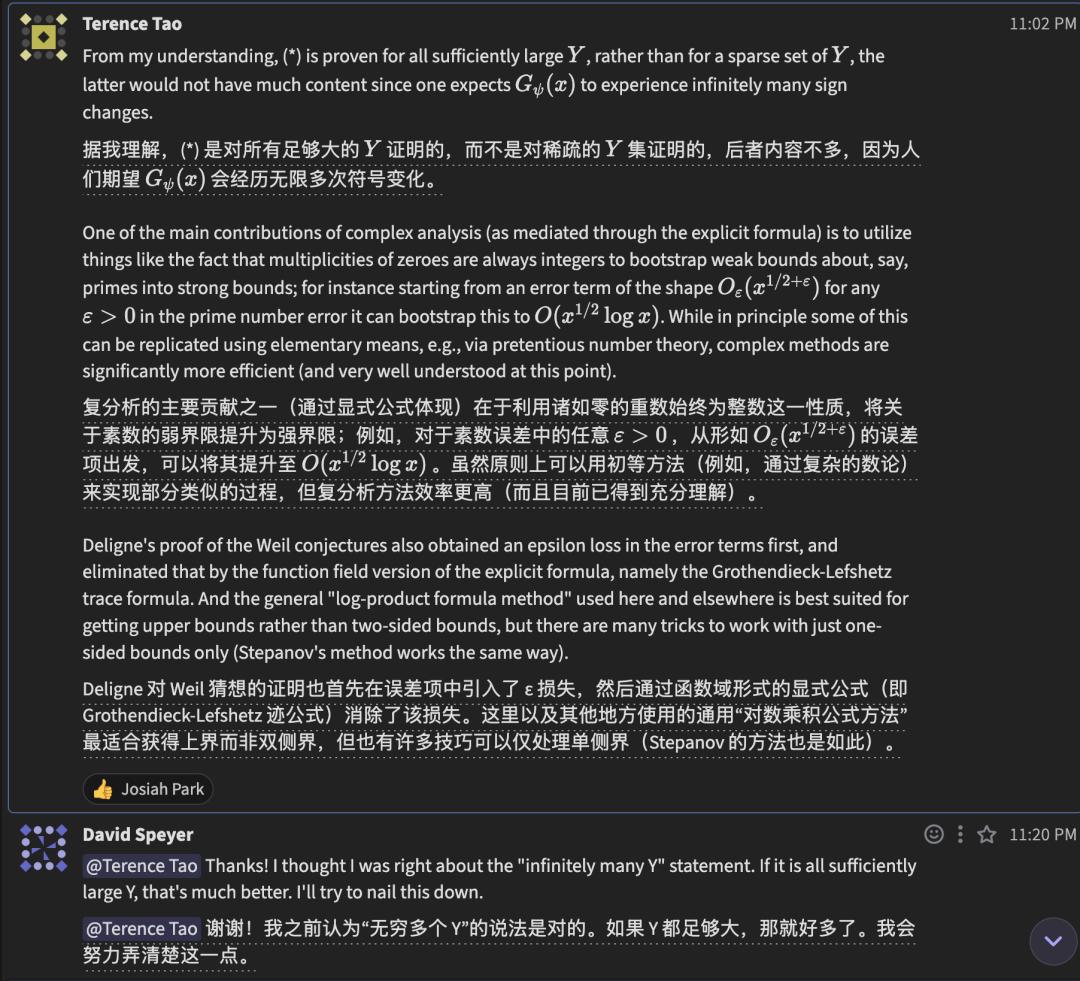
Based on his early comments on his blog, the proof seems to use many modern mathematical tools from the Langlands Program and arithmetic geometry.
His blog has also posted an invitation for an open research project. The goal is to bring people together to work through the proof of the Riemann Hypothesis.
After all, who would turn down the chance to use the most advanced AI tools to solve a mathematical problem that comes along only once in a thousand years? No mathematician would want to miss that chance.
Terence Tao is no exception.
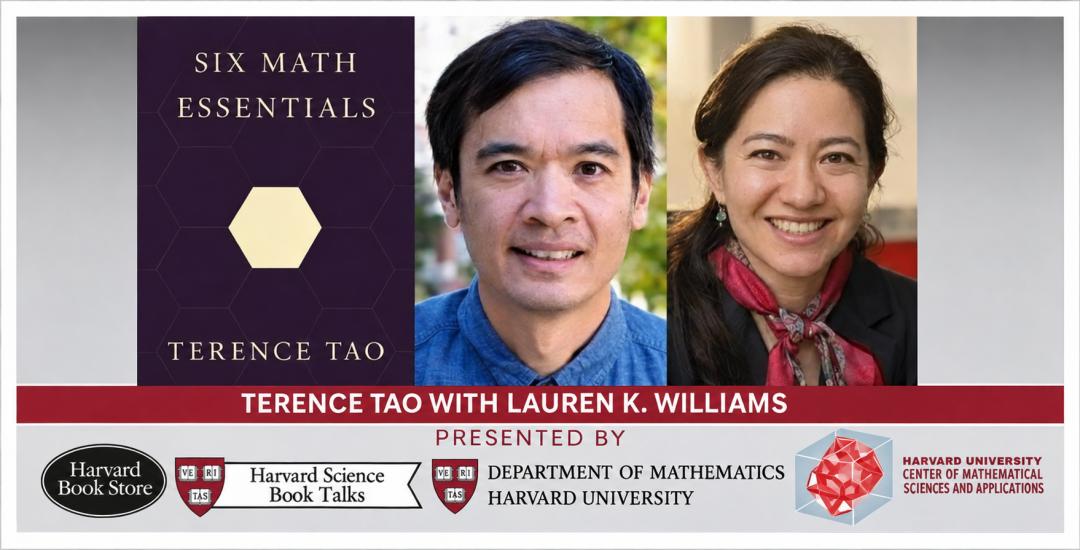
At the Harvard event, the host said that some PhD students worry that AI companies may have already solved the problems they are researching in private, without telling the public.
Tao said that after machines produce large numbers of proofs that are difficult to understand, companies face several difficult choices.
They can keep storing the proofs, make them public, or pay people to study and process them.
He would rather see companies talk to mathematicians before starting their work. Together, they could choose mathematical problems that are truly worth solving with AI.
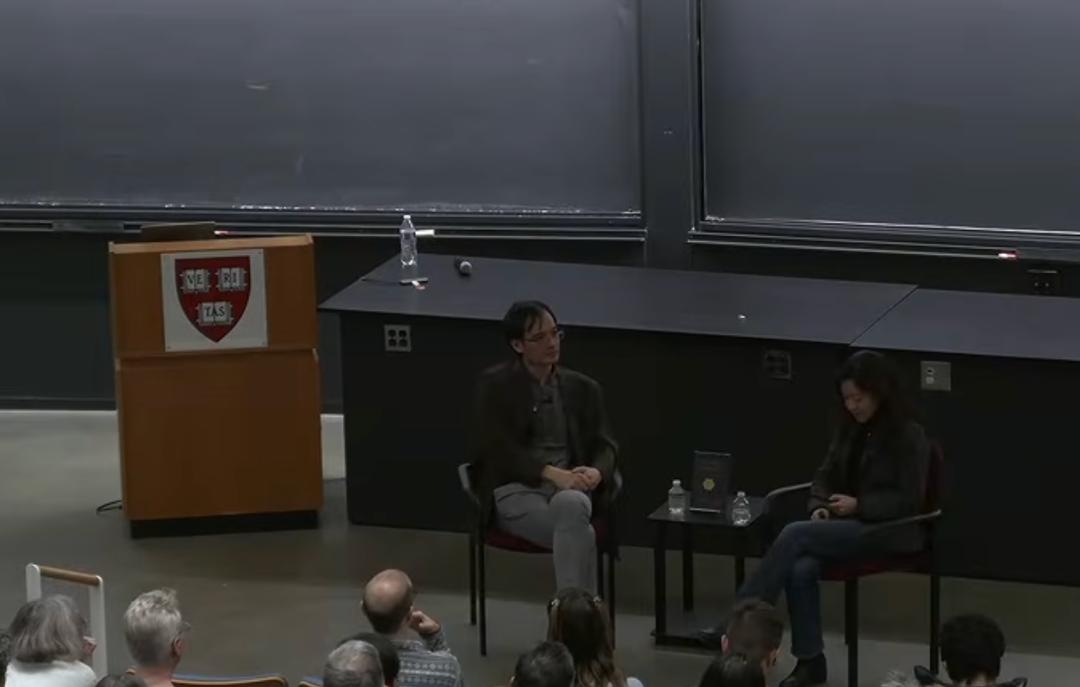
At the Harvard event, Tao also shared the following views.
1. What should students do if they worry that AI will solve their research problems first?
One of his students brought together several other students. They made a list of thousands of related problems and asked AI to test how far existing proofs could be extended to solve them.
2. If AI can now write research papers, how can mathematics departments judge whether someone is qualified for a teaching job?
Tao suggested asking job candidates to give a lecture at a blackboard. Other mathematicians could ask questions at any time.
3. What work does Tao himself give to AI?
He now lets AI handle tasks such as writing Python and JavaScript code and searching for research papers. But he still wants to keep his ability to work through mathematical proofs on his own.
Below is an edited and shortened version of the full transcript of Terence Tao's speech and the question-and-answer session at Harvard.
Enjoy!
As AI produces more proofs, is solving problems still the most important goal?
Terence Tao: Solving problems is a bit like getting a score in a course. It gives us a way to judge how much someone has learned. In the past, this was a very useful measure.
People who are good at solving problems are usually also good at understanding and explaining mathematics. They can find new ideas, suggest new questions, write textbooks, and guide students. In the past, these abilities were often closely connected to being good at solving problems.
So we used a simple way to judge people's work: give awards to those who solve difficult problems and make it easier for their papers to be published in top journals. When proofs were hard to find, this system worked very well because finding a proof was the main challenge.
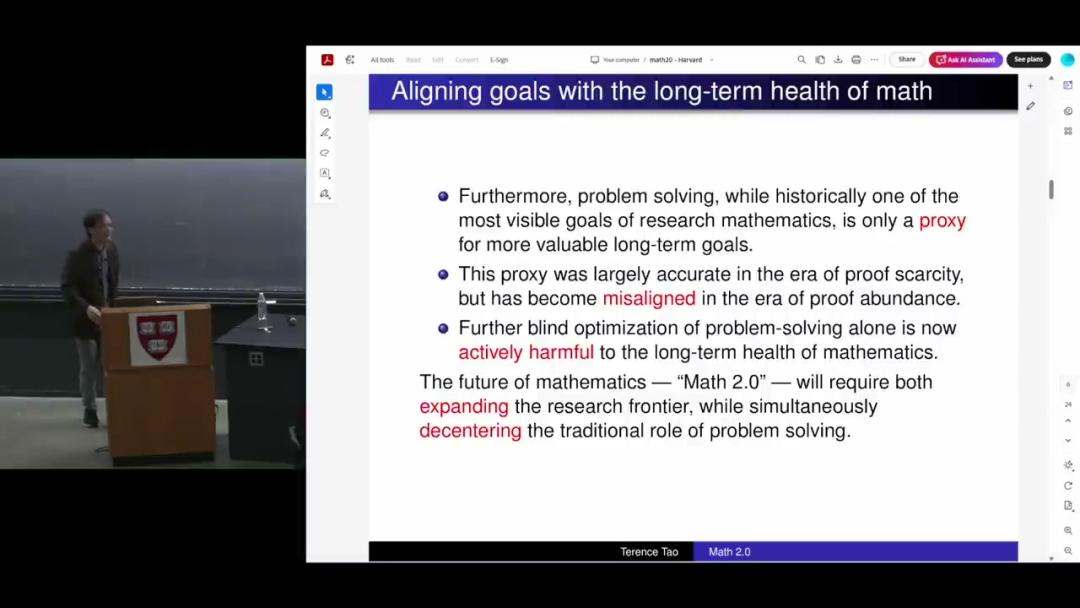
Today, AI has made it much cheaper and easier to produce proofs. If we continue to treat solving problems as the main goal, it will become less connected to the other things we want mathematics to achieve.
Students at Caltech held a mathematics hackathon over a weekend. At first, the plan was to compete to solve as many unsolved problems as possible. But the rules later changed. About 100 teams each chose a result that already had a proof, but where the existing proof was not very good in some way.
The teams tried to find simpler proofs and explain the results more clearly. They also created animations and computer programs to help people understand the mathematics.
What if an AI company has already solved the problem I am researching for my PhD?
Lauren K. Williams: Scott Aaronson said that some of his PhD students are very worried. They fear that OpenAI or Anthropic may have already solved the problems they are working on privately, without making the results public. When these results are eventually announced, other researchers may question their quality. How should research groups work with the mathematics community?
Terence Tao: Ideally, technology companies should work with mathematicians before asking machines to generate large numbers of proofs automatically. Once the machines have produced all those proofs, there are no easy choices left.
It is like power plants producing toxic nuclear waste. You can store it, release it into the environment, or pay someone to deal with it. None of these choices is easy. The best solution is to avoid producing this kind of waste in the first place.
The problem today is that technology companies and the mathematics community have very different goals. Companies use mathematical problems mainly to train their own AI models. The proofs they produce are just extra results from that process, almost like waste products.
Lauren K. Williams: So if a company wants to use a particular mathematical conjecture to train its model, should it first work with mathematicians who specialize in that area?
Terence Tao: I can imagine another way to do this. Mathematicians and technology companies could work together to design sets of problems.
In my project, there are more than 20 million algebra problems that nobody had worked on before. There are so many of them, but solving them is very interesting. They can also provide excellent training material for AI models.
Some problems are ones we want people to solve themselves because the goal is to discover new ideas and gain a deeper understanding. For other problems, we mainly want to know the answers. There are too many of these for people to solve them all, so we are happy to let AI handle them.
Think of a city like Boston. Some streets are for cars, while others are kept for people walking. We do not need to turn every walking path into a road for cars.
What should students do if they worry that AI will solve their research problems first?
Lauren K. Williams: In the age of AI, or what some call Mathematics 2.0, what are you most excited to see happen in mathematics?
Terence Tao: I want to see what new and creative methods people come up with, especially young researchers.
I have a student who became a little frustrated some time ago. AI had produced some results on a major problem that was very close to his own research topic. These results attracted a lot of attention. He had been studying a variation of that problem and had already made some progress, so he started to worry.
After we talked, he began working with several other researchers in the same field. They plan to make a list of thousands of variations of this type of problem. They will check what is already known about each one and then use AI to test them. For every existing proof, they will see which other problems it can solve and where it stops working.
In the past, researchers often competed to say, "I solved this problem." Now, people are thinking more about how they can work together to complete a shared collection of results.
I have done this kind of work before. Someone might say, "I found a new way to improve the result from 86% to 87%. I still cannot solve these few problems. Here are the methods I tried. Can someone else continue from here?"
Who can I ask if I cannot understand a proof produced by AI?
Lauren K. Williams: What can we do to encourage researchers to explain their results clearly? How can we give less importance to simply being the first person to find a proof?
Terence Tao: I helped edit a journal called "Mathematical Discourse." People submit presentations, and other mathematicians review those presentations.
There are also grants to support workshops where researchers work together to understand proofs that nobody can easily follow. These proofs are often produced by AI. A workshop might invite 20 young researchers to study one such proof together.
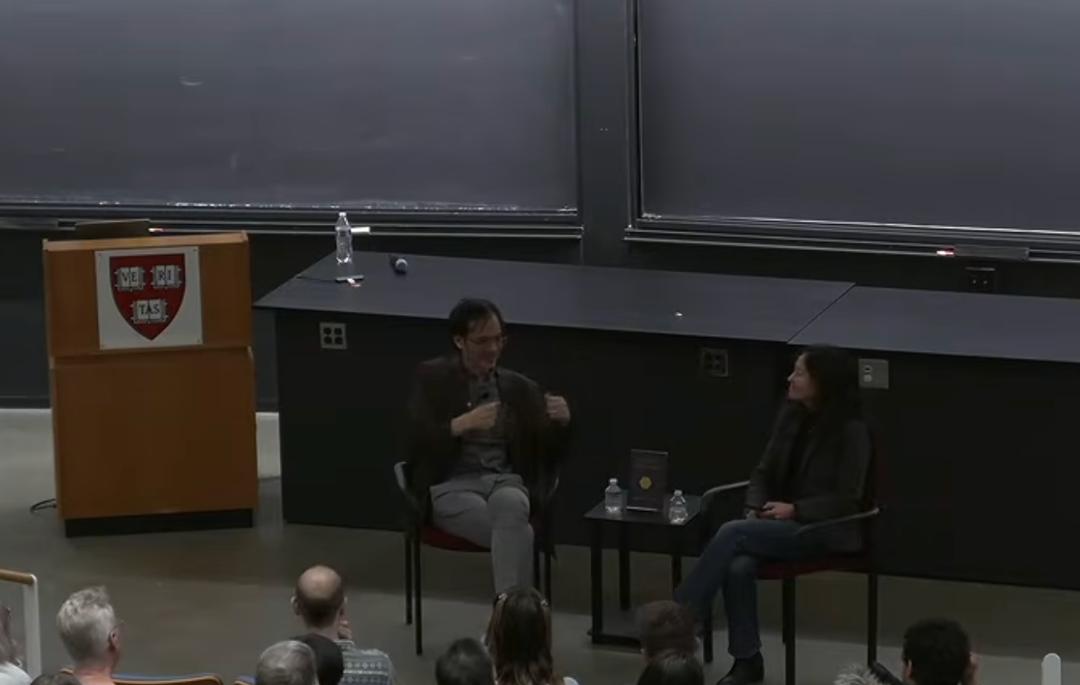
It is not enjoyable to struggle through a very difficult AI-generated proof on your own. I have done it, and it is exhausting. When you read a paper written by a person, even if it is difficult to understand, you know there is someone you can ask for help. If you get stuck on a sentence, you can email the author and ask for an explanation. With an AI-generated proof, there may be nobody you can ask.
When universities hire researchers, give awards, or decide on promotions, they can no longer judge people only by the number of papers they have published in top journals. AI can now write papers that look excellent, even if the person whose name is on the paper does not really understand what they contain.
In the future, when universities interview people for academic jobs, it would be better to ask candidates to give a lecture at a blackboard. Other researchers should be able to ask questions and discuss the ideas with them during the lecture. Simply showing a set of attractive Beamer slides does not tell us very much about how well someone understands the subject.
What work does Terence Tao himself give to AI?
Lauren K. Williams: What advice would you give to university students and graduate students studying mathematics? When should they use AI, and when should they avoid using it?
Terence Tao: I would roughly divide the things you need to do into two groups. The first group contains skills you want to keep and hope you can still use yourself. The second group contains skills you are willing to give up so that you can get your work done.
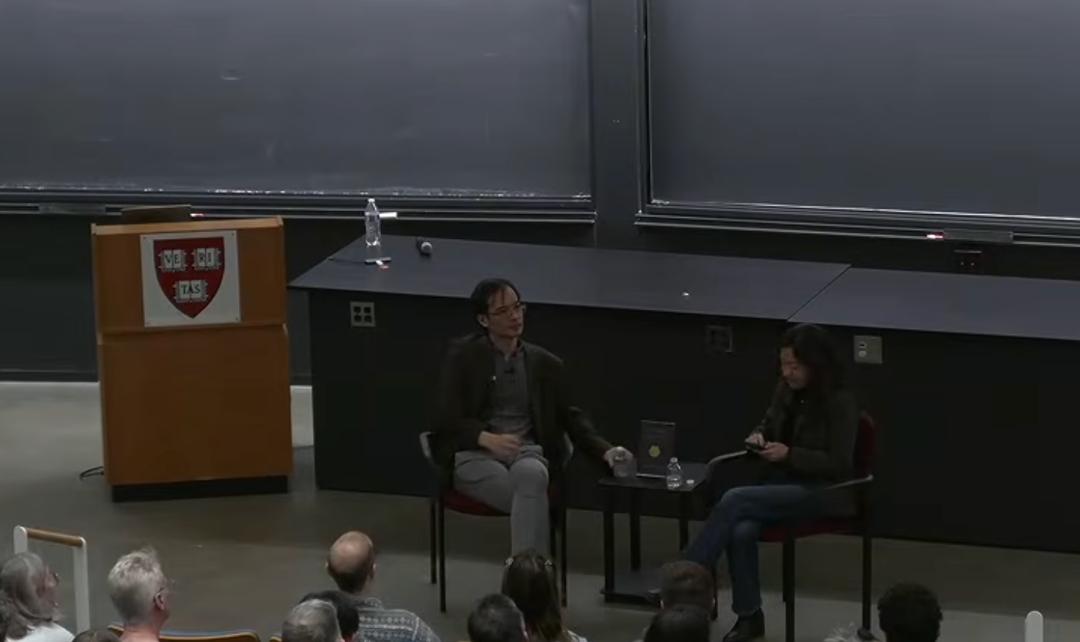
AI lets you move a skill from the first group to the second. But once you stop practicing a skill, you can become rusty, and it can be very hard to learn it again.
I do not think programming is a basic skill that I must keep doing myself. These days, I only write LaTeX by hand. I let AI handle Python and JavaScript programming. I also let it do most of my searches for research papers.
But I still work through mathematical problems and derive results by myself. I rarely use these tools to do mathematical research directly. This is an ability I want to keep.
Reference Links:
[1]https://www.youtube.com/watch?v=pOQ7IO4_Vxg
This article comes from the WeChat official account "QbitAI" (ID: QbitAI). The author is Ting Yu. It was published with permission from 36Kr.