
The Core Figure Behind Claude Code Reflects on the Future of Vibe Coding

Anthropic has been facing a difficult period recently.
On one side, its stock price fell below its IPO price less than a week after its listing, which had been described as the largest IPO in history. On the other side, several key members of its most important Claude Code team have left to join rival company OpenAI.
Yesterday, Thariq Shihipar, a key engineer on the Claude Code team, officially announced that he was joining OpenAI. Just now, some people online publicly questioned his decision. They argued that anyone who truly cared about AI safety would not change jobs and suggested that he had made the move mainly for a huge salary package.
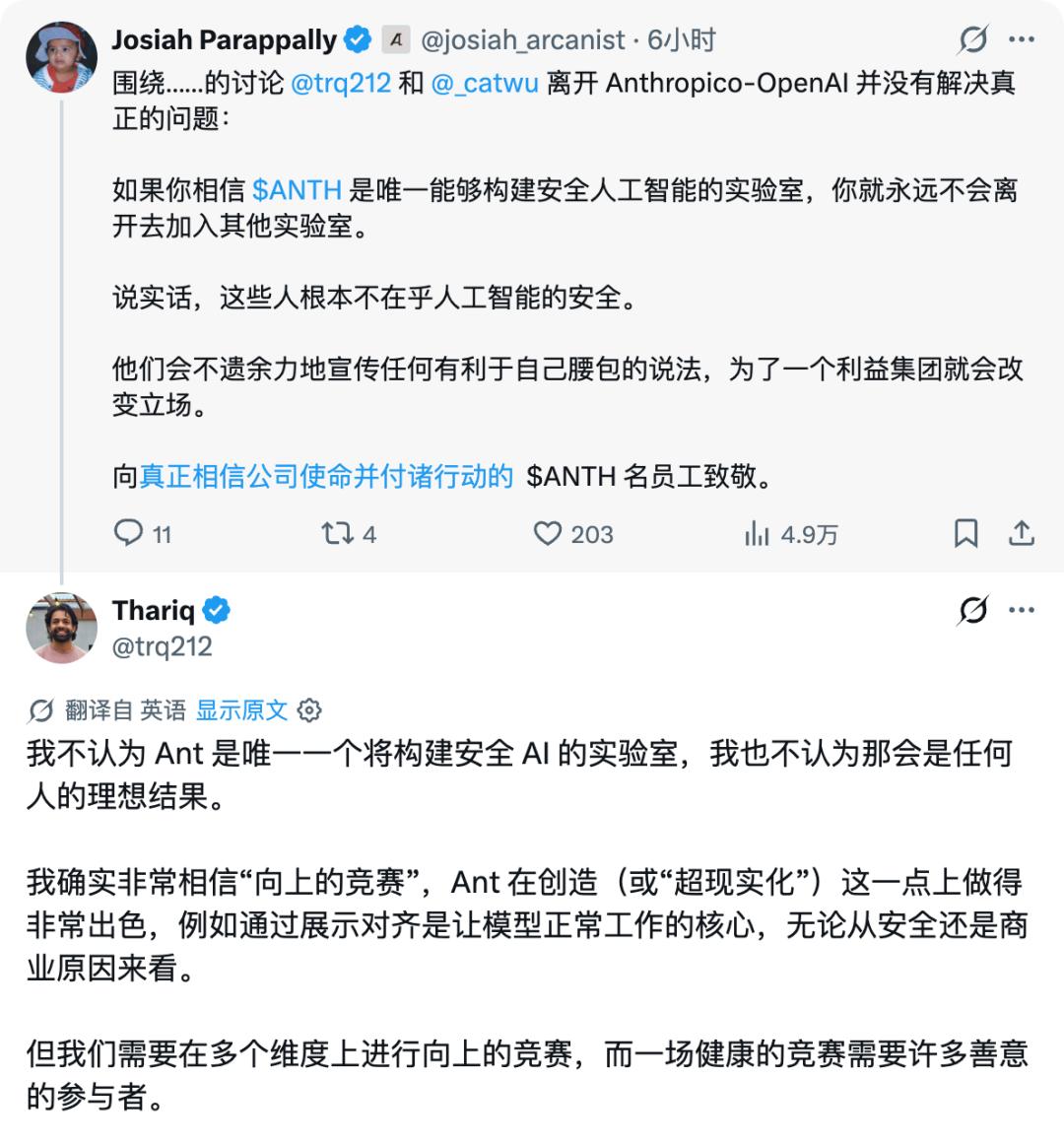
Thariq responded politely. He said he believed that healthy competition helps everyone, that having one company dominate the field benefits nobody, and that Anthropic is not the only AI lab working to build safe AI.
For a while, the situation was very tense.
Familiar members of the Claude Code team are coming together again at OpenAI
Looking at what has happened over the past week helps explain why Anthropic's shareholders may be feeling uneasy right now.
First, consider the stock market. On the evening of November 19, Beijing time, Anthropic made its stock market debut on NASDAQ. Its IPO price was $83 per share. On its first trading day, the stock reached a high of $115.10 during the day and closed up 17%. For a while, investors were very optimistic.
However, Morgan Stanley, the bank responsible for supporting the stock price after the IPO, used its full greenshoe option very early. This meant Anthropic lost a possible way to support its share price. At the same time, market confidence weakened, putting more pressure on the stock.
By the close of the US stock market in the early hours of November 25, Anthropic shares had fallen to $81.91. During the day, they had dropped as low as $75.61. The stock had officially fallen below its IPO price after just four trading days.
Along with the falling stock price, another problem is causing Anthropic even more concern: the loss of important employees.
The person leading this hiring effort is Thibault Sottiaux, head of core products at OpenAI, who is known in the industry as Tibo. Throughout November, Tibo recruited all four members of Claude Code's core team, one after another, almost as if he were checking names off a list.
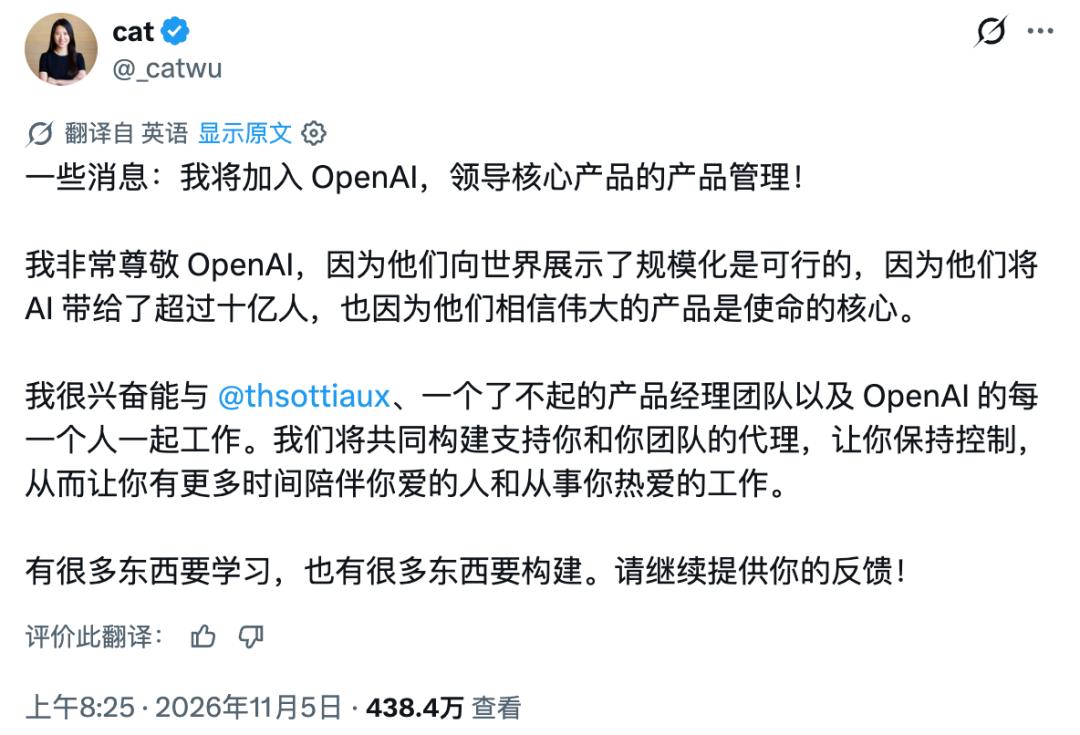
The first to officially announce the move was product lead Cat Wu.
Wu graduated from Princeton University's computer science department. Before joining Anthropic, she worked as an investor at Index Ventures and led product teams at YouTube and Scale AI. She was the person who turned Claude Code from an internal test project into a successful commercial product. She left Anthropic at the end of October and announced on November 5 that she was joining OpenAI. She is directly responsible for ChatGPT, Codex and the developer API.
Austin Lau also announced that he was joining OpenAI on the same day. He was Anthropic's first employee focused on growth marketing. His main job was to introduce Claude Code to developers around the world. On November 5, he also announced that he was joining OpenAI's Codex growth team.
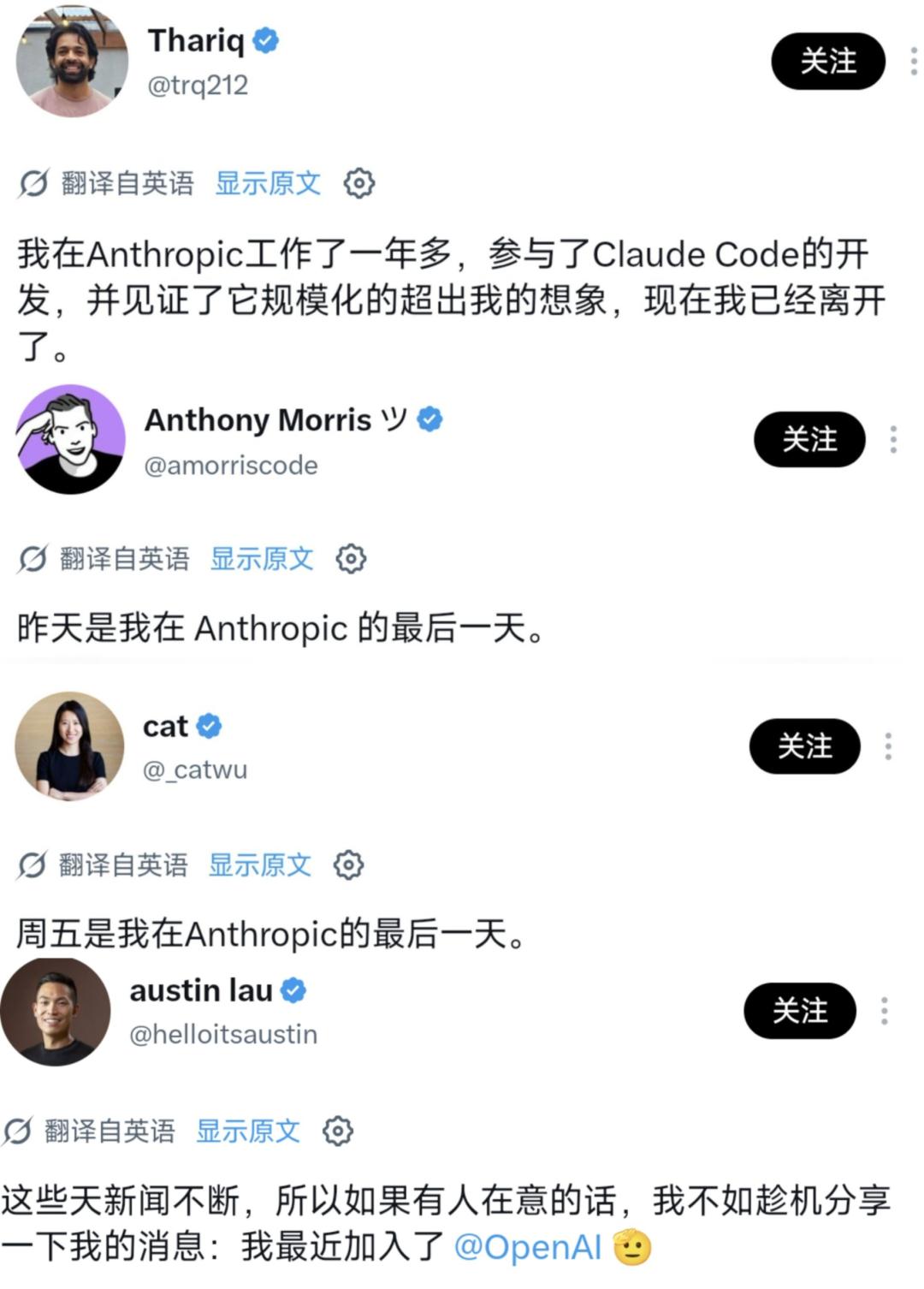
On November 18, a leaker named Arfur Grok reported that Anthony Morris, who created the desktop version of Claude Code and was a key developer of its desktop software, had also joined OpenAI. He has not made an official public announcement, but he had already left his job on October 24.
The final and most important recruit is Thariq Shihipar, who announced his move on November 26.
He left Anthropic on October 24, the same day as Anthony Morris. At Anthropic, he worked on how AI agents interact with users and how their tools are designed. He developed several important features, including the AskUserQuestion tool, the Claude Agent SDK and Skills, a system for creating flexible workflows.
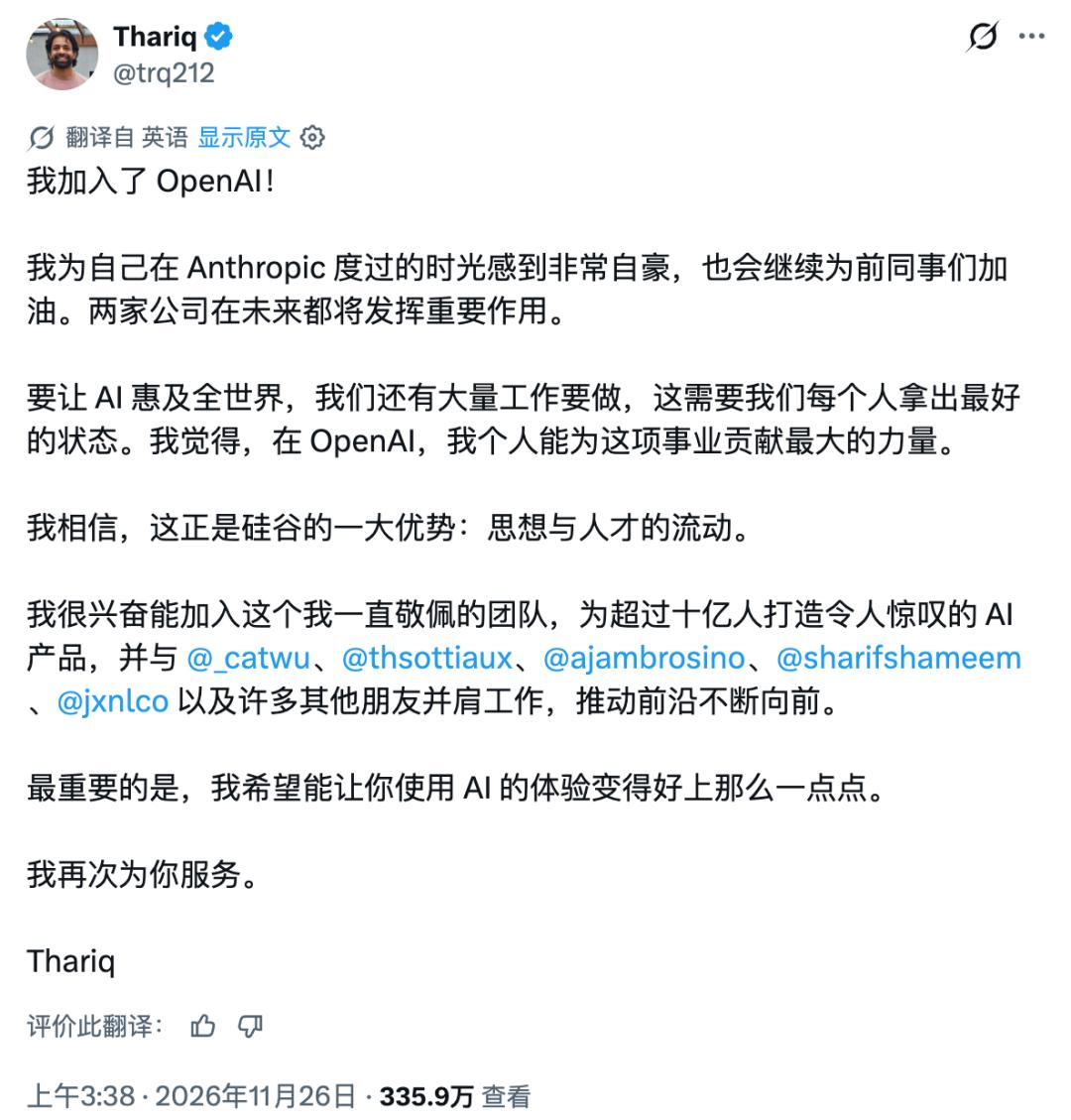
In just three weeks, OpenAI recruited four people from key positions: the product lead, the main developer of Agent interactions, the main desktop software developer and Anthropic's first growth marketing employee. OpenAI may have saved itself the time needed to build a team and help its members learn to work together. Instead, it gained an experienced Claude Code team that was already familiar with one another.
AI is not just an industrial revolution. It is also a new Renaissance.
Leaving aside the public debate, OpenAI's decision to spend so much money to recruit Thariq and his team shows what it really values: their ideas about what the next generation of programming tools should look like.
Around the time Thariq officially announced that he was joining OpenAI, a nearly 54-minute interview he had recorded earlier at the AI Engineer Code Summit was also released.
By looking at his comments in this interview, we can get an idea of how young people might work with AI in the future and where the next generation of AI programming agents could be heading.
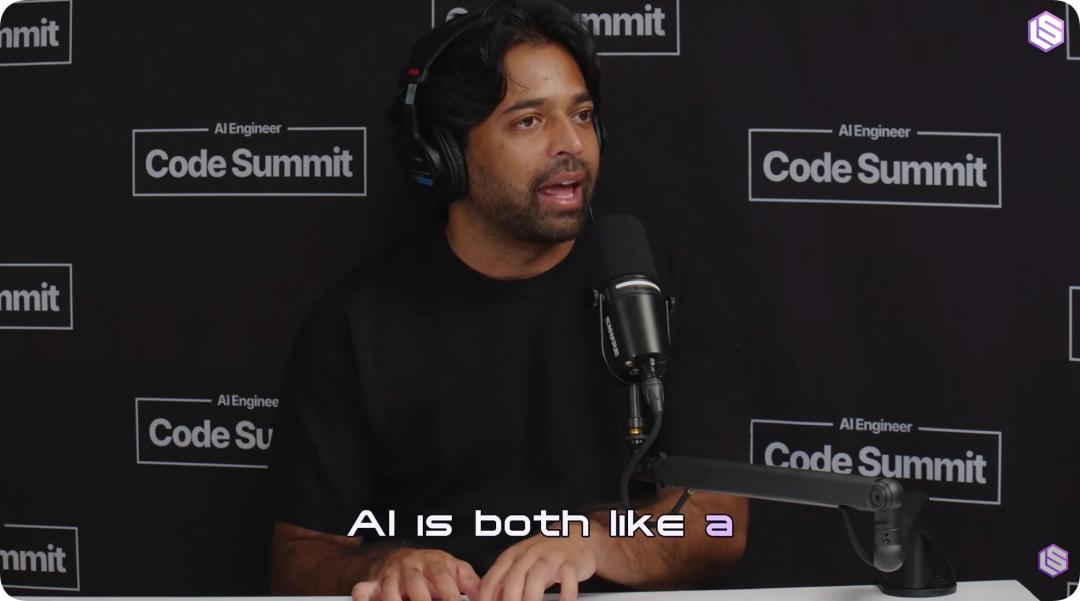
Figure | A screenshot from Thariq's interview, 🔗 https://www.youtube.com/watch?v=Qe9d9dWyED0&t=1s
The first big idea is that people should become more involved in making software again.
Over the past year, Thariq strongly supported ideas such as "Bash is all you need" and "React is all you need." He believed that all operations should happen through the command line, that front-end development should use only React, and that even MCP was unnecessary.
Now he has openly changed his mind. AI can already use Computer Use to operate Figma directly and create front-end designs. This means that people no longer have to change the way they work just to fit AI. Instead, AI is starting to adapt to the tools and methods that people already use.
Following this idea, he has also started to rethink the popular approach known as Vibe Coding.
Recently, Thariq used AI in his spare time to make a game about controlling elements. During development, he noticed that the AI model was making many design decisions by itself. When he later played the game, he discovered that the characters could do many things he had never known about.
This made him uncomfortable because he felt he had lost control of the project. He could not clearly see or understand everything the AI was doing. To solve this problem, he wrote a special scripting language and created a folder called /human. He required every piece of code in this folder to have full comments, banned variable names made up of just one character, and set a maximum length for each line of code.

His goal was to make every file easy to read, like a document explaining how the software should work, while still making sure that the code could run properly.
He lets AI rewrite the basic engine and main components using WebAssembly. He handles the settings and design changes himself in the /human folder. Even when AI automatically runs tests to balance the game, humans must make the final decision about what to change. After all, a game that is perfectly balanced can actually be boring.
Based on this experience, Thariq made an interesting prediction about the software industry.
He believes that 2026 is the year of software factories and industrial-scale software production. During this period, everyone will compete to make software cheaper, more standardized and easier to produce in large amounts. But the industry will later move towards a new software Renaissance. As the cost of making software falls sharply, small improvements in quality and individual taste will become valuable again.
He also shared an experience that may surprise people. He pays for two AI plans that each cost $200 a month. Even so, he has not used up their usage limits. He also rarely feels that the AI models are not smart enough for his needs. Although he does not understand PyTorch or CUDA, he can now use AI to carry out experiments in reinforcement learning and model interpretability. He believes that people with broad knowledge and strong general skills will become more valuable in the future.

The second big idea is to face the challenges of personal software and introduce what he calls "decision-making models."
As AI makes writing code easier, a new problem appears: people may not even know what they really want.
Thariq has experienced this problem himself. He once used AI to build an app that replaced the Dock on macOS. He wanted to keep writing, programming and browsing social media separate from one another. But after finishing the app, he only used it a few times. Later, he realized that what he really wanted was not simply to separate these activities. He wanted to reduce the distractions caused by social media while still keeping the freedom to live his life as he wished.
He then started building a new app that combines to-do lists, screen-time tracking, sleep reminders and calendars. He plans to add a "decision-making model" to it. This is what he called a System 1 model during the podcast.
For example, checking an information feed while attending the AI Engineer Conference can be a normal part of work. But constantly checking a phone while spending time with friends is a distraction. A small and lightweight decision-making model could quickly understand the situation and the user's purpose in the background. It could make everyday decisions within seconds. When it faces a difficult problem, it could call a much larger AI model to think more deeply. This approach could save both time and money.
He also hopes that personal AI agents made by different companies, such as Dot, Duet and Grok Bot, will be able to communicate with one another. This would mean users would not have to keep switching between many similar products.
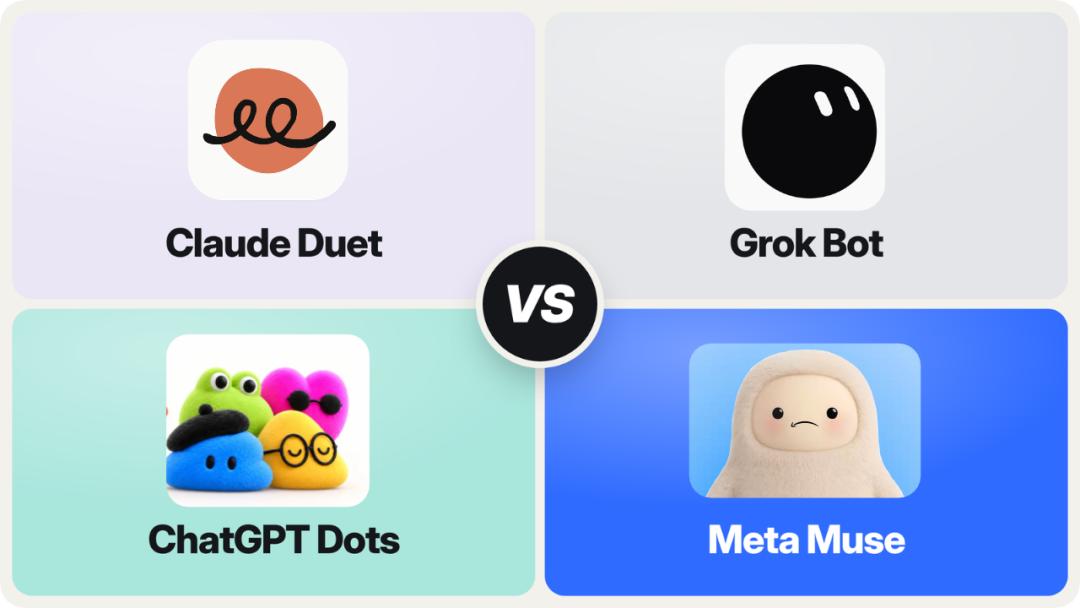
The third big idea is to set clear boundaries between humans and AI when it comes to RSI.
RSI has recently become a popular topic. Many people imagine a future in which AI research labs have no human workers and AI models improve themselves completely on their own. But Thariq warned against this idea. He does not believe that removing humans from the process is the best way for AI to improve itself.
In his view, a better approach is to turn AI research into a form of knowledge work. AI should handle difficult technical tasks and run experiments. Humans should come up with ideas, choose which directions to explore and decide how resources should be used.
After all, every AI lab has a limited amount of computing power. Training a leading AI model can cost billions of dollars. In the end, humans must decide how to spend such a large computing budget.
He believes similar changes could happen in many other industries. In biological research labs, robots could carry out experiments involving liquids and other materials, while humans decide what research to do and secure the funding. The same idea could apply to restaurants. Robots could handle the cooking, while humans decide what goes on the menu and calculate profit margins. If this change goes well, AI could even create more office-based jobs.
At the end of the interview, Thariq also discussed a practical question: As AI becomes more common, university degrees and GPA scores may become less useful for proving what someone can do. So how can young people show their abilities?
To answer this, he talked about achievement systems in video games. For example, someone who leads a guild in World of Warcraft must organize a team, plan when people work, set deadlines and coordinate dozens of players to complete difficult dungeons. These skills are similar to the organizational abilities that may be needed to manage huge computing clusters in the future.
The two hosts sitting beside him added another point. In the past, people often looked at someone's GitHub code submission history to judge their technical ability. Today, public talks and completed projects are also important. In addition, the amount of AI tokens a person uses has, to some extent, become another possible way to judge their abilities.
After watching the full interview, one idea appears again and again. Whether Thariq is talking about bringing human feedback back into game development, giving up an app he built himself, or making sure humans keep control over how AI research resources are used, he keeps returning to the same message.
The industrial revolution in software has given more people the ability to turn their creative ideas into real products. The new software Renaissance may change how we understand the value of creativity itself. As AI makes it easier and easier to bring ideas to life, the rarest skill in the future may be having an idea that is truly worth bringing to life.
This article was originally published by the WeChat Official Account "APPSO", written by Discovering Tomorrow's Products, and republished with permission from 36Kr.