
AI raises new questions about what penetration testing proves

Artificial intelligence (AI) is now a regular part of threat-led penetration testing (TLPT). This is a type of cybersecurity test in which experts act like real attackers to find weaknesses in an organization's systems. According to research by CREST, 81% of the companies surveyed are already using AI for real work, not just trying it out.
The study, AI and the Future of Threat-Led Penetration Testing: Capability, Control and Credible Assurance, is based on answers from 26 testing providers. It also includes ideas shared during two industry discussions involving cybersecurity experts and representatives of organizations. The research focuses mainly on financial services.
AI helps testers copy real cyberattacks
Over the next 12 months, 65% of those surveyed expect AI to help with at least 40% of their threat-led penetration testing tasks.
Right now, AI is used most often to write reports and assess test results. The next most common uses are gathering information about possible targets and preparing tests based on known threats. AI can also help teams plan tests, decide which threat information matters most, and choose which types of attacks to simulate.
Among providers using AI to copy the behavior of real cyberattackers, 86% say it makes their tests more accurate and realistic. They report that AI helps them study threat information faster, better match the tactics, techniques and procedures (TTPs) used by attackers, create testing tools, and develop attack methods that can change as a test moves forward.
But AI can also make mistakes because of biases in its models and training data. These biases may cause threat assessments to describe different attackers in overly similar ways. This can make it harder to tell one attacker from another. Cybersecurity testers must check whether AI-generated attack methods make sense for the organization being tested, match how the real attacker behaves, and fit the goals of the test.
Using AI to pretend to be another person also raises questions about what is right and safe. Voice cloning, AI-made videos, and messages written for specific people can help test how an organization checks identities and handles suspicious situations that need extra attention. But testers must have a good reason to use these methods, get permission, and put safety measures in place. Those measures should match how much the test might invade someone's privacy or cause harm to the people involved.
AI is still rarely allowed to run tests on its own
None of the 11 providers carrying out regulated threat-led penetration tests that answered questions about who controls test actions allow AI to perform those actions on its own. One provider offering commercial testing services said it does allow AI to run tests without a person controlling each action.
Two major risks stood out in the survey. The first was keeping tests within their agreed limits and under control. The second was protecting client information and keeping it private. Each of these risks was placed among the three biggest risks by 68% of respondents.
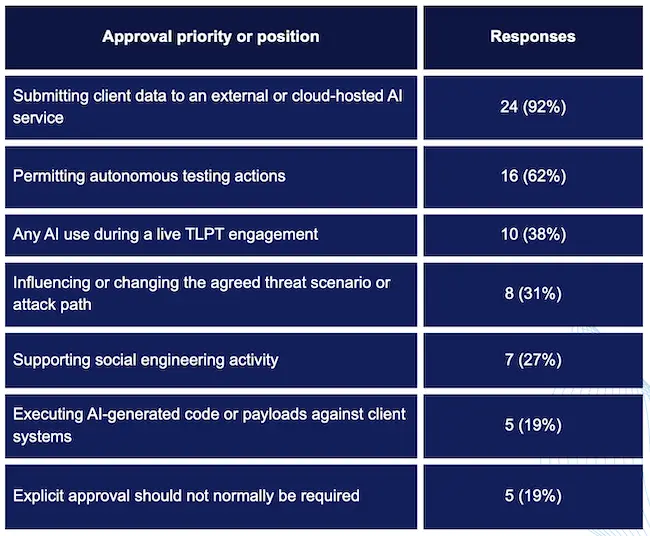
AI uses that respondents most clearly said need direct permission from the client (Source: CREST)
Limits on network activity, rules about what systems testers can access, monitoring, and clear conditions for stopping a test can help prevent unexpected AI behavior from causing problems. Testing providers also need to keep records of actions performed automatically, times when human testers stepped in, and decisions that affected the test.
Requiring a person to approve actions can slow down simulated cyberattacks. These delays may change how well a test measures an organization's ability to spot and respond to threats. The report recommends recording any changes to how the test is carried out and thinking about how those changes affect conclusions about the organization's ability to withstand and recover from cyberattacks.
Protecting client information is a major reason for requiring permission
About 92% of respondents believe testers must get clear permission from clients before sending their information to AI services run by outside companies or hosted in the cloud.
Another 62% said that letting AI carry out testing actions on its own should also require clear permission from the client. Rules for handling data need to cover where information is processed and stored, how long it is kept, whether it is used to train AI models, whether outside contractors are involved, and who is allowed to access it.
Organizations paying for penetration tests need to know which systems and connected services are being used with AI models. If the companies providing the technology, access permissions, or the ways information moves between systems change during a test, the testing team may need to ask for more permission.
Human technical skills are still very important
Some 92% of providers said that being able to check whether AI-generated technical work is correct will be an essential skill for cybersecurity testers over the coming year. Other highly valued skills include handling information safely, finding and using security weaknesses without relying on automation, and understanding what AI cannot do and how it can fail.
“Threat-led penetration testing, especially on systems that are actually being used, has always carried serious risks and needed very strong checks to make sure it is done properly. AI is making these concerns bigger and is already changing how testing is carried out,” said Nick Benson, CEO of CREST.
When AI is used to create tools for testing attacks, cybersecurity teams face an extra challenge: making sure those tools are properly supervised. Training, having other experts review the work, and following safe software development practices are needed. These steps help make sure testers know enough to check AI-generated code and understand what might happen when it is used, before putting it into action.
Clients are expected to ask for more information about AI use
Looking ahead, 88% of providers expect AI to be used more often to create tools for carrying out simulated attacks. The same percentage expect more demand for cybersecurity testers who have special skills in working with AI.
About 85% of respondents expect more AI-related rules and requirements when organizations buy cybersecurity testing services. Meanwhile, 81% expect more clients to ask testing providers to explain how they use AI over the next year.
Some financial institutions are building their own cybersecurity testing teams and tools. This could change how much they need outside cybersecurity companies. As AI tools become easier for more organizations to use, outside testing providers may need to stand out in other ways. These include offering independent assessments, designing complicated and realistic attack scenarios, making sure tests focus on threats that matter to each organization, and using expert human judgment.