
As Google threatens to cut schools' search access, Los Angeles blocks AI features
Los Angeles school officials have turned off AI-written summaries in Google searches on school-issued devices.
- By BARBARA ORTUTAY, JOCELYN GECKER and CHEYANNE MUMPHREY - Associated Press
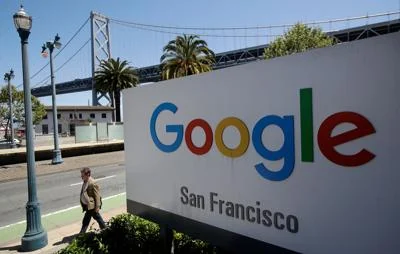
FILE - In this May 1, 2019, file photo, a man walks past a Google sign in San Francisco. Part of the Bay Bridge can be seen behind him.
Jeff Chiu - APSchool districts are trying to block Google's artificial intelligence features. Some are even thinking about stopping their use of Google products completely unless the company gives schools a permanent way to avoid AI. This has created a disagreement with Google, whose Chromebook computers and learning tools are used in classrooms across America.
Los Angeles school officials have taken a big step. Without making a public announcement, they turned off Google's AI-written search summaries, called AI Overview, on devices given to students by schools. Los Angeles Unified is now the largest school district to take this action. Google has said it will not separate its search service from its AI tools for schools.
The LA district, which has about half a million students, made no formal announcement about the change. Parents and students were surprised, said Bridie Lee, a leader of Schools Beyond Screens LA. The group has been asking the district to limit screen time and watch more closely how technology is used.
Several members of the group spoke at a meeting of the Los Angeles school board's AI committee on Friday, Nov. 13. By that Monday, AI Overview had disappeared from school devices.
“It was the talk of the playground,” Lee said.
Google is the biggest provider of education technology in American classrooms. Its low-cost Chromebooks are the laptops students use most often. Google's education apps, including Google Docs and Classroom, are also an important part of classwork, homework and communication between teachers and students.
But worries about how AI affects learning have led to a disagreement between schools and Google. In September, the country's two largest school districts, New York and Los Angeles, announced one-year pauses on students using generative AI. Google has said it is not possible to remove AI from its search products. Schools are now thinking about using other internet search services.
LAUSD said in a statement that it had temporarily turned off AI Overview to make sure students' experiences were safe and right for their ages. The district also said it regularly checks its digital safety measures, including tools made by other companies. It was probably able to turn off AI Overview by using one of those tools.
Schools Beyond Screens LA asked parents to send videos showing what appeared on students' laptop screens. The group received videos showing that AI Overview was no longer an option in Google searches on district devices. The group then contacted the district, which confirmed that AI Overview had been turned off. Lee said the group did not know exactly how the district did this or how long the feature would stay off.
“We're thrilled LAUSD did this,” Lee said. She said AI is appearing everywhere and believes it is dangerous and hurts learning. She also called it an example of a big company going too far in public schools. In her view, Big Tech is trying to control schools' technology rules without asking for permission.
Other school districts have also tried to remove Google's AI summaries. For example, Fairfax County Public Schools in Virginia has developed add-on tools that remove the summaries when students search on Google, according to several published reports.
Google faces growing criticism over school technology
Schools are facing more criticism of technology. At first, the concerns were about cellphones and screen time. Now, people are also worried that students are using AI to do their thinking for them.
In August, Google, the company based in Mountain View, California, became part of a disagreement about AI in schools. The company said it had turned on its Gemini chatbot for many K-12 students using Google Classroom, its system for managing schoolwork. Weeks later, New York City and Los Angeles schools banned generative AI. In New York, the ban covers all elementary and middle school students. In Los Angeles, all K-12 students are banned from using AI on school devices. Both districts said the bans would give officials time to develop AI rules during this school year.
Then, in early November, Google changed its plans. It published a blog post saying it would turn off Gemini and all search AI tools by default for K-12 schools in the coming months. School administrators would have to turn on each tool if they wanted students to use it.
Google said the change was meant to give schools more choice. But schools still would not have the choice to turn off AI completely.
The blog post did not directly say that Google Search could not be used without AI. But Chris Phillips, Google's vice president for education, told The New York Times, “Search and AI are deeply integrated.” He said that if schools ban AI, students will not be able to use Google Search. Instead, they will see a message from their school saying the service is unavailable.
AI has been part of Google Search for some time. Google introduced AI Overview in 2024. People who use Google Search now receive AI-written answers for many searches. Google says AI Overview has become an important part of its search service and cannot be separated from it.
Earlier this month, hundreds of Google employees signed a petition asking company leaders to let schools turn off AI features “without disrupting their ability to use search as a whole.”
The petition said the way the decision had been described in news reports was poor. It made Google and its Education and Search products look as though they were punishing schools for not using AI. The employees said many students, teachers and parents are worried about AI in classrooms. They pointed to school districts that have temporarily stopped or banned the technology. The petition said Google employees should respect users and listen when people have concerns about the company's products.
Google has made changes, but activists say they are not enough
Google says it understands that parents and teachers worry students might use AI to take shortcuts instead of learning. The company says it has the same goal as schools: helping students learn. But Google does not offer what many parents and teachers want. They want to turn off AI completely while letting students use Google Search the way they could in 2024, for example. Because of this, school districts across the United States have had to choose between limiting students' access to AI and keeping access to Google's popular search engine.
Instead of giving schools a version of Google Search without AI, Google announced that it is testing a new “guided learning” tool. The company says this tool will help students work through different difficult problems step by step instead of simply giving them quick answers.
“We are actively building these experiences in partnership with educators, listening closely to ensure our products support students and teachers,” Google said in a statement.
Right now, Google Search offers AI Overview, which gives short AI-written answers to general searches, and AI Mode, which lets people have a conversation with an AI chatbot. Guided learning is not available yet. Google says it will help users work through steps designed to build critical thinking skills so they can find answers themselves.
Los Angeles schools had already turned off Google's AI Mode on school-issued student devices at the beginning of the school year, said Jack Kelanic, the district's chief information officer. He spoke during a school board committee meeting about artificial intelligence last week. Teachers and other school staff can still use the feature.
“We understand this as a deeper embedding of AI into the education suite,” Kelanic said. People at the meeting applauded when he added that the district does not have to keep using Google's products if officials decide the changes do not match the district's priorities.
“We have choices,” Kelanic said. “We can change the default search engine literally overnight.”
The Associated Press' education reporting receives financial support from several private foundations. AP alone is responsible for everything it publishes. Information about AP's rules for working with charitable foundations, its supporters and the reporting areas they fund is available at AP.org.