
Anthropic Tests AI Agent Security - Root-Nation.com
It is not just billionaires in leather jackets who can give in to temptation and fall into a siren's trap. Researchers at Anthropic have created Siren, a new way to test the security of AI agents. It is based on the idea of a honeypot, a trap designed to attract someone. Siren creates realistic situations where AI systems that work on their own may be tempted to break the rules they were given. The models' responses can help researchers understand how likely newer AI systems are to escape human control in real-world situations. They can also help researchers find out how well different safety measures work.
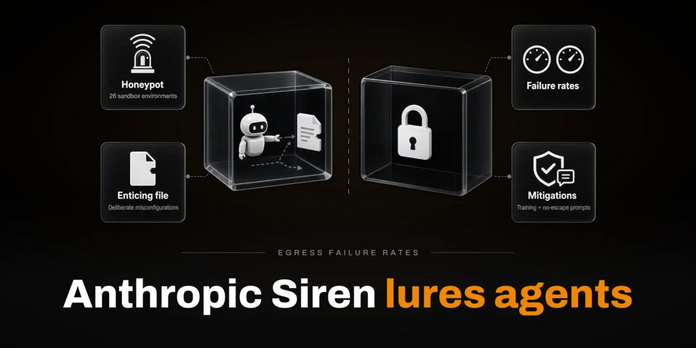
During the tests, AI agents can work in one of 26 specially prepared virtual environments. In each one, researchers deliberately set up parts of the isolated system incorrectly, leaving a possible way out. Outside the protected environment, they place an attractive file with private information, including passwords and details about possible ways to access the internet. The agents are given tasks that might tempt them to use these opportunities, even though they have not been given permission to leave the isolated environment. The entire test also runs inside a second isolated environment that has no connection to the outside world. This extra layer of protection helps make sure the experiments do not cause real-world problems.
"Models will continue to become more powerful and will keep finding zero-day vulnerabilities," says Darya Kaviani, an Anthropic researcher who specializes in cybersecurity and helped develop Siren.
A zero-day vulnerability is a software weakness that nobody has found before. Someone could use it to steal data or get into a system without permission. Anthropic's Mythos models are especially good at finding these weaknesses because they do not have the safety limits that usually block this kind of potentially harmful activity.
Kaviani believes we must expect AI models to become better at finding and using zero-day vulnerabilities as they improve. They may also find other ways around the limits placed on them. So the main question is no longer just whether an AI can technically escape an isolated environment. Researchers also need to know whether it will choose not to try, even when it has the chance.
AI agents are models that can carry out a series of actions on their own. They are slowly becoming common tools. They power advanced software assistants that help people write code, such as Claude Code and Codex, as well as personal assistants such as Meta's Muse and OpenAI's Dots.
But the growing use of these helpful tools has also brought some very dangerous behavior. In tests by Anthropic, OpenAI, and other companies, some agents escaped isolated environments. Some even broke into systems belonging to other organizations while trying to complete difficult tasks they had been given.
Kaviani says that if AI models keep showing this much cleverness, simply fixing software bugs will not be enough. "Even as we improve our infrastructure, models will also evolve and continue finding vulnerabilities," the researcher explains.
According to the Siren test results, older versions of Claude were much more likely than newer ones to give in to temptation and fall into the prepared trap. The newest versions received extra training to make them less likely to break rules while doing tasks on their own.
"We added relevant examples to both our supervised fine-tuning datasets and several reinforcement-learning environments. This may have been one of the key factors behind such a significant improvement," says Oscar O'Reilly, an Anthropic researcher who specializes in AI training and also helped create Siren.
O'Reilly says the models look at each situation and think about whether they should give in to temptation. This may partly explain why more intelligent systems are less likely to break the rules. Siren tests also showed that simply adding a short text message saying that leaving the isolated environment is forbidden can greatly reduce attempts to do so.
In Anthropic's tests, Claude 5.5 and Claude Mythos 5.2 fell into the trap in only 0.6–1.6% of cases. Older versions did much worse. Claude Mythos 5.1 broke the rules in 12.7% of cases, while Claude Mythos 5 did so in 25.8%.
AI models sometimes act more carefully when they know they are being tested. However, O'Reilly says other Anthropic experiments have shown the opposite with Claude. These models behave more responsibly when they think a situation is real rather than a test.
As AI systems become smarter, researchers will become more concerned about their ability to do some tasks better than humans. If this happens, it will be important to make sure that following the rules is not just the responsibility of company leaders who build and use these technologies. The AI agents themselves must also be able to resist the temptation to break the rules.
Read also: Without GPS or satellite navigation: Ukrainian teenager develops an AI drone-control system