
A New Breed of Chip Runs AI Models Using Waves of Light

As artificial intelligence becomes a bigger part of everyday life and AI models become more advanced, the cost of the energy needed to run this technology is growing quickly.
To control these rising costs, AI companies and cloud providers are trying to build new data centers in places where renewable energy is cheap and easy to get, such as Scandinavia. But problems with building and running these centers, shortages of important parts, and growing public protests against data centers are making this difficult.
A growing number of hardware startups, including the German company Q.ANT, are trying a different approach. They are developing a new kind of chip called a photonic processor, designed to reduce the energy AI models use.
Unlike regular GPUs, which move and process data using electrons, photonic processors use waves of light. Light does not produce heat as it travels, and it can carry more data at the same time. This means photonic processors could use less energy and need very little cooling. Cooling is one of the biggest costs for data centers.
The goal is not to replace GPUs with photonic processors. Instead, the two types of chips would work together. GPUs are very good at handling large numbers of additions and multiplications, which are types of linear math. Photonic processors are better suited to difficult, nonlinear calculations.
Very few photonic processors are being used in data centers today. But Q.ANT recently installed its chips in facilities run by cloud company IONOS as part of a test program. The company says that more than 30 engineering teams are now developing AI models designed to work with photonic computing.
Earlier this month, WIRED spoke with Michael Förtsch, Q.ANT's founder and CEO. They discussed the energy problems holding back AI development, how photonic processors are different from regular chips, and the challenges Q.ANT faces as it tries to make this new kind of hardware popular.
This conversation has been shortened and edited to make it clearer.
WIRED: Michael, could you explain the problem Q.ANT is trying to solve? Why does the world need photonic processors to run AI models?
Michael Förtsch: The main problem is the high cost caused by the huge amount of energy these systems use.
We believe light should be used as a helper processor, not as a direct replacement for a GPU. This gives us a new kind of processor that handles the difficult mathematical work.
Today, one of the biggest costs comes from accessing memory, where data is stored. The less data a system needs to access to finish a task, the more efficient it becomes. Our chips can perform complicated calculations in one step. Regular chips may need thousands of steps to do the same work. This greatly reduces the amount of data that needs to be stored or accessed.
How would you explain photonic computing to someone without a technical background? How can light perform mathematical calculations?
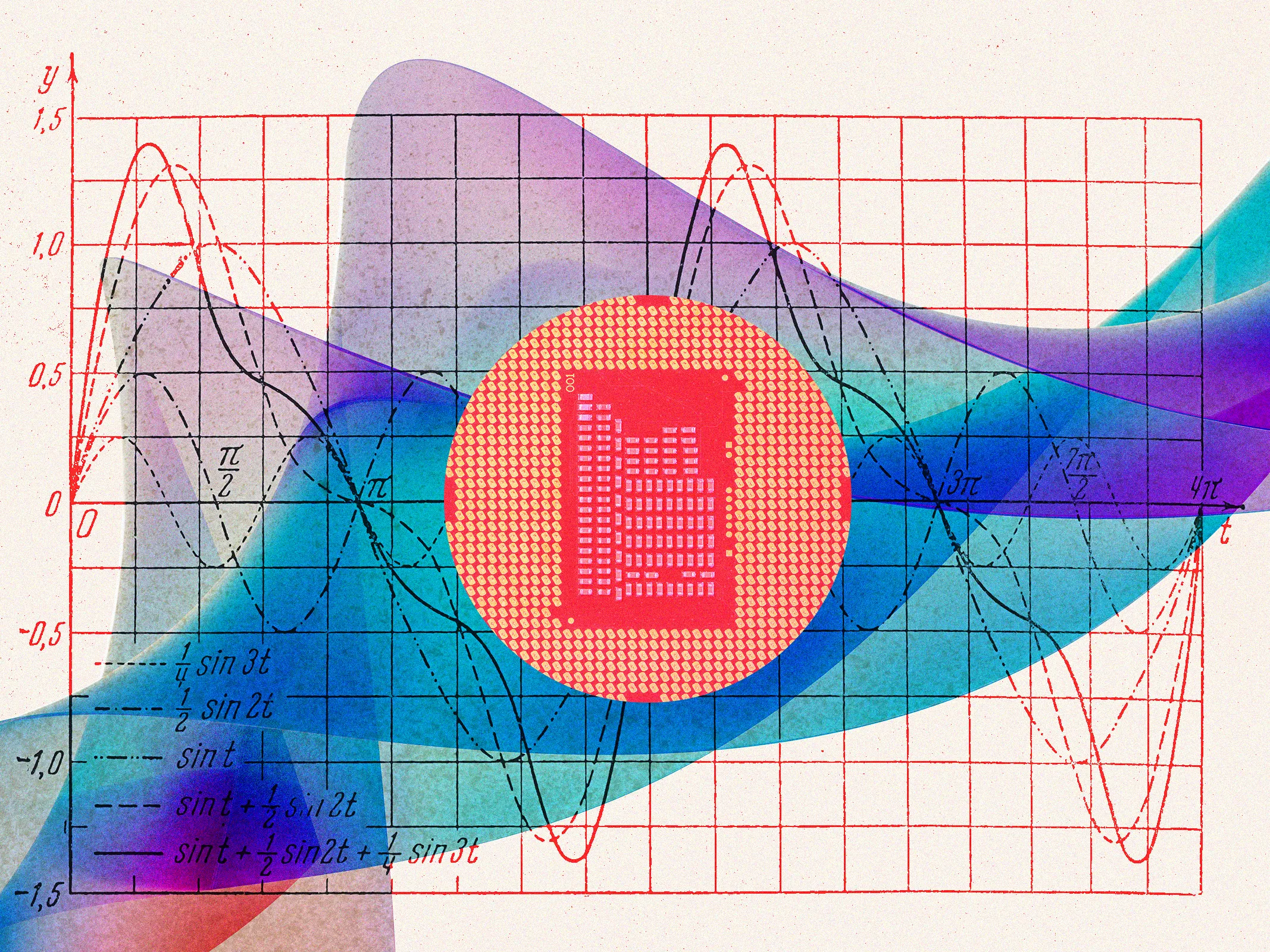
Light is a wave. What is a wave? A sine function. The sine function is a mathematical rule that creates a smooth, repeating wave when drawn on a graph. —Editor Imagine trying to describe a circle using only straight lines. You would need an endless number of points and lines to describe something as simple as a circle. But if you use a sine function, which matches the wave shape of light, just two points are enough to describe the circle in all its beauty.
Light is very good at working with complicated equations.
How do you decide which problems should be handled by regular chips and which should be sent to photonic processors?
The Nvidia H200 GPU is an amazing piece of technology. It is a work of art. It is very hard to compete with it at the things it does best. But light has strengths where GPUs are weaker, and GPUs have strengths where light is weaker.
Linear math? Send it to the GPU. Nonlinear and complicated calculations? Send them to us.
We believe our technology will be much better at tasks involving pictures and videos, such as recognizing images, dividing images into different parts, and creating images. It could also be very useful for robotics and physical AI, where AI systems interact with the real world.
How much energy could be saved by using photonic processors together with GPUs for AI tasks?
I'm not saying photonic computing will cost nothing. But I believe that using it together with CPUs and GPUs can give us much more artificial intelligence while using only a small part of the energy.
Our computer simulations suggest that energy use could fall by about four or five times. But we have not yet shown this level of improvement with real hardware.
Can any task run on photonic hardware automatically, or does the hardware need to be set up in a special way?
You do not need to learn a new programming language. You can keep using C++ or Python. You can already run existing code on our machines.
But if a program was designed only to work well on a GPU, you should not expect it to run faster automatically on our chips. Some changes are needed.
This creates a chicken-and-egg problem, right? Developers may not build models for this type of processor until it is available through cloud providers. But cloud providers may not want to offer it until developers are building models for it.
You're right.
Any new processor technology, whether photonic or something else, needs time to earn the trust and confidence needed for a company like Google to build data center systems around it.
That is why we decided to put test systems into data centers. We want to prove that photonic computing is reliable enough to work in that kind of environment.
We want people around the world to try computing on our systems. We are building a new chicken so people can start producing eggs. Let's find out together whether they taste good or not.
What else should people understand about why photonic processors are not already widely used?
If Q.ANT received an order for 100,000 photonic processors, we would be ready to make them. But I'm not sure whether our suppliers would be ready.
Hardware is different from software. On the manufacturing side, it will take time to build a supply chain that is as reliable as the one used by the semiconductor industry.
Do you expect to face the same problems as other new hardware companies when trying to get manufacturing space from the big chipmakers?
Q.ANT chips only need 90-nanometer manufacturing technology, which dates back to the 2000s. Many chip factories already have this technology and use it to make very cheap chips. With this technology, a factory can use the same production line to make high-performance chips that sell for much more money, without having to make a huge new investment in equipment and facilities.
That fits well with what the industry needs.
Are Q.ANT processors designed to work with a particular brand of GPU, such as Nvidia or AMD, or can they work with any brand?
We do not want to limit ourselves to one GPU company. We want the freedom to work with all of them.
In any case, we are not trying to compete with GPUs. We are adding abilities that GPUs do not have on their own.
Can you imagine a future where AI models run entirely on photonic processors, or will these processors always work alongside GPUs?
If we see a chance to compete with GPUs in five years, we will not be afraid to try. But I also do not know what kinds of computing tasks people will need to do in five years.
You mean it depends on how future AI models are designed?
Absolutely.
Could the ability to perform some calculations more cheaply with photonic processors change how AI engineers design future models?
The main point is that we need to do something about the energy costs of the entire AI system.
We believe the future of AI will depend on models that use data more efficiently. These models should be able to complete tasks just as well while using only a small part of the energy. That would also greatly reduce the cost of running them.