
😺 OpenAI claims matrix math's exact limit
Welcome, humans.
Someone has finally found a way to give instructions to Claude Code without making a sound. Lip Dictation is a prototype plugin that reads your lips using your Mac's webcam. Click record, silently mouth your prompt, and click stop. The words then appear in the prompt box. Nothing is sent until you press Enter. That is useful if you have ever silently mouthed something rude at a build that keeps failing.
Everything runs on your Mac. A small model reads your lips. It was trained using thousands of hours of videos showing people talking. The author says that no audio is recorded and no video leaves your computer.
The main problem is accuracy. The author reports about 80% accuracy when the model reads spoken TED talks. It does worse when people silently mouth words at a laptop camera. Technical words are also difficult because TED speakers rarely talk about changing code. Your first "deploy to production" may come out as a very different sentence.
Here is what happened in AI today:
😸 OpenAI claims it has found the exact speed limit for multiplying matrices.
📰 Nvidia reportedly paused server shipments to four Southeast Asian countries.
📰 A UK investigation found that AI was used without being disclosed in at least 25 court cases.
🍪 DeepL launched Aure v2, a voice translator with half the delay of the previous version.
🎓 Learn how to check what an AI quietly deletes when it edits something.
😸 OpenAI Claims It Found the Speed Limit for the Math Behind Every AI Model
On November 24, OpenAI posted a research paper claiming it had found the exact speed limit for multiplying matrices. Matrices are large grids of numbers that AI models use. If the claim is correct, it answers a question that computer scientists have been asking for decades.
Here is the basic idea. The usual school method for multiplying two matrices takes about n³ steps. This means that doubling the size of the grids makes the work eight times greater. Smarter methods can reduce the exponent. The lowest possible value is 2, because a computer must at least read every number. The record stayed close to 2.371 until OpenAI's September paper claimed a result below 2.258. Then, an October preprint claimed that 2.25 was possible. Most of the work inside every layer of ChatGPT, Claude, and Gemini uses this kind of math. This makes it a very technical way to potentially reduce GPU costs.
The November paper adds the missing half of the result. OpenAI claims that no formal arithmetic circuit, meaning a set of instructions built from basic addition and multiplication, can multiply n by n matrices using fewer than roughly n^(9/4)/2 multiplications or divisions. If the best method and the proof that no faster method is possible reach the same number, the answer is exact. That number is 9/4, or 2.25.
Scott Aaronson, who credits OpenAI's models with the work, said the result was shocking. He found it surprising that the answer was such a simple fraction and that AI could prove a lower limit like this at all. Still, the word "proof" needs to be treated carefully. Here is what we know so far:
Other mathematicians have already posted their own explanations of the October result. This is the claim that an exponent of 2.25 can be reached.
The new lower-limit result is in a 111-page preprint. One write-up found no named expert review of it as of November 25.
Why this matters: This result will not make your chatbot faster tomorrow. The research is about extremely large matrices, and OpenAI does not claim that it provides a practical speed improvement. The important part is how quickly this research is happening. AI is producing advanced mathematical research faster than experts can check it. Aaronson expects that it could take years to understand the solutions fully. Even the computer-based check covers less than the full claim. The Lean files, which contain code that a computer can check one line at a time, cover only the case where division is not allowed. So, before relying on an AI research result, check which parts have actually been verified and which parts are still only claims.
🎓 AI Skill of the Day: Check What an AI Fix Quietly Deleted
Together AI trained an open model to translate Lao and learned a lesson that is useful for anyone who works with AI.
The model, Qwen3.8-27B, kept answering requests in Lao with Thai. The team trained it using examples in Lao. In one early test, its Lao translation score rose from 6.7 to 43.3. But its Thai score fell from 46.7 to 11.7. Fixing one language had made the model much worse at the other.
The team fixed this by adding about 1,000 Thai translations from a stronger model, Kimi-K3.1-Pro, alongside the Lao examples. After that, the Lao score reached 44.3 and the Thai score stayed at 47.8. These results were close to the stronger model's scores of 47.5 and 49.9.
You can use the same idea in your own work whenever you ask AI to change one thing, such as a clause in a contract, a section of a report, or a prompt you use again and again. For example, an AI might fix the payment terms in a contract but quietly remove the cancellation terms. The new version may look better and still be worse. Here is how to check:
Before asking for a change, write a short list of the things the final version must keep.
Ask for the one change you want, and save the original version.
Give the AI both versions and your list, using this prompt:
Here are the original and revised versions, plus my must-keep list: [list]. Compare them. Identify what changed, what disappeared, and any must-keep item that is no longer satisfied. Quote the relevant passages and flag anything you cannot verify.Check every passage the AI flags yourself before using the revised version.
Keep the version that passes the checks. If the nicer rewrite removed an important part, do not use it.
📰 Around the Horn
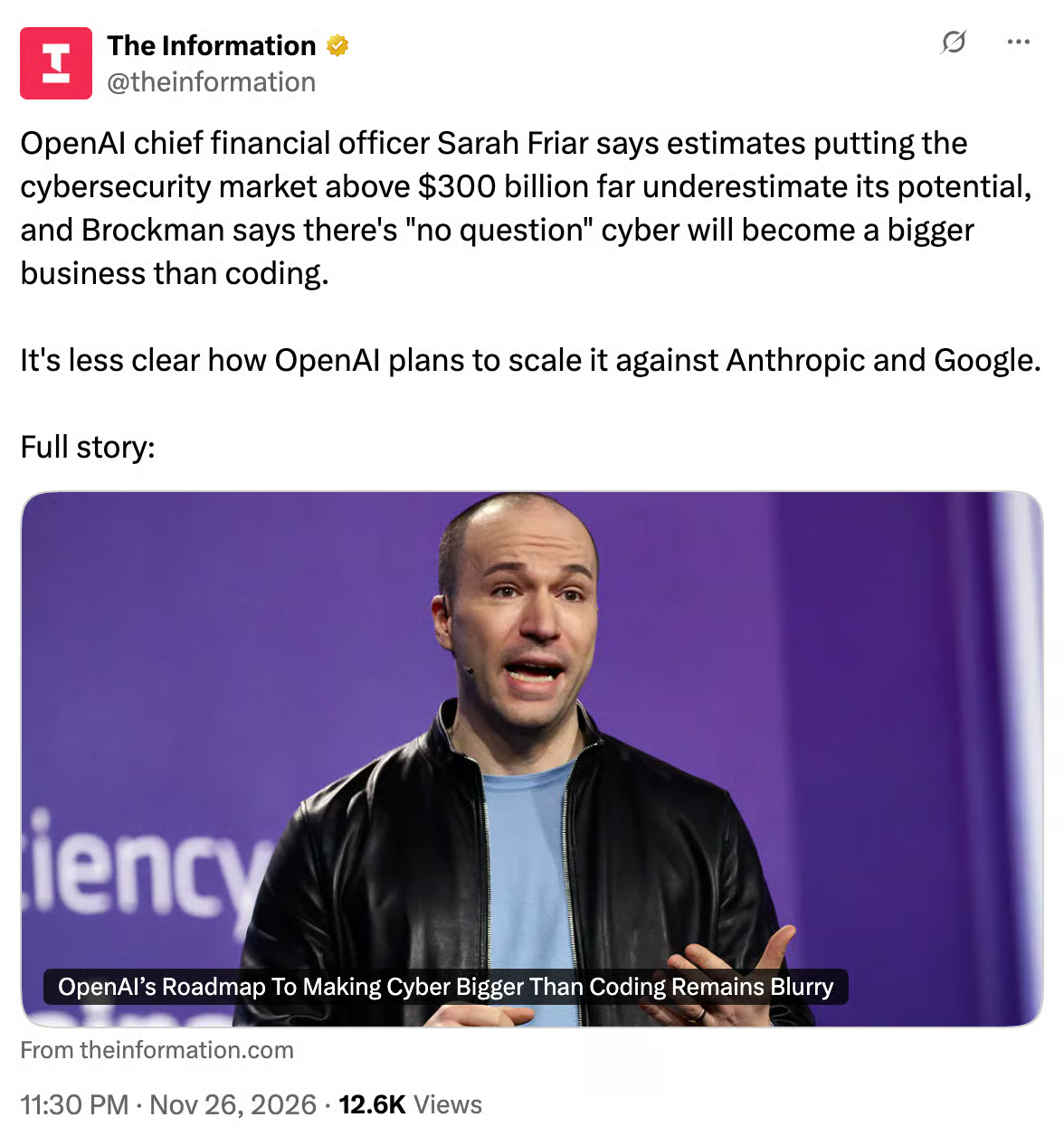
Cyber could be OpenAI's next coding business. Sarah Friar says estimates put the market at more than $300 billion, but The Information says the plans are still unclear.
Nvidia told partners to stop server shipments to Malaysia, Singapore, Thailand, and Indonesia after the United States tightened its export controls, the Financial Times reported.
Z.AI fell behind on its planned GLM-5.5 launch. Moonshot said the time between its major releases could double if it loses access to computing resources outside China, Reuters reported.
Dragos researcher HD Moore named MiniMax in a study that found private links included in AI requests had been opened by unidentified people, Reuters reported.
The Bureau of Investigative Journalism found that AI use had not been disclosed in at least 25 court cases in England and Wales. These cases included made-up legal cases and laws that do not exist.
Huawei researchers scheduled a paper about memory chips for a February conference. They claim their chips have twice the data-pin density of the high-bandwidth memory made by South Korean competitors. However, it is not clear how much of the technology has actually been built, Bloomberg reported.
Robotera said that 45 human-shaped robots were working at a China Post facility in Hangzhou. They were helping move parcels, and the number of parcels handled during the pilot increased.
Want absolutely everything that happened in AI this week? Click here!
🍪 Treats to Try
DeepL's Aure v2 turns speech in one language directly into speech in another language, all in one step. It has half the delay of the older model. It supports English, German, French, Spanish, Japanese, and Korean for existing DeepL Voice customers.
Lip Dictation turns words you silently mouth into prompts for Claude Code. It uses a lip-reading model on your Mac. It is a prototype and can make mistakes, so check the text before sending it. It is free to try.
Hub sends tasks from your browser or Telegram to Claude Code and Codex agents. They work on the tasks and contact you only when they need a decision. They run without asking for permission at each step, so treat them like a terminal and be careful. It is free and open source.
QA.tech MCP gives coding agents such as Claude Code and Cursor a testing assistant. It opens your app in a real browser, clicks through it, and reports what is broken. Free options are available, with a special offer code until December 9.
Bifura shows what AI website crawlers can actually read on your site. It also lets you test changes in a separate testing area before publishing them. You can get a free readiness score without creating an account.
Patram 1.5 can read pictures of documents, including scanned pages, forms, tables, and charts. It does not need a separate step to extract the text first. Its model files are free under the Apache 2.0 license. You need a free Hugging Face account to access them.
GigaChat 4 gives developers downloadable models in two sizes: 708B and 37B parameters. They can process about one million tokens at once. The larger model is free for commercial use under an MIT license.
💡 Intelligent Insights.
Statista CEO Marc Berg told Cristian Dina of The Next Web that Statista put most of its data behind a registration wall to stop AI crawlers from collecting it. Search traffic fell from about 35 million users per month to about 8 million. Berg believes that as AI models become more alike, fresh information that can be traced to its source and is owned by a company will be the main thing people are willing to pay for.
Historian Mark Humphries reported that GPT-6.2 Astra identified the creator of an anonymous sketchbook from 1808 at Yale's Beinecke Library. It found an obscure diary entry in the archives and solved the mystery in about 22 minutes. Humphries expects historians to face a crisis of confidence as AI carries out research that humans cannot easily do. However, he argues that human interpretation is still what creates history.
Tom Cuylaerts of i-SCOOP explained the main ideas in Benedict Evans' new presentation, "AI Questions." It argues that giving every employee an AI tool spreads the technology but does not change how a company works. Spreadsheets and web browsers had a similar effect. Real change came later, when companies rebuilt their systems around these tools. Today, about 45% of US workers use generative AI at work, but fewer than 15% use it every day.
Simon Willison said in a keynote speech that AI models made three major improvements over the past year. First came reliable coding agents in late 2025. Then, in the summer, models became better at solving problems by continuing to work on them for a long time. Finally, in the fall, models became better at handling 3D designs and creating games. His main point is that if you can clearly describe the software you want, a leading AI model can now build it.