
‘It’s not helping’: calls for guardrails and regulations as AI use rises at US retailers
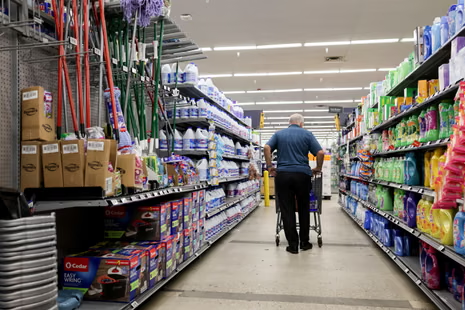
Labor leaders and campaigners are calling for protections for workers and customers as artificial intelligence becomes more common in stores.
As millions of Americans begin their holiday shopping on Black Friday, both customers and workers are already seeing how artificial intelligence is changing the retail industry.
Anna, a cashier at a Walmart in southern Oregon and a leader with United for Respect, criticized how Walmart uses AI and how it affects workers. She asked not to be named because she fears the company could punish her for speaking out.
Anna said Walmart uses AI for human resources tasks, including making work schedules and giving workers points for attendance problems. She also said the company uses a safety alert system that is often wrong and regularly interrupts her when she is helping customers.
“During the course of a day on a given shift, I will get at least 10 or 15 safety alerts on my phone. I can’t move on through the app until the safety alert’s clear,” she said. “It’s very annoying when you get them. I need to go over here to help this young lady who’s crying her eyeballs out because she needs a pregnancy test, and I can’t get in to get her pregnancy test because I have to clear a stupid alert.”
She explained that after dealing with a safety alert, she must take a photo and upload it. She said the system often mistakes shadows, stickers or other things for safety problems. Sometimes it also sends an alert to a store worker about something that should be handled by the maintenance team.
“If there is something that I clearly see that is on the floor, I’m going to pick it up. I’m not that ignorant to not to pick it up, but I don’t need an AI telling me to do it,” she added. “It’s not helping. This thing is supposed to be working with us and to help us and things like that. I don’t see how this is, because it’s not.”
In September 2026, several hundred Walmart workers had signed an open letter asking the company to put workers first as it brings AI into its stores.
In June 2026, Walmart investors voted overwhelmingly against a proposal for a report about how AI and automation are affecting the company's workplaces. A Walmart spokesperson pointed to an internal survey from June 2026, which found that 84% of Walmart workers said they felt confident using digital tools.
“Walmart’s approach to AI is, and always has been, people-led and tech-powered,” a Walmart spokesperson said in an email. “We use AI to serve our customers and members and better support associates – not to replace their judgment, experience, or expertise. Like any technology, these tools evolve over time, and feedback from the associates who use them helps us continually improve the experience and build practical tools that are useful on the floor.”
Industry leaders expect the use of AI in retail to keep growing.
A survey published in December 2025 by the National Retail Federation asked 56 AI leaders at US retailers about the technology. It found that most retailers were already using AI or putting it into use in different parts of their businesses. They also planned to spend more and use it more over the next few years.
About 75% of the retailers surveyed said they were using AI tools for computer coding and app development. Some 73% were using them for office tasks, 66% for cybersecurity and fraud prevention, 59% were preparing to use or already using them for supply chains and warehouse work, and 45% were doing so for marketing and advertising.
As AI becomes more common, labor leaders and campaigners are calling for rules to protect workers and customers. They also want protections in union agreements so workers can have a say in how AI is used and introduced at their workplaces.
“Without proper guardrails, AI systems have supercharged surveillance for both consumers and for the workers who make it possible for consumers to buy what they need or what they want for their loved ones for the holiday season,” said Crystal Weise, policy and programs director at the AFL-CIO Tech Institute, a nonprofit labor organization started by the AFL-CIO, the largest federation of unions in the US.
Weise said the monitoring of workers starts in factories and warehouses, where goods are made and sent out. It also happens to customers shopping online and in stores, whose buying habits are tracked and influenced by computer programs. Workers are monitored too, and AI helps power these systems.
“We know that these surveillance technologies make jobs worse, and we know that it makes products and services more expensive. We need policies and collective bargaining agreements that stop exploitative surveillance,” she added. “We want to see humans in control of how shoppers and consumers are accessing the goods and services that they need.”
Weise said AI-powered monitoring systems are already collecting large amounts of valuable information about workers and customers. Examples include surveillance pricing, work targets based on productivity, and systems that monitor workers who disagree with management or take part in workplace organizing. She said companies use the information to lower costs and increase profits.
Customers may face AI monitoring even before they enter a physical store. Several large retailers, including Macy’s, Target, Home Depot and Costco, use automatic license plate readers (ALPRs). Other retailers are using AI tools to reduce Black Friday discounts and increase their profits.
“We use this technology for limited, authorized purposes. Data is collected through ALPRs to prevent theft and fraud, help ensure security, and maintain the safety of individuals and our properties,” says a notice from Macy’s explaining how the technology is used at some of its stores.
Workers may also face AI from the moment they apply for a job. For example, Amazon-owned Whole Foods uses an AI hiring assistant called Sage. According to the company's job application website , this is the only way to apply for a job there.
Once inside stores, customers and workers may be watched by AI facial recognition systems. Large retailers such as Wegmans, Macy’s and Home Depot have said they use this technology. Major retailers also collect customer data. For example, Kroger stores customer information, including details about their shopping habits, and sells it, according to a 2025 investigation by Consumer Reports.
“We’re not anti-technology, but we are anti-dehumanization of the workplace,” said Stuart Appelbaum, president of the Retail, Wholesale, and Department Store Union and executive vice-president of the United Food and Commercial Workers.
Appelbaum said AI cannot understand people's personal circumstances or take them into account when making decisions about punishment or firing. He also pointed to the harmful effects of computer-based monitoring on workers.
“We’ve seen a rise in algorithmic surveillance, and it creates a pressure cooker environment. People are afraid to pause for a breath, or even to go to the bathroom, and for us, that’s really workplace harassment by algorithm,” he said. “Every worker deserves to have a human involved before any discipline takes place.”
He said his union had won agreements with employers that protect workers by setting rules for how AI can be used in the workplace. He stressed that workers must be able to negotiate over new technology because employers often use AI to try to reduce labor costs and increase profits.
“A lot of retailers are using AI as an excuse to have fewer people on the shop floor,” Appelbaum added. “What you end up doing is diminishing the in-store experience, and I think that’s a huge mistake. Not only does it put pressure on the people who remain working, but it also, I think, isn’t good for the future of the store. Basically, we think the technology should be used to empower and strengthen retail workers, and I think that’s part and parcel of everything we negotiate.”
So far, fears that AI will cause large numbers of job losses across the retail industry have not come true. A policy report published by Stanford University researchers in July 2026 said AI's effect on total employment was “likely small” at that time. However, several companies have announced plans to cut jobs over the next few years, naming AI or spending on AI as a major reason. New technology, such as electronic shelf labels, is also expected to lead to job losses and higher prices for customers.
In October 2026, Kroger announced plans to cut 3,000 office jobs over the next three years. The company said it would use AI to make its operations simpler and more efficient.
“These notifications are part of the corporate headcount reduction the company announced in early October to lower prices and improve the shopping experience by simplifying operations and better use of technology,” a Kroger spokesperson said about the job cuts.
The announcement came after Kroger recorded a $2.6bn charge in 2025 after deciding to close three automated delivery centers that used robots. Kroger did not comment on that decision.
“As retailers feel the pressure from Wall Street to cut costs and pump up share prices, they’re turning to AI to do the dirty work,” said Milton Jones, international president of the United Food and Commercial Workers. The union represents workers at around two-thirds of Kroger stores in the US. “Whether it’s AI-powered scheduling that slashes retail workers’ hours or surveillance pricing that raises costs for consumers, people are getting squeezed on both sides of the cash register.”
Bryan Wynn, national bargaining director for the United Food and Commercial Workers, said investors were pushing companies to invest in AI to reduce labor costs, make work more efficient and increase profits. He said they often did not consider how these technologies affect workers and customers.
He explained that planning for new technology had become an increasingly important issue when unions and employers negotiate contract renewals and new agreements. Retail employers use AI to collect information and monitor the actions of workers and customers, then use that information to try to increase profits, he said.
“People should have a say in how AI and their data are used to change how they work and shop,” added Jones. “We need technology that works for our members, and all working people, not automation that steals their livelihoods.”