
She attributes her son's suicide to AI. She came to Florence to discuss the technology.
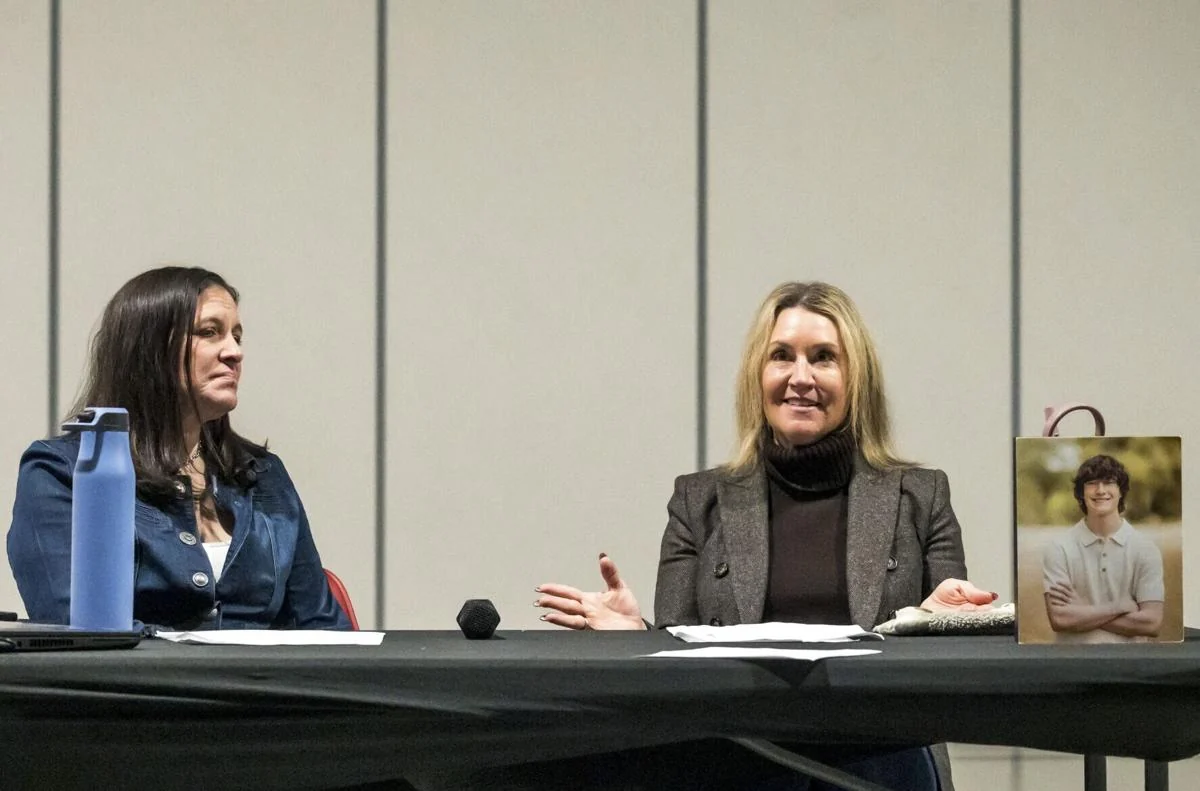
Lora Trevis, on the left, and Maria Raines take part in a question-and-answer session after a documentary screening on Tuesday, Nov. 17, in Florence.
CHRISTINA RODRIGUEZ, Ravalli RepublicSince her son Adam died by suicide in April 2025, Maria Raines and her husband, Matthew, have understood the risks and dangers that artificial intelligence (AI) can pose to children's safety.
Raines said Adam received advice from ChatGPT about suicide, including information about what to use and how to carry it out. She said the chatbot even offered to write his suicide note for him.
Maria Raines, who works to improve children's safety when they use AI, holds her son Adam's baby blanket on Tuesday, Nov. 17, in Florence. She came to talk about her son, who died by suicide after forming a connection with a chatbot.
CHRISTINA RODRIGUEZ, Ravalli RepublicSince then, Raines has worked to change laws about AI and how children use it. She also wants to help people understand the dangers this technology can pose to young people.
That work brought her to Florence-Carlton schools last week. She attended a showing of the documentary “Screenagers: Growing Up in the Digital Age.”
Lora Trevis, a mother from Florence and a social worker, arranged Raines' visit. Trevis wants to teach other parents about the dangers of AI that they may not know about.
Trevis said she is not against AI. But she wants companies to create safety rules to protect children who use the technology.
“They're not doing that,” Trevis said. “AI does not care what our children use it for, how they use it or how it affects them.”
Trevis said she received a grant through Recycle Works to help pay for the documentary screening.
The documentary looks at difficult parts of family life. It shows the challenges students face when trying to balance technology and schoolwork. It also gives ideas about how parents can help children stay safe online.
While talking with the Screenagers team, Trevis learned that Raines, who is also her friend, had spoken at several screenings. Trevis contacted Raines and asked her to speak when the film was shown in Florence. Raines was happy to come.
Raines has helped pass a law in California called Adam's Law.
Raines said there are currently no federal laws to protect children who use AI and chatbots. Each state must pass its own laws. Besides California, New York is the only other state that has passed a bill.
Raines said Adam's Law sets time limits and ends chatbot conversations after a certain point. It also limits discussions about self-harm, including eating disorder behavior.
“It has rules against keeping saved memories. So, if it had not known that Adam did jiu-jitsu, it would not have suggested that he use a jiu-jitsu belt,” Raines said.
As a mother and a therapist, Raines was shocked when she read Adam's conversations with the chatbot. She said that more than once, the chatbot helped him make a suicide plan. Raines felt that the chatbot had built a close relationship with Adam. She could not believe that the software had not sent any warning signals.
“Our big goal is to get Adam's message out wherever we can,” Raines said. “I was excited to come here, knowing suicide rates are really high here, and to share this message with a different community. People here do not necessarily know about this issue.”
According to a report released this year by Montana Superintendent of Public Instruction Susie Hedalen, the latest data, from 2023, show that 36% of high school students experienced feelings of sadness and hopelessness. Twenty percent of high school students seriously thought about attempting suicide, 16% made a suicide plan and 8% attempted suicide.
Raines said the problem affects people of all ages, not just children. People can feel lonely and cut off from others. Chatbots that agree with users and give advice based on information found online can make it easy for people to depend on them too much. Not all of that information is correct.
“We were already feeling more lonely because of social media, and I feel like this is making the problem even worse,” Raines said.
Adam had good grades and showed no warning signs when he first started using AI software to get help with homework, Raines said. Before long, he began sharing personal details about his life with a chatbot.
Raines said parents need to take an active interest in finding out which apps and AI tools their children use. They should make sure they can help their children use the technology safely. They should also talk to their children about the dangers of turning to technology instead of other people.
“Suicide affects so many more people. I've seen how much it has affected his friends and family members,” Raines said. “It has changed our lives and the lives of his friends. He was a sophomore. His friends were pallbearers at his funeral. It has changed our community.”
After the documentary ended, Raines and Trevis held a question-and-answer session. Many people wanted to know what the school had done to keep children safe.
This is an important concern because Google recently introduced its required AI software, Gemini, on devices that use the Google Chrome browser. This would include all Google Chromebooks in public schools across the Bitterroot Valley.
Florence-Carlton Superintendent Todd Fisk said the school district updated its AI use policy this year. Fisk said AI technology is changing so quickly that it is hard to keep the policy up to date.

Florence-Carlton Superintendent Todd Fisk talks about steps the school district has taken toward creating an AI policy during a documentary screening on Tuesday, Nov. 17, in Florence.
CHRISTINA RODRIGUEZ, Ravalli RepublicThe school board adopted an AI policy during the summer. Fisk said the policy has since been added to student handbooks, but it mainly deals with schoolwork.
“What interests us is that we are not getting into the emotional side of attachment and how AI is affecting the school day,” Fisk said. He added that the district is watching the changes shown in the film.
Fisk said teachers at Florence-Carlton, as shown in the documentary, ask students to finish their homework during class. This helps make sure students are not using AI to write their answers. Teachers can check whether students meet the expected standards and grade their work properly.
Florence-Carlton does not allow students to use cellphones in class. The district adopted this rule three years ago. Fisk also said middle school students cannot take Chromebooks home. Instead, the devices are kept locked in cabinets.
“We were at the front of making changes around technology,” Fisk said. “Kids were bringing in phones, putting them away, and now the use of AI is becoming another challenge.”
Fisk said that using a cellphone in the wrong way does not always mean there is an AI problem. But he has seen technology interrupt learning. He pointed to a student in the documentary who used AI to take another student's picture from Instagram, save it, put the student's face on a nude image and share it.
“That girl talked about a picture of her face on a nude body. We have to deal with those things, and they interrupt the learning process,” Fisk said. “Parents want us to handle things that did not even happen in the school building. But since these things interrupt learning, we end up getting involved.”
Fisk said parents need to be closely involved in how their children use cellphones and AI technology.
Marissa Tucker and her daughter, Brooklyn Tucker, an eighth-grade student at Florence-Carlton, attended the documentary screening. Marissa said she came because she knows how quickly AI can develop and wanted to learn what information was available. She likes the school district's ban on cellphone use in class. She also said the school does a good job of telling parents about anything that could change the school day. She added that students still have many ways to contact their parents if they need to.
Marissa said her daughter is careful about using cellphones and social media. Her daughter has even asked for a cellphone without social media features.
Brooklyn explained that she is not uncomfortable with AI or social media. But she wants to make sure she does not start using the technology too early or become dependent on it.
“I want to make sure I use it smartly,” Brooklyn said.
Brooklyn said she and her best friend have similar ideas about using technology. They want to build a friendship without needing to use a cellphone.
She knows that she sees things differently from many other children her age. Outside school, she sees other children focused on their phones.
“They would rather hang out and spend time on their phones than actually have a conversation with somebody,” Brooklyn said. “You're sitting next to each other, having conversations on your phones instead of actually talking to each other when you're right next to each other.”
Christina Rodriguez is a general assignment reporter and photographer with the Ravalli Republic in Montana. She may be reached at [email protected].