
A Chatbot Account Held the Blueprint in the OpenAI Bugging Case

Oct

A routine sweep found the device in two days. The record of intent sat in an account no employer license covers, and that is where insider risk now lives.
An OpenAI engineer is charged with hiding an encrypted recorder behind the TV in an executive conference room. A scheduled bug sweep found it two days after it went in. The planning evidence comes from three trails, and the most damaging one, a chatbot account registered to his spouse that allegedly asked how to build the device and referenced its MAC address around the time it went in, sat outside anything an employer controls. Companies have spent two years pulling workplace AI onto managed accounts. This case shows where the blind spot went.
Everyone is reading this as a spy story. The Wall Street Journal’s 10-Point newsletter led with it on October 15 under a headline about Silicon Valley bracing for spies, and the Justice Department’s release reads like a counterintelligence briefing.
Read the complaint as an operator and a different document appears. It is a map of where evidence lives inside a company that runs on AI tools, and which of those places the company can actually see. The answer matters to every business with a laptop fleet, not just the ones building frontier models.
What Happened
On October 13, the Justice Department announced the arrest of Abdulrahman Alfozan, 35, a Saudi national who had worked at OpenAI as an engineer since July 2025. He was arrested on Friday, October 9, and charged with using or endeavoring to use a device to intercept oral communications under 18 U.S.C. 2511. The maximum penalty is five years in prison and a $250,000 fine. A complaint is an accusation, not a conviction.
The timeline, as prosecutors lay it out:
- September 24 to 30: a chatbot account associated with Alfozan’s spouse, sharing multiple identifiers with his own account, submits prompts about building a continuous audio recorder, customizing Wi-Fi, improving live listening and encrypting an SD card.
- September 27 and 28: the same account asks about a specific device, including its custom header and unique MAC address.
- Around September 28: a recorder wrapped in toilet paper goes into a USB port on the back of a TV in an executive conference room in San Francisco. Its contents are encrypted.
- September 30: OpenAI’s technical surveillance countermeasures team finds it during a regular sweep, according to CNN and the San Francisco Standard.
- October 5: a camera OpenAI added after the discovery records Alfozan entering the room and looking behind the TV. The same day he leaves a bag in another room. Security opens it and finds his wallet, his ID and a second, similar recorder.
Before any of that, the complaint says, he used a productivity tool to ask about OpenAI’s building addresses, meeting rooms, room capacities and calendars, the locations of leadership, and external partner meetings. Corridor CCTV placed him near the executive room about half a dozen times in September, a room he had no authority to enter.
OpenAI broke the news itself on X, saying “We used our models to understand the device and where it had come from.” The company said it has no indication he accessed or took model weights, source code or customer data, and that he intended to place more devices. He was fired.
Two things the complaint does not do are worth stating plainly. It does not allege theft of trade secrets or work for a foreign government, a point his lawyer stressed to CNBC. And according to the Associated Press, it does not say what he wanted to do with anything he recorded. Prosecutors told a judge he had booked a one-way flight to Saudi Arabia with family before his arrest. CNBC reported he is also a partner at Raed Ventures, a Saudi venture firm, and that the complaint does not allege the firm knew anything.
The Backstory
AI labs have been preparing for this for years. The Journal reports that companies including OpenAI, Anthropic and Google now train staff to recognize approaches from strangers, including an OpenAI training scenario set on a San Francisco playground, where a parent striking up small talk about your job turns out to be working an angle. Employees are reportedly told not to advertise where they work.
The fear has a history. In early 2023, a hacker got into an internal OpenAI forum where employees discussed the company’s technology, according to The New York Times. OpenAI did not report it to law enforcement at the time, and the episode prompted a memo from then-employee Leopold Aschenbrenner arguing the company was not doing enough to protect its secrets.
Meanwhile, the industry’s talent war has turned trade-secret law into a standing feature of the business. xAI lost its case against OpenAI with prejudice in June, and Apple is now running a sharper version of the same claim, which we walked through in our piece on Apple’s evidence filing against OpenAI. Every one of those disputes is about information walking out the door in someone’s head or on a laptop.
The broader corporate world is paying for the same problem at scale. The 2026 Ponemon Cost of Insider Risks report, sponsored by DTEX, puts the average annual cost of insider risk at $19.5 million per organization, $24.2 million for technology and software companies. The average incident took 67 days to contain in 2025, and only 13% were contained in under 30. Insider risk grew from 8.2% of IT security budgets in 2023 to about 19% in 2025.
The Plan
The plan most companies are running against AI-era insider risk has one big lever: get employees off personal accounts and onto licensed, managed ones the company can log, retain and inspect.
It is working. Netskope’s 2026 Cloud and Threat Report, built on anonymized enterprise telemetry from October 2024 to October 2025, found the share of generative AI users on personal apps fell from 78% to 47% in a year, while the share on company-managed accounts rose from 25% to 62%.
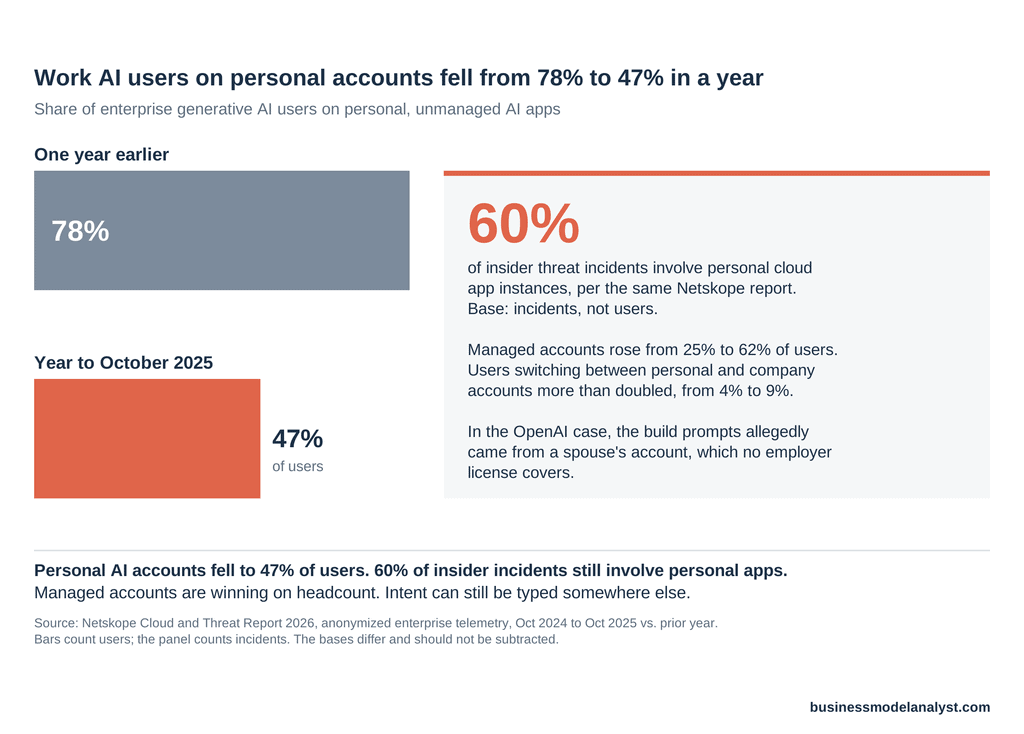
Two numbers in the same report complicate the victory lap. Users who switch back and forth between personal and company accounts more than doubled, from 4% to 9%. And Netskope found that 60% of insider threat incidents involve personal cloud app instances. Those are different bases, users on one side and incidents on the other, so they do not subtract. But they point the same way. The licenses are following the headcount. The incidents are following the personal account.
The second lever is old-fashioned, and it is the one that worked here. OpenAI found the recorder with a scheduled physical sweep, the oldest product in counterintelligence. The room had no camera when the device went in. One was added afterward, and it caught him checking on his hardware.
The Business Model Angle
Set aside the physical evidence and three trails remain. Who owns each one is the whole story.
Trail one, corridor CCTV, belongs to the employer. It placed him near a room he had no business in. Useful, cheap, and silent on intent: walking past a door is not a crime.
Trail two, the productivity tool, belongs to the employer. Reporting describes it as internal. It shows reconnaissance (room capacities, executive locations, partner meetings) without a single query about code or weights. Stronger, still circumstantial.
Trail three, the chatbot account, belongs to whoever runs the chatbot. This is the trail that shows building, encrypting, obfuscating and remotely accessing a recorder, and that names the device by its MAC address on the day before and the day of its installation. It sat in an account registered to a family member. No enterprise license covers a spouse. No data loss prevention tool claims to. Matching that account to the employee required “multiple identifiers and attributes,” which is a match only the platform holding both accounts can make, whether on its own or under legal process.
The complaint does not name the chatbot, and OpenAI has not said what its models examined. Either way, the structure is the point. The most incriminating evidence existed in a third party’s database before the crime occurred, and the employer, acting purely as an employer, had no contractual right to it.
That has three consequences for anyone running a company.
The household is the new shadow IT. Two years of governance spend has moved the measurable perimeter from personal accounts to managed ones, and the 78% to 47% drop is a real achievement. But a determined insider does not need a personal account. A spouse’s, a sibling’s, or a second phone’s will do, and none of them appear in any vendor’s coverage report. The managed-account push shrinks negligence, which Ponemon says drives 53% of insider incidents. It does very little against intent.
Model vendors are becoming insider-risk infrastructure whether they want the job or not. Intent now gets written down. People who once would have sketched a plan in their heads or a notebook now type it into a prompt box, and the prompt box keeps a log. That makes the vendor the holder of the most valuable insider-risk dataset in the economy, available to employers only through subpoena, after the fact. OpenAI is a rare case where the employer and a plausible vendor could be the same company. Almost every other employer is on the outside of that log.
The law protects the channel, not the content. Alfozan is charged with intercepting oral communications, a statute that turns on the act of recording. The Economic Espionage Act’s foreign-benefit provision carries up to 15 years and a $5 million fine for an individual, but it requires proving the information was a trade secret and that someone meant to benefit a foreign power. Prosecutors charged what the device itself proves. The recordings are encrypted, so nobody outside the case knows what, if anything, was captured.
Look at what the complaint says that room was for. It lists nine kinds of information discussed there: proprietary research, product plans, business-development opportunities, technical progress, strategic decisions, capabilities, priorities, government engagements and commercial relationships. Three are technical. Six are commercial or strategic. For a company that confidentially filed for an IPO in June, the second group is the kind of information securities lawyers treat as material and nonpublic. Frontier labs build vaults for weights. The alleged target was a meeting.
And meetings are hard to protect by design. California requires every party’s consent to record a confidential conversation, so a company cannot audio-monitor its own boardroom without becoming the thing it is guarding against. The most valuable room in the building is, legally and culturally, the least instrumented one. That leaves sweeps, cameras on the door, and logs of everything that happens before someone walks in.
The Risk
The best counterarguments are strong, and they deserve full weight.
The logs may have corroborated rather than caught. A scheduled sweep found the device and a camera caught him checking it. A competent prosecution might have reached the same arrest on the physical evidence and the bag alone. On that reading, the chatbot trail made the case stronger, not possible, and the lesson is to fund sweeps, not prompt forensics.
A careful insider leaves no vendor log. Open-weight models run locally on a laptop with no account, no retention policy and no subpoena target. The case is a portrait of an alleged plotter who used hosted tools, wrapped a device in toilet paper and left his wallet in a bag next to a second recorder. The insider worth worrying about will not do any of that.
Vendor-side visibility has a trust bill. If chatbot providers start being seen as the place where employers and prosecutors go to read intent, consumers will price that in, and some will move to local models or providers with stricter retention. The same log that convicts in one case is a privacy liability in a million others.
This is one complaint. Nothing has been proven, the defense has barely begun, and the most dramatic framing around the case comes from officials, not from the charging document. Building a thesis on a single allegation is a known way to be wrong.
The 47% figure is a moving target. If managed adoption keeps climbing at the pace Netskope measured, the shadow-AI problem shrinks on its own, and the residual risk becomes the narrow, intent-driven tail this case represents. That is a smaller market than the security industry would like it to be.
Quick Questions
What exactly is Alfozan charged with? Using or endeavoring to use a device to intercept oral communications, under 18 U.S.C. 2511. Maximum five years and $250,000. He is not charged with trade-secret theft or espionage.
Was any OpenAI data stolen? OpenAI says it has no indication that model weights, source code or customer data were accessed or taken. The device’s recordings were encrypted, and the complaint does not say what was captured.
Which chatbot did the spouse’s account use? The Justice Department release says only “a chatbot account.” Some outlets have described it as ChatGPT; the charging papers as described publicly do not name the vendor.
How was the device found? By OpenAI’s technical surveillance countermeasures team during a regular sweep on September 30, about two days after installation.
What should a company outside AI take from this? That managed AI accounts reduce careless leaks but do not reach deliberate ones, that physical sweeps of sensitive rooms are cheap relative to a $19.5 million average annual insider bill, and that the OpenAI business model and its rivals now sit on a type of evidence employers cannot access on their own.
The Business Model Analyst Take
For thirty years, insider risk was a problem of things leaving the building: files, laptops, people. Companies bought tools that watched the exits, and the tools got good. What this case shows is that the plan no longer forms inside the building. It forms in a prompt box, sometimes in an account belonging to someone the company has never heard of, and the record lands on a server the employer does not own.
We have seen this pattern before at BMA. The North Korean IT worker scheme worked because hiring verified identity after the decision instead of before it. The war on DMs exists because executives realized their agents could only read the part of the company that was written down in the right place. The OpenAI case is the security version of the same lesson. Visibility now depends less on what you control and more on who holds the log.
Pre-IPO companies, which are hiring aggressively and holding more material nonpublic information than ever, should take the cheap wins first: sweep the rooms where deals get discussed, put cameras on the doors, and stop treating managed-account coverage as the finish line. The expensive problem, intent written in somebody else’s database, is not one any employer can buy its way out of. It is a question the model vendors are going to have to answer in public, probably soon.
