
90% of Music Industry Blasts Albanese's AI Plan [2026]
90% of Music Industry Blasts Albanese’s AI Plan [2026]
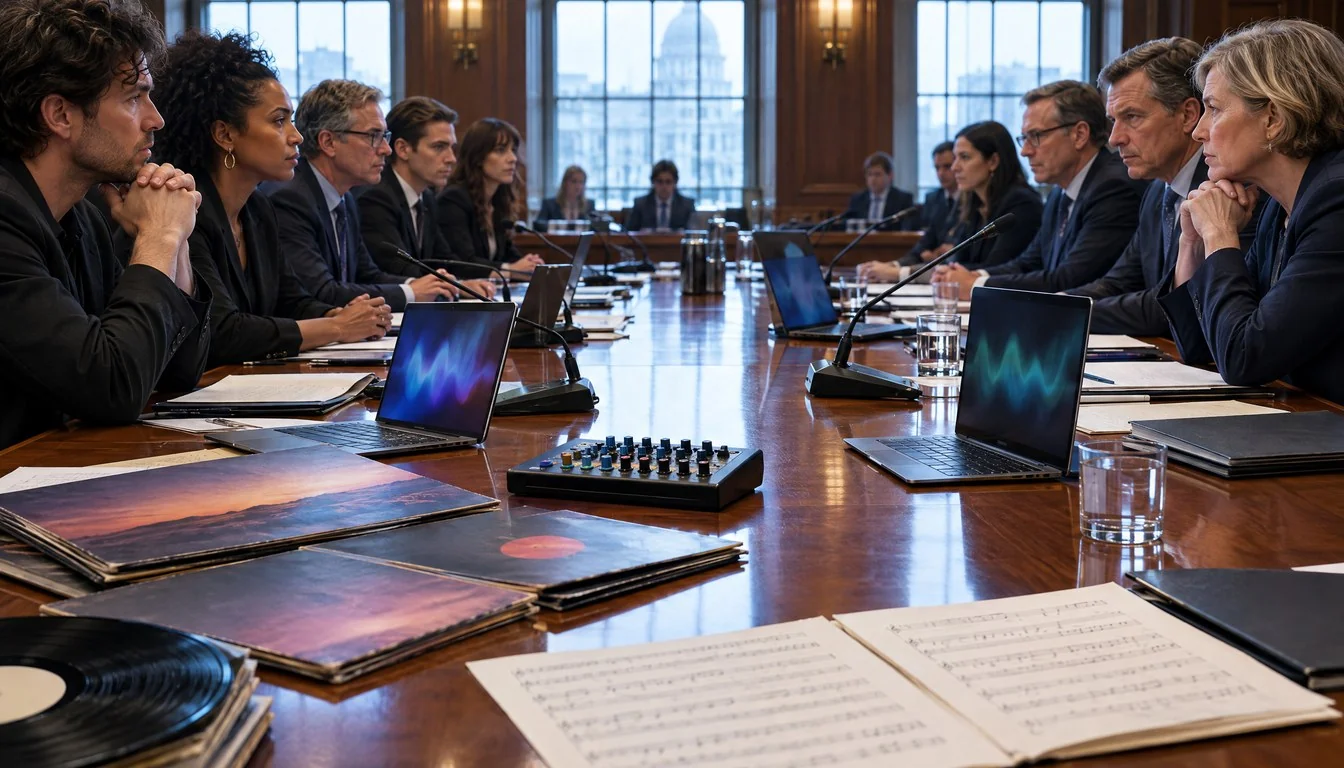
Global music publishers have accused the Albanese government of drafting an artificial intelligence copyright policy that would “legitimise larceny,” setting up a direct clash between Canberra and the world’s biggest record labels less than a year before new laws are due to land. The intervention, reported by the Australian Financial Review on October 16, 2026, came from the International Confederation of Music Publishers (ICMP), a Brussels-based body that says it represents about 90 per cent of the world’s commercial music, including publishers tied to Sony, Universal and Warner Chappell.
The dispute centres on how Australia will treat copyrighted music, books, art and journalism when AI companies want to use that material to train large language models and generative tools. Prime Minister Anthony Albanese has staked out a clear public position, declaring that “no company should use Australian books, music, art or news to build or train AI without the artist’s control, and that includes the artist’s control of the price and value of their work,” adding that “anything less is theft.” The ICMP’s pushback suggests the government’s framing has done little to reassure an industry that has spent the past two years fighting almost identical battles in courtrooms across the United States.
Don't miss new tech stories on Google
Add Tech Insider once in the Google app and our stories appear in your news suggestions.
What the Music Industry Is Accusing Canberra Of
At the centre of the ICMP’s objection is a leaked policy document that reportedly outlines two possible paths for Australia’s AI copyright regime: an opt-out system in which rights holders would need to actively withdraw their catalogues from AI training and be compensated through a central licensing body, or a negotiated model in which AI companies and rights-holder organisations strike direct deals. Publishers view the opt-out option as a reversal of the basic principle that underpins copyright law, since it would shift the burden onto songwriters, composers and labels to police unauthorised use of their own work rather than require AI developers to seek permission first.
The AI copyright debate in Australia is not simply about whether training data has value; it is about who carries the legal and administrative burden of proving consent. ICMP’s intervention argues that an opt-out framework would effectively hand AI developers free access to commercial repertoire unless individual creators manage to find and flag every unauthorised use, a near-impossible task given how training datasets are compiled at scale. The group’s warning that Australia could become what amounts to a safe harbour for unlicensed copying is the sharpest language yet used by an international rights body against a specific Australian government proposal.
Albanese’s Office of AI and the Theft Framing
The government’s response to mounting pressure from creative industries has been to stand up a new Office of AI inside the Department of the Prime Minister and Cabinet, alongside a commitment to develop mandatory Australian AI standards. Albanese has used increasingly blunt language to describe the stakes, telling reporters that Australian creative content “is not up for grabs” and promising “the strongest possible protection for Australian artists and Australian media.” New legislation covering AI and copyright is expected to be introduced in 2027, giving the government roughly a year to settle the detail of how licensing, consent and compensation will actually work in practice.
That timeline matters because it places Australia’s legislative process on a collision course with an increasingly crowded field of unresolved AI copyright cases overseas. The government appears to be deliberately waiting to see how courts in the United States rule before finalising its own approach, a strategy that creates short-term uncertainty for AI companies operating in Australia but could also help Canberra avoid locking in rules that get overtaken by overseas precedent within months of being enacted.
Inside the ICMP’s “Legitimising Larceny” Warning
The ICMP’s core argument, as reported by the Australian Financial Review, is that Australia risks moving ahead of global consensus on AI and copyright at exactly the wrong moment. Rather than waiting for litigation overseas to clarify whether training AI models on copyrighted recordings and lyrics counts as fair use or infringement, the group says Canberra appears willing to write permissive rules into law before those questions are settled. For an organisation representing the bulk of the world’s commercial music catalogue, that sequencing is seen as reckless: if Australia adopts loose rules first, AI companies could have an incentive to route training activity through Australian jurisdiction specifically because it offers fewer protections than the US or EU.
Publishers are also wary of a dynamic already playing out in the United States, where the biggest AI developers have faced a wave of lawsuits over training data sourcing. Major music publishers and record labels have brought cases alleging that AI companies, including Anthropic, scraped or otherwise obtained large volumes of copyrighted lyrics and recordings without a licence. Anthropic’s own US copyright dispute ended in a court-approved settlement worth billions earlier this year, a result rights holders now point to as evidence that unlicensed training carries real financial and legal exposure, not just reputational risk. Labels have brought comparable actions against AI music generators Suno and Udio, alleging that unlicensed recordings were used to train systems capable of producing music that mimics the style and sound of signed artists.
Two Models on the Table: Opt-Out Versus Negotiated Licensing
The leaked policy framework reportedly under consideration in Canberra boils down to two competing philosophies of how creative rights should work in an AI economy. The first, an opt-out system, would classify AI training as a permitted default use of copyrighted material unless the rights holder formally excludes their catalogue, likely administered through a central collecting body responsible for distributing any resulting payments. The second, a negotiated model, would require AI companies to reach licensing agreements directly with publishers, labels or collective rights organisations before training on their material, mirroring how radio, television and streaming licensing already works in Australia.
Each option carries sharply different economics for the two sides. An opt-out system, from an AI developer’s perspective, keeps training costs predictable and avoids the friction of negotiating with thousands of individual rights holders. For publishers, it inverts the normal burden of proof in copyright law and risks normalising a situation where the default is use-first, pay-later, if at all. A negotiated licensing model preserves the existing principle that permission comes before use, but risks fragmenting the market if large numbers of individual creators cannot realistically be reached for consent at the scale AI training requires. Resolving that tension is likely to be the single hardest technical question the government’s promised 2027 legislation needs to answer.
Why the US Litigation Wave Is Shaping Australia’s Timeline
Australia’s wait-and-see approach is a direct response to an unusually active docket of AI copyright litigation in the United States. Music publishers, authors, news organisations and visual artists have all filed cases against major AI developers over the past two years, testing whether scraping copyrighted material to train a model qualifies as fair use, whether AI-generated outputs can themselves infringe copyright, and whether companies broke the law in how they originally acquired training datasets. None of these cases has produced a single, settled legal doctrine that other jurisdictions can simply adopt wholesale, which is part of why Australian officials appear reluctant to legislate ahead of clearer outcomes.
The stakes of that litigation extend well beyond the companies directly involved. If US courts ultimately find that training on copyrighted material without a licence is lawful under fair use doctrine, AI developers will have a strong precedent to resist licensing demands everywhere, including Australia. If courts instead side with rights holders, it strengthens the hand of groups like ICMP and gives Australian lawmakers a template for building a licensing-first framework with less risk of being overturned by trade pressure or international legal challenge. Either outcome will likely shape how aggressively Australia’s 2027 legislation leans toward protecting creators versus providing AI companies with operational certainty.
Australian Creative Groups Rally Behind the Government’s Line
Domestic reaction to Albanese’s comments has been largely supportive among Australian creative industry bodies, even as the ICMP’s international intervention signals that overseas rights holders see the detail of the policy very differently. According to Rolling Stone Australia, performing rights organisation APRA AMCOS and record industry body ARIA both welcomed the Prime Minister’s public commitment to creator control, framing it as validation of years of lobbying for stronger AI guardrails. A broader coalition of Australian creative organisations, including songwriter and publisher groups, screen industry bodies and Indigenous music representatives, has pushed the same message: AI training on Australian creative work should require permission, transparency and fair payment, not simply a legal exemption.
That domestic coalition’s support for the government’s stated intent does not necessarily mean full alignment with the ICMP’s reading of the leaked policy options. Local groups appear focused on securing the principle that licensing must come first, while the ICMP’s criticism is aimed specifically at the opt-out model reportedly under consideration, which it argues would betray that same principle in practice even if the government’s public rhetoric says otherwise. The gap between what Albanese has promised in speeches and what the final legislative text might actually say is exactly the space the music industry is trying to close before any bill is drafted.
How AI Companies Have Responded
Public commentary directly from major AI developers on the Albanese government’s specific proposal has so far been limited. None of the leading frontier labs has issued a detailed on-record response to the ICMP’s criticism or the leaked policy options, and it would be premature to assume their positions mirror arguments made in separate US litigation. What is clear is that the broader legal strategy pursued by AI companies in overseas courts, arguing that model training involves transformative computational analysis rather than straightforward copying, is likely to inform how they engage with Canberra as the 2027 legislation takes shape.
The stakes for individual companies vary. OpenAI has spent much of 2026 deepening its relationships with national governments, a pattern that makes a protracted copyright standoff with Canberra commercially awkward at a time when AI developers are racing to lock in data centre capacity and government partnerships across the Asia-Pacific. Anthropic has already committed capital to Australian infrastructure, giving it a direct stake in how local copyright rules land. Any company that has made long-term bets on the Australian market has a strong incentive to negotiate rather than litigate once the legislative text is public.
Historical Context: The Copyright Act 1968 Meets Generative AI
Australia’s copyright framework rests on the Copyright Act 1968, which grants creators automatic rights over the reproduction and use of literary, musical, dramatic and artistic works, as well as sound recordings and films, without requiring formal registration. Unlike the United States, Australia has never adopted an open-ended fair-use doctrine; its exceptions are narrower and more specific, covering activities such as research, criticism, review, parody and certain library or education uses. That structural difference is central to why Australian policymakers cannot simply import the US legal debate wholesale: American courts are testing fair use arguments that do not have a direct Australian equivalent, meaning any AI-specific exception Canberra creates would effectively be a new carve-out rather than an extension of existing doctrine.
According to the Law Society Journal, the practical effect of introducing a broad AI text-and-data-mining exception in Australia would be a meaningful departure from the country’s historically licensing-first approach to music, broadcast and publishing rights. Australia’s existing licensing infrastructure, covering radio play, television broadcast, streaming royalties and public performance, already handles the kind of large-scale, multi-party rights clearance that AI training would require. Rights holders argue that infrastructure should simply be extended to cover AI use cases rather than bypassed through a new legislative exemption.
The 2026 AI Model Landscape and the Training Data Problem
The copyright fight is unfolding against the backdrop of an AI industry that has scaled dramatically through 2026, with leading developers racing to release increasingly capable models while facing growing scrutiny over exactly what data trained them. Companies such as OpenAI, Anthropic and Google typically disclose only broad categories of their training data, such as publicly available web content, licensed datasets and human-annotated material, without publishing an itemised account of every copyrighted work involved. That opacity is precisely what rights holders say makes an opt-out system unworkable in practice: creators cannot meaningfully exercise an opt-out right over data use they have no visibility into.
The commercial pressure behind this debate is significant. Competition between leading chatbot and model providers has intensified on both price and capability through 2026, and training data remains one of the few inputs that can meaningfully differentiate one frontier model from another. Music and lyrics, in particular, represent a valuable but legally contested category of training data for any company building voice, audio or multimodal AI products, which is precisely why labels and publishers have been so aggressive in pursuing litigation against AI music generators specifically, rather than only general-purpose chatbot developers.
Market Impact: What’s at Stake for Labels, Publishers and AI Developers
For music publishers and labels, the commercial calculus is straightforward: a licensing-first AI copyright regime creates a potential new revenue stream from training-data deals, while a permissive opt-out system risks eroding the value of catalogues that labels have spent decades building through radio, streaming and sync licensing. For AI developers, the dynamic runs in the opposite direction. A negotiated licensing requirement adds cost and legal complexity to building and training models in Australia, while a lighter-touch opt-out framework keeps compliance costs lower but exposes companies to reputational risk and the kind of public backlash now playing out in the AFR’s reporting.
Beyond music, the policy outcome will set a template that other creative sectors are watching closely. Book publishers, news organisations and visual artists all face versions of the same question, and the government’s eventual answer for music licensing is likely to become the reference point for how AI training on journalism, literature and visual art gets treated under the same 2027 legislation. That is partly why the ABC reported the government’s data centre and copyright announcements together: Canberra is treating AI infrastructure investment and AI content rules as two sides of the same policy package, which means copyright settings could directly influence where global AI companies choose to locate training and data centre capacity.
Competitive Comparison: How Australia’s Approach Stacks Up Globally
Australia is not alone in trying to draft AI-specific copyright rules while overseas litigation is still unresolved. The European Union has moved furthest on paper, requiring AI developers under its AI Act framework to document training data sources and respect existing opt-out mechanisms for text and data mining established in EU copyright law since 2019. The United Kingdom proposed and then stepped back from a broad AI training exception in 2025 after creative-industry backlash, leaving its position closer to the status quo than originally planned. The United States has no AI-specific copyright statute at all, leaving the matter almost entirely to the courts hearing the current wave of lawsuits against OpenAI, Anthropic, Meta, Suno and Udio.
| Jurisdiction | Primary Mechanism | Current Status | Creator Opt-Out? |
|---|---|---|---|
| Australia | New legislation under Office of AI | Policy options leaked; law expected 2027 | Reportedly one of two options being weighed |
| European Union | AI Act plus existing text-and-data-mining exception | In force, with transparency and documentation duties | Yes, since 2019 EU copyright directive |
| United Kingdom | Government consultation | Broad exception proposal withdrawn after backlash | No formal AI-specific opt-out mechanism yet |
| United States | Case-by-case court rulings | Multiple active lawsuits, no single resolved doctrine | No statutory opt-out; fair use argued case by case |
What distinguishes Australia’s position is the explicit decision to wait for US court outcomes before legislating, a strategy neither the EU nor the UK adopted. That caution could pay off if it allows Canberra to draft more durable rules informed by settled case law, but it also leaves Australian creators and AI companies alike operating in a grey zone for at least another year, which is exactly the uncertainty the ICMP’s intervention is trying to shorten.
Timeline: Key Dates in Australia’s AI Copyright Fight
| Date | Development |
|---|---|
| 2026 (mid-year) | Albanese government signals data centre and AI copyright standards agenda |
| 2026 | Australian creative coalition, including APRA AMCOS and ARIA, unites to oppose unauthorised AI training |
| 2026 | Office of AI established within the Department of the Prime Minister and Cabinet |
| October 16, 2026 | ICMP publicly brands leaked AI copyright options “legitimising larceny” |
| 2027 | Government’s AI copyright and creator-protection legislation expected to be introduced |
What Happens Next: The Road to 2027 Legislation
With legislation not expected until 2027, the immediate fallout from the ICMP’s intervention is likely to be political rather than legal. Expect the government to face sustained pressure from both directions: international rights bodies and domestic creative groups pushing for a licensing-first model, and AI companies and their advocates warning that an overly restrictive regime could discourage the kind of large-scale AI infrastructure investment Australia has been actively courting. According to Asia IP Law, the Office of AI’s first substantive test will be translating Albanese’s public commitments into legislative text that survives consultation with both camps without being watered down into the kind of opt-out model ICMP is already warning against.
How that consultation process unfolds will likely depend heavily on developments elsewhere. A significant US court ruling against any of the AI companies currently being sued, including Anthropic, Meta, Suno or Udio, would strengthen the hand of Australian rights holders ahead of the 2027 bill. Conversely, a ruling favourable to AI developers would increase pressure on Canberra to adopt a lighter-touch regime to avoid disadvantaging local AI investment relative to jurisdictions with looser rules. Major US technology companies have already signalled tens of billions of dollars in planned Australian AI infrastructure investment, and how comfortably that capital continues to flow may hinge on just how restrictive the final copyright framework turns out to be.
Five Predictions for Australia’s AI Copyright Fight
- The government will not finalise its preferred model (opt-out versus negotiated licensing) until at least one major US court ruling lands, pushing substantive legislative drafting into late 2026 or early 2027.
- Expect a formal consultation paper from the Office of AI before any bill is introduced, giving both the ICMP and domestic groups like APRA AMCOS and ARIA a structured opportunity to lobby on the final text.
- AI companies with existing Australian infrastructure commitments, including Anthropic, are more likely to pursue negotiated licensing deals quietly rather than publicly oppose the government’s framing of “theft.”
- Pressure from the ICMP and the “theft” framing used by Albanese will likely push the final legislation toward a licensing-first model rather than a pure opt-out system, mirroring the EU’s approach more closely than the current leaked proposal suggests.
- Expect book publishers, news organisations and visual artists to cite this music industry fight directly when lobbying for their own sectors to be covered under the same protective framework in the 2027 bill.
Frequently Asked Questions
What did the ICMP actually say about Australia’s AI copyright plan?
The International Confederation of Music Publishers, which represents roughly 90 per cent of the world’s commercial music including publishers linked to Sony, Universal and Warner Chappell, said Australia’s leaked AI copyright options risked “legitimising larceny” and urged Canberra to wait for US litigation outcomes before changing local copyright law.
What has Prime Minister Albanese said about AI and copyright?
Albanese has said no company should use Australian books, music, art or news to train AI without the creator’s control over the use and value of their work, describing anything less as theft. He has also promised the “strongest possible protection” for Australian artists and media.
What is the Office of AI?
The Office of AI is a new government body established within the Department of the Prime Minister and Cabinet. It is tasked with developing mandatory Australian AI standards and is expected to play a central role in shaping the AI copyright legislation due in 2027.
When will Australia’s AI copyright laws actually take effect?
New laws governing AI and copyright are expected to be introduced in 2027. No exact month has been confirmed, and the government appears to be timing its legislative drafting partly around the outcome of ongoing AI copyright litigation in the United States.
What are the two copyright models reportedly being considered?
Reports describe two options: an opt-out system where AI training is permitted by default unless rights holders actively withdraw their catalogues, with payments distributed through a central body, or a negotiated model requiring direct licensing agreements between AI companies and rights-holder organisations.
How have Australian music industry groups reacted?
Local groups including APRA AMCOS and ARIA have welcomed Albanese’s public commitments to creator control, joining a broader coalition of Australian creative organisations that wants AI training on local works to require permission, transparency and fair payment rather than a blanket legal exemption.
Are AI companies like OpenAI, Anthropic and Google facing similar fights elsewhere?
Yes. Major AI developers are currently facing active copyright litigation in the United States brought by authors, publishers, news organisations and music rights holders, testing whether training models on copyrighted material without a licence qualifies as fair use.
Why does this dispute matter beyond the music industry?
Whatever framework Australia settles on for music licensing is likely to become the template for how the same 2027 legislation treats AI training on books, journalism and visual art, making this single dispute a preview of a much broader fight over creative rights in the AI era.

Mason Whitfield
Mason Whitfield is a Sydney-based technology journalist who has spent over a decade testing laptops, smartphones and consumer software for Australian readers. He focuses on hands-on hardware reviews and practical buying advice, with a particular eye for value-for-money picks and accurate local pricing.
View all articles