
AI: Anthropic’s Mega Data Center Sprint ahead of its Mega-AI IPO. AI-RTZ #1241
…a $16.8 billion quarter, $530 billion in leases, 15 gigawatts, and the neoclouds racing to build it.

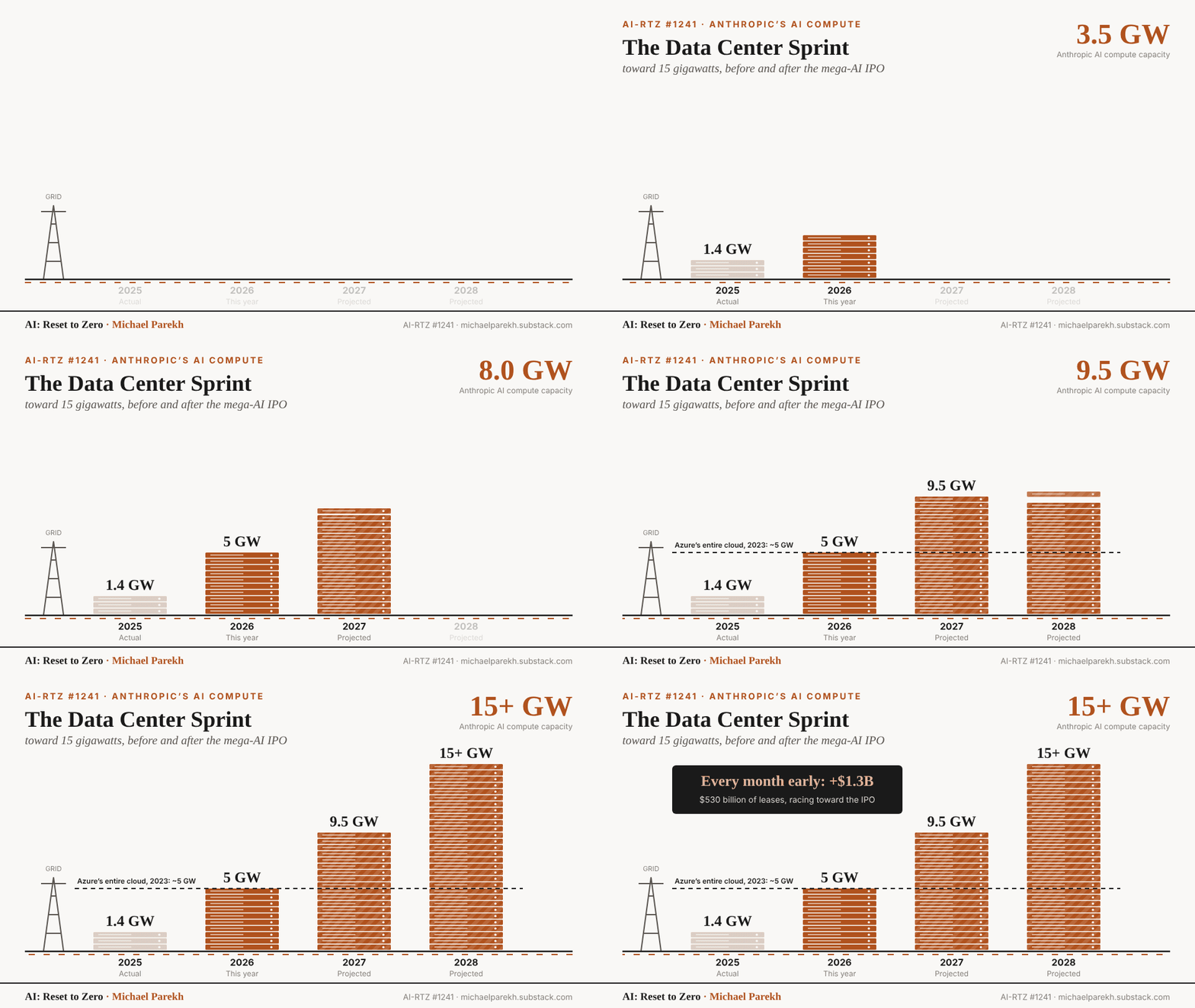
Anthropic is sprinting to switch on AI data centers ahead of its mega-AI IPO, expected next month, before Thanksgiving. And it is pushing its partners to run faster. This week it also made its case to potential investors in San Francisco. Let’s unpack this next phase of the AI Tech Wave.
It’s straightforward economics, as The Information lays out in ‘The Attractive Economics Behind Anthropic Data Center Sprint’. Anthropic has signed some $530 billion of data center leasing deals, and as the piece puts it:
“Every server Anthropic plugs in sooner to run its products could be wildly profitable.”
It’s all part of the broader mosaic of this AI Tech Wave: the AI Compute race, the neoclouds building behind the big clouds, and the Wall Street, private equity and sovereign money lining up to finance it all, with Nvidia as Kingmaker and banker. Lots of devil in these details.
Toward 15 gigawatts, with ‘fresh horses’
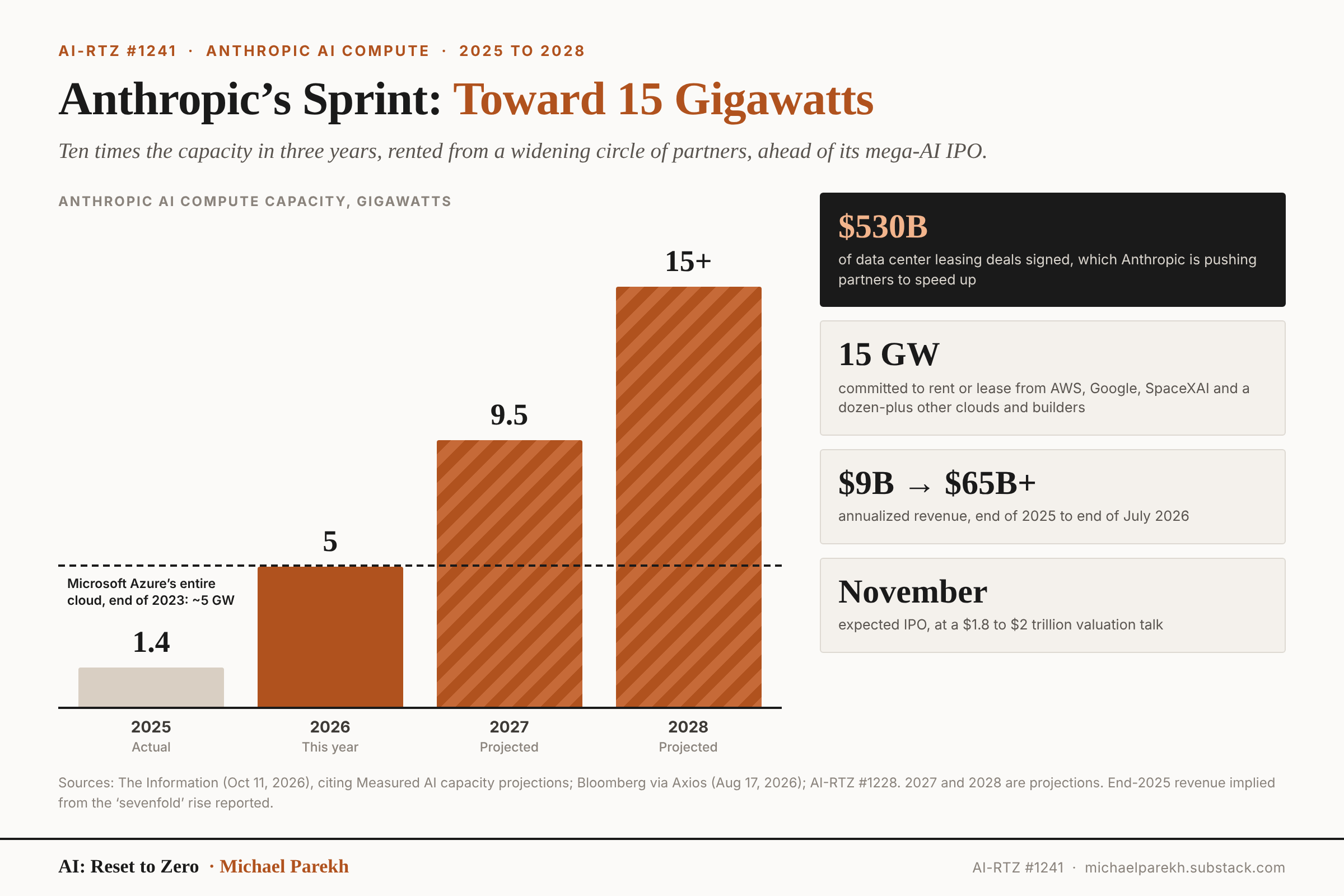
Anthropic has committed to renting or leasing about 15 gigawatts of capacity in the coming years, from Amazon AWS, Google, SpaceXAI and more than a dozen other cloud providers and data center firms. Measured AI, an AI construction newsletter, projects Anthropic’s capacity rising from 1.4 gigawatts in 2025 to 5 gigawatts this year, 9.5 in 2027 and over 15 in 2028, as the chart below shows. For perspective, Microsoft’s entire Azure cloud ran at about 5 gigawatts at the end of 2023, for all of its customers.
And as a reminder, every gigawatt of AI data center capacity typically means $50 billion plus of investment, in chips, buildings, power and networking, by the companies concerned, as I laid out in Data Centers 101. At that rate, 15 gigawatts implies some $750 billion plus of build-out, much of it on the balance sheets of Anthropic’s partners and their lenders rather than its own.
The latest site is outside Baton Rouge, Louisiana. In rural St. Francisville, Hut 8, a bitcoin miner turned AI data center developer whose legacy mining business counts Donald Trump Jr. and Eric Trump as partners, kicked off a 330 megawatt campus last week, aiming for a gigawatt over time. Fluidstack will lease and operate it, Anthropic supplies Google’s TPU chips, and compute starts in the second quarter of 2027. Louisiana’s governor, some 300 bankers, investors and utility officials, and Anthropic’s head of compute, James Bradbury, were all there under the tent.
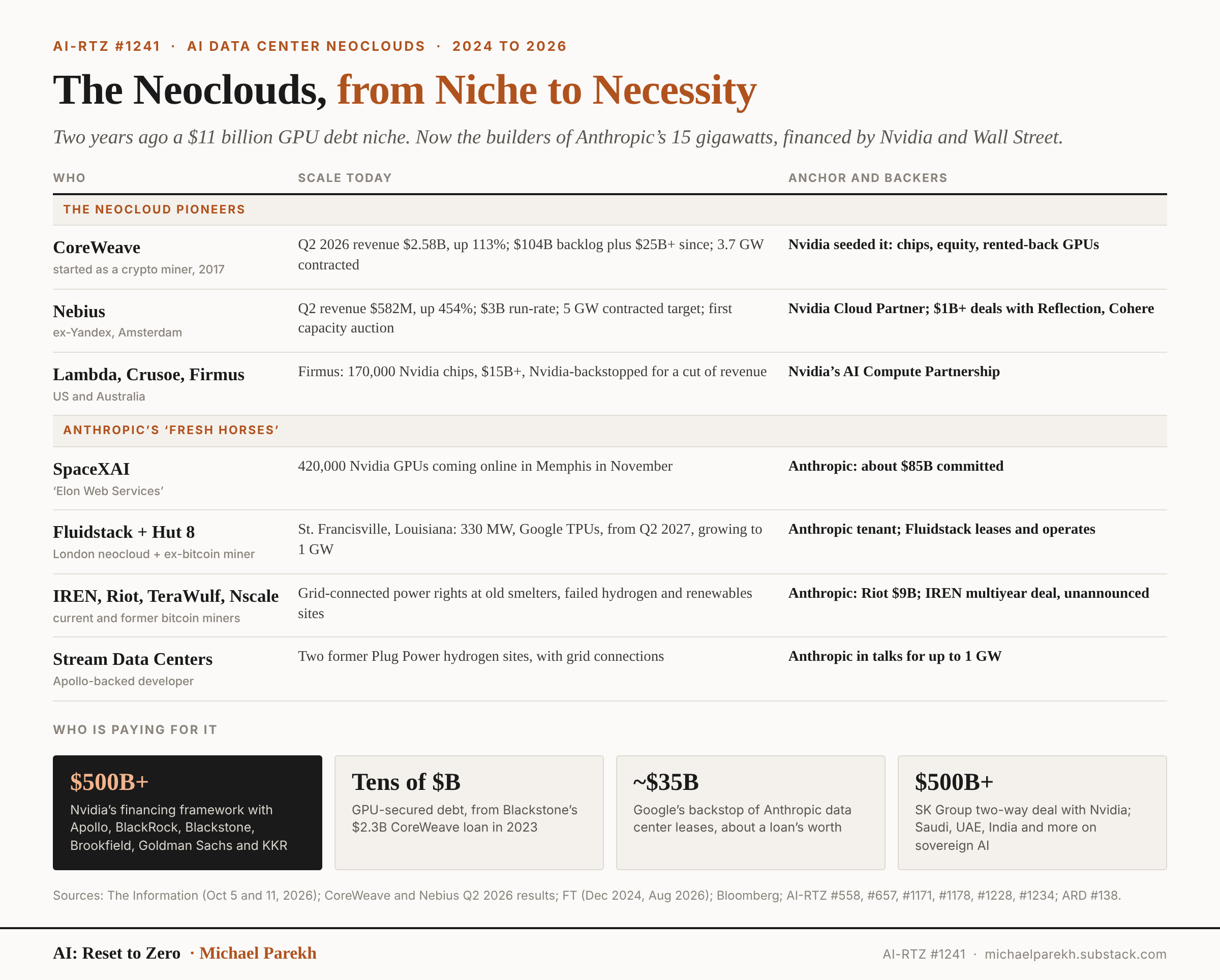
Hut 8 is one of many ‘fresh horses’ Anthropic has brought to the race. TeraWulf, IREN, Riot Platforms, Nscale and other current and former bitcoin miners now matter to Anthropic’s compute race against OpenAI. They picked up what the big clouds missed or passed on: grid-connected power rights, at old aluminum smelters, failed green hydrogen sites and renewables-rich land. Riot struck a $9 billion computing deal with Anthropic in August, as I noted on ARD #138. IREN has a multiyear deal not yet announced. And Anthropic is in talks to lease up to a gigawatt from Apollo-backed Stream Data Centers, which just bought two failed Plug Power hydrogen sites. Add SpaceXAI, where Anthropic has committed about $85 billion, as I discussed in AI-RTZ #1228.
The build itself is being redesigned for speed. Vertiv CEO Giordano Albertazzi says it now ships prefabricated bundles of power, batteries, cooling and fire protection, assembled offsite, that cut typical installation time in half.
The economics: why speed pays
Here is the math behind the urgency. The Louisiana campus draws 330 megawatts to deliver 245 megawatts of usable compute. If that capacity comes online even one month early, Anthropic could generate an extra $1.3 billion or more in revenue, based on investor and analyst estimates, assuming it all goes to inference rather than model training.
Against that, Anthropic might pay roughly $200 million a month to lease the chips from a cloud provider at disclosed long-term rates, per Christian Okoye of Occam Edge. That implies about an 85% gross margin on inference at the site. It gets better where Anthropic cuts out the cloud middlemen, as it is starting to do by buying TPUs outright for its own data centers, as I noted in AI-RTZ #1176.
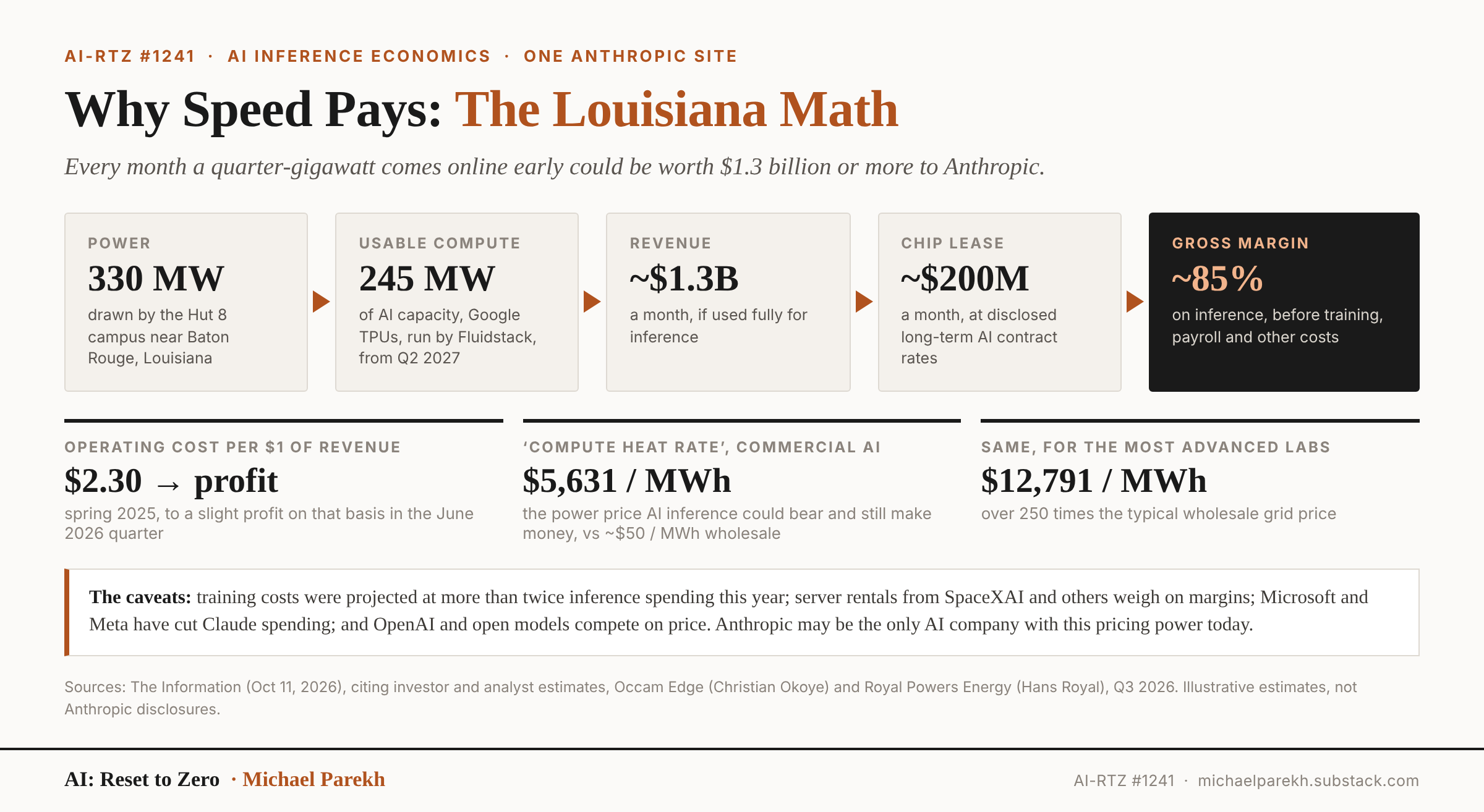
It shows up in the company-wide numbers too. Anthropic went from spending about $2.30 on operations for every $1 of revenue in the spring of 2025, to a slight profit on that basis in the June 2026 quarter. Its run-rate revenue went from about $9 billion at the end of 2025 to over $65 billion by the end of July, per Axios, and it projects roughly $190 to $200 billion for 2028, as I discussed in AI-RTZ #1181.
Even power prices barely dent the math. Energy analyst Hans Royal tracks a ‘Compute Heat Rate’, the electricity price an AI inference data center could pay and still earn a return. In the third quarter, it was $5,631 per megawatt-hour for commercial AI, over 100 times the typical $50 wholesale grid price, and $12,791 for the most advanced labs like Anthropic. Royal Powers and Occam Edge suggest a better trade than simply paying more: AI data centers get grid power sooner by agreeing to switch off for a few peak hours a year, and utilities spread their costs over a wider base of ratepayers. That matters, with AI data centers now a political football in the midterms, as I noted in Data Centers 101.
The caveats are real. Anthropic projected its model training costs this year at more than twice its inference spending. Its spree of server rentals from SpaceXAI and others will weigh on margins. Large customers like Microsoft and Meta have cut their Claude spending, and OpenAI and open source models are competing hard on price. And Anthropic may be the only AI company with this kind of pricing power on inference today. No one else, OpenAI included, appears to come close on gross margin.

The latest numbers, and the IPO math
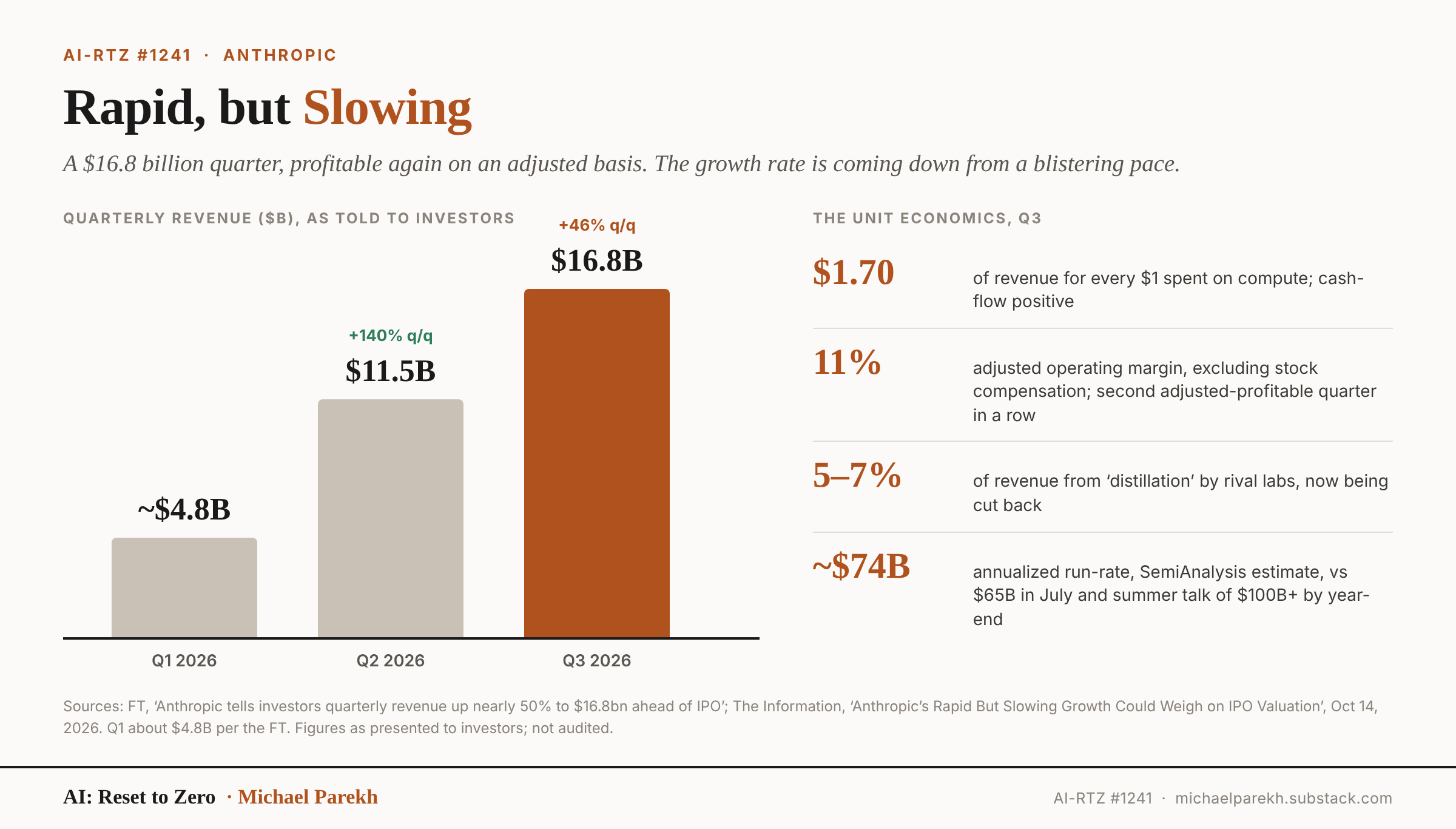
Fresh numbers this week sharpen the picture. At an investor day in San Francisco on Wednesday, Anthropic said third-quarter revenue rose nearly 50% to $16.8 billion, from $11.5 billion in the June quarter, per the FT in ‘Anthropic tells investors quarterly revenue up nearly 50% to $16.8bn ahead of IPO’.
It was profitable on an adjusted basis for the second quarter in a row, cash-flow positive, and earned $1.70 in revenue for every $1 it spent on compute. Adjusted operating margins, excluding stock compensation, were 11%. That $1.70 is the company-wide version of the Louisiana math above, and the reason every month of speed matters.
But the growth is slowing from a blistering pace. Revenue more than doubled from the first quarter to the second, on fevered demand for Claude Code, per The Information in ‘Anthropic’s Rapid But Slowing Growth Could Weigh on IPO Valuation’. Anthropic did not update the $65 billion annualized run-rate it hit in July; SemiAnalysis estimates roughly $74 billion now, below the summer talk of $100 billion plus by year-end. Anthropic also said 5% to 7% of its revenue came from ‘distillation’, rival labs training their models on Claude’s outputs, which it is cutting back. And big customers like Meta and Microsoft are leaning more on their own AI tools.
The bull case is just as real. As Axios puts it in ‘Anthropic brings Wall Street an AI bull case’:
“Anthropic on Wednesday made that case in cash.”
Anthropic is arguably cash-flow positive even as Alphabet, long a money-printing machine, turned free cash flow negative in its second quarter on AI infrastructure spending. Claude Code alone reached an estimated $6 billion to $7 billion in annualized revenue by late summer, per Bloomberg Intelligence, and Anthropic charges roughly 20% to 30% more than competing models. SemiAnalysis estimates its API business generates about 90% of revenue on 58% of its compute, for a roughly 92% gross margin before certain costs. That is pricing power, at company scale.
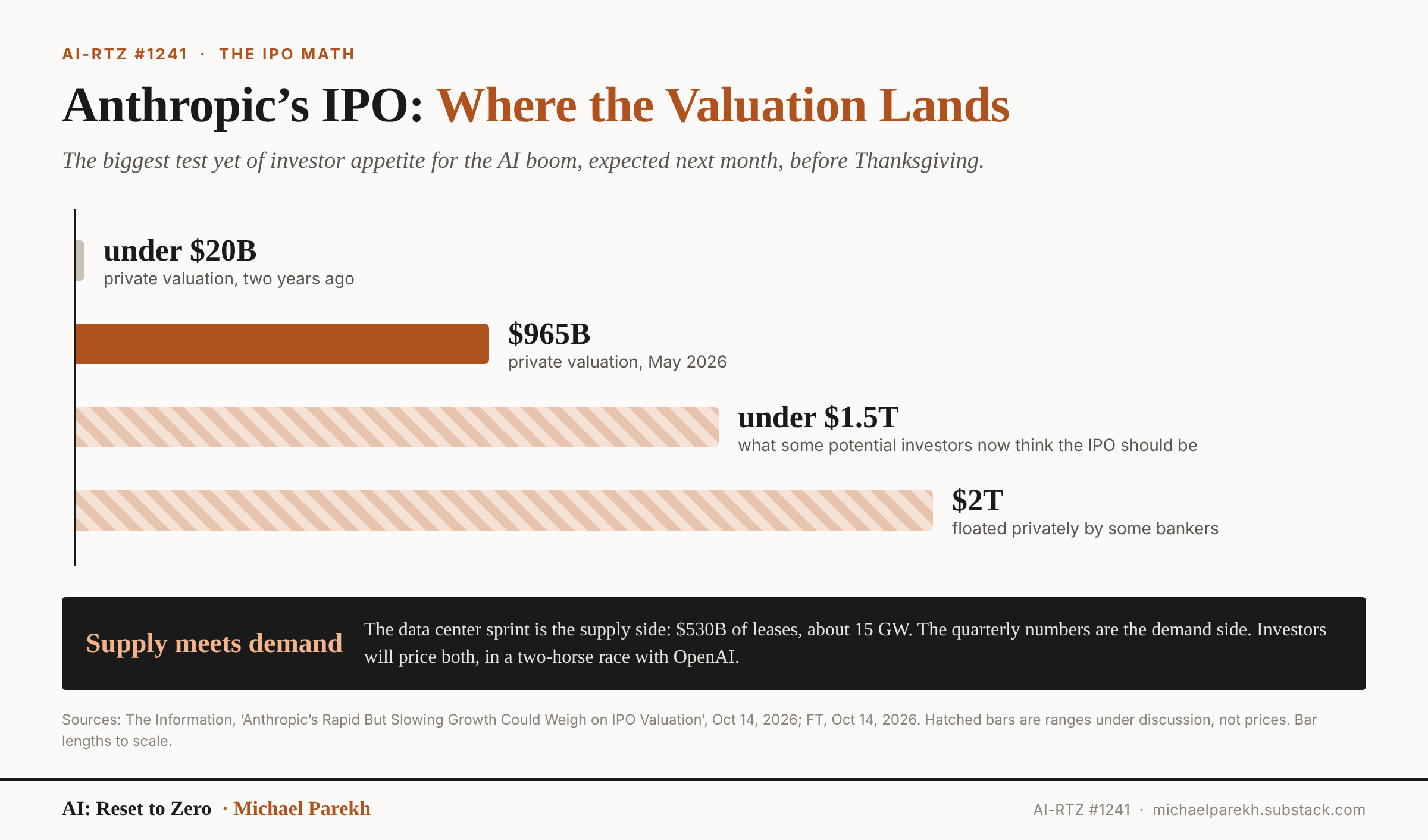
That feeds straight into the IPO math. Anthropic, valued at $965 billion privately in May, is expected to go public next month, before Thanksgiving. Some bankers have floated $2 trillion; some potential investors now think it should come in below $1.5 trillion. As one analyst told the FT, it is now ‘a two-horse race’ with a resurgent OpenAI.
The data center sprint is the supply side of the story. The quarterly numbers are the demand side, and investors will be reading both.
Who pays for the build: Nvidia, Wall Street and sovereigns
Anthropic rents. Someone else has to build and finance.
That is where the capital markets come in, led by Nvidia, the ‘Uber AI Investor & Banker’ I described in AI-RTZ #1171. In August, Nvidia and the who’s who of world finance, Apollo, BlackRock, Blackstone, Brookfield, Goldman Sachs and KKR among them, lined up a financing package of more than $500 billion for AI infrastructure, as I discussed on ARD #138. Nvidia has also backstopped loans for Australian neocloud Firmus to buy over $15 billion of chips, for a cut of future cloud revenue, and is working to turn GPUs into a financial asset class that lenders can value and trade, as I laid out in AI-RTZ #1234.
The big clouds back their AI tenants too. Google is backstopping Anthropic’s data center leases, roughly a $35 billion loan’s worth. And governments want their own AI, an AI factory with a flag on it, from SK Group’s $500 billion plus two-way partnership with Nvidia in Korea, to Saudi Arabia, the UAE, India and Kazakhstan. The alluring ‘Sovereign AI’ market I wrote about in RTZ #732 keeps growing.
The money is getting pricier, though. All four high-yield data center bond deals since July sold at a discount, as I noted in AI-RTZ #1228. Nvidia’s credit default swap spreads have roughly doubled. And some of Anthropic’s newer partners are struggling to raise public market money at the valuations they want. Last week, Nvidia-backed Firmus Grid pulled what would have been Australia’s biggest IPO in almost 30 years, citing market volatility, per The Information.
The neoclouds, from niche to necessity
Two years ago, in ‘Rise of the AI data center Neoclouds’, I wrote about a new cluster of companies building furiously behind the big clouds, CoreWeave, Lambda, Crusoe and others, backed by Nvidia and an $11 billion niche of GPU-backed loans from Blackstone, Pimco, Carlyle and BlackRock. A few months later came Nvidia’s rocket fuel propulsion of CoreWeave into its IPO.
Today they are a necessity. CoreWeave, which had annual revenue of just $25 million when it took its first big GPU-backed loan in 2023, reported $2.58 billion of revenue in its June quarter alone, up 113%, with a $104 billion backlog, more than $25 billion of new commitments since, and 3.7 gigawatts of contracted power. Nebius grew revenue 454% to $582 million, runs at a $3 billion annual pace, and targets 5 gigawatts of contracted power by year end. Both are cashing in on soaring compute prices, as I discussed in AI-RTZ #1178, with rentals of Nvidia’s 2022-vintage H100 chips up 50% or more.
Now there is a new layer: the former bitcoin miners, and Elon’s SpaceXAI, which I have called ‘EWS’, Elon Web Services, a mega version of the neoclouds. And Anthropic is the anchor tenant that makes much of it financeable.
The open questions
First, execution. Anthropic’s capacity plan increasingly depends on young partners, several of them crypto miners, building at record speed. Energy, chips, construction crews and debt all have to stay plentiful. As The Information concludes, that is still a big ‘if’.
Second, the margins. The 85% is inference at one site, on estimates. Training costs, rentals at premium prices and a price war with OpenAI all pull the other way. Anthropic’s S-1 will show the real blend. As I noted in AI-RTZ #1235, then everyone counts with the same ruler. The first look came this week: an 11% adjusted operating margin, before stock compensation.
Third, concentration. When one AI lab is the anchor tenant for a dozen neoclouds and developers, those builders carry Anthropic risk, and Anthropic carries theirs. It is the same circularity as Nvidia’s neocloud bets, as I noted in AI-RTZ #1234: bookings to buildings to billings, as long as demand holds.
Fourth, the grid and the politics. Rising utility bills are a sensitive topic. West Feliciana Parish shows how the gains might be shared: Hut 8’s tax payments are expected to triple the parish’s annual revenue to $130 million, and a new state law lets local officials cut residents’ property taxes by 25%. Whether voters elsewhere see it that way is another matter.
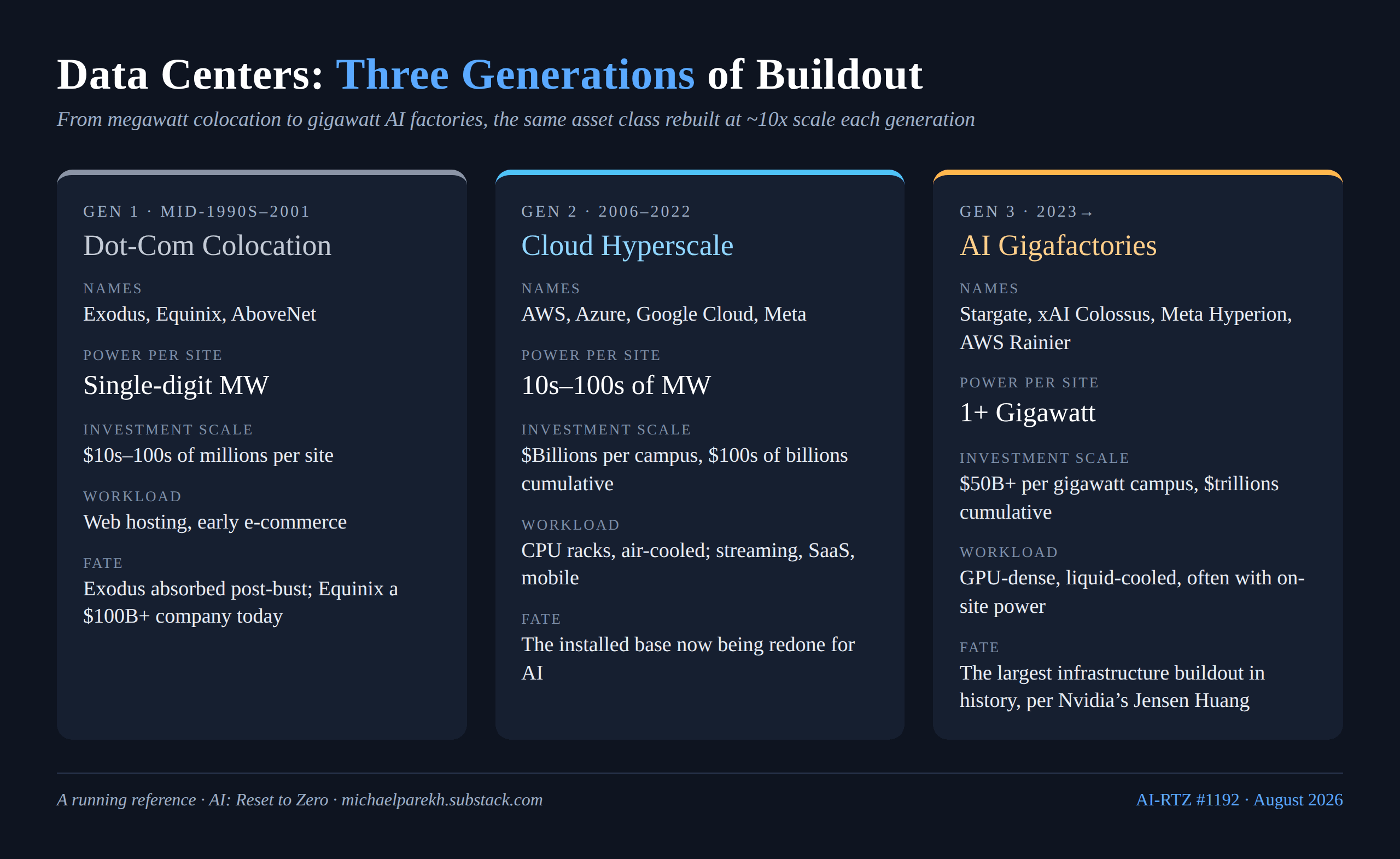
Stepping back, it’s quite a journey from where data centers started a few decades ago, with a lot more zeroes on almost every metric.
My take
Anthropic is doing what the leader in a supply-constrained market does: turning pricing power into locked-in capacity, deal by deal, ahead of its IPO. As I said on ARD #176, Anthropic is ready to go, come hell or high water. Showing investors that the supply is locked in for the demand is the game it has to play. And every month of speed is worth more than a billion dollars. This week’s numbers back that up: a $16.8 billion quarter, cash-flow positive, $1.70 of revenue for every $1 of compute. Slower growth will shape the IPO price more than the case for the build.
It also closes a loop I have watched for years. Nvidia seeded the neoclouds to have customers beyond its big cloud ‘frenemies’. Wall Street, private equity and sovereigns followed with the money. Now the frontier AI labs, Anthropic first, are the anchor tenants that make the whole stack financeable. Demand for AI Agents and AI Coding holds it all together, for now.
As I wrote in Data Centers 101, the honest precedent is the first internet data center buildout, Exodus and Equinix, which I helped take public at Goldman Sachs. Some of today’s builders will not survive their own capital cycle.
But the facilities, the fiber and the power will compound value for decades, whoever’s logo ends up on the door. The Louisiana math says the sprint is rational. The capital cycle will decide who is still running at the finish.
Anthropic’s accelerating operational and financial realities are at the heart of the AI Tech Wave worth tracking through Thanksgiving 2026. Along with OpenAI on the other side of 2027, of course. Stay tuned.
Sources and further reading
Axios, “Anthropic brings Wall Street an AI bull case”, October 15, 2026
The Information, “The Attractive Economics Behind Anthropic Data Center Sprint”, October 11, 2026
Axios, “Anthropic’s revenue run rate reportedly surpasses $65 billion pre-IPO”, August 17, 2026
For longtime readers
RTZ #1036: Nvidia accelerating role as the AI Computing ‘Kingmaker’
AI-RTZ #1171: Nvidia the ‘Kingmaker’, Now ‘Uber AI Investor & Banker’
ARD #138: ‘Gaming the System’ for AI. Nvidia, OpenAI & Anthropic
AI-RTZ #1176: Anthropic warms up Investors for 2026 mega-AI IPO
ARD #176: ‘Come Hell or High Water’ in AI. Anthropic, DC & SpaceXAI
AI-RTZ #1228: Anthropic’s IPO Go Time, OpenAI’s $1.4 Trillion, Gemini 4 & More
AI-RTZ #1235: OpenAI’s Revenue Math, Nvidia the Kingmaker, AI Czar 2.0 & More
ARD #182: ‘Counting the Ways’ in AI. OpenAI, Anthropic & AI Compute
(NOTE: The discussions here are for information purposes only, and not meant as investment advice at any time. Thanks for joining us here.)