Even if it earns $18.8 billion in the third quarter, it is not enough to relieve AI anxiety... "Number" to read from Antropic Performance [Issue Plus]
 사진 확대
Can artificial intelligence (AI) make money. The answer given by Antropics, a leader in the Frontier AI model, was positive, but it was not enough to quell investor anxiety. Amid the downward trend centered on AI companies for a week, we looked at the numbers of Antropic's third-quarter report cards, which received expectations from investors around the world, to see how they will affect the market.
CPI shock highlights infrastructure debt risks
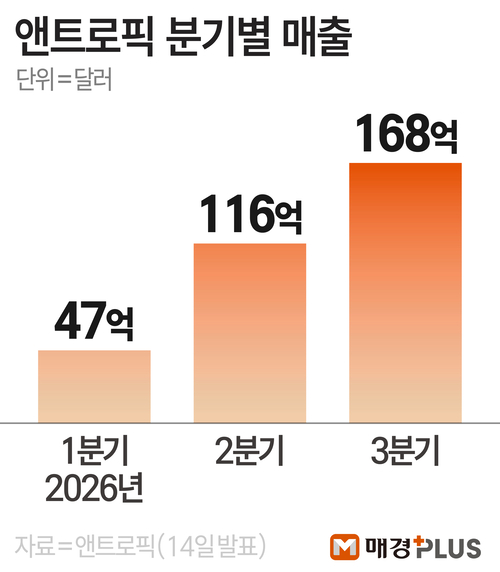 사진 확대
Antropic's third-quarter earnings, which were released on the 14th (local time), showed the potential for AI to monetize, but they were not enough to turn around investor sentiment shaken by the inflation shock from the Consumer Price Index (CPI) in September announced on the same day.
According to the Financial Times (FT), Antropics held an investor presentation in San Francisco on the same day and announced that its third-quarter sales reached 16.8 billion dollars (about 22.5 trillion won). Antropic management explained that it can achieve a successful listing with a safety-oriented philosophy, rapid growth, and improved efficiency.
Antropics posted its second consecutive quarterly surplus on an adjusted basis in the July-September quarter, the FT reported, citing multiple officials. However, compared with $11.5 billion in sales in the second quarter and about $4.8 billion in the first quarter, the pace of growth slowed slightly compared to the beginning of the year, when it more than doubled between the first and second quarters.
Bloomberg, citing sources, reported that the adjusted gross margin of revenue exceeded 85%, the adjusted operating margin exceeded 11%, and the surplus cash flow was also in the black.
Antropics explained that it had positive cash flow in the third quarter and made $1.70 in sales for every dollar spent on computing power. Chip and data centers are the company's biggest cost items, and sales figures for Antropic and OpenAI are seen as important indicators of whether they can sustain infrastructure investments that are key to the AI boom.
The first thing to watch about the announcement of entropic performance is the growth rate. Antropic's revenue was approximately $4.8 billion in the first quarter, $11.5 billion in the second quarter, and $16.8 billion in the third quarter. The growth rate in the third quarter is about 46%. Compared to growth more than double that of the previous quarter, the pace has slowed. However, sales growth in the third quarter is still between $5.2 billion and $5.3 billion. Slow growth should not be read as a decline in demand.
What Wall Street paid attention to is annual conversion sales (ARR). Based on the previously known $65 billion in annual conversion sales at the end of July and $18.8 billion in third-quarter sales, the monthly growth rate is about 6.6%. Sales from July to September in this model are about $5.25 billion, $5.59 billion, and $5.96 billion, respectively. This annualized pace of sales approaches about $74 billion.
The second key is the quality of sales. Business Insider (BI) pointed out that it is unclear whether the $18.8 billion is total or net sales and how it calculated the adjusted surplus. Antropic has a precedent of reflecting sales through cloud partners in the past as a total amount in sales. Specifically, in order to prove Antropic's ability to make money, partner allocations need to be disclosed.
In simple terms of 'sales of $1.70 per dollar of computing costs', the proportion of computing costs is estimated to be about 59%. The remaining 41% cannot be directly called gross profit margin. This is because it is necessary to check whether R&D, labor costs, and distribution costs are included. The company's proposed operating margin of 11% and cash flow plus also differ in meaning depending on adjustment items and whether investment expenditures are reflected.
The third is the listing price. The existing corporate value delivered by FT is $965 billion, and Reuters reported that the IPO target exceeds $2 trillion. Even if $74 billion in annual conversion sales is applied, $2 trillion is about 27 times higher. The number is not enough to resolve excessive valuation concerns. Investors want confidence that the recent pace of sales continues and profitability improves.
An analysis posted by research platform PitchBook on Morningstar before its earnings announcement focused on the contract structure of sales and costs. Customers can reduce their spending or move to competitors, but the obligation to pay long-term infrastructure is not easily reduced. Conversely, if usage increases within the secured computational capacity, the profit margin can be improved quickly. The variables that will determine future performance are not only the growth of the AI market as a whole, but also customer retention, price competition, and computational efficiency.
The full text of the article is available on Maeil Business Newspaper's premium financial content platform Maekyung Plus. Search 'Maekyung Plus' on Naver or take a QR code below with your smartphone to connect.