OpenAI Revenue at $50 Billion: What Wall Street Got Wrong
TL;DR
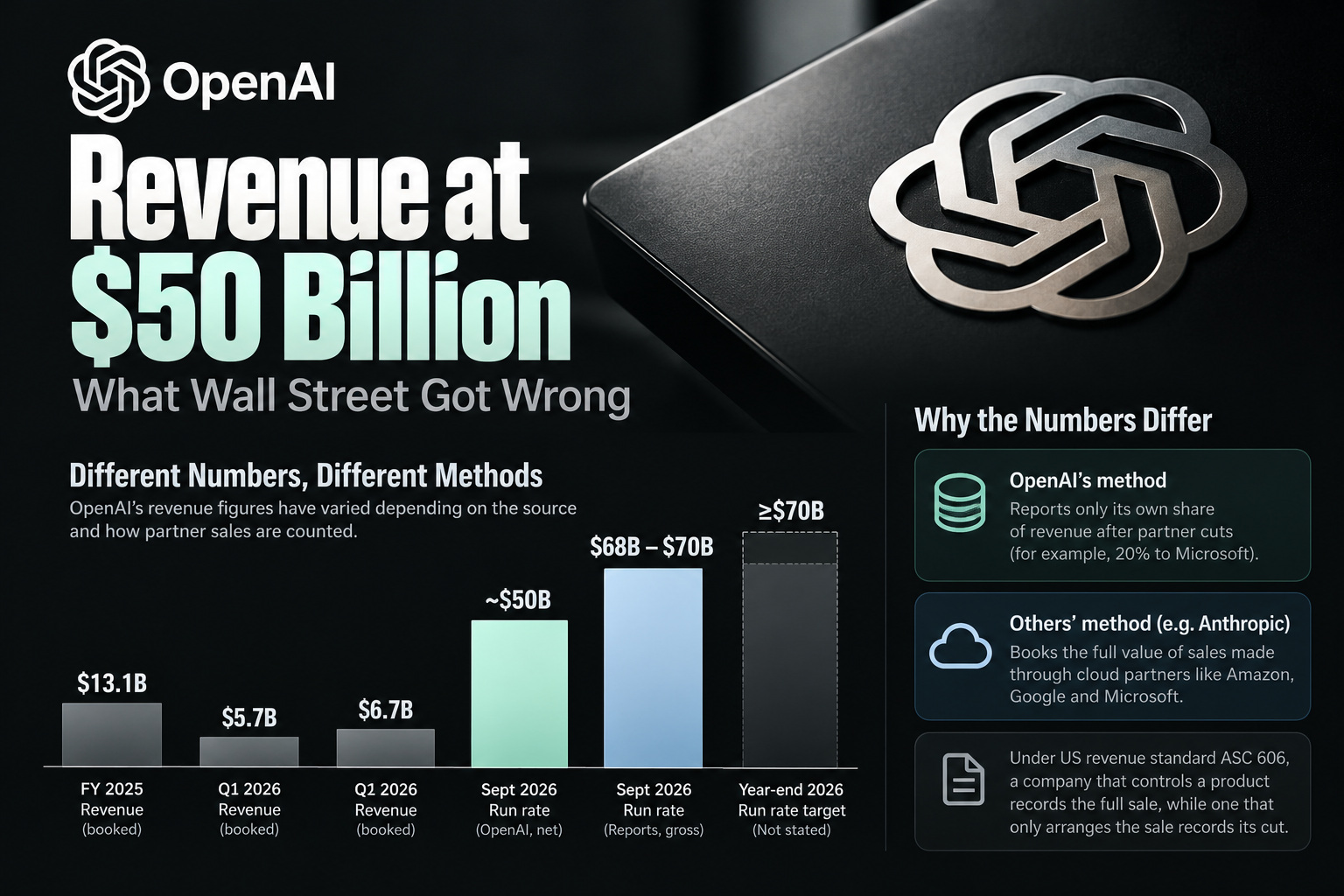
- OpenAI told investors its run rate was just under $50 billion (net) at the end of September; the earlier $68 billion to $70 billion figure counted partner revenue gross.
- Booked revenue of $6.7 billion in Q2 plus 70% to 77% Q3 growth leads back to the $50 billion figure, not $70 billion.
- The year-end target of $70 billion or more implies about 40% growth in Q4, roughly half the Q3 pace.
- Oracle fell 5.48% and CoreWeave 7.77% against 2.94% for Nvidia; OpenAI's $300 billion Oracle deal averages $60 billion a year.
OpenAI told investors its annualized revenue was just under $50 billion at the end of September, about $20 billion below the nearly $70 billion figure reported a week earlier, and AI stocks fell on the report, with Oracle down 5.48% and CoreWeave down 7.77%. The gap comes from how revenue is counted rather than from lost sales, and OpenAI’s own booked revenue lines up with the $50 billion figure. The number that deserves more attention is OpenAI’s year-end target of $70 billion or more, which, read as a net figure, assumes growth slowing from more than 70% in the third quarter to about 40% in the fourth.
| Figure | What it measures | Counting basis |
| About $68 billion to $70 billion | Annualized run rate, reported Sept. 29 | Gross, including partner sales |
| Just under $50 billion | Run rate at the end of September, reported Oct. 8 | Net, as told to investors |
| $70 billion or more | Year-end 2026 run-rate target | Not stated, most likely net |
| $6.7 billion | Booked revenue, Q2 2026 | OpenAI’s own accounting |
| $5.7 billion | Booked revenue, Q1 2026 | OpenAI’s own accounting |
| $13.07 billion | Booked revenue, full year 2025 | OpenAI’s own accounting |
Where Did OpenAI’s $70 Billion Figure Come From?
OpenAI’s annualized revenue run rate was “reaching almost $70 billion” and had grown more than 70% since the start of the third quarter, according to Axios, citing people familiar with the company’s financials on Sept. 29, while CNBC put the same figure at $68 billion. OpenAI told investors its run rate was approaching $50 billion at the end of September, according to an Oct. 8 report in the Financial Times, and a person familiar with the matter told CNBC that the higher number had counted gross revenue from OpenAI’s partnerships, according to AFP. A source who spoke to CNN said the $70 billion figure did not come from OpenAI at all, according to The Next Web.
The distinction matters because Anthropic and OpenAI count partner sales differently, with Anthropic booking the full value of Claude sales made through Amazon, Google and Microsoft’s clouds, while OpenAI books only its own share after the 20% that goes to Microsoft, according to The Next Web’s summary of reporting by Bloomberg and The Information. Under the US revenue standard ASC 606, a company that controls a product before it reaches the customer records the full sale, while one that only arranges the sale records its cut, so the same customer dollar can look larger at one lab than at the other. Memeburn’s breakdown of Anthropic’s $65 billion run rate covered how run rates are built, and the $70 billion figure appears to restate OpenAI on Anthropic’s method, which helps when comparing the two labs but is not what OpenAI reports.
OpenAI’s Booked Revenue Supports the $50 Billion Figure
OpenAI booked $5.7 billion in revenue in the first quarter of 2026 and $6.7 billion in the second, after $13.07 billion for all of 2025, according to Wall Street Journal figures cited by Crypto Briefing, so the second quarter alone works out to an average annualized pace of $26.8 billion. A person familiar with OpenAI’s investor presentation told CNBC the run rate grew 77% in the third quarter, with the enterprise run rate up 107%, while chief financial officer Sarah Friar put growth from the end of June to the end of September at 70%, according to The Next Web. Working backward from $50 billion, those rates imply a run rate of $28.2 billion to $29.4 billion at the end of June, slightly above the second-quarter average, as expected for a business growing every month.
The same calculation fails for the $70 billion figure, because a 70% gain over the quarter would put the end-of-June run rate at about $41 billion, which would require June revenue of roughly $3.4 billion in a quarter that averaged $2.2 billion a month and leave April and May at about $1.65 billion each, below the first quarter’s monthly average of $1.9 billion. Both reports also describe third-quarter growth of 70% or more, and when two numbers grow at the same rate the gap between them stays a fixed ratio, which is what a counting difference looks like, whereas weaker demand would have shown up as slower growth.
OpenAI’s $70 Billion Year-End Target Assumes Slower Growth
OpenAI expects its annualized revenue to “reach or exceed $70bn by the end of the year,” according to Bloomberg reporting summarized by The Next Web, which does not say whether the target is gross or net. Since the gross figure was already close to $70 billion at the end of September, a gross target would mean no growth at all in the fourth quarter, so Memeburn reads it as a net figure, which also makes it the clearest forward signal in the episode.
Moving from just under $50 billion to $70 billion requires growth of about 40% in the fourth quarter, compared with the 70% to 77% reported for the third, so OpenAI’s own plan assumes its quarterly growth rate roughly halves, although a 40% quarter, if sustained, would still nearly quadruple revenue in a year. If the run rate rises in a straight line through each quarter, Memeburn estimates OpenAI will book about $9.8 billion in the third quarter and $15 billion in the fourth, for a 2026 total near $37 billion, or about three-quarters of the $50 billion headline.
Why Oracle and CoreWeave Fell Harder Than Nvidia
Oracle shares fell 5.48% on Oct. 8 and CoreWeave lost 7.77%, while Nvidia slipped 2.94%, a drop that erased about $169 billion of market value, and Broadcom and AMD fell 4.35% and 3.9% as the S&P 500 lost 0.47%, according to 24/7 Wall St., which said OpenAI declined to comment.
Oracle’s exposure is unusually direct, because OpenAI agreed in 2025 to buy $300 billion of compute from Oracle over five years starting in 2027, according to DatacenterDynamics, which Memeburn calculated as an average of $60 billion a year, more than OpenAI’s entire net run rate today. Nvidia sells to every major cloud provider and AI lab, while Oracle, which has been spending heavily on AI infrastructure, and CoreWeave, which rents GPU capacity to OpenAI, depend more on OpenAI growing into its contracts. That difference in exposure may explain why the same headline moved them two to almost three times as far as Nvidia, even though the report showed no fall in OpenAI’s sales.
What the $20 Billion Gap Means for OpenAI’s Valuation and the Anthropic Race
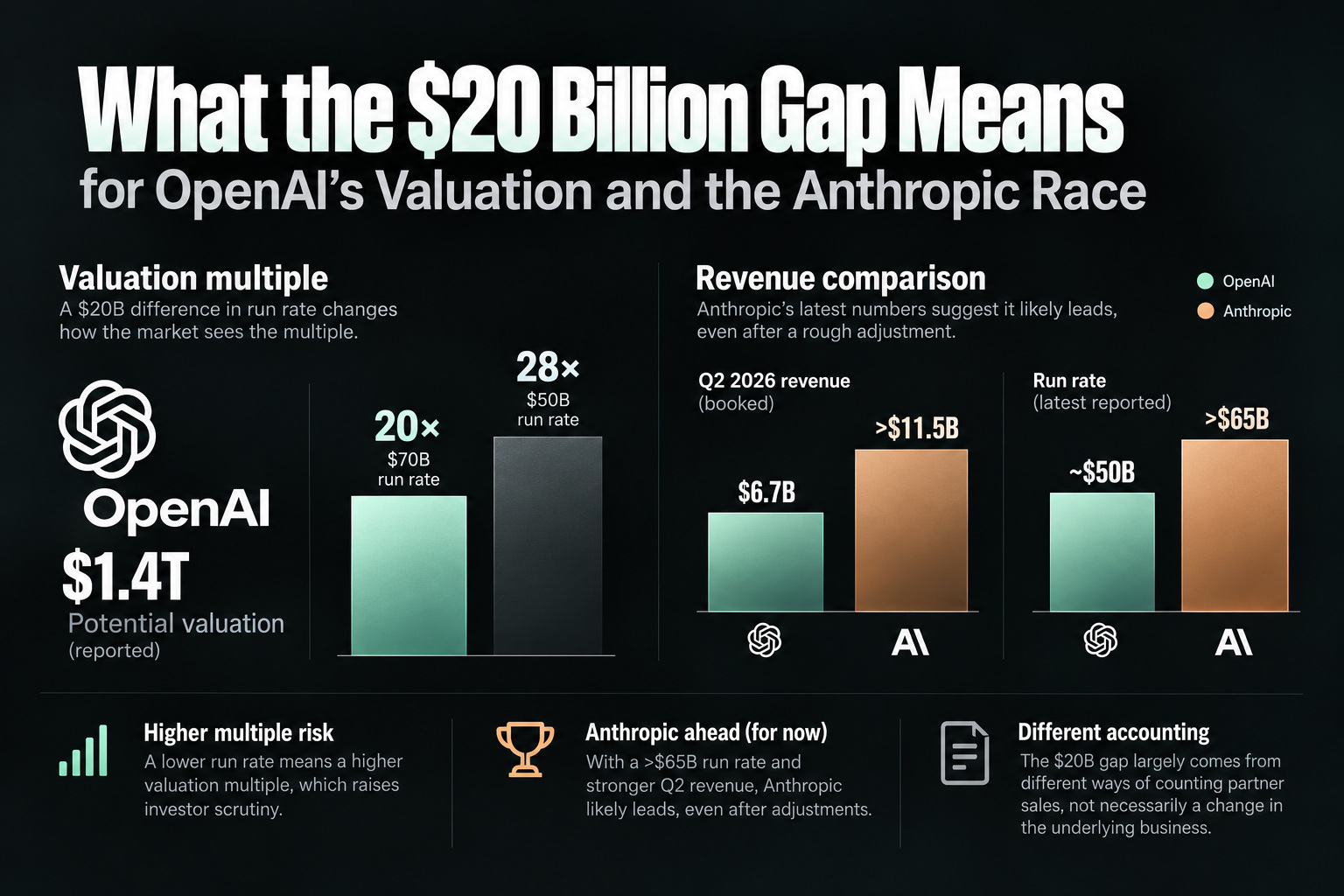
OpenAI is negotiating a private funding round that could value it at about $1.4 trillion, according to the Financial Times, which is 20 times a $70 billion run rate but 28 times a $50 billion one. Investors in that round were given the $50 billion figure directly, however, so what moved was the public market’s reading of the multiple, not the multiple itself, a test Memeburn also applied to Anthropic’s possible $2 trillion valuation.
The counting difference matters most in the comparison with Anthropic, whose run rate passed $65 billion at the end of July and whose second-quarter revenue of more than $11.5 billion beat OpenAI’s $6.7 billion, according to The Next Web’s summary of Reuters reporting. Scaling OpenAI’s quarter up by the ratio between its two run-rate figures gives roughly $9.1 billion to $9.4 billion, so Anthropic probably leads even after a rough adjustment, although that assumes the two figures differ only in method. Anthropic is expected to list next month, according to AFP, and its prospectus will put its gross accounting into audited form, while OpenAI has ruled out a 2026 IPO, leaving its numbers to investor documents and leaks.
FAQs
How much revenue does OpenAI make?
OpenAI told investors its annualized revenue run rate was just under $50 billion at the end of September 2026, on a net basis. It booked $5.7 billion in the first quarter of 2026 and $6.7 billion in the second.
Why was OpenAI’s revenue reported as $70 billion?
The figure of nearly $70 billion reported on Sept. 29 counted gross revenue from OpenAI’s partnerships, closer to Anthropic’s method, according to a person familiar with the matter. OpenAI books only its own share of partner sales, which produces the lower $50 billion figure.
Has Anthropic overtaken OpenAI in revenue?
Anthropic’s second-quarter revenue of more than $11.5 billion was well ahead of OpenAI’s $6.7 billion, but Anthropic counts partner sales at full value and OpenAI does not. A rough adjustment still leaves Anthropic ahead, and its IPO prospectus should provide the first audited basis for a comparison.
Marko Nguyen
Marko is a tech journalist covering AI, consumer technology, crypto, and digital innovation. His work focuses on clear, accessible reporting that helps readers understand how new technologies are shaping business, finance, and everyday life.
Visit Profile