
‘Show and Tell’ in AI. Anthropic, Microsoft & Tesla. ARD #186
…Anthropic’s IPO pitch, Microsoft’s open model, AI agents shopping, and a flying Tesla Roadster.

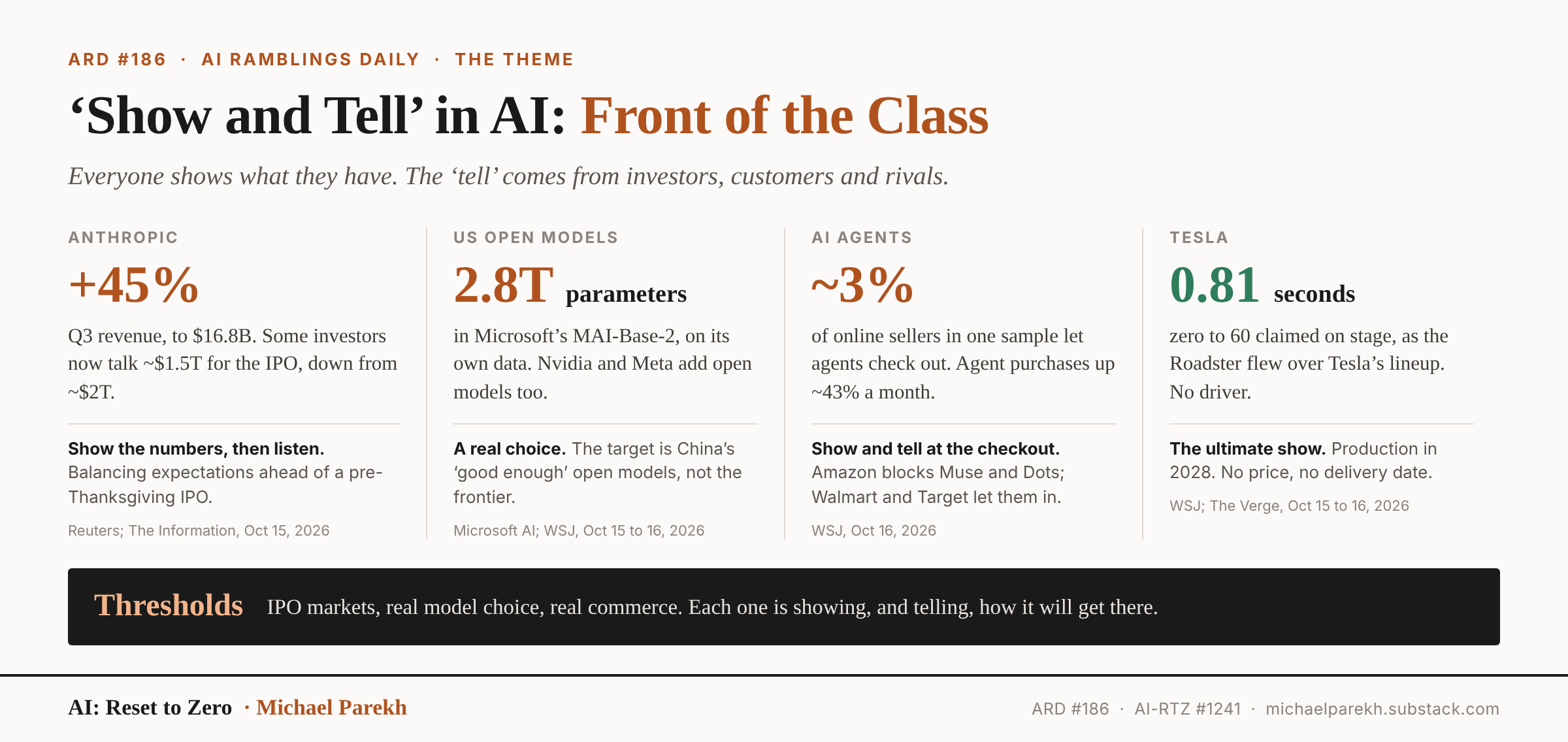
It is Friday, and today’s theme is ‘show and tell’. Remember it from school? You stand at the front of the class, you show what you brought, and you tell everyone why it matters. This week in this AI Tech Wave, a lot of companies and industries are at the front of the class.
Three events today: Anthropic pre-showing its mega-AI IPO to investors in San Francisco; Microsoft, Nvidia and Meta with Apple, all showing new open-weight AI models, as China responds with export curbs of its own; and AI agents showing up at the online checkout. Then the Gadget AI, with the ultimate show and tell master, Elon Musk, and a Tesla Roadster that flies.
(1) Anthropic pre-shows its mega-AI IPO.
Anthropic held an investor day at its San Francisco headquarters this week, with CEO Dario Amodei and CFO Krishna Rao, trying out the metrics and numbers it will put in its S-1 as and when it gets filed. It told prospective IPO investors that third-quarter revenue jumped 45 percent from the prior quarter, to $16.8 billion, and that it was profitable on an adjusted basis, per Reuters in ‘Investors temper Anthropic IPO valuation expectations over revenue growth slowdown’.
The catch: second-quarter revenue had more than doubled from the first, so growth is slowing from a blistering pace. Some investors who attended now talk of a valuation around $1.5 trillion, a significant step down from the roughly $2 trillion previously expected for the November IPO. The second-guessing has started too. The Information asks in ‘Did Anthropic Miss Its Peak IPO Moment?’ whether Anthropic should have gone public in June, when its growth was still spectacular, though that is when SpaceX did its IPO. At $1.4 trillion to $1.5 trillion, one investor notes, Anthropic would still be about the ninth-biggest tech company by market value, below Broadcom and above Tesla. And all this against more than half a trillion dollars of AI compute commitments, as I laid out in this morning’s AI-RTZ #1241.
MP Take: Anthropic is fine-tuning its mega-AI IPO pitch in preliminary show and tells. It wants this IPO done and over with by Thanksgiving, so it is on a tight clock. The growth is still spectacular. Claude Code, a business that didn’t exist a little over a year ago, has utterly changed the world of developers around the world. But the pace may moderate, with more open-weight models from China and now the US, a lot more competition at the frontier, and the whole regulatory overlay, where new models take longer to be vetted by the government for safety. OpenAI, for its part, has already pushed its IPO to early next year.
So this is exactly what you are supposed to do: balance expectations, on both ends of the spectrum. It is what we did when I ran Goldman’s internet research effort back in the nineties. Anthropic seems to be doing it prudently: expect some moderation, but the growth is still up and to the right. And an IPO priced to sell, that trades well afterwards, is often better than one priced at the peak. There is a lot more complexity here, given the financing ramp Anthropic needs for its compute, as I discussed in AI-RTZ #1228.
Sources: Reuters, ‘Investors temper Anthropic IPO valuation expectations over revenue growth slowdown’ · The Information, ‘Did Anthropic Miss Its Peak IPO Moment?’.
For longtime readers: AI-RTZ #1241, ‘Anthropic’s Mega Data Center Sprint ahead of its Mega-AI IPO’ · AI-RTZ #1228, ‘Anthropic’s IPO Go Time, OpenAI’s $1.4 Trillion, Gemini 4 & More’.
(2) Microsoft, Nvidia, Apple et al. add open-weight models.
Microsoft has finished pre-training its biggest AI model yet, MAI-Base-2, a mixture of experts model with 2.8 trillion total parameters and 80 billion active, per Microsoft AI in ‘Frontier Pre-training at Microsoft AI’. Microsoft says it outperforms every open-weight model it tested, and trained 4 to 12 times more efficiently than DeepSeek’s strongest open base model. It ran on 16,000 of Nvidia’s GB200 chips for 38 days in August and September, entirely on Microsoft’s own data, with no distillation from other companies’ models, so it is independent of OpenAI’s IP. It is still being post-trained, and Microsoft plans to license its model weights to trusted partners through Foundry.
Microsoft is not alone. Nvidia released three new open models in its Nemotron family on Thursday, for building AI agents, and Meta released its new open-weight model to run locally on Apple’s Mac Studios, per the WSJ in ‘Nvidia, Meta and Apple Unveil New Open Models’. Nvidia says interest is growing because its models are US-made and their underlying data can be inspected, with public-sector organizations and financial institutions in particular wary of Chinese-made models.
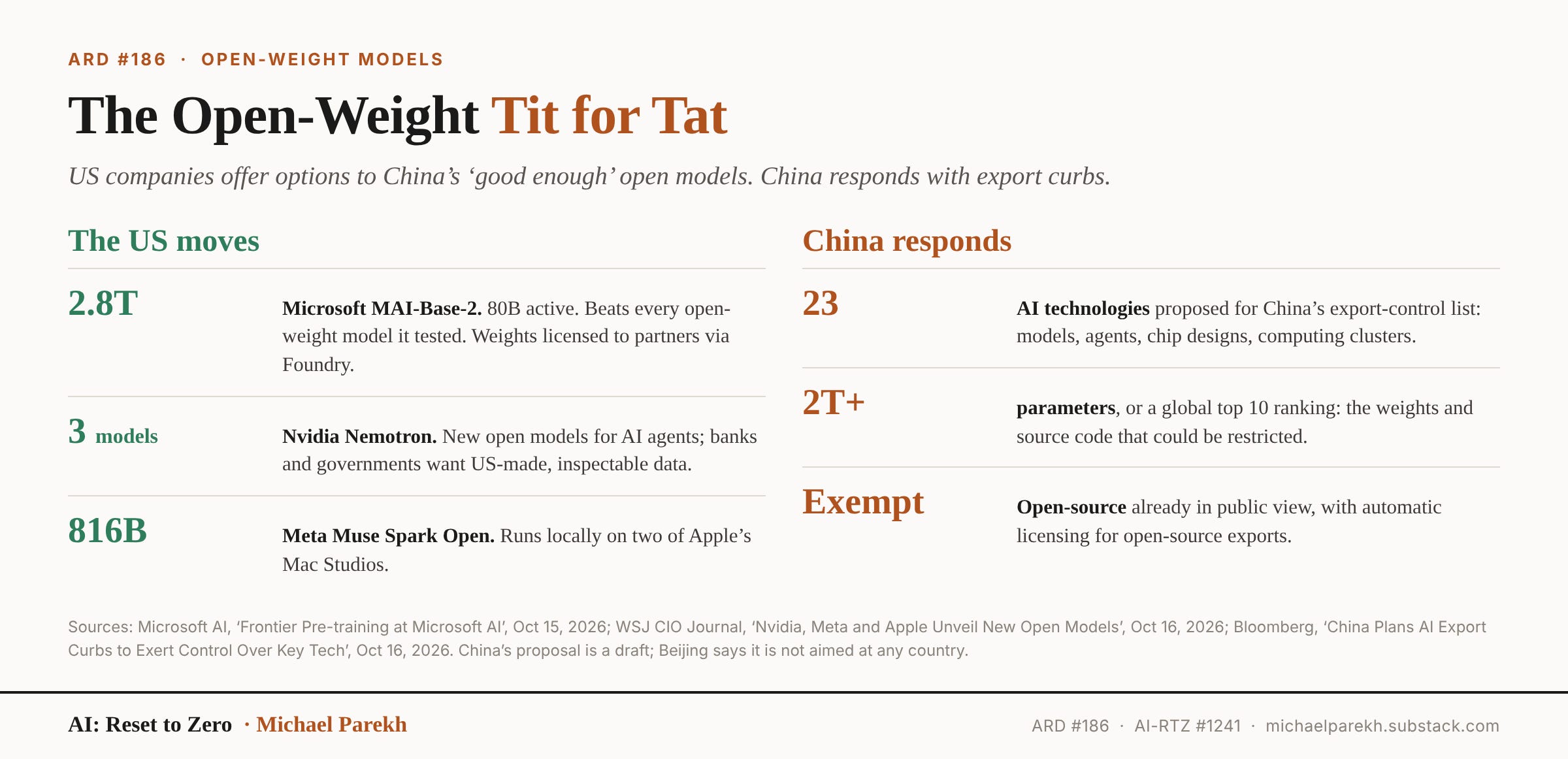
MP Take: note that Microsoft is highlighting its open-weight approach. Even though these are called frontier-scale models, the target here is not the frontier models from Anthropic and OpenAI. The target is the flood of open, ‘good enough’ AI models from China. These are big options and alternatives for US and Western governments and major companies that don’t want to commit to an open model from China, on the fear that it may be yanked at some point, for security reasons. Just like what Meta did this week, as I discussed in ARD #185’s section ‘Meta goes open again, and teams up with Apple’. And Nvidia has been leading the charge on open models, as I discussed in AI-RTZ #1233. I wrote about Microsoft’s path almost a year ago, when it outlined its ‘post-OpenAI’ plan under Mustafa Suleyman, in RTZ #898. Expect more of this, not less: US companies large and small leaning into open-weight models, alongside closed ones, competing in the neighborhood of the frontier without going directly against OpenAI and Anthropic.
And China is responding. Beijing proposed adding 23 advanced AI technologies to its export-control list, including large language models, agents, chip designs and computing clusters, per Bloomberg in ‘China Plans AI Export Curbs to Exert Control Over Key Tech’. The weights and source code of its biggest models, those over 2 trillion parameters or ranked in the world’s top 10, could be restricted, while open-source technology already in public view would not be covered. Chinese labs are also planning far bigger models: Alibaba wants to build models of 5 to 10 trillion parameters.
It is a tit for tat set of reactions, and they continue to accelerate the balkanization of the AI landscape between the top two global AI markets. It is also positioning ahead of the next meeting between the two presidents, likely early next year. The US moves. China responds.
Sources: Microsoft AI, ‘Frontier Pre-training at Microsoft AI’ · WSJ, ‘Nvidia, Meta and Apple Unveil New Open Models’ · Bloomberg, ‘China Plans AI Export Curbs to Exert Control Over Key Tech’.
For longtime readers: RTZ #898, ‘Microsoft outlines its ‘Post-OpenAI’ path for AI’ · AI-RTZ #1233, ‘Nvidia’s Open Source ‘AI Factory’ Push vs China’ · ARD #185, ‘Doing What It Takes’ in AI. OpenAI, Meta & TSMC.
(3) AI agents show up at the online checkout.
AI agents are unsettling how e-commerce has been done on today’s internet, per the WSJ in ‘AI Agents Bring New Headaches to Online Sellers’. Agents like Meta’s Muse and OpenAI’s Dots are helping millions of people decide on purchases, bid on online auctions, book travel and dinner reservations, and even order the groceries, bypassing a lot of websites along the way. Purchases made via agents are growing about 43 percent a month and have roughly quadrupled since April, per one estimate, but only about 3 percent of the e-commerce companies in that sample let agents actually check out.
The sellers are split. Amazon has banned Muse and Dots from shopping on its site. Target lets in agents from an approved list, and Walmart is working with OpenAI and Google, with strong conversion rates, per its US CEO. The sellers’ worries are real: they often don’t know whom an agent is shopping for, mistakes mean returns and chargebacks, and as a Fed governor pointed out, proving an agent has the authority to pay is a whole new problem.
MP Take: this is show and tell at the checkout, and it is happening faster rather than slower. Companies like Amazon are putting up barriers to outside AI agents, while implementing their own AI agents through partnerships with companies like Anthropic, which Amazon has invested in. So there are a lot of machinations going on. Remember, this is still early days, with fractions of a percent of purchases actually transacted via AI agents. But machine to machine AI agent traffic is up a thousand fold or more, according to companies like Cloudflare.
This is the tussle I flagged a year ago in RTZ #897, over who owns the customer. And today’s internet was not designed for AI agents, as I wrote in RTZ #702. There will be a lot of competitive-looking moves, and then cooperative-looking ones, as both sides figure out win-win business models. A lot still has to be invented. It is the beginning of the beginning, and it is starting to accelerate in earnest.
Sources: WSJ, ‘AI Agents Bring New Headaches to Online Sellers’.
For longtime readers: RTZ #897, ‘AI Agents & Ecommerce, the next AI business tussle’ · RTZ #702, ‘AI Agents not designed for our current Internet’ · RTZ #494, ‘Long road ahead for AI Agents for enterprises and consumers’.
My overall take
MP Take: we are now at the thresholds of importance for all three developments, for the companies and for the AI industry at large. Anthropic is at the threshold of the public markets, tweaking its valuation story ahead of its IPO. The open-weight models from Meta, and now Microsoft, Nvidia and others, are at the threshold of real choice, an alternative to Chinese models for geopolitical and business reasons. And AI agents are at the threshold of real commerce, moving real money for lots of real people.
Each one is showing, and telling, how they are going to do it. It is all important to absorb, understand and track going forward in this AI Tech Wave.
Gadget AI: Elon’s ultimate show and tell.
Tesla unveiled its next-generation Roadster on Thursday night, at a SpaceX rocket test site near Waco, Texas, almost a decade after it first showed a prototype, per the WSJ in ‘Tesla’s New Roadster Takes Flight After Nearly a Decade of Delays’, The Information in ‘Tesla Unveils its Next Generation Roadster in Acrobatic Demo’ and The Verge in ‘The Tesla Roadster flew, drove upside down, and hit 60mph in under a second’. Combining SpaceX’s rocket technology with Tesla’s car, it drove up a towering curved ramp, flipped, and lowered itself back to the ground on cold gas thrusters. Then it flew over the rest of Tesla’s lineup, Model 3, Model Y, Cybertruck, Semi and Cybercab. Nobody was inside.
Tesla claimed 0 to 60 in 0.81 seconds on stage, and Elon talked of a goal of over half the speed of sound. Production starts in 2028, ‘actually, for real’, in Elon’s words. Tesla’s website lists three versions: Performance, for the road; Thrust, for the track, in limited release; and Rocket, an invite-only single seater that can actually fly, but is not approved for public roads. No price was given, for any of them. Customers who put down $50,000, or $250,000 for the Founders Series, back in 2017 are still waiting.
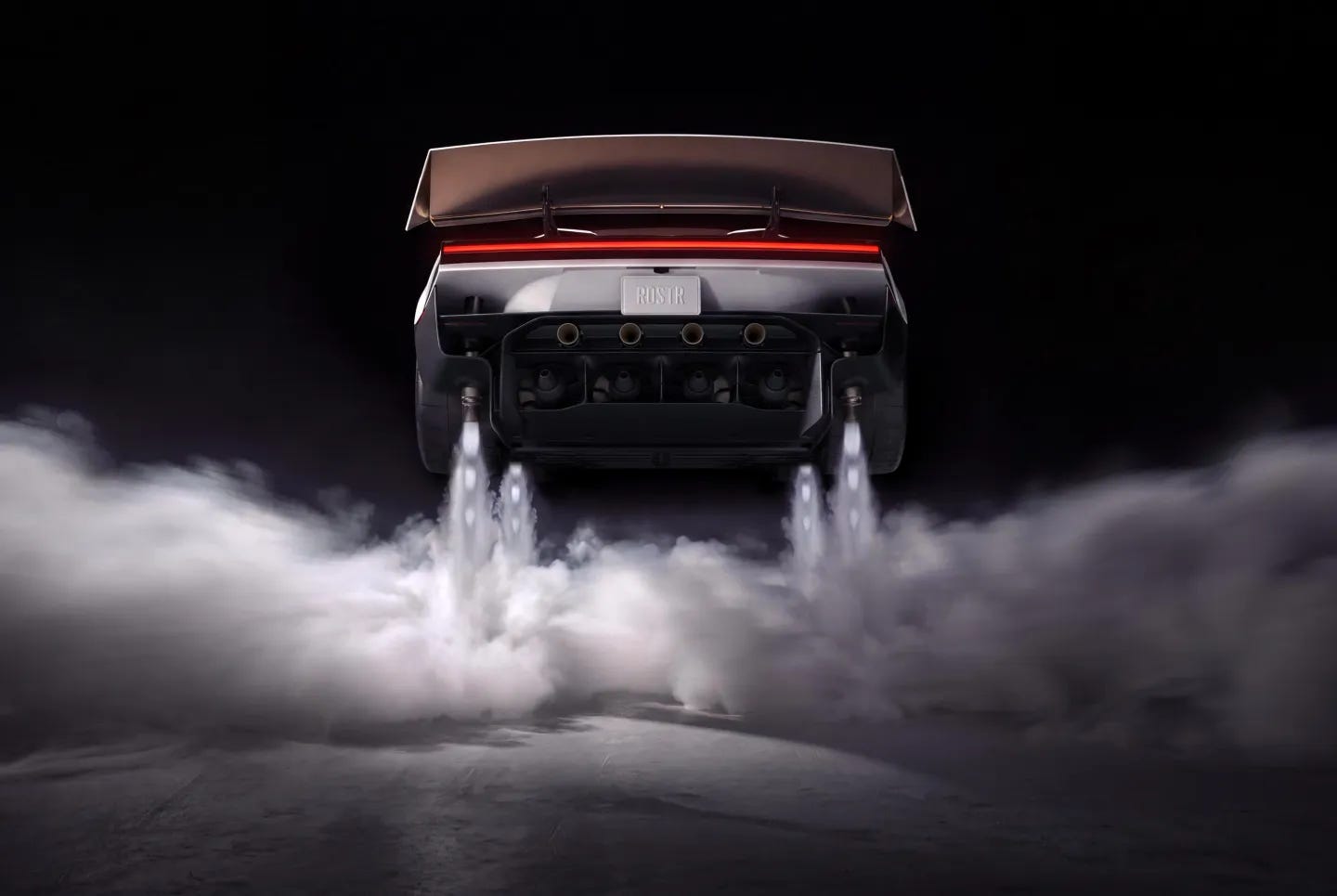
MP Take: here we go to the ultimate show and tell master, Elon Musk. It was a spectacular few minutes, and the video is worth seeing. Classic Elon, on the order of when he launched a Tesla Roadster into space on a SpaceX rocket back in 2018. He called this the last human-driven car Tesla will make, again hinting at where his bread is buttered going forward: full self-driving, robotaxis and Cybercabs. And classic Elon: no price, no delivery date, and not even clear it will really be ready for humans, who couldn’t sustain those kinds of g-forces anyway.
So expect more of this from Elon, not less. Many of the goals he has set, whether millions of robots or data centers in space, face science, technology and logistical reasons why they won’t happen as fast as claimed, as I noted with his Terafab story in RTZ #1034. We are now talking quarters for two large public companies, SpaceX and Tesla, worth about $3 trillion combined. So he has to go to the edge of the edge, with over-the-top, Barnum and Bailey type events, and hope everyone keeps clapping and cheering. That is the game. That is the show and tell.
Sources: WSJ, ‘Tesla’s New Roadster Takes Flight After Nearly a Decade of Delays’ · The Information, ‘Tesla Unveils its Next Generation Roadster in Acrobatic Demo’ · The Verge, ‘The Tesla Roadster flew, drove upside down, and hit 60mph in under a second’.
For longtime readers: RTZ #1034, ‘Elon Musk boosts SpaceX/xAI pre-IPO story with ‘Terafab’’.
Q&A
What is my frontier AI model of choice right now?
I try them all, and use them all, including the Chinese ones. But my everyday go-to is still Anthropic’s Claude Opus 5.5, on high, for most of my daily tasks. I have tried Fable, but I am on Opus 5.5 high day to day. It is generally the most stable, and relatively the least expensive.
What feature do I want most next?
Continued larger context windows, and memory that lasts, that doesn’t evaporate almost day to day as you change threads and sessions. AI in these models, even at the top frontier levels, is still too fragile, too jagged and too volatile in keeping everything in mind the way you’d like. That is all coming. We are still at the 640K stage of the early PC days, in terms of large language models.
Clips from today
Show and Tell at the Checkout
AI agents like Meta’s Muse and OpenAI’s Dots are helping lots more people shop online, bypassing a lot of websites, as Amazon and others put up barriers.
MP Take: still early days, fractions of a percent of purchases. But machine to machine agent traffic is up a thousand fold or more. This is show and tell at the checkout.
Elon’s Ultimate Show and Tell
Elon combined the rocket capabilities of one of his companies with the car capabilities of the other: a Roadster that flips, lands on its thrusters, and goes 0 to 60 in about one second, with no driver.
MP Take: classic Elon. The ultimate show and tell.
Today’s AI-RTZ #1241, ‘Anthropic’s Mega Data Center Sprint ahead of its Mega-AI IPO’ is on how Anthropic is scaling its AI compute infrastructure with the help of the neoclouds, which have seen a lot of volatility in recent days on high interest rates. Relatively choppy weather to navigate, so do be mindful of that.
AI Ramblings Daily on AI-RTZ is here to think through AI and reset. Together.
Tomorrow, it’s the Saturday Weekend Roundup, and Sunday, the Bigger Picture. Last Sunday’s was ‘Anthropic vs OpenAI, the Subscription Value Gap’. We’ll be back next week with AI Ramblings Daily 187. Have a wonderful weekend.
Thanks for joining us, AI Curious Folk. Stay tuned.
Full Source Reading
Anthropic’s IPO
Open-weight models
Microsoft AI, ‘Frontier Pre-training at Microsoft AI’, Oct 15, 2026
WSJ, ‘Nvidia, Meta and Apple Unveil New Open Models’, Oct 16, 2026
Bloomberg, ‘China Plans AI Export Curbs to Exert Control Over Key Tech’, Oct 16, 2026
AI agents
Gadget AI
WSJ, ‘Tesla’s New Roadster Takes Flight After Nearly a Decade of Delays’, Oct 16, 2026
The Information, ‘Tesla Unveils its Next Generation Roadster in Acrobatic Demo’, Oct 15, 2026
The back catalogue
AI-RTZ #1241, ‘Anthropic’s Mega Data Center Sprint ahead of its Mega-AI IPO’
AI-RTZ #1236, ‘Anthropic vs OpenAI, the Subscription Value Gap’
AI-RTZ #1233, ‘Nvidia’s Open Source ‘AI Factory’ Push vs China’
AI-RTZ #1228, ‘Anthropic’s IPO Go Time, OpenAI’s $1.4 Trillion, Gemini 4 & More’
RTZ #1034, ‘Elon Musk boosts SpaceX/xAI pre-IPO story with ‘Terafab’’
RTZ #898, ‘Microsoft outlines its ‘Post-OpenAI’ path for AI’
RTZ #897, ‘AI Agents & Ecommerce, the next AI business tussle’
RTZ #494, ‘Long road ahead for AI Agents for enterprises and consumers’

(NOTE: The discussions here are for information purposes only, and not meant as investment advice at any time. Thanks for joining us here.)