
Anthropic report: AI agents now outnumber human work hours 6 to 1, reshaping hiring and productivity


A new analysis from Anthropic's internal data shows AI agents logged six times more working hours than employees by August, while the company's hiring shifted away from junior technical roles and productivity surged across functions.
Anthropic has published a detailed internal analysis of how AI has restructured work and employment at the company, offering a rare look at what happens when a frontier AI lab fully integrates agents into its operations. The report, authored by Nathan Wilmers, Regina Catipon, Maxim Massenkoff, and Peter McCrory, draws on comprehensive internal data covering employment, AI use, output metrics, employee surveys, communication patterns, calendars, and hiring records, plus 17 employee interviews.
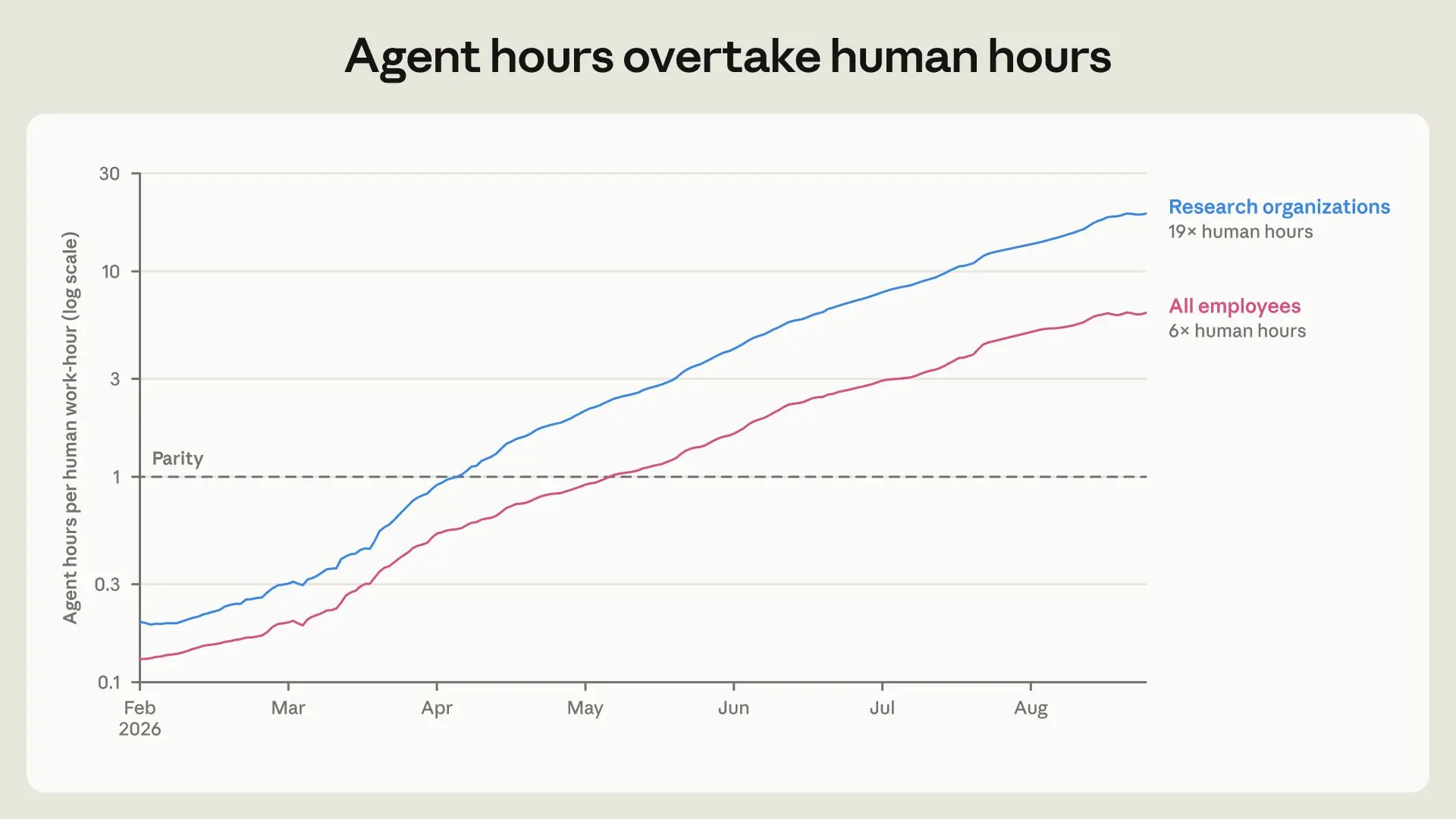
The headline finding: by August, interactive AI agent hours outnumbered human employee hours 6 to 1. In March, agent work hours first surpassed human work hours. The report describes a workplace where agents fix bugs autonomously, schedule meetings, and tackle large engineering projects, while employees increasingly act as supervisors and bottleneck managers.

Junior technical hiring declines
The most striking employment shift is in entry-level technical roles. The share of junior-level employees in technical departments slipped from 21% to 14% since early 2025. Junior technical hires fell even faster, from 27% to 9% of all technical hires. Postings for junior positions dropped particularly sharply after December 2025.
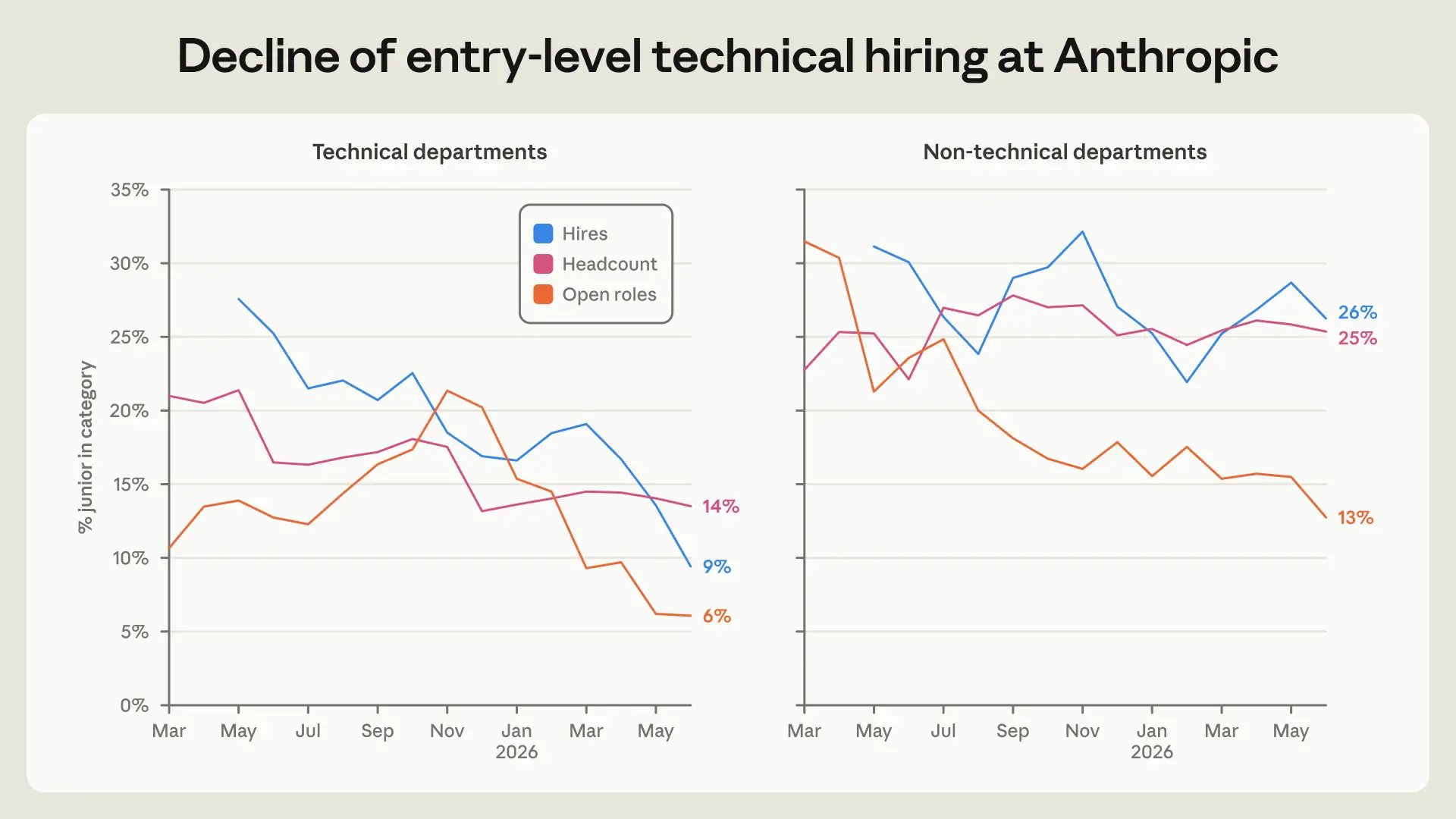
The shift emerged in January 2026, when teams that relied heavily on Claude found that writing code and finding bugs could increasingly be offloaded to the model. One manager said the "uplift for performance engineers in particular" changed what the company was looking for "basically overnight." By April, engineering and research teams had deemphasized hiring for lower-band technical positions, and a majority of managers said they were hiring for a different set of skills due to AI.
The overall employment share of technical departments fell from 61% to 56% in the last year, even as the company grew. Hiring accelerated in sales, finance, and recruiting. Part of the shift reflects natural scaling of business functions, but part reflects coding tools allowing non-technical employees to build software themselves. One sales representative built a custom dashboard and pipeline in three to four hours, describing it as "out of my wheelhouse" before Claude.
Coding-focused AI agent sessions for non-technical employees leapt from 2 per month in August 2025 to 90 per month in May 2026.
Productivity gains across functions
Agent work hours overtook human hours in March 2026, driven partly by fleets of agents conducting industrial-scale software engineering, routine tests, maintenance, and codebase translation campaigns. Even narrowing to agents deployed by individual employees, agents worked 6 times as many hours as their human handlers by August.
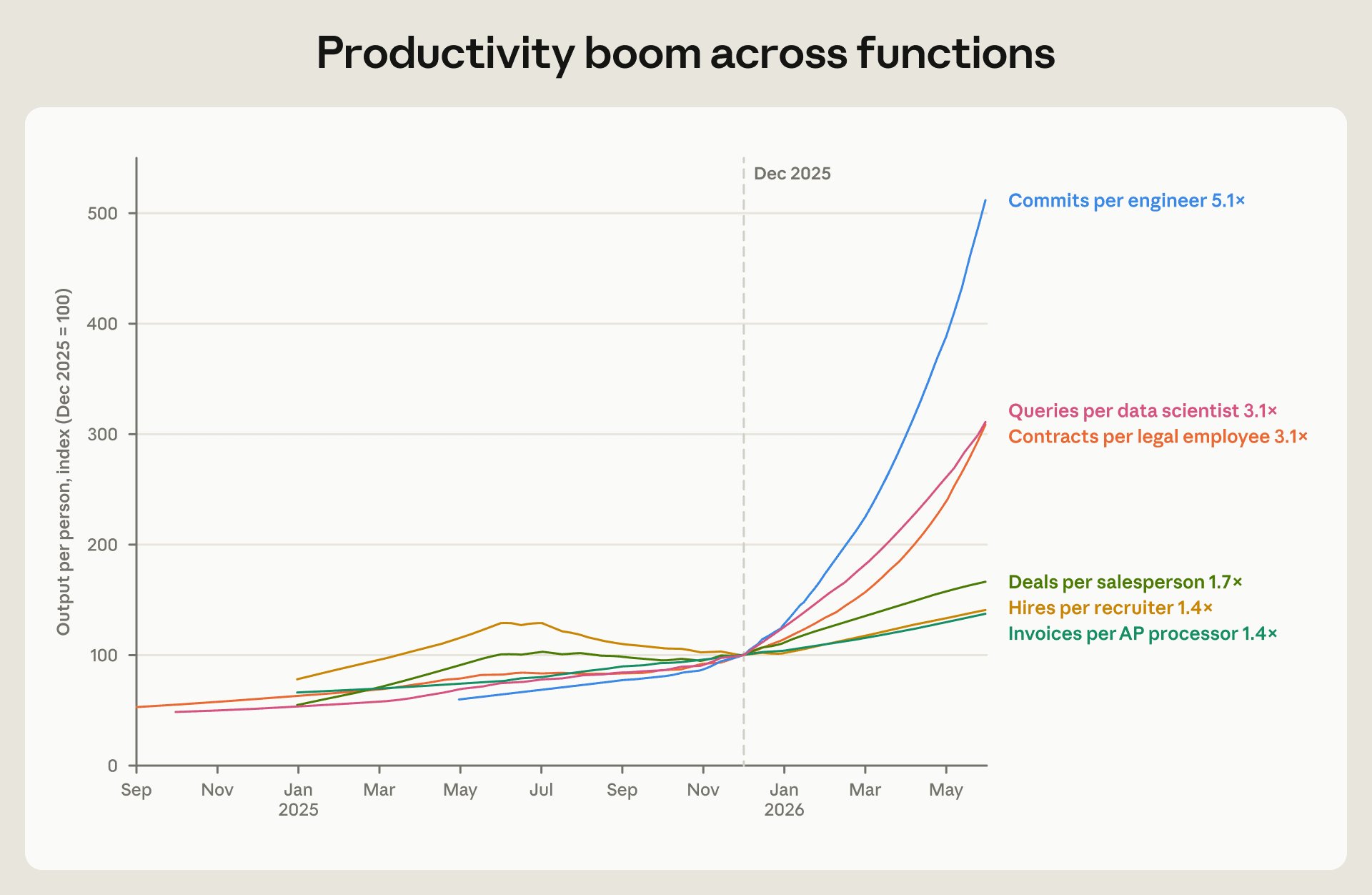
Output rose across measurable job functions. Code commits per engineer increased 5x over six months. Lawyers processed more contracts, accounts payable handled more invoices, and salespeople closed more deals. The report notes the company also saw explosive business growth during this period, making it harder to attribute gains purely to AI.
To isolate the effect of AI, the researchers compared 192 engineers who adopted coding agents against 74 who did not, using person and calendar-month fixed effects. Output rose sharply in the months following adoption. Code quality checks found no difference in rates of lines subsequently removed or reverted between agent-written and human-written code, suggesting the productivity gains were not accompanied by a drop in quality.
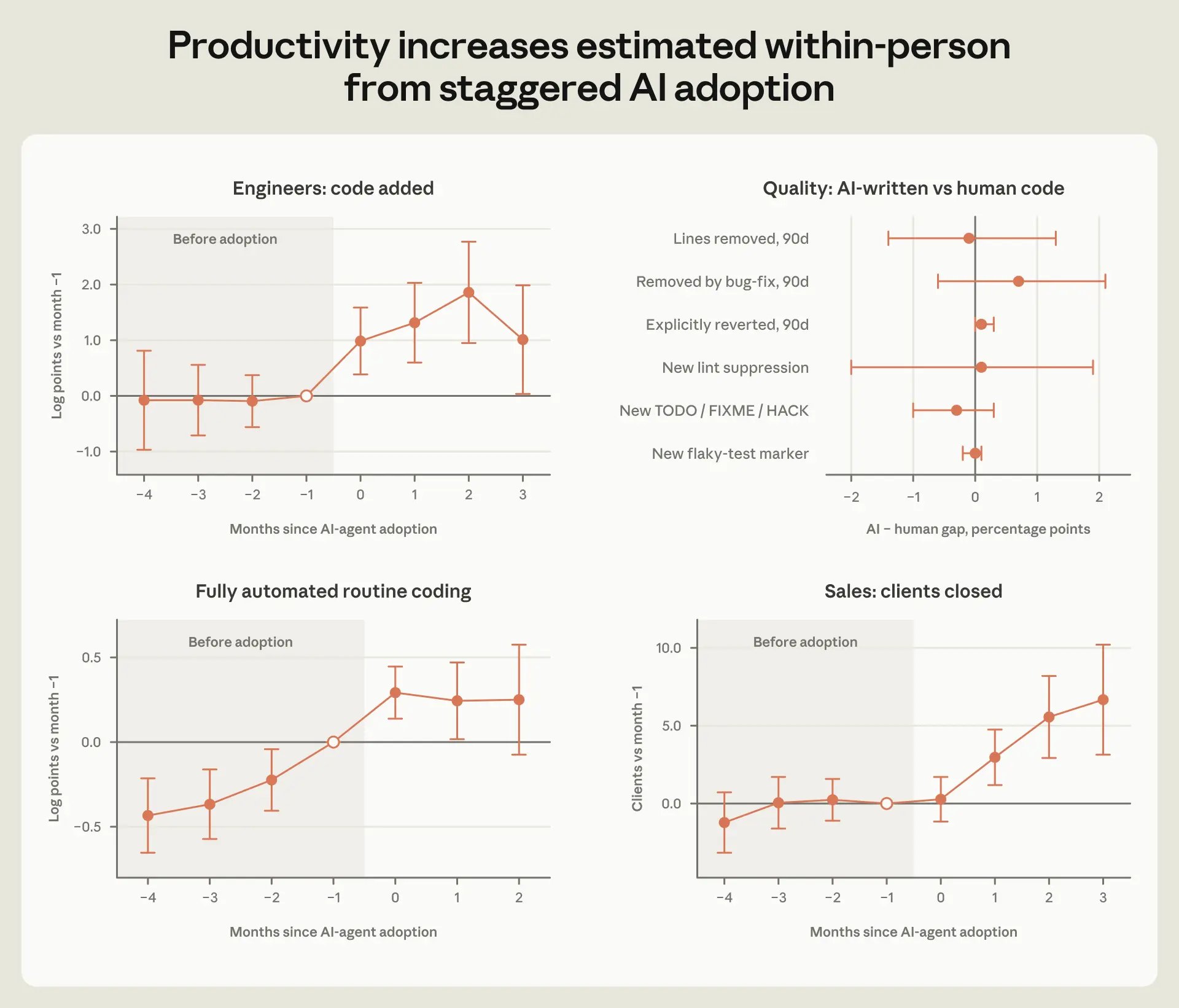
Sales representatives who adopted agents closed deals with more clients. One account executive said Claude automations replaced about 20% of prior work tasks, freeing time to talk to 30% more customers. A lawyer built automations to scan risks, triage legal questions, and take first passes on public-facing copy. A recruiter used Claude for candidate sourcing and analysis that would have taken "maybe a couple of weeks."
Human attention becomes the bottleneck
The report describes a workplace where human attention is the limiting factor. In interactive multi-turn sessions, agents spend about 80% of session time idly waiting for human input. For non-technical groups, interactive Claude sessions output enough content to take up over half the work week just to read.
Employees responded with "meta-work": building visibility tools and monitoring agent pipelines. Written standing instructions for agents grew from a few hundred in July 2025 to 8,500 a year later. Meta-work rose from 10% of the average employee's interactive Claude sessions in fall 2025 to 22% in spring 2026.
One engineer set up an agent chief of staff to triage agent requests. Another wrote a performance review for their Claude team. A lawyer shifted from reviewing legal questions to "SEO for legal advice," writing frameworks that clients' agents would discover.
Despite automation, human coordination remains critical. The median employee spends 20% more time in meetings than a year ago, and technical individual contributors spend 16% more. Agents appeared in nearly half of active public Slack channels, but human communication structure changed little. Agents became teams for single employees rather than highly connected nodes.
Hiring managers value judgment over expertise
Hiring manager scorecards show a clear shift in what the company values. In 2024, managers noted candidates' track record on AI tooling in about 5% of assessments for technical roles and 7% for non-technical roles. By 2026, those rates had tripled and quadrupled respectively.
The biggest increases in technical candidate assessments were comments on autonomy and judgment, while discussion of domain expertise shrank. One manager explained: "I expect models to continue to be jagged, so for my team I want them to be fungible across domains." For non-technical candidates, customer and mission orientation increased while execution skills discussion fell.
What employers can do
The report draws lessons for other organizations. First, widespread stock ownership gives employees a financial stake in successful AI adoption. The authors compare this to the post-World War II union-management settlement, where labor allowed work reorganization in return for pay increases tied to productivity.
Second, Anthropic is building an early warning system to monitor jobs facing AI-driven transformation, tracking role-level demand and productivity metrics against AI capabilities. This allows the company to reallocate affected employees to roles with better skills fit. Employees working at the company for at least a year were 50% more likely to move across departments each month in 2026 than in 2025.
The report acknowledges tradeoffs: commitments to reallocate incumbent workers could make employers hesitant to hire new employees, and employment protections for incumbents don't help those never hired. The authors argue private action must come alongside government policy around retraining and income support.
"A workforce that is anxiously worried is not a workforce doing its best work," one Anthropic executive told the researchers.
The full report is available on Anthropic's research page.
Source:anthropic.com
Comments
Please log in or register to join the discussion