
The AI expectations gap


A survey comparing US adults and Anthropic staff reveals a large gap in expectations about AI's future. The people building frontier AI see much faster progress, more automation of their own work, and larger productivity gains than the general public does, and the difference is tied to day-to-day experience with the technology.
US adults and the people building the most advanced AI systems see the future in different ways.
A survey from August 2026 asked 10,980 nationally representative US adults and 1,334 Anthropic staff about their expectations for AI. The questions covered capabilities, adoption, time savings, automation, and the labor market. The results show broad agreement on what AI can do today. They show disagreement about what comes next.
The gap reflects more than optimism. The people closest to the technology experience it day to day, and that shapes what they expect.
Capabilities: What AI can do and when
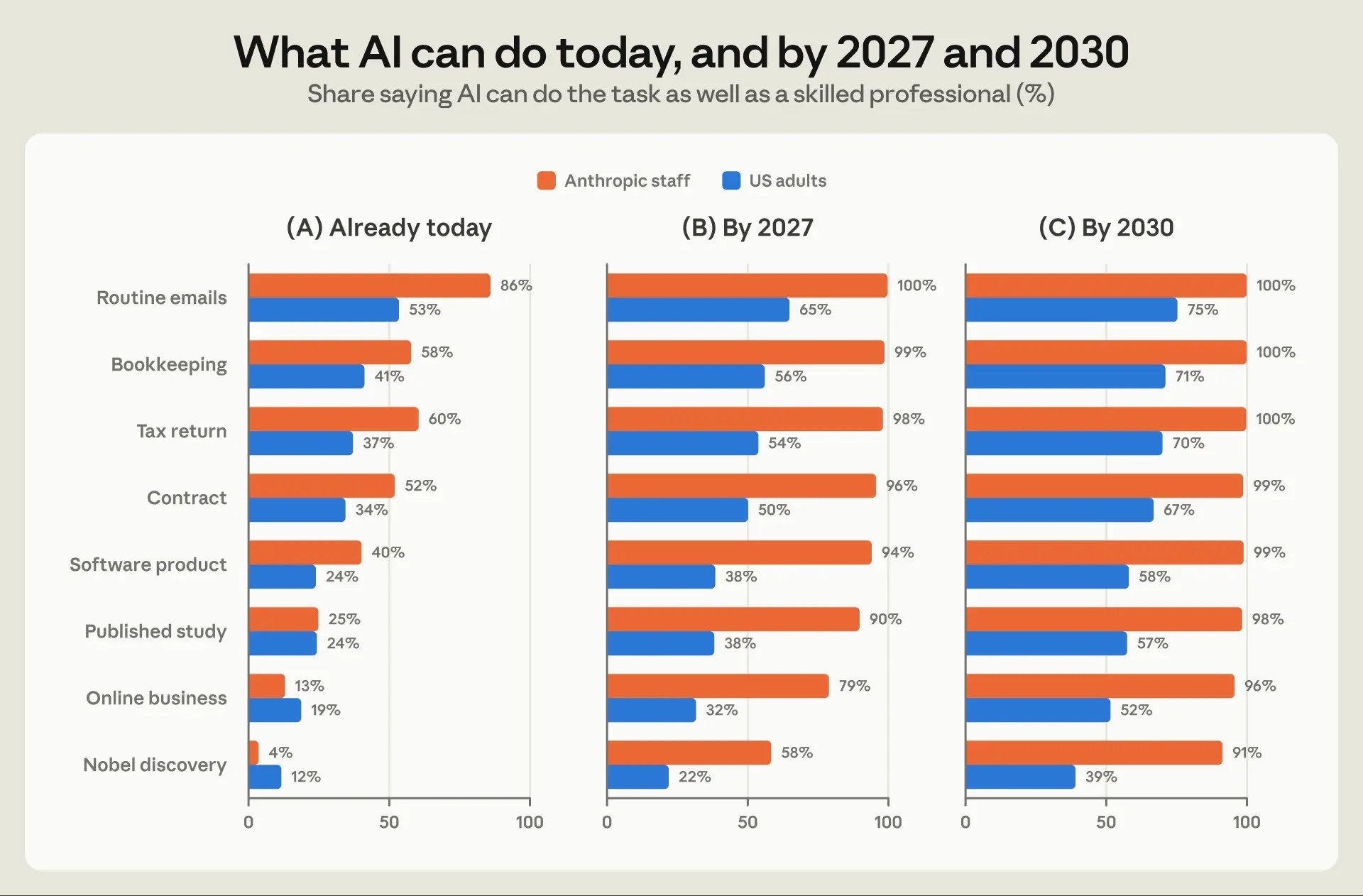
Both groups rank eight tasks in nearly the same order of difficulty. Writing routine emails is easy. Making a Nobel-level discovery is hard. On complex tasks, the two groups agree on what AI can already do.
They diverge on the timeline.
About a quarter of both US adults and Anthropic staff say AI can design, conduct, and publish scientific studies today. By 2027, nine in ten staff expect this to be feasible. Only 38% of US adults do.
By 2030, 39% of US adults expect AI to make a Nobel-level discovery. Among Anthropic staff, 91% do.
The difference is sharpest on one question: depending on the task, between 19% and 40% of US adults say AI will never be able to do a given thing. Among staff, at most 2% say that.
Frequency of use explains part of the gap. Among US adults who use AI at work regularly, 56% expect AI to master at least seven of the eight named tasks by 2030. That is higher than the 41% average for all US adults. It is still well below the 96% of staff who say the same.
Adoption: What holds AI back
Capabilities matter, but AI has to actually be used.
US adults expect that 42% of tasks AI can do will be done with AI by 2030. Anthropic staff expect 65%.
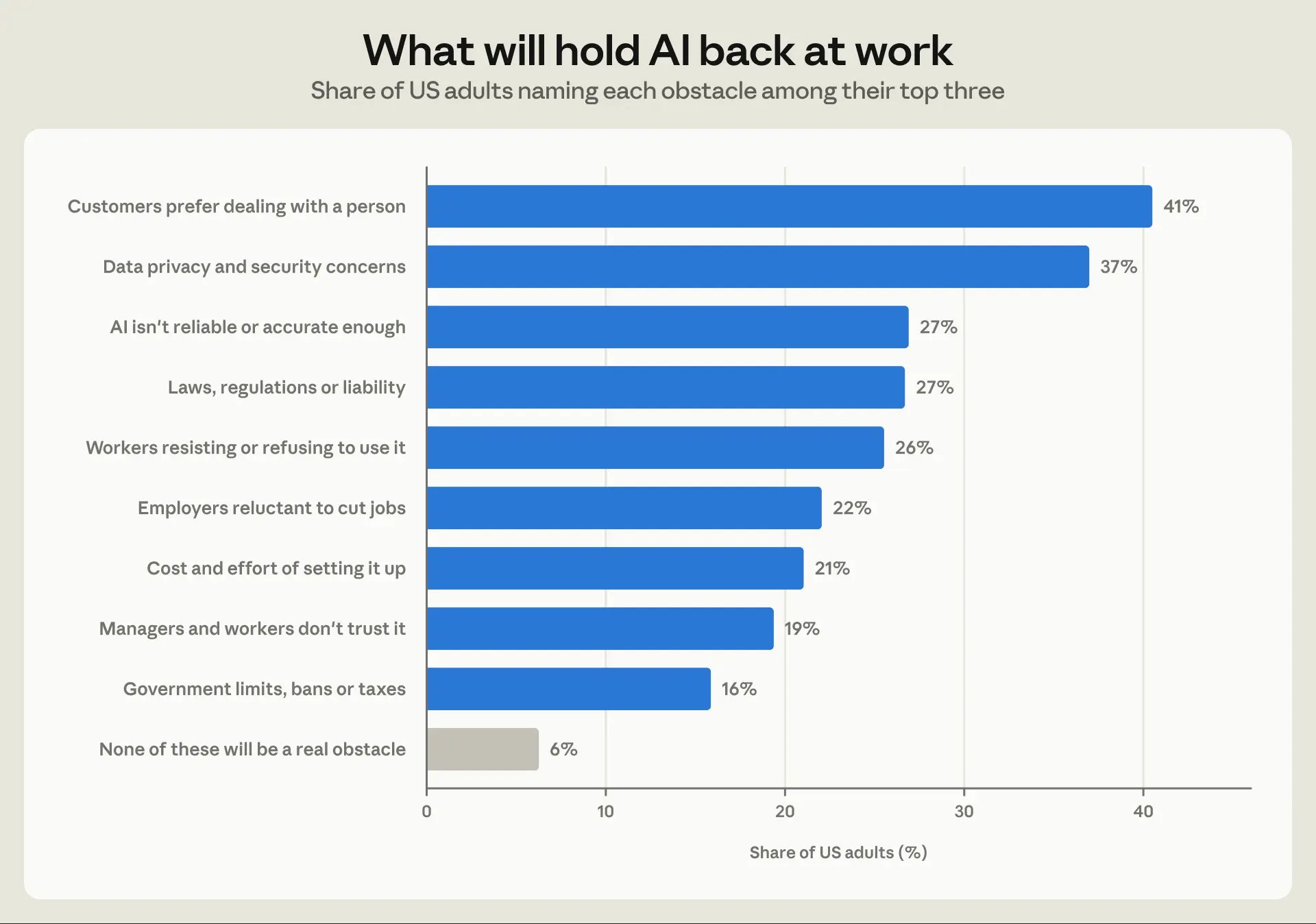
When asked what will slow adoption, the public points to human factors rather than technology constraints. "Customers preferring to deal with a person" was the most commonly named obstacle. Data privacy and security, AI reliability, and laws and regulations followed.
Among regular AI users at work, data privacy and security ranked first. Customer preference for human interaction ranked slightly lower.
Autonomy: Who does the work
Whether AI displaces workers or augments them depends on who does the task.
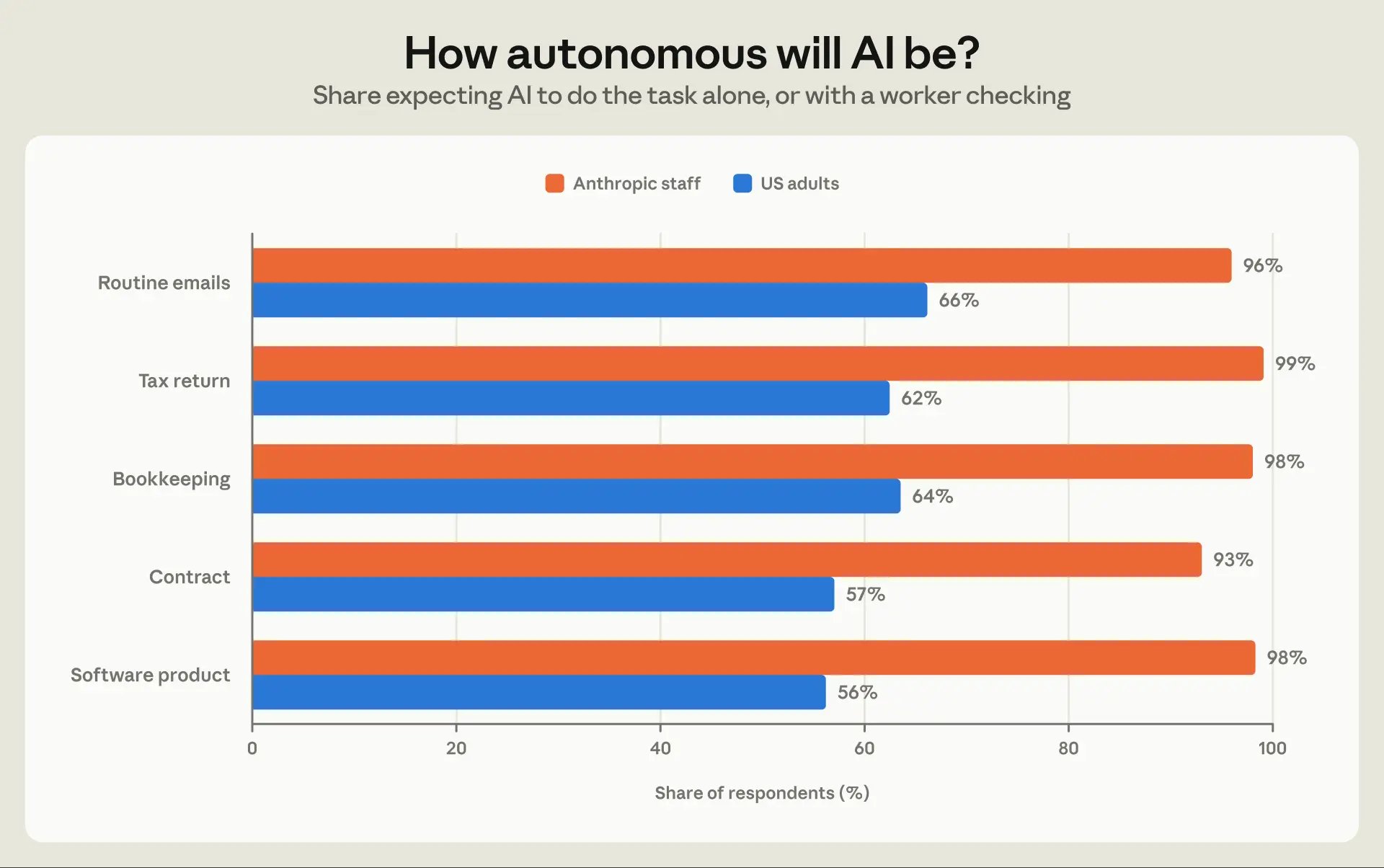
By 2030, the vast majority of Anthropic staff expect AI to complete tasks either alone or with a worker checking the output. Four in ten US adults expect humans to do most of the work themselves, with AI helping.
Time savings: How much faster
A technology that barely replaces workers does not raise GDP much. A technology that completes tasks in a fraction of the time does.
Anthropic staff report larger expected time savings. 85% say a well-suited task takes half the time or less with AI. Among US adults who use AI at work, the typical answer is half the time. 29% say the task takes as long or longer. Only 5% of staff say that.
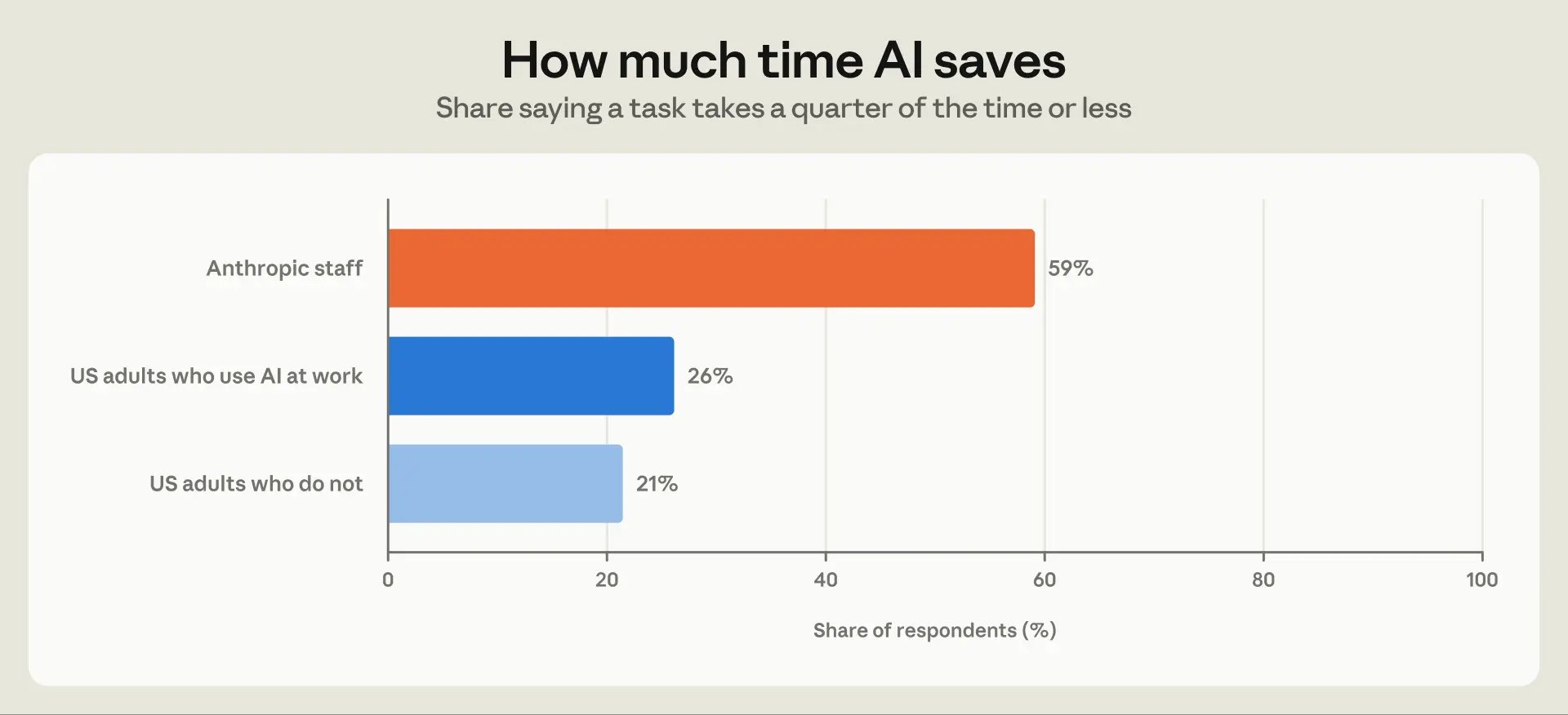
Among US adults who use AI at work, 26% say a task takes a quarter of the time or less. Among staff, 59% say that.
Staff may be describing what they already experience. At Anthropic, lines of code engineers added tripled in the month after adopting coding agents. Sales representatives closed more deals after adopting AI agents. Output per person rose in legal and recruiting too.
Own work: How much of a job AI will do
The gap is widest when people talk about their own jobs.
Anthropic staff say AI will be able to do 75% of their current work hours by 2030. US workers put the share at 28%. Only one in 20 US workers say AI could do 80% or more of their work.
Among US workers, expectations vary by occupation. Manual trades and transport workers expect 25%. Workers in computer, engineering, and science roles expect 33%. Even regular AI users in tech expect only 40%, closer to the US average than to the Anthropic staff average.
Unemployment: How own-job exposure shapes the forecast
How much of their own work people expect AI to do predicts what they expect for the labor market.
US workers who expect AI to do less than half of their work forecast unemployment of 7 to 8% in 2030. Those who expect AI to do 80% or more forecast 12.2%, above the peak of the Great Financial Crisis.
Each additional ten percentage points of work affected is associated with 0.4 points more forecasted unemployment. General optimism about AI does not explain this. Holding own-job exposure fixed, beliefs about AI's broader capabilities are unrelated to the unemployment forecast.
The same pattern appears among Anthropic staff. Their own exposure is much higher, but their unemployment forecasts align with the general public's. Both groups seem to reason about the labor market the same way. They differ in what they experience, not in how they connect their own jobs to the broader economy.
Hiring and re-employment
Even though Anthropic staff expect AI to do most of their work, 95% expect the company to keep hiring over the next 12 months. The median staff member expects headcount to grow by 66%. These are personal expectations from an internal poll, not Anthropic's plans.
Staff are more pessimistic than US adults about how quickly a displaced worker can find a new role. The median staff member expects 12 months. The median US adult answer falls in the 7-to-12-month range.
Mapping beliefs to economic scenarios
A model from the paper "Economic Scenarios for Transformative AI" translates each respondent's answers into an implied economic path. The median US adult's answers imply 5.4% GDP growth in 2030. The median staff member's answers imply 17.1%.
The distributions overlap widely. A visitor to the interactive scenario explorer at anthropic.com/institute/econ-scenarios, who chose to take the quiz, sits in between: 12.5% implied growth. More than 23,000 people completed the quiz in the first 48 hours, from over 140 countries.
The full report is available at anthropic.com/research/ai-expectations-gap.
Inside the lab
One reason staff are more optimistic: they see the development process up close. A recent Anthropic Institute report on recursive self-improvement describes AI systems increasingly improving their own capabilities.
In the survey, the median staff member says AI does 51% of the work of building an early-2026 frontier model today. By the end of 2027, they expect 80%. By the end of 2030, 95%.
Research teams, closest to model-building, put the current share at 60%, compared with 53% for everyone else.
What this means
The public and the people building AI agree on what AI can do today. They disagree on how fast it will improve, how widely it will be used, and how much time it will save.
The day-to-day experience explains much of the gap. Most Anthropic staff already work alongside AI that does much of their job. Few US workers do. Those US workers who do use AI regularly hold expectations closer to those of staff.
Whether public expectations shift will depend on whether AI comes to do as much of the work elsewhere as it does at a frontier lab.
Source:anthropic.com
Comments
Please log in or register to join the discussion