
“Would you consider working for me?” ... The era of AI assistants that effortlessly handle bookings and payments
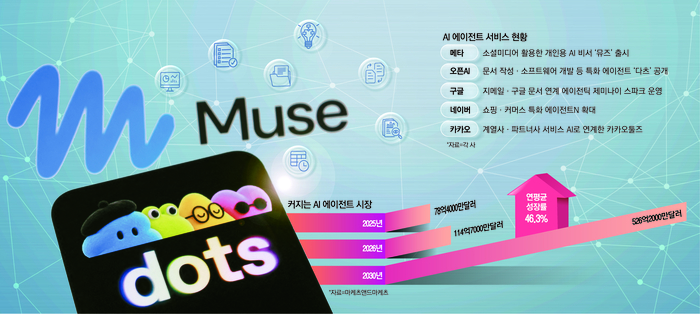 사진 확대
The era of agents has officially begun in the artificial intelligence (AI) market. That is because major tech companies such as Meta Platforms, OpenAI and Google are rolling out agent services one after another. Cybersecurity issues related to AI agents are also expected to become a major topic.
The service that sparked the AI agent market was Muse, launched by Meta Platforms early last month. It handles not only email, messaging and calendar management, but also travel and restaurant bookings, product purchases and payments, and online form filling. Most of its features are free, with the company’s business model based on transaction fees. Muse has proved hugely popular, thanks in part to users’ ability to access a high-quality AI agent for free. It even climbed to No. 1 on Apple’s App Store.
Meta Platforms’ AI agent stands out for being more specialized in personalization than any other service. The company has social platforms used by billions of people, including Facebook, Instagram, WhatsApp and Threads. In effect, it has amassed a huge amount of information that its AI agent can draw on to understand users’ preferences. The approach also aligns with the “personal superintelligence” strategy that Meta CEO Mark Zuckerberg has long emphasized. Social media users continue to share reviews, saying they used Muse to “plan a trip at the lowest price” or “shop at the lowest prices.” Meta Platforms is reportedly considering adding Muse features to its new AI glasses.
As Muse soared in popularity, OpenAI countered with its AI agent, Dots. OpenAI unveiled Dots at its annual developer conference, DevDay 2026, held on the 29th of last month (local time) at Fort Mason Center in San Francisco, U.S. Dots is an agent that proactively completes projects—including research, data analysis, document writing and software development—within a virtual computer in the cloud. While Muse is specialized in shopping and similar tasks, Dots is more focused on work. It runs on OpenAI’s top-tier model, GPT-6 Astra, and carries out tasks by understanding the related context once users set a goal. Users can give Dots instructions not only through the ChatGPT website or app, but also via external channels such as text messages and workplace messaging platforms like Slack and Microsoft Teams.
OpenAI said, “Starting today, you can create your first Dot, give it a name and make it your own,” adding, “In the future, multiple Dots will work as a team for you.” Sensitive tasks such as changing passwords, permanently deleting data and installing software have been configured to require users’ explicit approval. The service is expected to be available at no extra cost to ChatGPT Pro subscribers, whose plans start at $100 a month, and Business Premium subscribers. With enterprise AI agents also expected to grow, Meta Platforms is working to expand the market, including by unveiling an enterprise version of Muse.
 사진 확대
Google is expanding its AI agent services through Gemini Spark. Its focus is on connecting services familiar to Google users around the world, such as Gmail, Google Docs and Sheets. When an email confirming a flight or hotel reservation arrives, Spark automatically adds the details to a travel itinerary. It can also look for things to do near a destination and add them to the calendar in advance when there are gaps in the schedule. It helps organize school announcements received by email and keep track of deadlines for submitting field trip permission forms. It analyzes emails users have written over time to learn their individual tone and style, then reflects them in drafts of new emails.
Big Tech companies are racing to launch AI agents because they are expected to become game changers in the market. According to global market research firm MarketsandMarkets, the global AI agent market jumped from $7.84 billion (about 10.504 trillion won) in 2025 to $11.47 billion (about 15.364 trillion won) in 2026. It is projected to grow to $52.62 billion (about 70.484 trillion won) by 2030. The compound annual growth rate (CAGR) over this period is expected to reach 46.3%.
Amid a sustained onslaught from global giants, South Korea’s two leading IT companies, NAVER and Kakao Corp., are accelerating their agentic AI businesses. They are betting on services tailored to the Korean market, which global AI services can easily overlook. NAVER unveiled Agent N, which understands users’ intentions through conversation alone and takes real-world actions, such as making payments and bookings, without requiring them to labor over search terms. After introducing a “shopping agent” that proactively checks product inventory and finds deals on users’ behalf, the company plans to pilot payments within the agent for some product categories before the end of the year. The move is intended to make shopping more convenient for AI shopping agent users. The AI shopping agent also includes a delivery-focused feature that recommends products that can arrive quickly on the desired date, based on the user’s address. For product categories where fast delivery is important, it uses the conversation’s context to include quick-delivery options in its recommendations even if the user has not specifically asked for them.
Kakao Corp. is boosting its AI agent service Kakao Tools through ChatGPT for Kakao, integrated into KakaoTalk. A key feature is that users can access external partners’ services—including HanaTour, Daiso Mall, Shinsegae Duty Free and LF Mall—using Kakao’s AI technology. Users can access the linked partners’ services through conversations in the ChatGPT for Kakao chat window. Kakao Tools currently connects a total of 28 services, including those of Kakao and its affiliates as well as partner companies. Its range of offerings is also diversifying, from games and spaces to lifestyle, finance, travel and shopping.
As AI agents become commonplace, concerns about related security risks are also growing. Another key issue is how to compensate for harm caused by AI agents’ autonomous actions. An industry official said, “More important than launching AI agent services is designing systems to prevent and compensate for harm down the line,” adding, “If customer harm cannot be prevented, the growth of the AI agent market could slow sharply.”
This article has been translated by GripLabs Mingo AI.