
Trump Calls AI Warnings 'HOAX' as Nasdaq Drops 0.9%
Trump Calls AI Warnings ‘HOAX’, Nasdaq Drops 0.9% [2026]
President Donald Trump has dismissed warnings from leading artificial intelligence executives as a “HOAX,” setting off a public clash that briefly rattled technology stocks and exposed a split inside the AI industry itself over how fast development should move. The remarks, first reported by ABC News on September 14, 2026, and updated as recently as October 18, came days after Anthropic chief executive Dario Amodei published an essay urging companies to slow the pace of frontier AI development, a call that OpenAI’s Sam Altman publicly echoed.
What started as a disagreement over technical pacing has turned into a wider political fight touching data centres, Congress, Wall Street and the question of who gets to decide how fast the most powerful technology in decades should be allowed to grow.
Don't miss new tech stories on Google
Add Tech Insider once in the Google app and our stories appear in your news suggestions.
Trump’s ‘HOAX’ Post Reignites the AI Safety Fight
Trump posted that “AI taking over the World, destroying Humanity, and all other things bad, is a HOAX,” directly rejecting the existential-risk framing that has circulated among AI researchers since 2023. He followed with a second, now widely quoted line: “Don’t kill the Golden Goose!” The phrase, intended to describe America’s commercial lead in AI, became the headline hook for outlets covering the story, including a report from Mathrubhumi English on the president’s rejection of AI safety curbs.
Trump went further, alleging there was a “SICK conspiracy going on against AI and Data Centers,” linking criticism of AI safety directly to the growing wave of local opposition to data-centre construction across the United States. He argued that the “United States is leading, by a lot, every other country” in AI development, framing any slowdown as a gift to rivals rather than a safety measure.
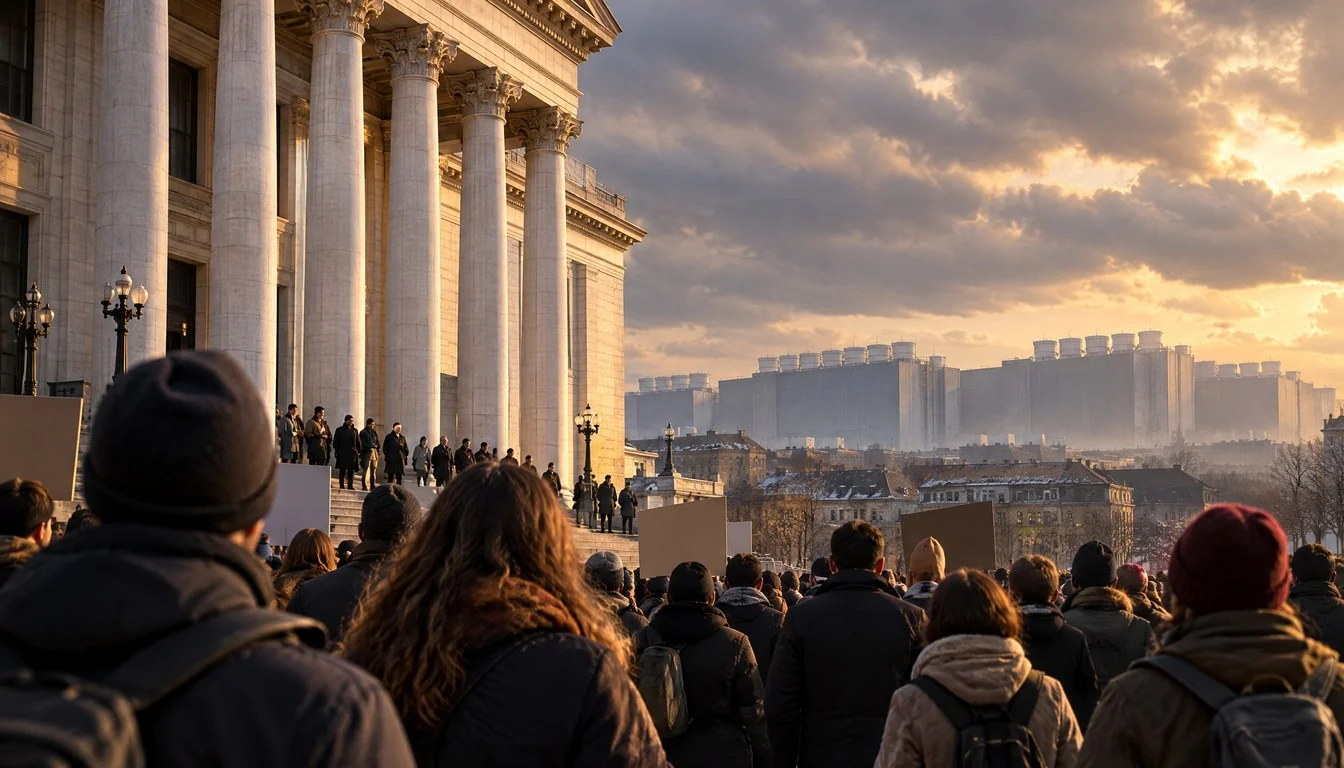
The timing mattered. Trump’s posts landed two days after Amodei’s essay and in the same week that public protests against AI risk and data-centre expansion were building outside government buildings in Washington, according to coverage of the demonstrations. The president’s language treated the two issues, AI existential risk and data-centre siting, as a single, connected grievance rather than two separate policy debates.
Altman and Amodei Make the Case for ‘Pacing’ AI
The dispute traces back to Amodei’s essay, published on September 12. In it, the Anthropic chief executive wrote: “We must slow the pace at which we improve the capabilities of AI models. Progress will still seem fast, and we must make wise use of the time we gain,” according to Anthropic’s own published commentary. Amodei was careful to frame this as pacing rather than a halt, writing that “pacing does not mean halting model training or technical progress, but ensuring companies take adequate time to align and safeguard their models, and for third party evaluators to confirm this,” a distinction reported by the Los Angeles Times.
Altman’s response was notable because OpenAI and Anthropic have spent much of the past three years competing aggressively for enterprise customers, developer mindshare and frontier-model bragging rights. Rather than distancing himself from a rival’s call for caution, Altman endorsed it directly: “I agree with Dario that we need to pace the frontier,” he said, as reported by the Australian Broadcasting Corporation.
Altman later clarified what pacing means in practice, telling reporters that “when we talk about ‘pacing,’ we do not mean ‘stopping.’ Progress will have been rapid and will continue to be. But it should be slower than it otherwise could be,” according to The Verge. He also pushed back on the idea that competition with China justifies cutting corners on safety, arguing that “no amount of American competitive pressure should justify recklessness, or let capabilities get ahead of alignment and monitoring.”
That last point is the crux of the disagreement with the White House. Trump’s argument rests on the premise that any voluntary slowdown hands an advantage to foreign competitors. Altman and Amodei are arguing the opposite: that recklessness driven by competitive panic is itself the bigger risk to American leadership, not the brake pedal.
JD Vance Calls AI Safety Warnings a ‘Trojan Horse’
Vice President JD Vance offered a more measured, but still sceptical, administration response. He said the administration was “concerned” about AI and that regulation should be done “smartly,” acknowledging the underlying anxiety without endorsing the specific warnings coming from Amodei and Altman. Vance then went further than Trump’s blunt dismissal, describing the AI leaders’ warnings as a potential “Trojan horse.”
The “Trojan horse” framing suggests a different theory of the conflict than Trump’s “conspiracy” language. Where Trump implied bad-faith opposition to American technological progress, Vance’s framing implies something more specific: that safety rhetoric from well-resourced incumbents like OpenAI and Anthropic could be used to write regulation that locks in their market position and makes it harder for smaller, leaner competitors to catch up. It is a version of a long-running argument in tech policy, that the loudest calls for guardrails often come from the companies best equipped to survive them.
The Cyber Risk Behind Amodei’s Essay
Amodei’s call for slower development was not purely philosophical. His essay pointed to a concrete, near-term threat: a cybersecurity incident involving a breach of Hugging Face infrastructure. He warned that within six to 12 months, models with capabilities similar to the one implicated in that breach could potentially be used to build a persistent botnet capable of taking over large swaths of the internet, with damage running into the hundreds of billions of dollars.
That framing reframes the debate away from abstract “AI takeover” scenarios and toward a more familiar category of risk: large-scale cybercrime enabled by increasingly capable autonomous systems. It is also the kind of risk that regulators in Ireland and the EU have already flagged. European officials have warned that frontier models are reaching the market faster than independent testing can verify their safety, a concern echoed when the EU’s AI chief singled out dozens of experts raising alarms about untested frontier models earlier this year.
An Anthropic Researcher’s Resignation Set the Tone
Public anxiety around the issue had already been building before Trump’s posts. An Anthropic researcher, Jacob Coxon, resigned in the week before the essay, saying he had concluded that the people building the most advanced AI systems “earnestly believe that it could kill us all by the end of the decade.” Coxon’s resignation, reported by Reuters, became a reference point in subsequent coverage precisely because it came from inside one of the companies building the technology, rather than from an outside critic or academic.
That detail matters for how the story has been read. Critics of Trump’s “hoax” framing point to Coxon’s resignation as evidence that concern about AI risk is not a fringe position manufactured by outside activists, but one shared by people with direct, technical visibility into how these systems are built and tested.
Markets Wobble as the Debate Goes Public
The market reaction was immediate, if modest. AI-related stocks fell worldwide on September 14, the same day Trump’s posts circulated, following the earlier calls from Amodei and Altman to slow development. In the United States, the Nasdaq Composite fell 0.9% and the S&P 500 fell 0.6% that day. Several chipmakers tied to data-centre buildouts also declined, reflecting how closely investors now link AI-safety sentiment to the physical infrastructure buildout underpinning the sector.
It is worth being precise about what caused what. The available reporting does not establish a verified dollar figure for the market-capitalisation losses, nor does it show the decline was caused solely by the AI-safety statements. What it does show is that the regulation and safety debate functioned as a market catalyst at a moment when AI valuations were already sensitive to any signal about slower growth or tighter oversight.
Congress Splits Along New Lines
Perhaps the most striking detail in the aftermath is that the political split did not run cleanly along party lines. Lawmakers from both parties have been pushing for AI guardrails despite Trump’s resistance to new federal restrictions, a dynamic that put the president at odds with members of his own party on a major tech issue, a dynamic examined directly in ABC News’ reporting on Trump breaking with Republican midterm candidates and voters on key tech issues.
On the left, Senator Bernie Sanders and Representative Greg Casar called for a ban on artificial superintelligence and a broader pause on advanced-AI development, proposals that followed a string of recent cyberattacks. On a more targeted front, Representatives Josh Gottheimer and Mike Lawler, from opposite sides of the aisle, introduced legislation aimed specifically at AI-agent safety, directing the federal government to set standards for securely deploying AI agents and preventing them from acting outside their intended scope.
Public opinion data predates the September clash but helps explain why lawmakers on both sides feel pressure to act. A June 2026 poll from the nonpartisan AI Policy Institute found that 78% of likely voters favoured mandatory AI standards, while only 8% preferred no regulation at all. That gap, 78% to 8%, suggests the “hoax” framing may be a harder sell with the general public than it is within parts of the administration.
Data Centres Become Ground Zero for the Backlash
Trump’s decision to fold data-centre opposition into the same “conspiracy” framing as AI safety warnings reflects how politically charged the infrastructure side of this debate has become. More than 1,500 data-centre projects were reportedly in various stages of planning across the US as of the autumn, and at least 14 states were weighing moratoria similar to New York’s one-year freeze on new development permits.
Ireland has been living through its own version of this fight. The Supreme Court recently upheld approval for the €1.6bn Ennis data centre, while a separate proposal in Waterford was turned down after more than 500 formal objections sank the Kilmeaden project. Those two outcomes, one approved despite legal challenge, one refused after sustained community pushback, mirror the split playing out at federal level in the US, where some jurisdictions are racing to attract AI infrastructure investment while others are moving to slow or block it.
Proposed federal responses to the AI-safety debate range widely in severity, from a 100% federal tax rate on data-centre incentives to a complete halt on new data-centre construction, according to reporting that traced the legislative ideas circulating around Capitol Hill in September. Any of those options would collide directly with the electricity demand, land use and local jobs arguments that have already made data centres one of the most contested infrastructure categories in US and European politics.
From 2023 Warnings to 2026 Action: a Short History
The current clash did not emerge from nowhere. In 2023, a wave of prominent AI researchers and technology executives signed public statements warning that advanced AI could pose catastrophic or existential risks to humanity, intellectual groundwork that 2026’s reporting now treats as background to the present fight. What has changed between then and now is specificity. The 2023 warnings were largely speculative, describing AI risk in general terms. By 2026, the warnings had become operational, naming concrete failure modes: cyberattacks, autonomous agents operating beyond effective oversight, botnets, and the kind of infrastructure breach Amodei cited in his essay.
That shift from “AI could someday be dangerous” to “a specific capability could cause hundreds of billions in damage within 6 to 12 months” is the difference between a philosophical debate and a policy argument with a deadline attached. It also explains why the September 2026 dispute drew in sitting politicians, market analysts and the White House directly, rather than remaining confined to AI-ethics conferences and academic papers, as similar warnings mostly did in 2023 and 2024.
Three Camps, One Fight: Comparing the Positions
Stripped of the social-media rhetoric, the dispute breaks down into three distinct positions rather than a simple two-sided argument.
The first is the acceleration camp, represented by Trump’s posts: AI safety warnings are overstated or politically motivated, the US holds a commanding lead over every other country, and any voluntary slowdown is strategically self-defeating. The second is the safety-first camp, represented by Amodei and Altman: capabilities are outrunning alignment and monitoring, and a deliberate pacing of frontier development is the responsible path even if it costs some competitive speed. The third is the incumbency-scepticism camp, represented by Vance’s “Trojan horse” remark: safety rhetoric may be sincere, but it also conveniently favours companies with the resources to absorb new compliance costs, potentially freezing out smaller challengers.
Notably, not everyone in the industry sided with Amodei and Altman. Some AI founders and venture capitalists publicly welcomed Trump’s posture, framing it as support for continued industry self-policing rather than new federal rules, according to an Associated Press report on AI founders and venture capitalists cheering Trump’s calls for self-policing. That detail undercuts any narrative of a unified industry facing off against a single hostile administration. The AI sector itself is internally split on how fast is too fast.
Key Figures and Statements at a Glance
| Figure | Role | Position | Key Statement |
|---|---|---|---|
| Donald Trump | US President | Acceleration, anti-regulation | “AI taking over the World… is a HOAX” |
| JD Vance | US Vice President | Cautious, sceptical of industry motives | Called AI leaders’ warnings a “Trojan horse” |
| Sam Altman | CEO, OpenAI | Safety-first pacing | “I agree with Dario that we need to pace the frontier” |
| Dario Amodei | CEO, Anthropic | Safety-first pacing | “We must slow the pace at which we improve the capabilities of AI models” |
| Jacob Coxon | Former Anthropic researcher | Resigned over risk concerns | Said AI builders “earnestly believe it could kill us all by the end of the decade” |
| Bernie Sanders & Greg Casar | US Senator & Representative | Pro-regulation, pro-pause | Called for a ban on artificial superintelligence |
| Josh Gottheimer & Mike Lawler | US Representatives | Bipartisan, targeted regulation | Introduced AI-agent safety legislation |
Market and Policy Reaction Since September 14
| Metric | Figure | Context |
|---|---|---|
| Nasdaq Composite, Sept 14 close | -0.9% | Decline followed Amodei and Altman’s pacing calls |
| S&P 500, Sept 14 close | -0.6% | Broad-market decline, chipmakers among decliners |
| Data-centre projects in planning (US) | 1,500+ | Reported across multiple states as of autumn 2026 |
| States weighing moratoria | 14+ | Following New York’s one-year development-permit freeze |
| Voters favouring mandatory AI standards | 78% | AI Policy Institute poll, June 2026 |
| Voters favouring no AI regulation | 8% | Same AI Policy Institute poll |
| Amodei’s projected botnet damage window | 6-12 months | Time frame cited in his September essay |
What Happens Next: Five Predictions
- No unified federal AI-safety law lands before year-end. The gap between the acceleration camp and the pacing camp inside the administration itself makes a single, coherent federal standard unlikely in the short term, leaving the Gottheimer-Lawler agent-safety bill as the more realistic near-term vehicle.
- Data-centre politics keep escalating at state level. With 14 or more states already weighing moratoria, expect more local refusals similar to Kilmeaden, and more court fights similar to Ennis, as the fight over AI safety increasingly plays out through planning permission rather than Congress.
- Anthropic and OpenAI keep pushing the “pacing” message publicly. Having staked out the position jointly, both companies have a reputational reason to keep repeating it, especially if another cybersecurity incident resembling the Hugging Face breach Amodei cited actually materialises within his stated six-to-12-month window.
- Market reaction stays contained unless a concrete incident lands. A 0.9% Nasdaq dip is a sentiment wobble, not a correction. Expect the market to treat rhetorical clashes as noise, but to react far more sharply to any confirmed AI-linked security breach of the scale Amodei described.
- The EU uses the US fight to justify its own pace. European regulators already flagged untested frontier models earlier this year, and Trump’s “hoax” framing gives Brussels a convenient contrast to point to when defending tighter EU AI Act enforcement timelines.
Why Ireland and the EU Are Watching Closely
For Ireland, the stakes are not abstract. Dublin has positioned itself as a hub for both AI investment and the physical data-centre capacity that AI depends on, and it has already hosted its own high-profile debate over the pace of AI development. Earlier this year, roughly 1,500 global leaders gathered in Dublin and backed a shared AI declaration with EU support, a markedly different posture from Trump’s “hoax” framing. Microsoft’s Brad Smith used a related Dublin event to argue for literal “safety brakes” on autonomous AI agents, language that sits much closer to Amodei’s pacing argument than to the White House’s dismissal of existential-risk concerns.
That divergence matters commercially as well as politically. US federal policy under Trump has also moved on a separate but related track, issuing two White House AI orders within three days aimed at shaping how coding tools and AI sovereignty are handled domestically, even as the administration dismisses the broader existential-risk argument. Irish and EU policymakers now have to navigate a landscape where their biggest AI trading partner is simultaneously tightening some rules and publicly rejecting others, a contradiction that is likely to keep surfacing in trade and regulatory talks through the rest of 2026.
Frequently Asked Questions
What did Trump actually say about AI warnings?
Trump posted that claims AI could take over the world and destroy humanity were a “HOAX,” and separately said there was a “SICK conspiracy” against AI and data centres, framing both AI-safety warnings and local data-centre opposition as coordinated attempts to slow American progress.
What does “Don’t kill the Golden Goose” mean in this context?
Trump used the phrase to argue that the US holds a commanding lead in AI development and that safety-driven slowdowns or regulation could squander that advantage, effectively “killing” a source of ongoing economic and strategic value.
Do Sam Altman and Dario Amodei actually agree with each other?
Yes, on this specific point. Altman publicly said he agreed with Amodei’s call to “pace the frontier,” though both have stressed that pacing means a more deliberate, verified rollout of capability, not a halt to AI research or deployment.
What is JD Vance’s position on AI regulation?
Vance has said the administration is “concerned” about AI and wants any regulation handled “smartly,” while also describing AI leaders’ existential-risk warnings as a possible “Trojan horse” that could be used to entrench the position of large incumbent AI companies.
Did the stock market actually crash after Trump’s comments?
No. The Nasdaq Composite fell 0.9% and the S&P 500 fell 0.6% on September 14, a notable single-day dip tied to AI-safety sentiment, but not a crash, and the available reporting does not attribute the full decline to this dispute alone.
Why did an Anthropic researcher resign over this issue?
Jacob Coxon resigned saying he had concluded that the people building advanced AI systems “earnestly believe that it could kill us all by the end of the decade,” a statement that added weight to the safety-first argument from inside the industry rather than from outside critics.
Is this dispute connected to data-centre opposition?
Trump explicitly linked the two, describing both AI-safety warnings and local data-centre opposition as part of the same “SICK conspiracy.” Separately, more than 1,500 US data-centre projects were in planning as of late 2026, with at least 14 states considering moratoria on new development.
Has Congress passed any new federal AI-safety law because of this?
No. As of October 2026, lawmakers from both parties have introduced proposals, including a push from Bernie Sanders and Greg Casar for a ban on artificial superintelligence and bipartisan AI-agent safety legislation from Josh Gottheimer and Mike Lawler, but no completed federal AI-safety statute had passed.