
What will happen to Samsung Electronics and SK hynix shares on Monday? ... Another “China DeepSeek shock” is said to be on the way
Chinese artificial intelligence (AI) company DeepSeek has released a new model that outperforms major U.S. AI models in some performance evaluations and costs as little as one-fortieth as much to use. Analysts say it could reignite debate over the profitability of U.S. tech giants’ AI investments, as the “R1 shock” did in January last year. Attention is also focused on how it could affect the share prices of Samsung Electronics and SK hynix, which supply high-bandwidth memory (HBM).
DeepSeek announced on its official X account and website that it had released “V4.1-Flash-1017” on the 17th. An upgraded version of “V4.1-Flash,” released on the 10th of last month, it features improved coding and AI agent capabilities. DeepSeek said it performs better on benchmarks than the previous version, works faster and produces shorter answers.
In DeepSeek’s own evaluations, the new model scored 77.0 on DeepSWE v1.1, a software-development benchmark, ahead of Anthropic’s Claude Opus 5 (74.0) and OpenAI’s GPT-5.6 Sol (73.0). It also scored 60.5 on AutomationBench, a work-automation benchmark, topping Opus 5 (50.3). Its score on TerminalBench 4.0, a coding-agent benchmark, rose to 42.3 from 31.2 for the previous model. However, it outperformed Opus 5 in only four of the 11 comparison categories. DeepSeek released all the figures itself, and they have not been externally verified.
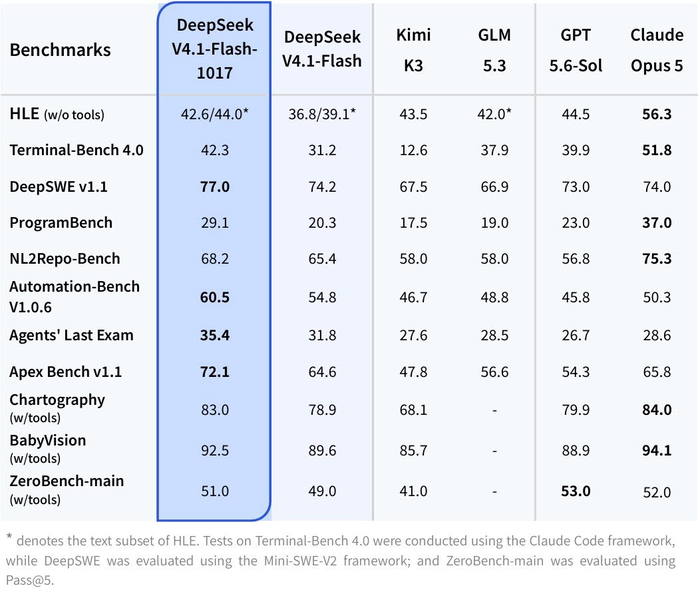 사진 확대
The key advantage is price. During off-peak hours, the API fee per million output tokens is $0.60 for DeepSeek—one-thirty-third of GPT-5.6 Sol’s $20 and about one-forty-second of Opus 5’s $25. The German AI publication The Decoder, citing a cost chart released by DeepSeek, reported that the new model averages less than $0.20 per task, no more than half the previous model’s roughly $0.50. Competing U.S. models cost between $2 and more than $10 per task.
Across the global AI industry, some are focusing on the scale of the performance improvement while others are calling for verification. Hugging Face co-founder Thomas Wolf said on X, “It’s funny to call it a ‘small update’ after raising the TerminalBench score from 31.2 to 42.3,” adding, “I wonder whether these scores will hold up outside its own evaluation environment.”
The market’s attention is on the stock market, which opens on the 19th. The new model was unveiled over the weekend, so there has not yet been a market reaction. When DeepSeek released its R1 reasoning model in January last year, NVIDIA’s share price fell about 17% in a single day, wiping out around $589 billion in market capitalization. The move came amid questions about whether massive AI infrastructure investment was necessary if low-cost models could deliver performance on par with U.S. models.
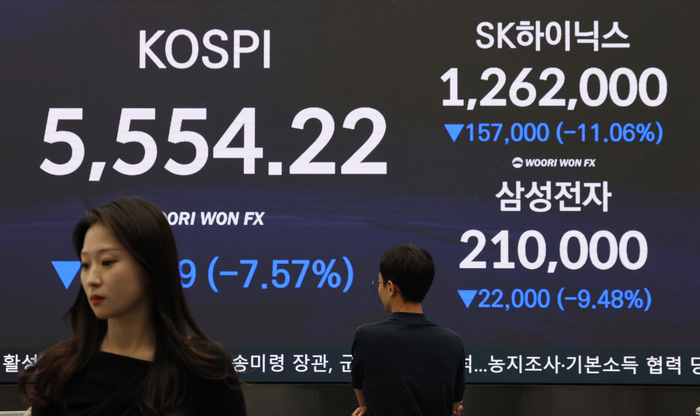 사진 확대
U.S. stock markets are already being shaken by concerns over the profitability of AI investments. Concerns about the financial health of neocloud company CoreWeave are spreading across the AI sector. Over the week beginning on the 12th, CoreWeave’s share price fell 23.5%, from $80.26 to $61.39 based on closing prices. On the 15th, TSMC took a cautious view of its 2027 outlook, citing macroeconomic uncertainty.
As debate over the profitability of U.S. tech giants’ investments flares up again, the fallout has also hit HBM suppliers Samsung Electronics and SK hynix. Alongside the debate over AI investment returns, higher-than-expected U.S. consumer price inflation and heavy foreign selling drove the two companies’ share prices down sharply on the 15th, by 9.48% and 11.06%, respectively. They edged up on the 16th but failed to make up the losses. There are also concerns that the downturn could continue if DeepSeek’s new model further fuels skepticism about investment.
There is a counterargument: the Jevons paradox, which holds that lower AI usage fees lead to increased use and, in turn, greater demand for computing. DeepSeek itself is also facing a shortage of computing resources. According to the Financial Times (FT), demand for AI semiconductors in China is expected to substantially exceed 5 million units this year, while supply is forecast to reach no more than 3.5 million. This is why some analysts say the spread of low-cost models will not necessarily lead to an immediate decline in semiconductor demand.
Meanwhile, DeepSeek is facing questions about the reliability of its services. According to Hong Kong’s South China Morning Post (SCMP), DeepSeek’s chatbot and API services were down for four hours and 50 minutes on the morning of the 15th, two days before the new model was released. Users around the world received an error message saying, “The server is temporarily unavailable.” DeepSeek apologized and said it would refund in credits the full amount charged for API usage from the 8th through the 14th, but did not disclose the cause of the outage. Chinese IT publication TechNode counted at least 18 major service disruptions at DeepSeek so far this year. At the end of March, its service was down for more than 12 hours.
This article has been translated by GripLabs Mingo AI.