
UC Berkeley math community left at crossroads in wake of OpenAI Navier-Stokes proof
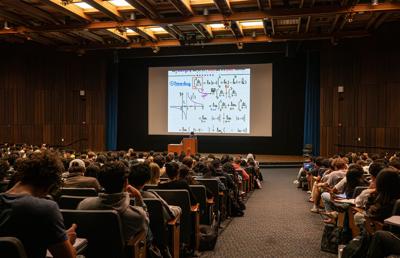
UC Berkeley math professor and Fields Medal winner Richard Borcherds said he thought AI would reach this level in about 10 years. Now, mathematicians disagree about how AI will change their field.
Anjalie Butte | StaffAfter OpenAI announced that it had solved one of mathematics' hardest unsolved problems, the Navier-Stokes existence and smoothness problem, mathematicians at UC Berkeley began thinking about how AI could change the future of their field.
The Navier-Stokes problem was announced in 2000 as one of seven “Millennium Prize Problems.” The Clay Mathematics Institute chose these problems to celebrate “mathematics in the new millennium.” Anyone who solves one of them receives $1 million.
OpenAI's solution was created by an internal AI model that used about 10,000 AI agents, or computer systems that can work on their own. OpenAI research scientist Noam Brown said in a post on X that the work cost “millions of dollars,” more than the prize itself.
Yes, this result cost millions of dollars. But remember that when @OpenAI announced o3 it cost about $500,000 to score 87.5% on ARC-AGI 1. Today, Astra scores higher for about $20. In 2025, it took us and GDM an enormous amount of computing power to reach gold-medal level at the IMO. For the 2026 IMO, anyone with a $20-a-month ChatGPT subscription could do it. Using much more computing power while a model works on a problem gives us a glimpse of the future. I believe that a year from now, everyone will have an AI at their fingertips that can solve problems of this level.
— Noam Brown (@polynoamial) September 8, 2026
UC Berkeley math professor Richard Borcherds, who won the 1998 Fields Medal, an award often seen as the mathematics equivalent of the Nobel Prize, said he had expected AI to reach this level in about 10 years. He is surprised by how quickly AI is improving.
“It's fairly obvious that if things go like this, in a few years, humans doing math research will be redundant,” Borcherds said.
He added that it is hard to know what advice to give graduate students because the future is “changing in a rather major way.” Borcherds said AI is already better than students who are just starting graduate school.
“If you're starting off as a (graduate) student in math, it's likely that AI will always be better than you at mathematics,” Borcherds said. “Grad students are not stupid — this has occurred to all of them, and quite a lot of them are dropping out or getting very worried about it.”
But Robin Huang, who is in the final year of her math Ph.D. program at UC Berkeley, is not yet convinced that AI is as capable as some people believe. She has used AI to help with her own research, but has found it “very stupid and very inefficient.”
Huang said she believes many graduate students and postdoctoral researchers in mathematics are worried about finding jobs. Still, she remains hopeful about the future. She said that if AI's abilities stayed the same, she could learn much more about mathematics in a “perfect vacuum,” meaning a situation without outside changes or pressures.
Huang called AI companies' efforts to solve unsolved math problems an “extremely cynical undertaking” and said she believes AI is harming the math community. She accused AI companies of making mathematicians compete against one another and creating fear of being “scooped.” This means another researcher — or, more recently, an AI model — publishes a result before someone else can.
OpenAI's Navier-Stokes solution is now facing questions from mathematicians. One of them is New York University math professor Tristan Buckmaster, who posted a statement on social media claiming that the AI models may have been trained using prompts that Buckmaster and his collaborators entered into OpenAI's Codex. He also claimed that OpenAI refused to credit mathematician Levent Alpöge because of his connections to Anthropic, a competing AI company.
Borcherds said he is not worried about AI and that these advances do not matter if people enjoy learning mathematics.
“People are complaining that AI is pushing out this 100,000-line formal proof of some major conjecture. I don't really see what harm this does because you can always ignore this if you want, and then you're no worse off than before,” Borcherds said. “I think what people are getting upset about is they're slowly realizing that they are dumb and somehow blaming this on AI, even though it's not really AI's fault.”
Borcherds currently teaches MATH 250A, a graduate-level course on abstract algebra. He also said AI would be much better than he is at teaching the course. In his view, AI is more patient, explains things more clearly and does not get angry when students ask questions that seem silly.
Borcherds said he has asked AI “deep mathematical questions” and received “much better answers from it than (he gets) from any human mathematician.”
Huang tells her students that mathematics is partly about sharing ideas with other people. Borcherds agreed, saying that other people taught him nearly everything he knows about mathematics. However, he added that it does not “(make) much difference” whether he learns mathematics from AI or from other mathematicians.
Huang said she believes mathematics involves something “deeply creative,” unlike the laboratory sciences, in her view. Mathematics involves developing one's own way of understanding the world, she said, and she does not believe AI can do that.
“I've told my students that you can, by all means, use AI,” Huang said. “I don't care if you do your homework or not. But if you don't do your homework by yourself, you will fail the f--- out of the exam.”
Huang also discussed concerns that the math community rewards the wrong things and that mathematicians have come to believe that mathematics is mainly about proving major unsolved problems.
“Maybe AI companies are able to do this because our community standards and incentives were already wrong,” Huang said. “We already knew this, and maybe this will be a wake-up call for us. I'm not saying that I'm confident that everything will change immediately, but I do have faith that we will be able to move past this. … The other thing is, there are other things in life that make me happy. Even if — which I do not think will happen — but, even if (AI) completely takes over math, there are things in life that may not be, and life goes on.”