
Artificial Intelligence ethics and sustainability panel gathers experts on emerging tech – The Appalachian
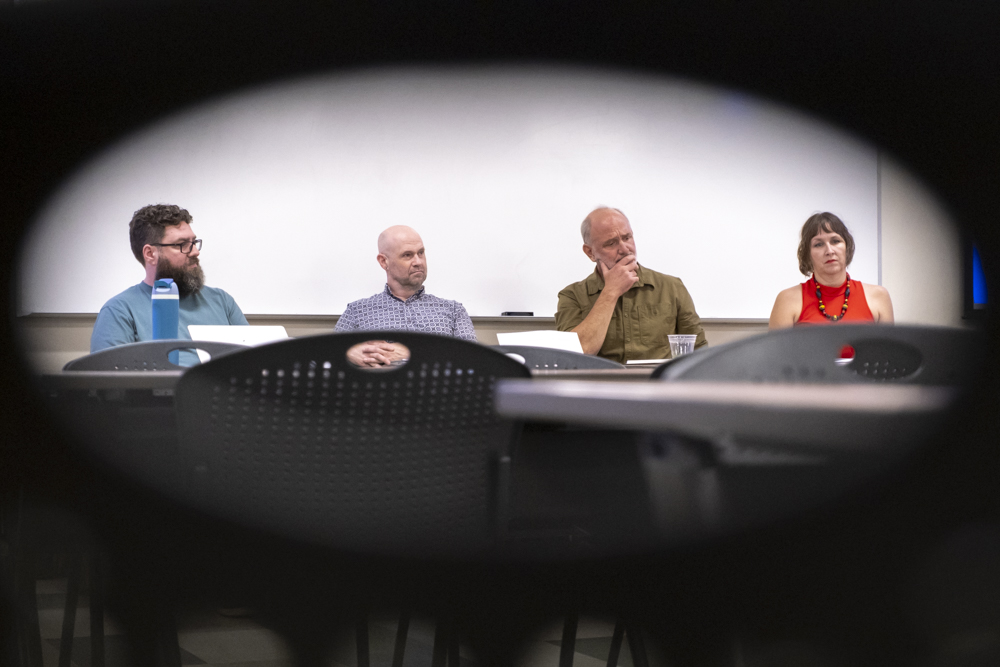
From left to right: Michael Vaughn, App State’s AI Literacy team lead, with Dr. Christopher Bartel, Dr. Jacqueline Ignatova and Dr. Richard Rheingans, App State professors, at their panel in Anne Belk Hall Oct. 14.
AppVotes held an panel about AI ethics in Anne Belk Hall on Wednesday evening. The event aimed to help students understand debates about whether artificial intelligence (AI) can be sustainable before the midterm elections. The panel was held with the Constructive Dialogue Institute, a nonprofit that studies and creates public tools to help people from different backgrounds and cultures communicate with each other.
Aidan Beauregard, a senior majoring in political science, introduced the panel. He explained that the goal was not to convince the audience to support one side.
“This is not for all of you to walk out with a unanimous opinion on AI tonight,” Beauregard said. “However, we want all of you to practice how to engage with messy, controversial subjects like this in a civil and constructive manner.”
The panel included four App State faculty and staff members with knowledge of AI systems, technology ethics and sustainability: Michael Vaughn, Christopher Bartel, Richard Rheingans and Jacqui Ignatova.
Vaughn leads Chancellor Heather Norris’s AI task force. He organizes training to help faculty and staff use AI tools responsibly. Vaughn said he does not fully support or oppose AI. Instead, he focuses on how people can manage its risks, just as they would with any technology that could cause harm. He said AI risks include false information and material showing child sexual abuse.
“It is a really powerful machine that can cause a tremendous amount of harm if it’s misused. If you want to do something like drive a vehicle, which is a dangerous thing to do, you have to go through rigorous, monthlong training, you have to be regularly tested, you have to register yourself with the state as a driver,” Vaughn said. “You have to review those things and there is a whole system to ensure people are being safe.”
Bartel is a philosophy professor whose research has focused on art, video games and the ethical problems built into technology. He studies whether AI, or any other tool, can be free of ethical concerns. Bartel believes AI has more built-in ethical problems than other technologies.
“I don’t blame a baseball bat for being used as a weapon, but I do feel very differently about landmines,” Bartel said.
Rheingans is a professor of sustainable development who studies the links between society, the economy and the environment. He is concerned about the social and environmental costs communities may face when AI infrastructure is built on their land. He also worries that most of AI's economic benefits go to technology companies rather than local communities.
“The distribution of benefits and harms is highly inequitable,” Rheingans said. “The cost will be borne among the rest of us.”
Ignatova is a professor of sustainable development who studies environmental politics in Africa. She discussed environmental dangers and the lack of informed, voluntary agreement from communities before data centers are built. As an educator, she was also concerned about a Massachusetts Institute of Technology study on cognitive surrender. This happens when people turn to AI as soon as they face a challenge in class or in social situations, rather than thinking carefully about the world around them.
“For me as a professor, I feel like this is very much at odds with what we should be doing in university settings. We should be supporting critical thinking development in your writing,” Ignatova said. “Struggling to communicate is so important and if we surrender our brains to AI we’re not going to be better for it.”
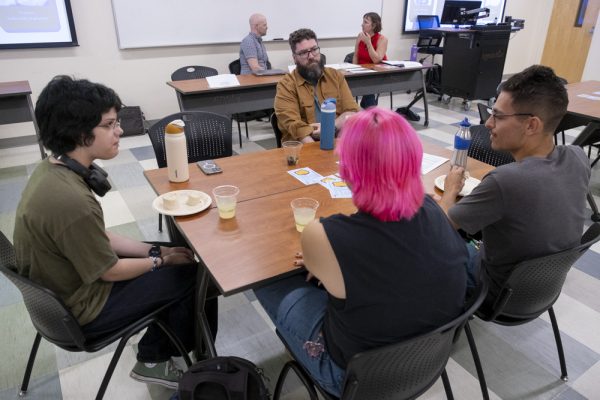
After the panel, professors met with small groups of students at individual tables to discuss their concerns openly. Rheingans spoke with one group about how AI is used to make inefficient tasks easier. Instead of avoiding inconvenience, the group discussed accepting the everyday challenges, or “friction,” of tasks such as household chores and deciding what to wear in the morning. The group agreed that avoiding these small challenges could mean missing out on an important part of being human.