
Not Nvidia. Not Micron. This Artificial Intelligence (AI) Chip Stock Has the Most Upside Through 2030.
As artificial intelligence (AI) continues to grow and change, investors face a harder question: Which chip companies will be the biggest winners five years from now?
Nvidia (NVDA +0.73%) faces growing competition because its biggest customers are developing their own chips. Meanwhile, Micron Technology (MU +3.32%) could face a tougher memory market as manufacturers increase production.
That is why I see Taiwan Semiconductor Manufacturing (TSM +1.40%), also known as TSMC, as a more attractive long-term investment. The company's latest earnings report showed how valuable its business is becoming as companies build the equipment needed to power AI.
Image source: Taiwan Semiconductor Manufacturing.
Nvidia and Micron face risks that Taiwan Semi can handle
Nvidia is the clear leader in the AI accelerator market. Its strengths include graphics processing units (GPUs), networking technology, and its CUDA software system. However, some of its biggest customers are developing other options. Alphabet, Amazon, Microsoft, and Meta Platforms are investing in application-specific integrated circuits (ASICs). These chips are designed to handle each company's own AI tasks. They are unlikely to replace Nvidia's GPUs completely, but they could make these large technology companies less dependent on Nvidia and give them more control over infrastructure costs and how well their AI models perform.
Nvidia is also exploring agentic AI, self-driving vehicles, and robotics. These areas could offer huge opportunities, but it may take longer than the next four years for them to become widely used commercially.
Micron faces a different challenge. Its memory products are important for AI computing, especially high-bandwidth memory (HBM) and advanced DRAM. Memory manufacturing has often gone through cycles of shortages and oversupply. Today's shortages and high prices may encourage manufacturers to build more factories and increase production. By the next decade, more memory could be available, putting pressure on prices and reducing profit margins.
Competition from China's ChangXin Memory Technologies (CXMT) is another factor to watch. CXMT does not yet match competitors in every advanced memory category, but its progress could affect how much memory the industry can supply over time.
Here is what makes TSMC different: Whether large AI companies buy Nvidia GPUs, develop their own chips, or use completely new chip designs, many of those chips will need TSMC's advanced manufacturing services. This means TSMC does not need Nvidia to beat Alphabet's custom-chip plans. It can make chips for both companies.
Taiwan Semi's Q3 earnings were incredible
Taiwan Semi's third-quarter earnings report showed just how strong its position is. The company made $46.7 billion in revenue, up 41% from the same period a year earlier. Its gross profit margin was 66.4%, and its operating profit margin was 58.7%. These results show the company's pricing power, or its ability to charge strong prices because its advanced chipmaking technology is so valuable to customers.
Company leaders expect AI-driven growth to continue. For the fourth quarter, they forecast revenue of between $52.3 billion and $54.3 billion as production of the company's next-generation 2-nanometer chips continues to increase.
Why Taiwan Semi stock could surge
Building a semiconductor factory requires a huge amount of money upfront, years of engineering work, and the ability to make complex chips with few defects at a cost that makes commercial sense. These challenges make it difficult for new competitors to enter the market. As demand for AI computing grows, TSMC should benefit from making more chips, using more advanced manufacturing methods, and finding more ways to package advanced chips.
The company's opportunities also go beyond the AI hardware used today. Consider what could happen between now and 2030. AI computing is likely to move from training large language models (LLMs) toward using these models to make predictions and carry out tasks, a process called inference. This could happen in self-driving systems, robots, and applications that have not yet become widely available. Some of these uses will need more GPUs, while others will rely on custom AI chips, central processing units (CPUs), or other specialized processors.
TSMC does not make DRAM or HBM memory. However, it does make advanced logic chips that work alongside these types of memory. In other words, Taiwan Semi could benefit as AI develops in many different directions instead of depending on just one type of semiconductor.
This flexibility could help Taiwan Semi's stock valuation rise more than those of other chip companies. In the past, chip manufacturers often traded at lower valuations than chip designers because manufacturing requires so much money to build and maintain. But TSMC's leading position in advanced chip manufacturing, rising profitability, and essential role in the AI supply chain could justify investors paying more for each dollar of its earnings over the long term.
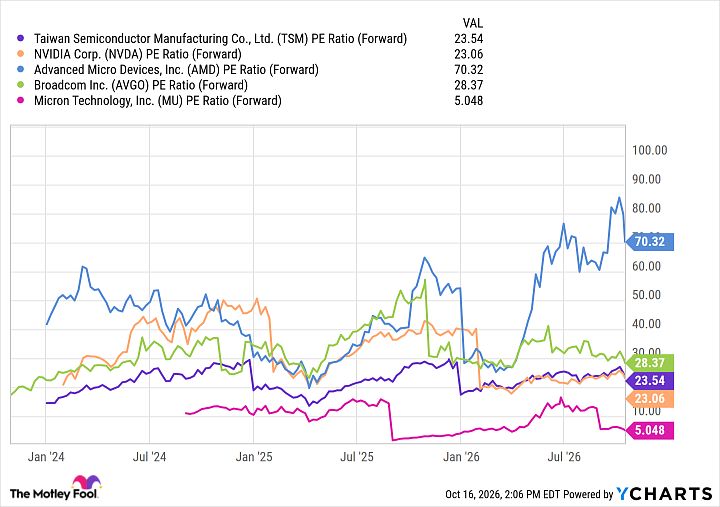
TSM forward price-to-earnings ratio data from YCharts.
In my view, Taiwan Semi offers a special opportunity: investors can gain exposure to many kinds of advanced chips, no matter which chip designers become most popular. Given its manufacturing strengths, strong profits, and potential for long-term growth, I see TSMC as an attractive AI chip stock to buy and hold through 2030.