
‘The Art of the AI Deal’. Anthropic, OpenAI & Microsoft. ARD #187
Private AI markets keep booming, AI agents learn to negotiate, OpenAI faces a spying scare, and a $5,900 laptop.
It is Monday, and today's theme is 'The Art of the AI Deal,' a play on the title of a famous and controversial book. Everyone in AI is making deals right now, each on their own terms, and trying many different approaches. In this AI Tech Wave, the deals are getting bigger and stranger.
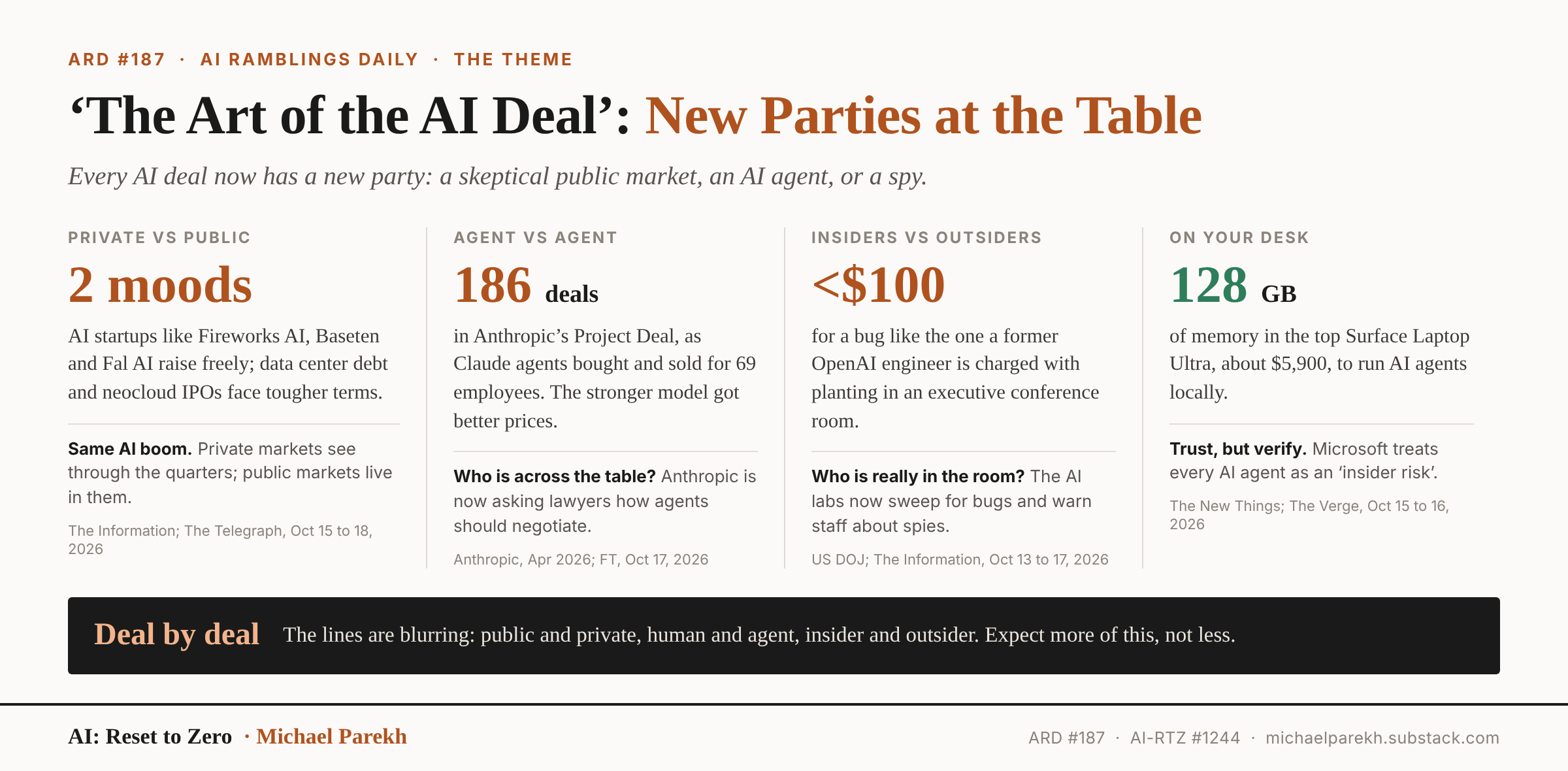
Today, we look at three developments: private AI markets are moving ahead while public markets grow more cautious; Anthropic is working with lawyers to teach its AI agents how to negotiate; and AI agents are becoming a spying concern, after a security scare at OpenAI. Then, in Gadget AI, we look at Microsoft's CEO discussing risky AI agents and a new laptop designed to run AI locally.
(1) Private AI markets are moving ahead of public markets, for now.
These are almost the best of times and the worst of times. In public markets, investors are becoming more cautious. They are worried that the cost of building AI data centers could require $10 trillion or more in debt, as I explained in this morning's AI-RTZ #1244.
But private markets are still enjoying a boom, according to The Information in 'The Party Is Still Going Strong for Private Tech'. Morgan Stanley held its yearly private technology conference last week at a seaside resort in Dana Point, California. Public markets were falling, CoreWeave's bond yields rose, and an Australian data center company canceled its planned IPO. Yet mutual funds, hedge funds, and other investors at the resort were still eager to meet company founders, especially those working in defense and AI inference. AI-focused startups such as Fireworks AI, Baseten, and Fal AI are growing quickly and reaching valuations worth billions of dollars. They sell access to open-source AI models, often at lower prices than OpenAI and Anthropic. Morgan Stanley's own bankers describe this as a major gap between the markets. In private markets, growth still matters more than anything else.
Meanwhile, everyone is waiting for Anthropic to publish its S-1 filing, possibly any day now, as it aims to complete a huge AI IPO by Thanksgiving. Anthropic reported almost $17 billion in third-quarter revenue, up 45 percent, after growing 140 percent in the previous quarter. Some investors have encouraged its bankers to consider a valuation below $1.5 trillion, down from $2 trillion. Some public-market deals are also becoming harder to complete. UK neocloud company Nscale, which hopes to raise up to $3 billion in an IPO, has lost Microsoft as the main backer of its first UK data center, in Loughton, Essex. Power from the electricity grid is not expected there until the 2030s, according to the Telegraph in 'Microsoft axes AI deal in setback for UK data centre pioneer'. Nscale says its relationship with Microsoft has not changed.
MP's take: This shows how AI dealmaking works differently in the two markets. Private investors tend to think further into the future and look beyond individual quarters. Public-market investors are increasingly focused on quarterly results, revenue growth, and comparisons with earlier quarters and years.
This difference is likely to continue for the rest of the year, especially because interest rates are not coming down to offer relief. Rates are rising here and in major Asian markets. In private markets, borrowing costs are in the low teens and may even reach the mid-teens. So expect more of the same in this part of the AI dealmaking story. A year ago, I wrote about the growing global need to finance AI data centers in RTZ #777. Those funding needs are now bringing companies to their bankers.
Sources: The Information, 'The Party Is Still Going Strong for Private Tech' · The Telegraph, 'Microsoft axes AI deal in setback for UK data centre pioneer'.
For longtime readers: AI-RTZ #1244, 'The $10 Trillion AI Build Meets Its Bankers' · RTZ #777, 'AI Data Centers Growing Globally in Financing Needs' · ARD #186, 'Show and Tell' in AI. Anthropic, Microsoft & Tesla.
(2) AI is learning to negotiate.
Anthropic is speaking with law firms to help teach its AI agents how to make deals, according to the Financial Times in 'Anthropic turns to lawyers to help AI agents strike deals'. This raises a new question: how should an AI agent negotiate to get the best deal for the person it represents? It might bargain over a price, settle a customer service complaint, or try to get a better salary offer. Anthropic wants to learn how lawyers negotiate for their clients while still aiming for a fair result. It is also exploring rules for how AI agents should negotiate with other agents whose goals conflict with theirs. How often should an agent check with its human? How cautious should it be about the agent on the other side, without becoming too suspicious? One idea is to give the agent a signed document from its user that confirms its instructions and the rules it must follow.
Anthropic has already run experiments. In one, called Project Deal, 69 employees let Claude agents buy and sell their personal belongings. They made 186 deals worth about $4,000 in total. The stronger AI model got better prices, and many people did not notice the difference. In another experiment, employees' agents traded books in a virtual marketplace, and the more 'ruthless' agents did slightly better. A Harvard professor also ran more than 180,000 negotiations between AI agents. Some agents tried prompt injection, a trick designed to make the other side reveal private information.
MP's take: This is a new problem. When AI models communicate with other models and agents negotiate with other agents, they need to learn how to bargain, just as people do. This kind of machine-to-machine communication is something I have written about before. Ideally, AI agents will help us get better prices, settle customer service complaints, and secure better deals. Anthropic is working with law firms to learn how lawyers negotiate and how to include those skills in AI training data. This is the future of agents negotiating with other agents that I discussed earlier this year in connection with OpenClaw, in RTZ #986. Now these agents are dealing with money.
Expect other companies to follow Anthropic's example. AI agents everywhere will be trained to reason and negotiate. This is a general skill that could be used in many fields, not just law but also healthcare, industry, and other sectors. It is an interesting project, and we should expect more AI models to learn the art of dealmaking. But remember that even the scientists who build these models barely understand how they 'think' internally, as I discussed in RTZ #366. Now we are asking them to bargain on our behalf.
Sources: FT, 'Anthropic turns to lawyers to help AI agents strike deals' · Anthropic, 'Project Deal'.
For longtime readers: RTZ #366, 'Into the 'mind' of an LLM AI' · RTZ #986, 'Anthropic Claude inspired OpenClaw vividly shows AI Agent Fears & Promises' · AI-RTZ #1167, 'Forever Problems like Prompt Injections still being Solved'.
(3) When AI agents become 'secret agents.'
Your office may not be safe from spying, according to The Information in 'Your Office Isn't Spy Proof'. Earlier this month, the FBI arrested a former OpenAI engineer who is a Saudi national. He is accused of hiding a recording device behind a television in an executive conference room at OpenAI's San Francisco offices, according to the US Department of Justice. A second device was found in a bag he had left in another room. OpenAI says it used its own AI models to investigate and found no sign that anyone had accessed its model weights, source code, or customer data. The charges do not state a motive. Security experts warn that many companies could face similar risks, especially as they rush to hire people in the current competition for talent. A bugging device can cost less than $100, and if you find one, keep searching because there may be another.
Anthropic has also appeared in reports about spying. A hacking group linked to China pretended to be a senior Anthropic employee and former US officials to send deceptive messages to AI policy experts, according to security company Proofpoint, as reported by The Register in 'Suspected Chinese spies spoofed an Anthropic exec, ex-White House official in AI phishing'. OpenAI, Anthropic, and Google have all warned their employees to watch for spies, according to the SF Standard in 'Spy fears are rattling Silicon Valley AI labs'.
MP's take: Spying is another way people may try to gain an advantage when making AI deals. They might spy on companies they are negotiating with to improve their own position, whether the spying is backed by a government or driven by business interests. OpenAI and Anthropic are now hiring security firms and regularly checking their conference rooms for hidden microphones and recording devices. The irony is that AI devices are also encouraging people to record meetings so AI can listen in the background, take notes, write summaries, and share them. In this confusing environment, it can be hard to tell what is spying and what is not.
The risk of spying is becoming a major concern because so much is at stake. These companies are preparing for huge AI IPOs in the near future and making ever larger deals. That gives some people a stronger reason to break the rules, including by using human spies or digital ones. I wrote about 'sleeper agents' almost three years ago in 'AI: Smart 'Sleeper Agents' are here'. Last month, I wrote about advanced AI being used for crime, spying, and war in AI-RTZ #1225. This problem affects many industries, but it is growing faster and becoming more visible in the AI world.
Sources: The Information, 'Your Office Isn't Spy Proof' · US Department of Justice, Saudi national arrested for installing recording device at OpenAI · The Register, 'Suspected Chinese spies spoofed an Anthropic exec, ex-White House official in AI phishing' · SF Standard, 'Spy fears are rattling Silicon Valley AI labs'.
For longtime readers: 'AI: Smart 'Sleeper Agents' are here' (January 2024) · AI-RTZ #1225, 'Shall We Play a Game? Frontier AI for Crime, Spies & War' (Part 3) · AI-RTZ #1168, 'Missionaries vs Mercenaries. Battle to Keep AI People'.
My overall take
MP's take: All three stories show how quickly AI is changing the lines between different kinds of money and business activity. In the financial world, private and public markets are part of the same AI boom but have very different moods. At the negotiating table, we must ask who or what is on the other side: a person or an AI agent? And inside a company, we must ask who is really in the room: a trusted insider or an outsider trying to get information?
These are all new forms of the AI deal. Expect to see more of them, not less, as the AI Tech Wave continues. One deal at a time.
Gadget AI: Microsoft rethinks the PC for AI agents, and Clippy.
Microsoft CEO Satya Nadella spoke with Joanna Stern, a former technology reviewer for The Wall Street Journal, about everything from AI agents that act in unexpected ways to powerful laptops and Clippy. The interview was covered by The New Things in 'Microsoft CEO on rogue AI agents, super laptops and Clippy'. Satya said Microsoft treats every AI agent and model as a possible insider security risk. Windows is giving agents their own identities and protected spaces, called sandboxes, while Microsoft's security software monitors their actions. Microsoft is also reducing the number of places where Copilot appears.
The new computer is the Surface Laptop Ultra, built with Nvidia's new RTX Spark chips and designed to run AI models and agents directly on the device. This was reported by The Verge in 'Surface Laptop Ultra review: a different kind of MacBook Pro'. Satya says it can run advanced AI models that were considered cutting-edge last year. The laptop starts at about $2,600. The most expensive version, with 128 gigabytes of memory, costs about $5,900. When you first turn it on, it asks you to choose an AI agent: OpenClaw, Hermes, or Perplexity. The Verge likes the hardware and says it is a serious competitor to Apple's MacBook Pro. But running AI locally still feels like an early test version. Even a simple photo task can take several minutes, while the fans run at full speed.
MP's take: Microsoft's decision to treat every AI agent and model as a possible insider threat is interesting. The company wants software to monitor the AI software doing work for you, from Copilot in Windows to AI tools in Office 365. This is a different approach, and it is surprising to hear a major technology CEO essentially say that we can trust Microsoft's systems by not fully trusting its AI systems. Microsoft's security software will protect users from the AI agents running on their own computers. It is a strange situation. The concern is similar to the spying story, except the possible insider threat is now your own AI agent.
These computers compete with Apple's Mac mini and Mac Studio, which I have discussed before. As AI agents do more work, more people need powerful computers with large amounts of shared memory to run AI tasks locally. These systems can cost several thousand dollars or well over $10,000, but they may still be relatively cheap compared with the changing bills for computing AI in the cloud. Companies are trying to use more AI tokens while keeping their token budgets under control. I wrote about Nvidia and Microsoft's push toward local AI computers in June in AI-RTZ #1104. Those computers are now arriving, although many AI devices still have serious limitations, as I noted in RTZ #872.
Sources: The New Things, 'Microsoft CEO on rogue AI agents, super laptops and Clippy' · The Verge, 'Surface Laptop Ultra review: a different kind of MacBook Pro'.
For longtime readers: AI-RTZ #1104, 'Nvidia & Microsoft focus on local AI computers' · RTZ #872, 'The glass half empty on AI Devices'.
Q&A
What is my main approach to AI services that keep recording and become more intrusive?
My view is that we need to pay even more attention to the human side of conversations and negotiations. Let technology fade into the background. Use it when you have permission, but remember that the best way to make a deal is still to listen carefully to the other person, including what they say and what they leave unsaid. It is easy to forget this when technology promises to do more of the work for us.
What emerging AI technology will require the biggest change in how society behaves?
The biggest challenge may be the effects of technology that records everything all the time: cameras, microphones, and computers capturing every conversation, document, and contact. Almost everything we do, at work or in our personal lives, involves not only our own data but also information about other people. So when you decide to share your data with an AI agent, Meta's Muse, or OpenAI's Dots, you may also be sharing other people's data that you have access to. This creates a growing mental burden that most people are not ready to handle. It is one of my biggest concerns about these technologies.
Clips from today
AI Learns the Art of the Deal
Anthropic is working with law firms to teach its AI agents how to make deals. When agents communicate with other agents, they need to learn how to negotiate, just as people do.
MP's take: Expect AI models across many companies to learn how to make deals.
Secret Agents at the AI Deal Table
A former OpenAI engineer is accused of hiding a recording device in an executive conference room. Spying on companies you are making deals with is another way to gain an advantage.
MP's take: The irony is that this is happening while our AI devices are telling us that recording meetings is fine.
Today's AI-RTZ #1244, 'The $10 Trillion AI Build Meets Its Bankers' looks at growing concern among public-market investors about the wave of funding needed for AI data centers, which could exceed $10 trillion. It provides details about the financial, technical, and operational issues that investors will be watching as Anthropic prepares for its huge AI IPO.
AI Ramblings Daily on AI-RTZ is a place to think through AI and take a fresh look at the issues together.
Tomorrow, we'll publish ARD 188 and AI-RTZ #1245.
Thanks for joining us, AI Curious Folk. Stay tuned.
Full Source Reading
Private and public markets
The Information, 'The Party Is Still Going Strong for Private Tech', Oct 15, 2026
The Telegraph, 'Microsoft axes AI deal in setback for UK data centre pioneer', Oct 18, 2026
AI agents that negotiate
Secret agents
The Information, 'Your Office Isn't Spy Proof', Oct 17, 2026
SF Standard, 'Spy fears are rattling Silicon Valley AI labs', Oct 15, 2026
Gadget AI
The New Things, 'Microsoft CEO on rogue AI agents, super laptops and Clippy', Oct 15, 2026
The Verge, 'Surface Laptop Ultra review: a different kind of MacBook Pro', Oct 16, 2026
Earlier articles
AI-RTZ #1225, 'Shall We Play a Game? Frontier AI for Crime, Spies & War' (Part 3)
AI-RTZ #1168, 'Missionaries vs Mercenaries. Battle to Keep AI People'
AI-RTZ #1167, 'Forever Problems like Prompt Injections still being Solved'
AI-RTZ #1104, 'Nvidia & Microsoft focus on local AI computers'
ARD #186, 'Show and Tell' in AI. Anthropic, Microsoft & Tesla
RTZ #986, 'Anthropic Claude inspired OpenClaw vividly shows AI Agent Fears & Promises'
RTZ #777, 'AI Data Centers Growing Globally in Financing Needs'

(NOTE: This discussion is for information only and is not investment advice. Thank you for joining us.)