
Macurdy AI bills draw warnings about costs, rapidly advancing AI models, and regulatory patchwork - New Jersey Globe
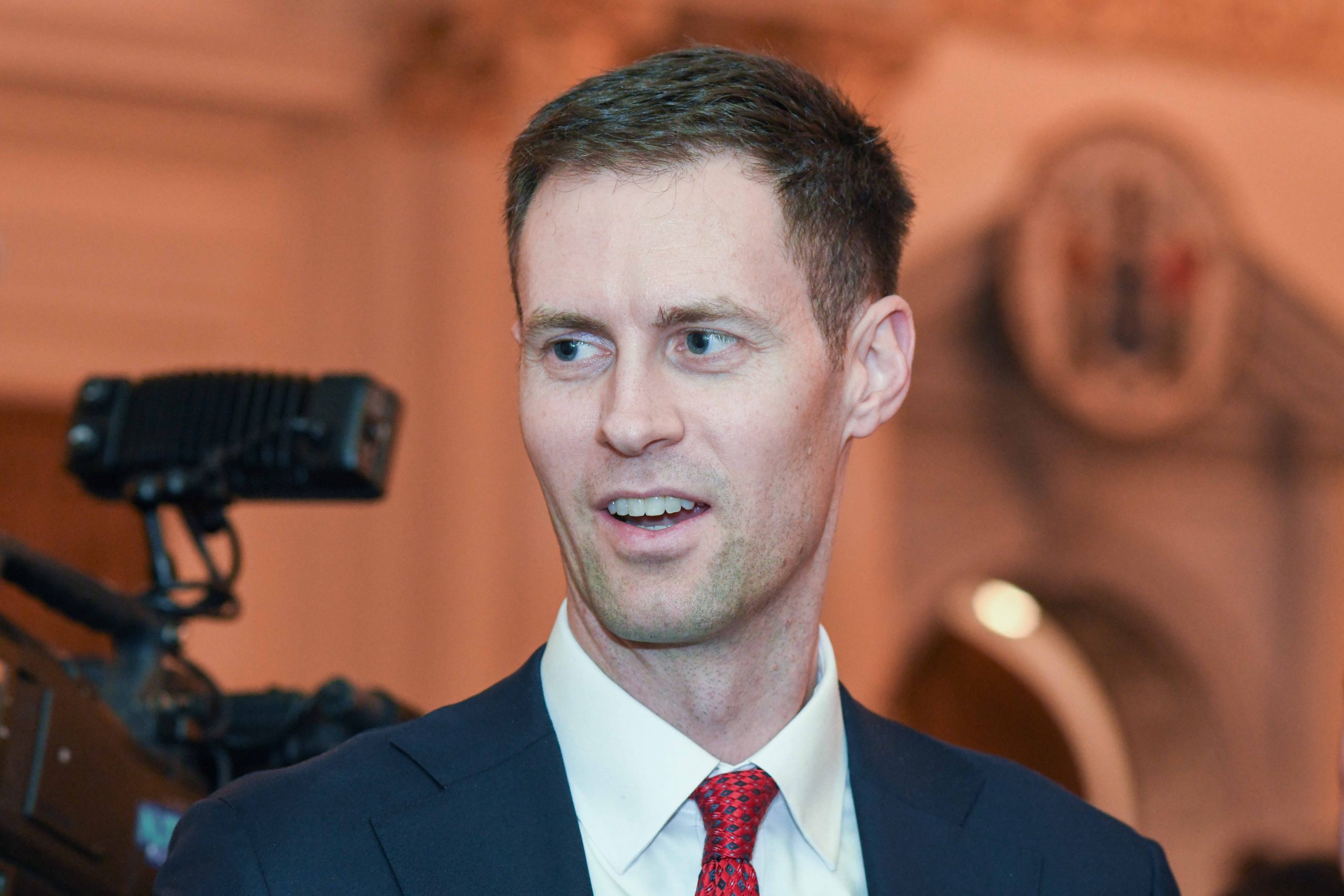
Assemblyman Andrew Macurdy at the Governor’s State of the State Address on January 13, 2026. (Photo: Kevin Sanders for the New Jersey Globe)
A first-term Democratic lawmaker wants stronger protections against increasingly powerful AI systems. But a business group warns that new rules could hurt smaller companies.
By Joe Seewald, October 19 2026 7:34 pm
As artificial intelligence (AI) becomes more powerful and could pose greater dangers, a first-term Democratic lawmaker wants New Jersey to introduce new protections. But business leaders warn that the proposed rules could raise costs, slow new ideas, and drive AI companies out of the state.
Assemblyman Andrew Macurdy (D-Summit) is sponsoring three bills to regulate AI. He says the technology is advancing so quickly that government protections are struggling to keep up.
“AI can bring enormous societal benefits; it also carries the potential for catastrophic threats,” Macurdy said during an Assembly committee hearing on Monday.
The committee discussed all three bills but did not vote on them.
A5089, called the “AI Image Disclosure Act,” would require notices on certain content created by AI. A5090, called the “GAI Accountability Act,” would allow civil penalties against generative AI platforms for harmful activities, including the exploitation of children. A5275 would require certain AI developers to share information with the state attorney general.
Macurdy pointed to warnings from former employees of OpenAI and Anthropic about how quickly AI is developing. He said pressure to compete is pushing companies to release increasingly powerful technology.
He also referred to recent cybersecurity tests in which AI models gained access to computer systems without permission. He argued that the technology has advanced greatly since he introduced the bills in May.
In July, OpenAI said that AI models being tested for cybersecurity had gotten around safety protections, accessed the internet, and broken into systems belonging to Hugging Face, a platform for developing AI.
Anthropic later reported three incidents in which its Claude models gained access to real-world systems without permission during cybersecurity tests. The company said a setup error had left the testing environments connected to the internet, even though they were supposed to be kept separate.
“It doesn’t take much imagination to envision increasingly serious harm as this technology evolves,” Macurdy said.
He argued that making AI companies legally responsible for harm through civil lawsuits would give them a financial reason to improve safety protections.
“If the companies faced the real possibility of civil liability and it impacts their bottom line, they will take stronger measures,” Macurdy said.
Jack Ramirez, a research analyst for the New Jersey Business and Industry Association, said the group supports sensible AI safety rules. However, he warned that the proposed rules could create major costs for smaller developers and startups.
“For our small and medium-sized artificial intelligence companies, this not only would be felt in their bottom lines but would be detrimental,” Ramirez said.
Ramirez was especially concerned about A5275. He argued that disclosure rules specific to New Jersey could create problems for companies making AI products for use across the country.
“A product that is inherently global or can cross states creates a multitude of problems for organizations trying to implement this tool and enter this market,” Ramirez said.
“We disagree with the concept of patchwork,” he added. He said NJBIA prefers one set of federal rules instead of different rules in each state.
Ramirez warned that companies might choose not to offer certain AI products in New Jersey rather than pay the costs of meeting rules that differ from those in other states.
Although Ramirez opposes the bills, he praised Macurdy for being willing to work with the business community.
“The assemblyman has been absolutely amazing to work with so far,” he said.