
AI: Anthropic’s Margin, OpenAI’s Opportunity. AI-RTZ #1251
OpenAI’s big discounts are drawing Replit, Rippling, and other customers away from Anthropic as the AI price war grows ahead of their planned stock market listings.

I have used a line from Jeff Bezos several times this year when writing about the AI technology wave.
The line helps explain the pricing battle between Anthropic and OpenAI as both companies prepare for huge AI stock market listings. Anthropic is expected to go public first, before Thanksgiving.
In July, I wrote about Anthropic expanding the price range around its best models in ARD #114. In August, I covered what is called the ‘race to zero’ in AI model prices in AI-RTZ #1169. Earlier this month, I wrote about Anthropic’s strict spending limit compared with OpenAI’s more flexible discounts for business customers in AI-RTZ #1227:
“Your margin is my opportunity.” (Jeff Bezos)
Now, The Information has used a similar idea in its headline: ‘Anthropic’s Margin is OpenAI’s Opportunity’. It names customers, gives real discount examples, and shows customers moving from one company to the other. This is the clearest picture yet of how the AI price war between these two closely linked rivals is unfolding, just weeks before Anthropic’s planned major stock market listing. The report also gives more detail about the large customers that buy AI models in bulk from both companies.
Here is what is happening.
Who is switching, and why
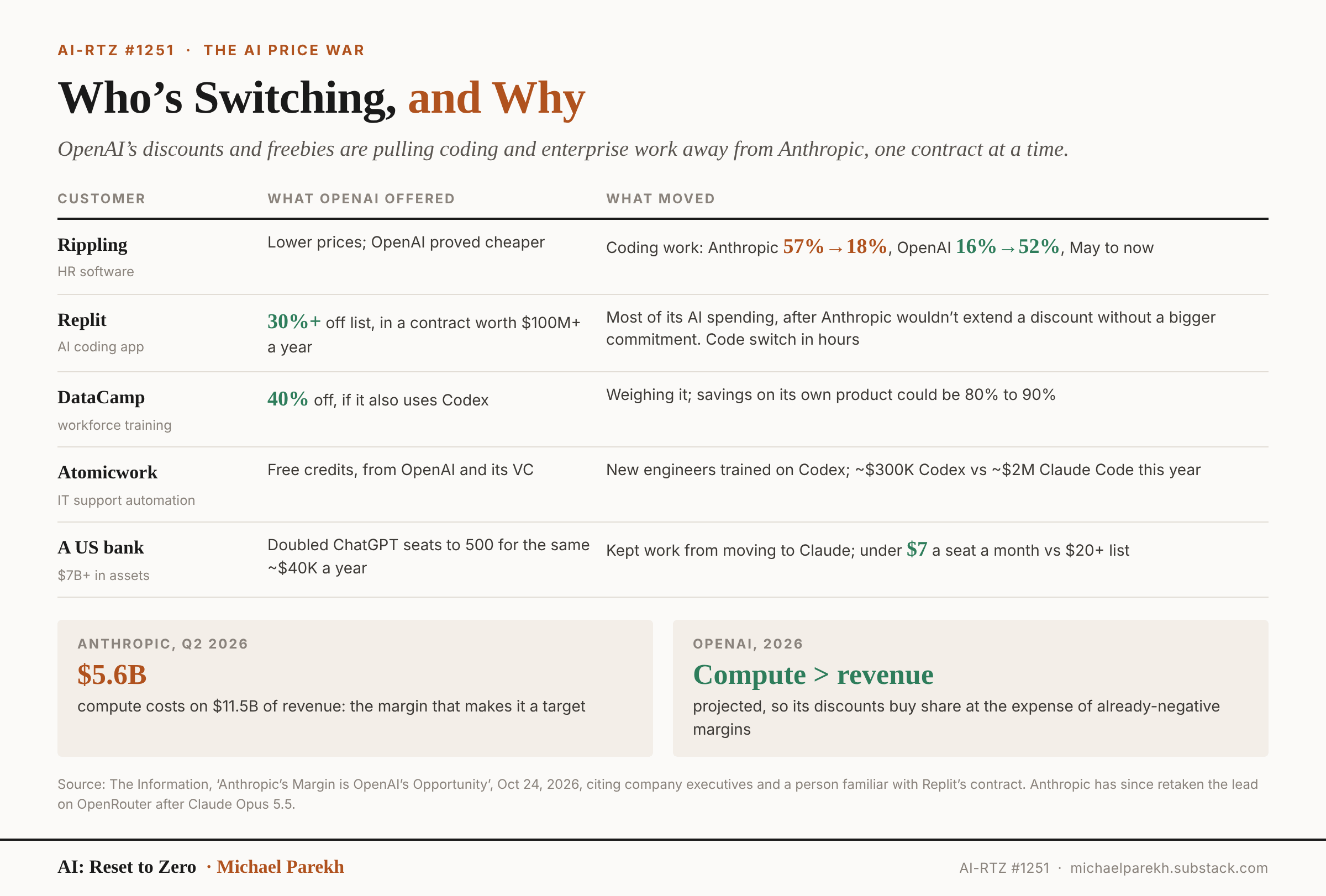
Start with Rippling, a company that makes software for managing employees. In May, Anthropic’s models handled 57 percent of the coding work done by its hundreds of engineers, while OpenAI handled 16 percent. Today, the numbers have reversed: OpenAI handles 52 percent, and Anthropic handles 18 percent. The engineers and the work are the same. Rippling wanted to lower its costs, and OpenAI was cheaper, the company’s CEO told The Information.
Next is Replit, a popular AI coding app used around the world. In recent months, it moved most of its AI spending from Anthropic to OpenAI after OpenAI offered a discount of more than 30 percent on a contract worth over $100 million per year. Replit had originally planned to stay with Anthropic.
But Anthropic would not continue a discount it had previously given Replit unless Replit agreed to spend more money. Moving to OpenAI took only a few hours of code changes, followed by a few days of work on Replit’s products. According to the report, switching was faster than negotiating Replit’s earlier contract with Anthropic.
There are more examples:
DataCamp, a large Anthropic customer, was offered a 40 percent discount on OpenAI’s models if it also switched from Claude Code to OpenAI’s Codex coding tool. DataCamp’s CEO says using OpenAI in its own product could cut costs by 80 to 90 percent.
Atomicwork, which automates IT support, is training new engineers to use Codex instead of Claude Code. It received free credits from OpenAI and from its venture investment firm, which is a major OpenAI investor. Atomicwork still expects to spend about $2 million on Claude Code this year, but its Codex spending is expected to reach almost $300,000, up from almost nothing.
A US bank with more than $7 billion in assets doubled the number of its ChatGPT accounts to 500 while paying roughly the same $40,000 per year. That works out to less than $7 per account per month, compared with a typical price of more than $20. The bank had already started moving some work to Claude.
Part of the difference is also the level of customer support. One startup says OpenAI engineers and sales staff work with it in a shared Slack channel to fix Codex problems as they happen. Anthropic did not provide the same kind of support.
The profit margin OpenAI is going after
Why is OpenAI willing to spend money to win customers? Because Anthropic has high profit margins, and its growth is a major factor in how investors value the company ahead of its stock market listing.
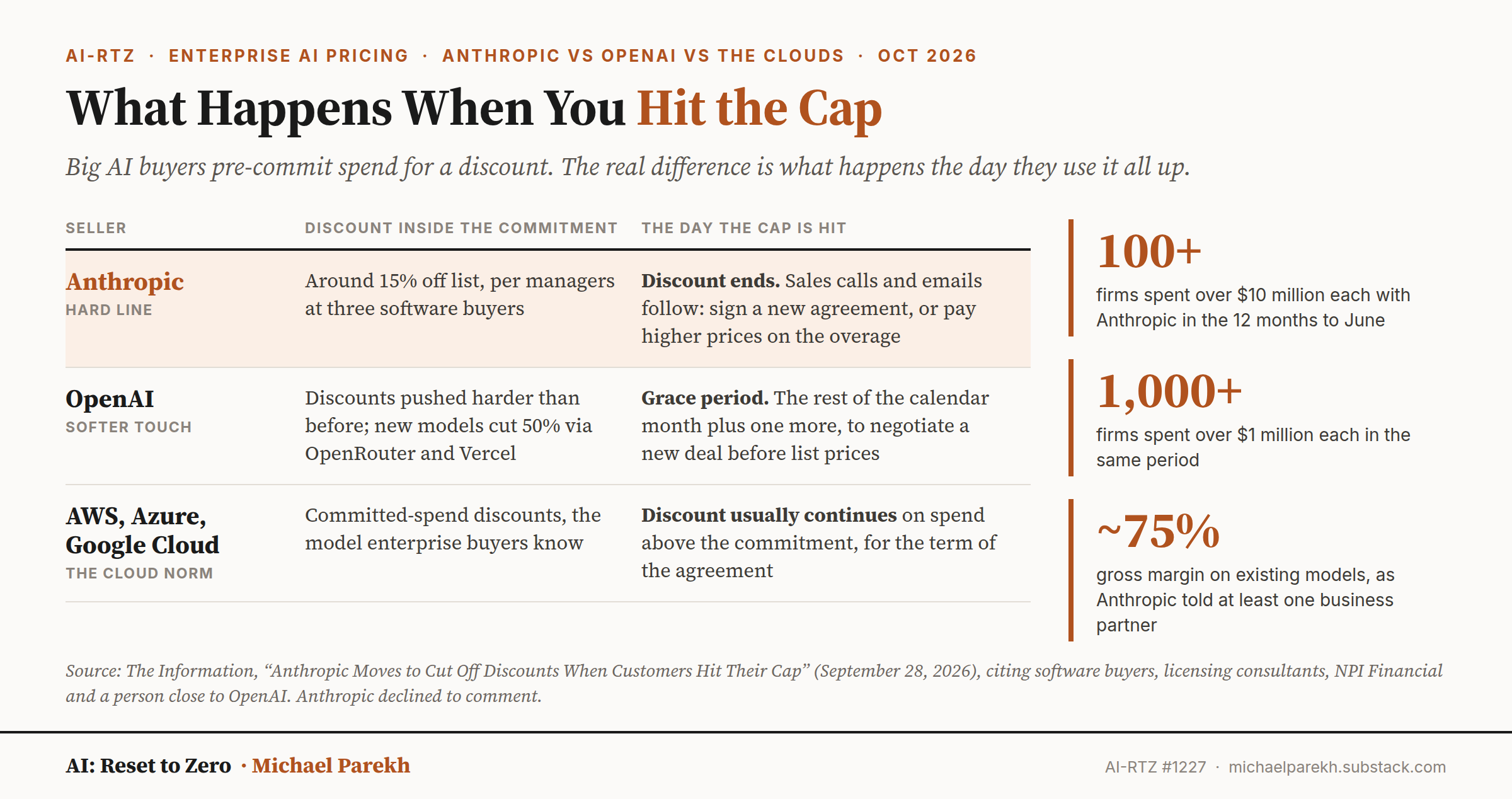
According to The Information, Anthropic spent $5.6 billion on computing in the second quarter, including work to develop new models, while earning $11.5 billion in revenue. Anthropic has told its partners that its existing models have a gross profit margin of about 75 percent, as I noted in AI-RTZ #1227. Its draft S-1 filing shows that revenue is now growing faster than computing costs, as I explained in AI-RTZ #1246. OpenAI, on the other hand, has forecast that its computing costs will be much higher than its revenue this year. This means its discounts are helping it win customers while its profit margins are already below zero.
The companies’ pricing rules also make a difference. Anthropic ends a large customer’s discount as soon as the customer reaches the spending limit in its contract. OpenAI gives customers time to renegotiate their deals. Anthropic’s strict limit is what cost it the Replit business. As I wrote three weeks ago:
“A hard cliff invites exactly what CodeRabbit did: multi-sourcing, and moving the next workload to whoever is cheaper per task.” (AI-RTZ #1227, October 2026)
The growth that matters for Anthropic’s planned stock market listing is also slowing. Its revenue grew 45 percent from the second quarter to the third quarter. That is still very fast, but it is slower than the more-than-doubling growth it reported in the previous quarter. Anthropic shared this information with investors at its investor day, as covered in ARD #186. Over the summer, Anthropic’s revenue was about 50 percent higher than OpenAI’s. Ramp’s data on company spending now shows the two companies at almost the same level.
Large buyers of AI models move first
The important new point is which customers are changing providers: companies that buy AI models in bulk and resell access to them. Companies such as Replit, Cursor, and Cognition put AI models inside their own apps and sell those apps to millions of developers. Their profit comes from the difference between what they charge users and what they pay AI companies for tokens, the units used to measure AI text and other output. This makes them especially sensitive to price changes and quick to switch providers. The move can take hours, not months.
We saw something similar with Cursor. Much of its coding business relied on Anthropic’s Claude, as I noted in ARD #116. Then, in June, Elon Musk’s SpaceX bought Cursor for more than $60 billion, as covered in ARD #98. It was the largest private technology company purchase of its kind so far.
Since then, Cursor has been moving business away from Anthropic and toward OpenAI and SpaceX’s own Grok models. Grok is now part of what Elon calls SpaceX Super Intelligence. Replit’s story is similar, except that a discount, rather than a buyer taking control of the company, helped drive the change.
According to The Information, some of Anthropic’s biggest customers, including Cognition, Meta, and Microsoft, are also building their own alternatives to reduce what they spend on Claude. This is the trend of companies trying to break their dependence on Claude that I discussed in ARD #178 and ARD #180.
Everyone wants a share of the profit
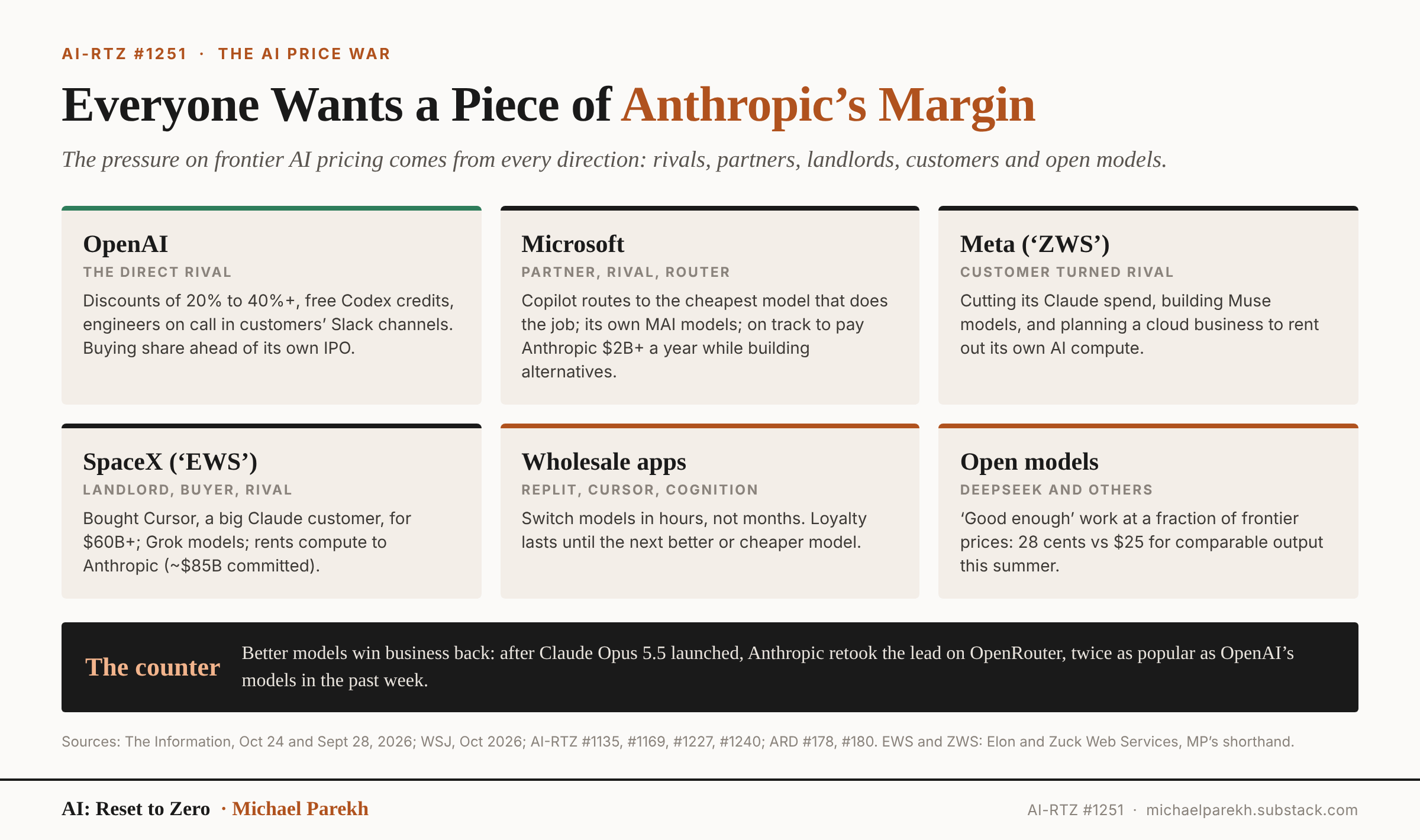
OpenAI is simply the most direct challenger. Pressure to lower the prices of the most advanced AI models is coming from many directions.
Microsoft chose its side back in June, as I wrote in AI-RTZ #1127: it is standing with customers against the companies that build the most advanced AI models. Copilot now sends each task to the cheapest model that can handle it. Microsoft is also building its own MAI models, even though it pays Anthropic more than $2 billion a year, as discussed in AI-RTZ #1240. Microsoft is a partner, a competitor, and a system that chooses which model to use, all at once.
Meta has gone from customer to competitor. It has cut its spending on Claude, built its own Muse models starting with Muse Spark, and plans to offer cloud services that rent out its own AI computing power. I jokingly called this ‘ZWS’, or ‘Zuck Web Services’, in AI-RTZ #1135. The name is a playful reference to Amazon Web Services (AWS), the world’s leading cloud service.
SpaceX, which I call ‘EWS’, or ‘Elon Web Services’, is a landlord, a buyer, and a rival. It owns Cursor and Grok, rents data center capacity to Anthropic under commitments worth about $85 billion, and even uses Claude for its Grok Bot when Claude is the best model for the job, as discussed in ARD #180.
Open models set a lower price that other providers must compete with. This summer, DeepSeek charged about 28 cents for coding output that would have cost $25 using Anthropic’s top model, as I noted in AI-RTZ #1169. For many tasks, a model that is good enough and costs only a small part of the price is a real alternative.
Anthropic fights back
This is not a one-way battle. Better models can win customers back, and they can do so quickly. A month ago, OpenAI passed Anthropic to become the most-used model provider on OpenRouter, a service many businesses use to access different AI models. After Anthropic released Claude Opus 5.5 late last month, it took the lead again. Over the past week, its models were used twice as often as OpenAI’s. Anthropic is also preparing a model that better understands what users want to do. OpenAI is racing to release its next flagship model.
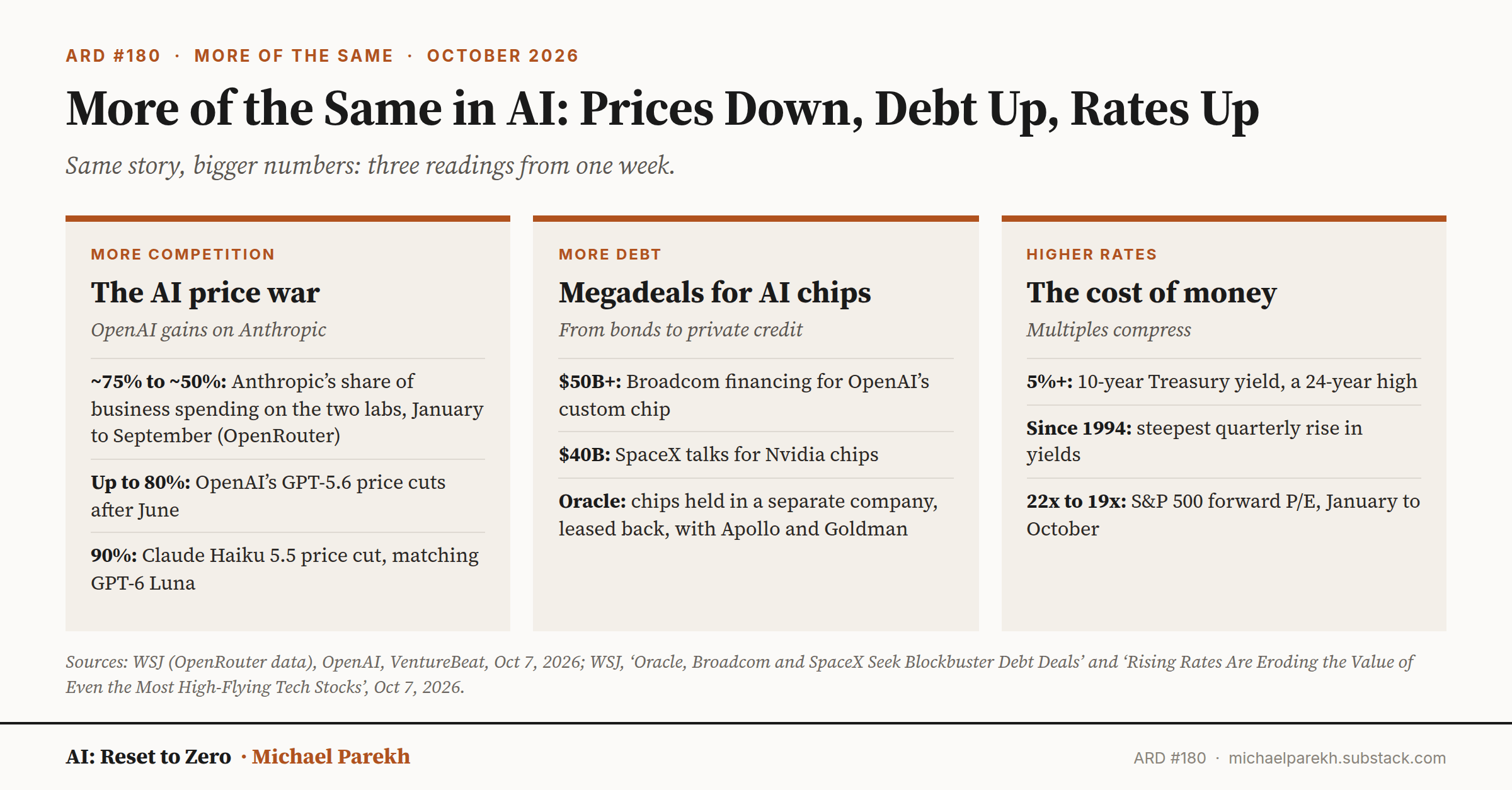
The same low cost of switching that hurt Anthropic with Replit can help it whenever it releases the best model. This is the back-and-forth competition I described two weeks ago in ARD #180, when prices were falling at the top, middle, and bottom of the AI market at the same time.
My view
There are four things to remember.
First, the power to set prices comes from having something scarce and having the best product. Anthropic has had both this year: the models that coders most wanted and not enough computing power to meet demand, as I explained in AI-RTZ #1080. Both advantages are becoming weaker. OpenAI’s models are competitive again, and the huge amounts of computing power that both companies are buying are expected to become available next year, as discussed in AI-RTZ #1204. When computing power becomes easier to get, strict spending limits become harder to maintain.
Second, bulk buyers are an early warning sign for the AI pricing market. Replit, Cursor, and similar companies depend on the difference between what they pay for tokens and what they charge their customers. They will always look for the cheapest model that does a good job, and they can switch in hours. Watch which providers they choose. Their decisions show which AI company is offering the best mix of price and performance each month.
Third, the planned stock market listings make the fight more intense. Before Thanksgiving, Anthropic must show investors that it can keep growing while also making good profits. Matching OpenAI’s discounts could protect its growth but reduce the profit margins shown in its listing documents. Refusing to lower prices could protect profits but cost it customers. OpenAI, which is heading toward its own listing next year, is spending money to win customers even though it does not yet have positive profit margins. As I said on Friday in ARD #191, both companies will keep changing their strategies. The stock market will decide which trade-off it likes better.
Fourth, customers benefit. Jeff Bezos built Amazon Web Services by cutting prices again and again, then making up for the lower prices by selling more. AI may follow a similar path to cloud computing, with discounts that change according to how much customers use, as I suggested in AI-RTZ #1227. Each token becomes cheaper, and usage grows rapidly. But total bills can still rise, as I explained on Sunday in AI-RTZ #1250. Every AI company’s profit margin is an opportunity for someone else to compete.
This is business, but there is also a personal side to the rivalry between these two companies, which have close ties, as I discussed in RTZ #1048. This price battle is worth watching closely throughout the AI technology wave and as the two companies approach their huge stock market listings. Stay tuned.
Sources
For longtime readers
AI-RTZ #1227: Anthropic’s strict spending limit vs OpenAI’s flexible discounts
ARD #180: ‘More of the Same’ in AI. OpenAI vs Anthropic, AI Debt & Rates
ARD #178: ‘Having Their Say’ in AI. Altman, AI Researchers & Big Tech
AI-RTZ #1240: Microsoft’s Copilot evolving to ‘a Costco of AI’
ARD #98: Lines in the Sand being Re-drawn & Entrenched (SpaceX buys Cursor)
AI-RTZ #1246: Anthropic’s $750 Billion Compute Bill, SpaceX’s AI Profit
AI-RTZ #1204: Anthropic’s $517B vs OpenAI’s $750B Compute Race
AI-RTZ #1080: Anthropic’s AI Compute Constraints throttling growth
AI-RTZ #1236: Anthropic vs OpenAI, the Subscription Value Gap
RTZ #1048: It’s Business and Personal in OpenAI/Anthropic pricing battles
ARD #186: ‘Show and Tell’ in AI. Anthropic, Microsoft & Tesla
ARD #191: ‘Bouncing Back’ in AI. OpenAI, Anthropic & Mr. Market
Note: This discussion is for information only and is not investment advice at any time. Thank you for reading.