
Making artificial intelligence a driving force for educational innovation.
Experience in some schools in Hanoi shows that for AI to work well in education, schools need to improve teachers' skills, provide the tools and equipment they need, and encourage everyone to use technology responsibly.
Gradually bringing AI into the classroom.
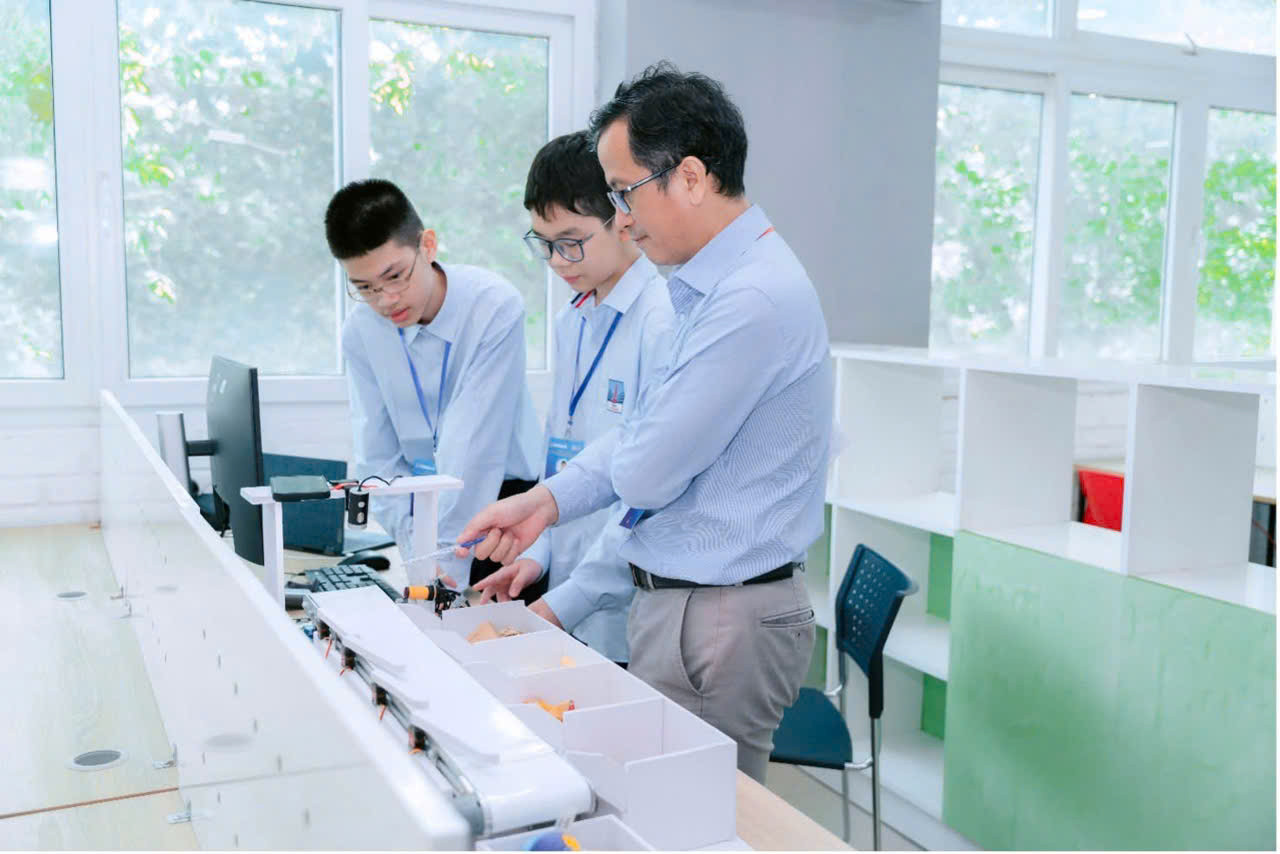
At Huynh Thuc Khang Primary and Secondary School in Lang Ward, the school is carefully planning how to bring AI into education. Its plans take into account the school's resources and how ready its students are to learn about this technology.
Nguyen Trung Kien, the school's principal, said that Huynh Thuc Khang Primary and Secondary School has 2,128 students. The main campus has a computer room with about 30 computers connected to the internet and a STEM room with basic equipment. Each branch campus also has its own computer room. Every classroom has a projector or an interactive television, as well as a reliable internet connection.
However, the school does not have enough computers for every student to use one during practical lessons. It also has only a small amount of special equipment for learning about and trying out AI. The school has two computer science teachers and several other teachers with experience in information technology, but it still needs teachers with deeper knowledge of AI. Teachers also need more training in how to plan and teach AI lessons at secondary school level.
To deal with these challenges, the school plans to create a core team of teachers, led by information technology teachers and working together with Technology and Natural Science teachers. Teachers will attend training courses organized by the Department of Education and Training. The school will also strengthen teacher training and knowledge-sharing activities among groups of schools. In addition, it hopes to work with universities and technology companies such as Viettel and FPT to gain more resources and practical experience for AI education.
Along with formal training, teachers are encouraged to learn on their own through platforms such as Google AI for Education, Microsoft AI Classroom, and AI4K12. The school plans to include AI in six lessons each semester. These lessons will be part of extra classes or activities outside regular lessons, so teachers will not need to add more teaching sessions.
The program is designed for different age groups. For students in grades 1 and 2, AI will be introduced through stories, games that recognize pictures and voices, and activities that help them become familiar with virtual assistants. Students in grades 3 and 4 will begin trying out tools such as AI drawing apps and chatbots. They will also develop logical thinking by using drag-and-drop programming tools such as ScratchJr and Code.org.
In grade 5, students will work on small projects, such as recognizing handwriting and sorting pictures into groups. They will also begin learning about privacy and how to use technology responsibly. At secondary school, students in grades 6 and 7 will learn basic ideas about data science and machine learning using tools such as Teachable Machine and ML for Kids. Students in grades 8 and 9 will start learning the Python programming language and some AI libraries. They will be encouraged to create projects such as chatbots and apps that recognize emotions.
Under the school's guidelines, at least 50% of the time in each AI lesson must be spent on practical activities. This gives students a chance not only to learn new ideas but also to try things out, conduct experiments, and build their own projects with help from their teachers.
At Thanh Cong B Primary School in Ngoc Ha Ward, AI is being introduced step by step, in ways that suit students' ages. Pham Minh Thao, the school's principal, said that primary school students often do not get many chances to use computers on their own. For this reason, the school has chosen to include AI in its "Digital Citizenship Skills" program and lessons. It also teaches students how to use technology in suitable ways, based on their abilities and age.
To help teachers, Thanh Cong B Primary School held training on how to use AI in teaching, following the program of the Ministry of Education and Training. Teachers can use AI to make video lessons and worksheets, and to help create music, poems, and rhymes. These tools help teachers offer students more varied learning materials and teaching methods.
During lessons, students showed more interest, took part more actively, and paid closer attention. With teachers guiding them and parents watching over their use, students were also able to carry out some simple tasks with AI. This experience shows that the main goal for primary school students is not to make them use complicated tools. Instead, it is to help them begin to understand technology and learn how to use it in suitable ways.
Building a culture of responsible AI use.
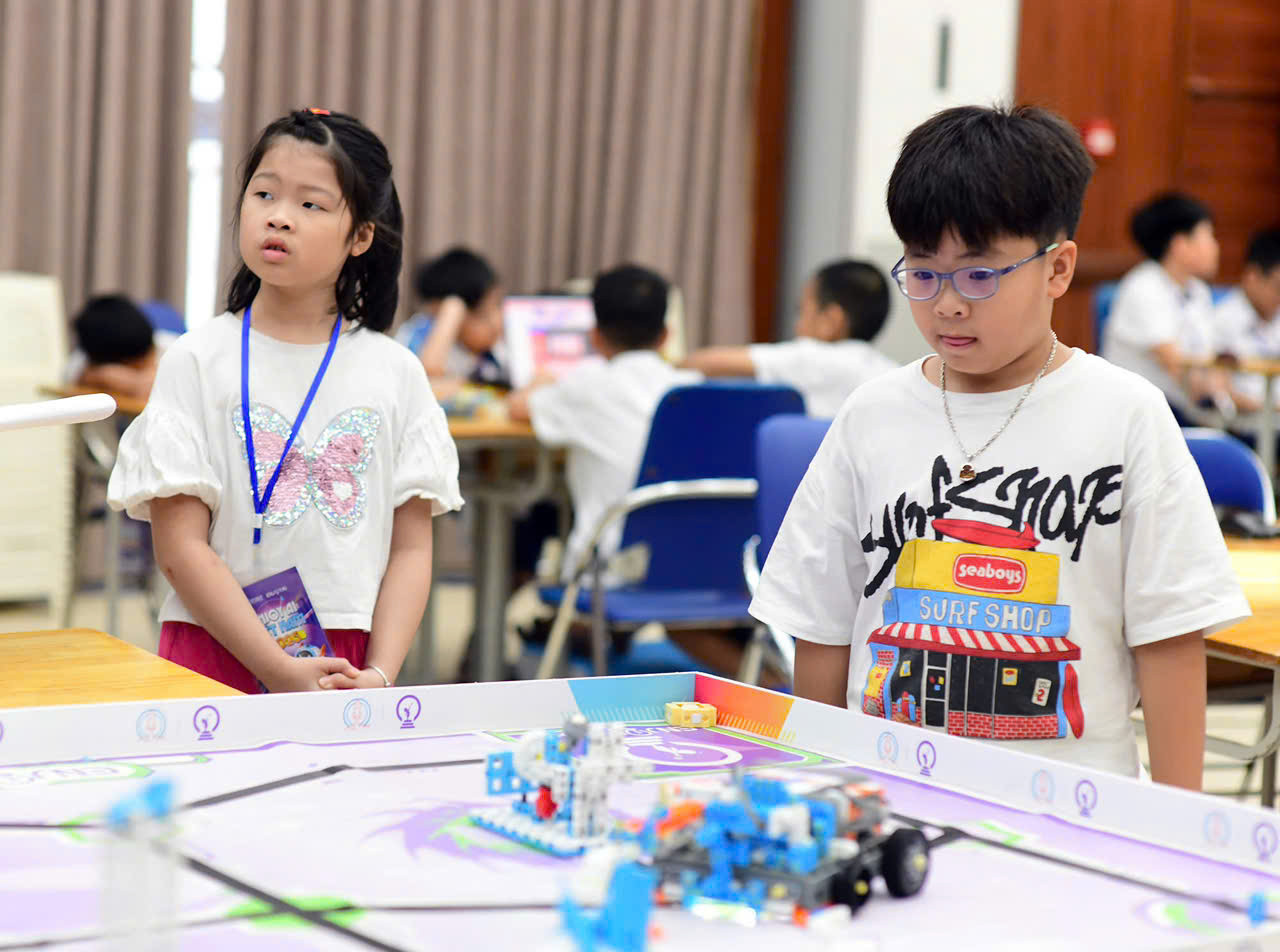
At primary school, the main goal is to help students become familiar with technology. At secondary school, students must also learn to use AI carefully, understand what it cannot do well, and take responsibility for the work they produce.
At Nguyen Sieu Secondary and High School in Yen Hoa ward, the school has chosen to teach students how to use AI rather than ban it.
Nguyen Thi Minh Thuy, the school's principal, said that technology is becoming a bigger part of everyday life, and schools are also affected by this change. AI can greatly reduce the time needed to do some tasks, but it cannot replace people in every situation. Users need to check information carefully, give AI clear instructions, and judge whether its answers are good and suitable.
According to Nguyen Thi Minh Thuy, the main question in education is not simply whether students use AI, but how they use it. Instead of stopping students from accessing AI, the school plans to create rules for using it and update its policies for the digital world. These rules will clearly explain the difference between using AI to support learning and using it in the wrong way.
"The arrival of artificial intelligence does not mean that we have lost our own intelligence. On the contrary, we must continue to develop and strengthen human intelligence," said Nguyen Thi Minh Thuy.
This approach can be seen in the school's learning activities. For its STEM Festival in the 2025-2026 school year, the school chose the theme "AI and Future Learning." Along with showing how AI can support new ways of learning, the school also drew attention to dangers in the digital world, including cyberbullying.
As well as looking after their physical and mental health, students need to learn how to protect their "digital health." This means controlling how much they use technology, recognizing dangers online, and behaving appropriately in digital spaces.
What schools have learned from their experience shows that bringing AI into education is not just about buying software or adding a few lessons. Schools need to improve their technology and equipment, build teachers' skills, plan suitable lessons, and put clear systems in place to guide and supervise students. Teacher training should include practical activities and real examples of how to teach. Lessons for students must suit their ages and should also teach them to think carefully, check whether information is correct, and protect their personal data.
AI can help teachers spend less time on some tasks, find more ways to explain ideas, and give students more chances to be creative. But technology is only truly useful when it supports the goals of education and helps students develop their abilities and character. Moving from understanding AI to using it well is therefore about more than learning a new tool. It is also about building digital skills and a culture of responsible AI use in every school.