
Do AI Labs Like Anthropic and OpenAI Have Economic Moats?
Leading AI labs are building lasting advantages to protect themselves from the risk that their products become common services that are hard to sell at high prices.



Morningstar is starting to cover artificial intelligence labs ahead of Anthropic’s expected initial public offering (IPO), when a company first sells shares to the public. One important question is whether these companies have economic moats: lasting advantages that help them do better than their competitors. In the first part of a three-part series based on our full research report, we examine whether companies such as Anthropic and OpenAI have these advantages.
In the almost four years since OpenAI launched ChatGPT, our technology stock research team has heard the same worrying question again and again: If every large language model (LLM) can write the same email, summarize the same earnings report, and produce clear computer code, can the companies that build these models really make much more money than their competitors?
We started hearing this question in 2024 and 2025. At that time, people were asking whether public cloud providers such as Amazon AMZN, Microsoft MSFT, and Alphabet GOOG/GOOGL could earn reasonable returns on the large amounts they have spent on AI. Each has invested billions in partnerships with Anthropic and OpenAI. Now, in 2026, investors are watching for possible IPOs by AI labs. They want to know whether companies such as Anthropic and OpenAI will soon face strong pressure to offer products that are hard to tell apart from competitors’ products, or whether they are building businesses that can stay strong over time.
If these labs cannot make profits, the problem reaches far beyond Anthropic and OpenAI. Companies are making huge spending commitments for chips, electricity, and data centers based on the belief that AI can bring attractive financial returns. So the question of whether AI products will become ordinary, easily replaced services also affects the long-term strength of the whole AI investment market.
Morningstar’s View
We are more optimistic than some others because we believe leading AI labs are building lasting competitive advantages. These advantages are not fully developed yet. Still, early data on how people use the products, ongoing product improvements, and business partnerships suggest that leading labs will be able to earn money from building and running advanced LLMs and avoid becoming providers of products that are easy to replace.
We see two main sources of these advantages taking shape: a network effect, where more data helps improve products, and a lasting cost advantage that comes from rising model-training costs and discounts on computing power purchased at the scale of gigawatts.
Network Effects: We See the Flywheel Beginning to Spin
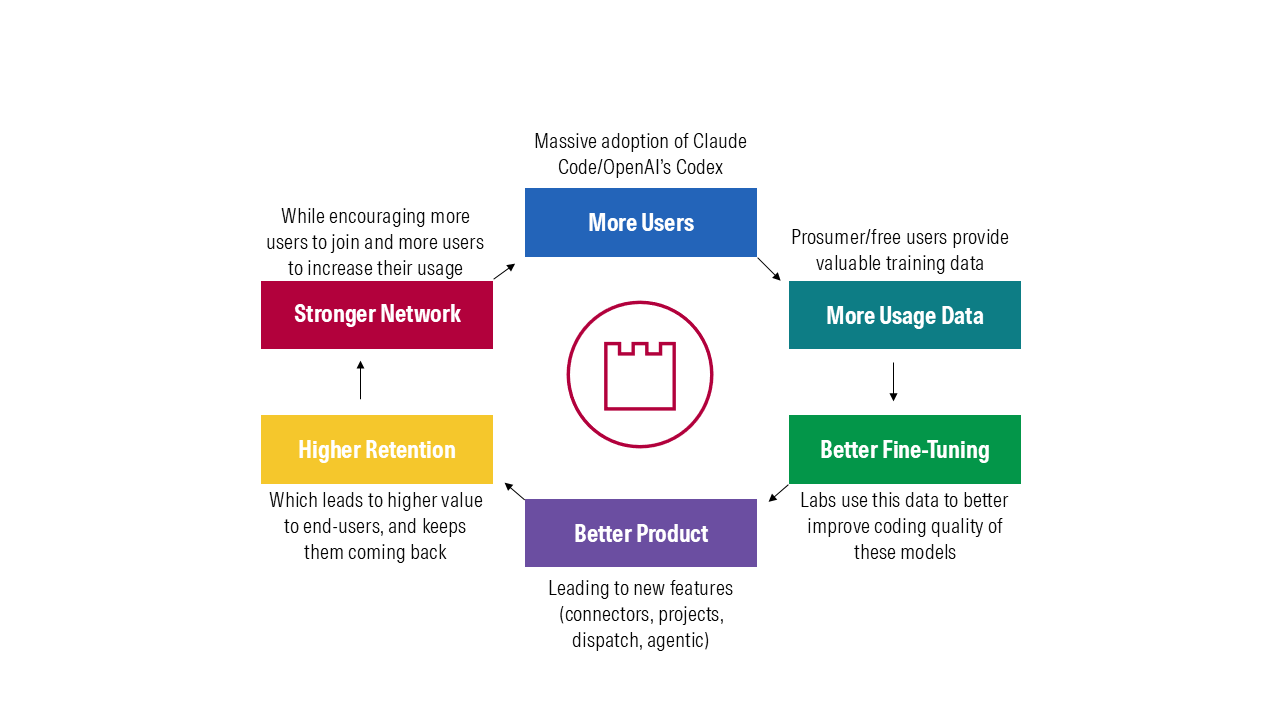
We believe a network effect is starting to develop around AI model businesses. It works like a cycle in which data helps improve a product for all its users. These early network effects create a feedback loop that helps AI labs improve their models and tools more quickly.
We see this process working through six stages. The early success of AI coding products clearly shows how it works. We expect the same pattern to spread to other uses and types of users as more people and businesses adopt this technology.
Network Effects
Structural Cost Advantages
We have seen Anthropic and OpenAI use better algorithms, custom computer chips, and long-term computing deals to lower the cost of providing their LLMs. This gives them a clear cost advantage over other companies.
Our main idea about the costs and profits of AI labs is that demand for inference is growing extremely quickly. Inference is when users ask an existing model to produce code, text, or answers. We believe this demand is growing much faster than the costs of training the original models and doing the research needed to build them. As both inference and training and research costs grow, the difference between their growth rates becomes larger. That difference is where the industry could make profits. How well these three costs—training, research, and inference—can be spread across more use and over time is key to understanding how these companies’ profit margins may develop in the long run.
The Three Primary Cost Centers for AI Labs
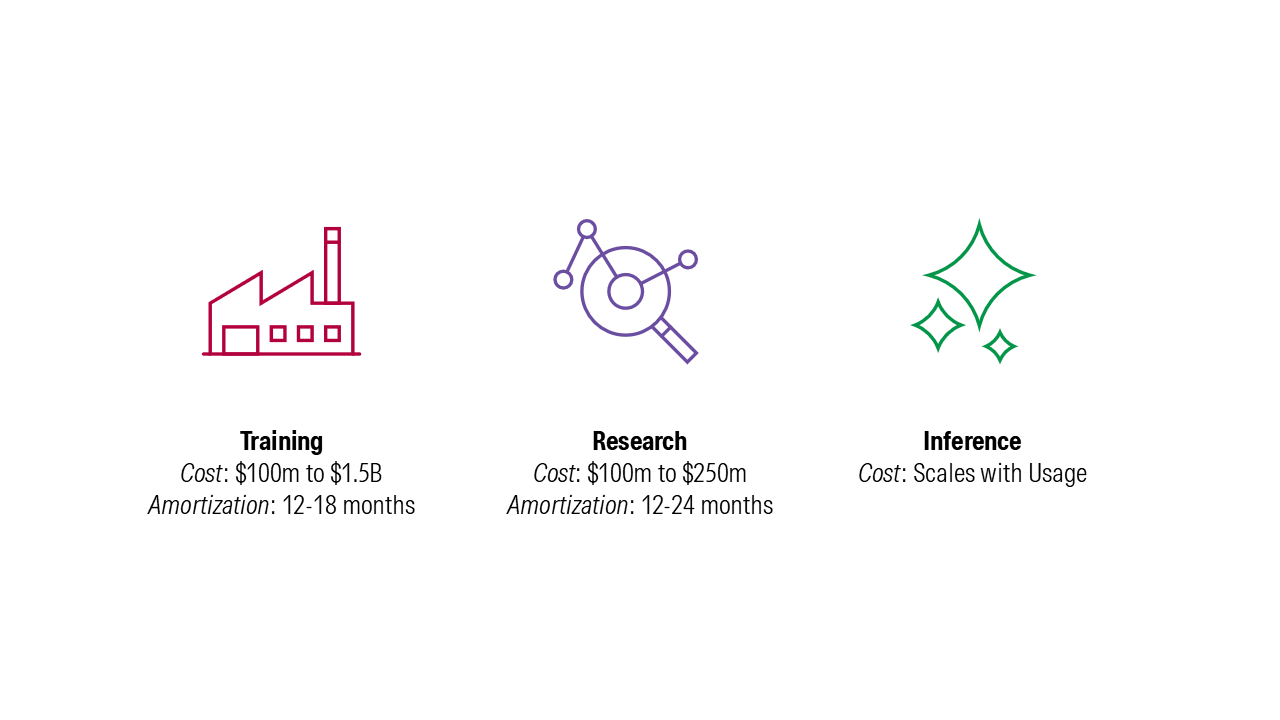
The timing and nature of these three types of costs explain an important difference in how AI model businesses work. Training and research require large amounts of spending upfront and happen in stages as new models are developed. Inference costs rise more steadily as people use the models.
Over the past few years, AI labs have spent most of their resources on training and research because they were building their main models and the tools and systems needed to use them from scratch. Inference began to grow quickly in 2025-26. This growth depended on earlier spending on training and research, which made the models and tools useful enough for businesses and individual users to adopt.
For investors, the key question about an AI lab’s finances is therefore not whether it loses money on training and research—it does—but what happens to its costs and profits as inference becomes a larger share of all computing activity, and how much inference can grow compared with training.
In the long run, profit margins for AI model businesses depend more on inference than on training. Investors who focus too much on large training budgets may miss the basic strength of these businesses. As more computing power becomes available, a much larger share will go toward inference, which should push profit margins higher. Put another way, overall profit margins start out negative because training costs are so large. But the profit margin on additional inference work is closer to 80%. As these companies grow and inference makes up a larger share of their total computing costs, their overall margins should move closer to 80%.
This change is already happening. Anthropic became profitable at the operating level—not just the gross profit level—in the first quarter of 2026. It reported an operating profit margin of 5% on quarterly sales of USD 11 billion. The company reached this point as a larger share of its computing power was used for inference. We also note that Anthropic became operationally profitable in the first quarter of 2026 much faster than pessimistic forecasts expected. Those forecasts assumed that AI labs would never become profitable.
More About Morningstar’s Economic Moat Ratings
Morningstar’s economic moat rating measures whether a company has a lasting advantage that can help it earn extra profits over a long period. Extra profits mean returns on the money invested in the business that are higher than Morningstar’s estimate of the cost of that money.
Morningstar gives a narrow-moat rating to companies that are more likely than not to earn these extra returns for at least the next 10 years. A wide-moat rating means Morningstar expects the company to earn extra returns for 10 years, with those returns more likely than not to continue for at least 20 years. Companies without moats are more exposed to competition. Morningstar identifies five sources of economic moats: intangible assets, switching costs, network effects, cost advantages, and efficient scale.
The author or authors own shares in securities mentioned in this article. Find out about Morningstar's editorial policies.