
Anthropic IPO: 22 Banks, Nasdaq ANT, $542B Spend [2026]
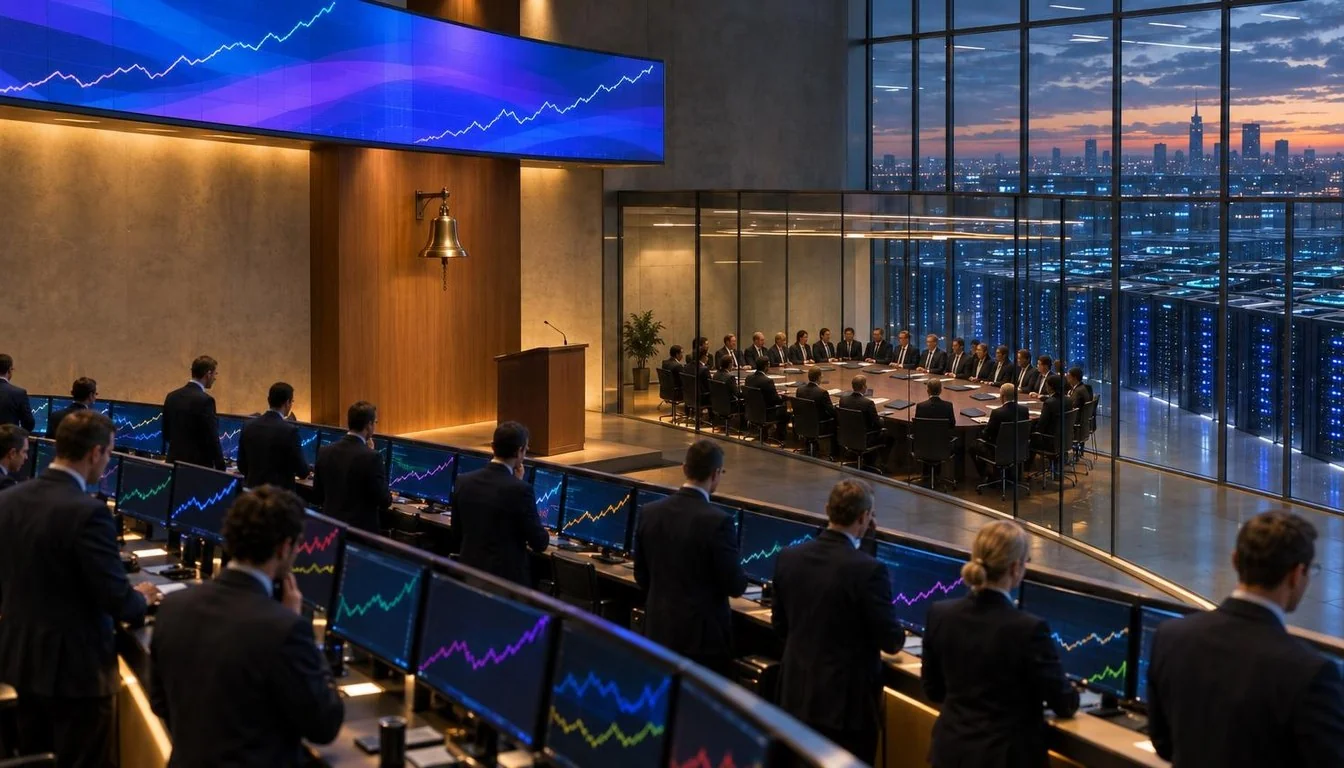
Anthropic filed a Form S-1 registration statement with the U.S. Securities and Exchange Commission on October 26, 2026. Its planned IPO is now one of the most closely watched stock market listings in the technology industry. The company plans to sell Class A common stock on the Nasdaq under the ticker symbol ANT. Goldman Sachs and Morgan Stanley are leading the group of banks handling the sale, and reports say 20 more banks will take part.
The biggest question is how large the IPO will be. PBS NewsHour described the filing as a possible record-breaking IPO. Reuters, The Independent, The Week and TechRadar have also reported that the listing could be among the largest in history. But the filing itself provides fewer details than these reports might suggest. It does not state how many shares the company plans to sell or set a price range. We first examined the filing's figures in our earlier report on the S-1 filing. This article has a different goal: to separate confirmed facts from unverified reports and examine whether the evidence supports claims that this could be the biggest IPO ever.
This article separates information into three groups. Confirmed facts come from the filing and news outlets that examined it. Unconfirmed figures come from reports that do not name an Anthropic source who has publicly confirmed them. Open questions are details the S-1 has not yet provided. The available reports contain no on-the-record comments about the filing from an identified Anthropic representative. Therefore, the quotes in this article come from earlier public statements by CEO Dario Amodei and are presented in their original context.
What the Anthropic S-1 filing confirms
Four facts are clear. First, Anthropic filed its Form S-1 with the SEC on October 26, 2026. Second, it plans to list its shares on the Nasdaq Global Select Market. Third, the shares offered will be Class A common stock. Fourth, the company making the filing is Anthropic, PBC, a public benefit corporation. This legal structure matters because the board can consider the company's stated public mission as well as the financial returns it provides to shareholders.
What the filing leaves out is just as important. It does not give a target company valuation, the number of shares to be sold or a proposed share price range. Early S-1 filings often leave these details open. Companies may add them in later updates after discussing investor demand with large financial institutions. For that reason, any dollar amount reported today should be treated as an estimate, not a confirmed IPO term.
Nasdaq ANT and the 22-bank underwriting group
Goldman Sachs and Morgan Stanley are the two named lead banks. CNBC's live coverage identifies Goldman Sachs as the lead-left underwriter. This bank traditionally manages the order book, which records investor orders for shares. Morgan Stanley is on the right side of the underwriting group. Reports say another 20 banks have joined the group, bringing the reported total to about 22.
Having so many banks suggests that Anthropic expects to sell shares to a wide range of buyers. A deal of this size could involve individual investors, government investment funds, mutual funds and international investors. One or two banks would struggle to distribute that many shares on their own. The large group may also suggest that Anthropic wants its shares spread among many investors rather than concentrated in the hands of a few major buyers.
Reports suggest the IPO could take place during the week of November 16, 2026. That would leave about three weeks between the filing and the setting of the final share price, which is a short period for an IPO. However, reports warn that the schedule could change. SEC reviews often lead to changes in company filings. Anyone familiar with large stock market listings would not be surprised by a delay of a week or two.
The missing numbers and the figures reported but not confirmed
There is a large gap between what the filing says and what news headlines report. The table below shows the status of each major detail and where the available evidence ends.
| Item | Status | What the sources say |
|---|---|---|
| Filing date | Confirmed | Form S-1 filed with the SEC on October 26, 2026 |
| Exchange and ticker | Confirmed | Nasdaq, symbol ANT, Class A common stock |
| Lead banks | Confirmed | Goldman Sachs and Morgan Stanley |
| Additional underwriters | Reported | 20 more banks in the syndicate |
| Share count | Not disclosed | Left blank in the filing |
| Target valuation | Not disclosed | Left blank in the filing |
| Raise of $100 billion or more | Unconfirmed | Reported, no on-record source |
| Raise of $60 billion to $100 billion | Unconfirmed | A separate, lower report |
| Valuation of $1.5 trillion to $2 trillion | Unconfirmed | Reported range |
| Valuation near $1.5 trillion or $1.75 trillion | Unconfirmed | Narrower reported marks |
| Listing in the week of November 16 | Reported | Timing could change |
Two reports give different estimates of how much money Anthropic might raise. One says $100 billion or more, while another puts the amount between $60 billion and $100 billion. Reports also disagree about the company's possible value. One suggests $1.5 trillion to $2 trillion, while others point to about $1.5 trillion or $1.75 trillion. When reports conflict, it is safest to avoid treating any one estimate as fact. The only firm conclusion today is that Anthropic has not publicly stated how much money it wants to raise or what it believes the company is worth.
The events leading up to the filing also provide useful context. Our report on the pre-IPO investor meeting explains what Anthropic told investors before submitting its paperwork. This article does not repeat the figures discussed in those presentations because the S-1 filing is the main document for assessing the offering.
Founder and insider ownership: who holds the Class A shares
The filing provides a look at how Anthropic's shares are distributed. According to the document, as described in reports, CEO Dario Amodei owns or controls 245 million shares. Six other named insiders each hold more than 200 million Class A shares. Their reported holdings are listed below.
| Holder | Disclosed stake | Note |
|---|---|---|
| Dario Amodei | 245 million shares owned or controlled | Chief executive |
| Daniela Amodei | More than 200 million Class A shares | Named in the filing |
| Tom Brown | More than 200 million Class A shares | Named in the filing |
| Jack Clark | More than 200 million Class A shares | Named in the filing |
| Jared Kaplan | More than 200 million Class A shares | Named in the filing |
| Sam McCandlish | More than 200 million Class A shares | Named in the filing |
| Christopher Olah | More than 200 million Class A shares | Named in the filing |
It is unusual for seven named people to each hold more than 200 million shares. In many large IPOs, one or two founders hold the biggest stakes, alongside many venture capital firms and corporate investors. Anthropic's reported ownership instead includes a small group of people with very large holdings. This raises two important questions that future filing updates should answer. How long must insiders wait after the IPO before they can sell their shares? And how will voting power be divided between the Class A shares sold to the public and any other classes of shares? CNBC's live coverage points to a plan that would release insiders' shares from sale restrictions in stages. The details will help determine how much stock could become available in the months after the IPO is priced.
Could the Anthropic IPO become one of the world's biggest listings?
The possibility sounds reasonable, and the reported fundraising estimates support it. But a possibility is not proof. For this article, we looked for verified offering values from earlier record-setting listings, including Saudi Aramco and Alibaba. We also searched for a completed IPO or S-1 filing from SpaceX or OpenAI. We did not find a new source that confirmed the figures needed for these comparisons, so we will not publish a ranking table containing dollar amounts that we cannot verify.
What the evidence supports
Three conclusions are supported by the available evidence. The filing is real and has a confirmed date. If Anthropic raises $60 billion or more, as reports suggest, the deal would be very large by historical standards. And a reported group of 22 banks makes sense for an offering intended to reach investors around the world. Together, these facts support the view that Anthropic is preparing a very large IPO. They do not prove how large the completed deal will be.
What the evidence cannot confirm yet
It is too early to say that Anthropic's IPO will be the largest ever. The company must first set a share price and sell the shares. The filing does not yet state the number of shares or the price range. Even a reported $100 billion offering would depend on how many shares investors buy and the price they pay. Market conditions during the two or three weeks before pricing could change the final deal size significantly. Readers should therefore treat claims about a record-breaking IPO as conditional. Reports that label this claim unconfirmed are right to do so.
The $542 billion data center bill behind the listing
One of the clearest figures in the coverage comes from CNBC. According to the filing, Anthropic expects to spend at least $542 billion on data centers and cloud computing over the coming years. This helps explain why raising tens of billions of dollars would not necessarily be excessive for the company. Its expected spending is far higher than even the largest fundraising amount reported so far.
Computing power is one of the main costs for an advanced AI research company. Training AI models, running them to answer users' requests and supporting agent products all require computer chips and electricity. CNBC also notes that the filing warns about the difficulty of obtaining enough computing capacity and predicting future needs. In simple terms, Anthropic is telling investors that demand for computing power might exceed what is available. Misjudging how much capacity it needs, whether too much or too little, could be expensive.
For people buying shares, this changes how they should think about the company's value. Buyers of ANT would not simply be investing in a software business with potentially high profit margins. They would also be investing in a long-term spending plan whose success depends on continued demand for AI models. The IPO is therefore a bet on both Anthropic's products and the wider business of building and running AI infrastructure.
Public benefit status and what it means for ANT shareholders
Anthropic, PBC is a public benefit corporation. This legal structure allows its directors to consider a stated public mission alongside profits. It also affects how shareholder lawsuits and campaigns by investors seeking changes at the company may work. Anthropic has previously created structures linked to its mission. Our report on the Anthropic public benefit fund examines one example.
This structure involves a trade-off for investors. They gain a stake in a leading AI company, but they also accept a system of corporate governance in which safety commitments may limit how quickly the company moves. Amodei's public writing shows the tension between these goals. A later section examines it directly. Investors can expect Anthropic to spend considerable time during its IPO roadshow explaining how the board will balance its mission and financial goals when they conflict.
The Claude 5.5 products investors will be buying into
An IPO is about the company's products as well as its ability to raise money. Anthropic's release notes show that it launched several products during the 60 days before filing. The table below summarizes these releases using Anthropic's own announcements.
| Release | Date | Anthropic’s stated claim |
|---|---|---|
| Claude Opus 5.5 | September 22, 2026 | First model in the Claude 5.5 family, 40% cheaper to run than Opus 5 on typical workloads |
| Claude Sonnet 5.5 | September 28, 2026 | More than 30% faster than Sonnet 5, up to 30% cheaper for most work |
| Claude Haiku 5.5 | October 7, 2026 | Fastest and most capable small model, built for high-volume, cost-sensitive tasks |
| Claude Duet | October 21, 2026 | Research preview for Pro and Max users, Claude as a proactive agent |
| Claude on Google Cloud | October 22, 2026 | Managed models launched, Fast mode available for Opus 5.5 |
The pattern is clear. Over about two weeks, Anthropic reduced the running costs of its two highest product tiers and released a new small model. It then expanded into AI agents and another cloud service. Our article on Claude Duet and Opus 5.5 compared with Muse looks more closely at its agent products. Lower running costs matter to the IPO because spending less to complete each task can increase gross profit margins. Public market investors are likely to pay close attention to this measure.
Competition: OpenAI, Google and the race to go public
Anthropic is not preparing to go public in isolation. Reports say OpenAI is exploring new funding, which we covered in our article about OpenAI's funding round and possible IPO. Our research found no completed IPO, S-1 filing or final valuation for OpenAI or SpaceX. Any direct comparison of their potential IPO sizes would therefore be speculation.
However, the order in which companies go public could matter. By filing first, Anthropic could attract early attention from public market investors who want to invest in AI. If its shares perform well, other companies may use its IPO as a model. If the shares perform poorly, competitors may decide to wait. Either way, ANT's first days of trading could help investors judge the value of other AI companies. These include rivals whose products can be compared in our analysis of GPT-6.1 Sol, Sonnet 5.5 and Gemini 4 Argon.
Google is important for another reason. Anthropic launched managed Claude models on Google Cloud on October 22. This links Anthropic to a major cloud provider that also develops competing AI models. Investors may see this relationship as a risk because a company that supplies important services to Anthropic is also competing with it.
What Amodei has said: three verified quotes
Because Anthropic has not made an on-the-record comment about its IPO in the available reporting, Amodei's earlier public statements offer a useful view of the company's leadership. The three quotes below are reproduced word for word and linked to their sources.
I probably spend a third, maybe 40%, of my time making sure the culture of Anthropic is good.
Dario Amodei, CEO and co-founder of Anthropic, in a February interview on the Dwarkesh Podcast, as reported by Fortune
This statement takes on added meaning before an IPO. A founder who spends up to 40% of his time on company culture is showing that he sees a strong internal culture as something valuable and difficult to replace. Once the company is public, its share price will change constantly, putting that culture under pressure.
I believe that if slowing down bought us even an extra year or two before models reach critical levels of capability, and we used that time to advance alignment, we could greatly reduce the risk that something goes seriously wrong.
Dario Amodei, CEO and co-founder of Anthropic, in a September essay, cited in PBS NewsHour’s coverage of the filing (linked above)
We must slow the pace at which we improve the capabilities of AI models.
Dario Amodei, from the same September essay, quoted in a public letter from the New York City Comptroller’s office that urges Anthropic to pause its planned IPO
These statements reveal a central tension in the IPO. Amodei has argued that AI development should move more slowly, while public shareholders often reward companies for growing quickly. Our earlier report on the training pause discussed in the filing examines this issue. The letter from the New York City Comptroller's office also shows that at least one public body wants Anthropic to delay its listing because of these concerns.
Market impact: Nasdaq, AI stocks and cloud partners
The following points are analysis rather than confirmed reports, so they should be treated as reasoned expectations. A stock market listing of this size would draw investment money from other places. Fund managers who want to buy ANT may sell some of their existing holdings to make room. Other AI companies and large technology stocks that already attract heavy investment could be among those affected. Index providers may also consider how quickly to add ANT to market indexes, since a company with a very large market value can lead to debates about early inclusion within weeks of its debut.
Companies that supply Anthropic could also be affected. A planned $542 billion investment in data centers could mean more demand for chipmakers, power equipment suppliers and cloud computing providers. If public investors support the spending plan, these suppliers may have a stronger reason to expand their own capacity. If investors are worried about the costs, the same companies could face the opposite effect.
Prediction markets are already treating the IPO race as an active event. Our report on the changes in Kalshi odds for the OpenAI and Anthropic IPOs explains how traders are betting on which company will go public first. Our AI and machine learning section brings together our ongoing coverage of the industry.
Historical context: how major technology IPOs change market expectations
Large technology IPOs often change how investors value an entire industry. Google's auction-style IPO changed views about founder control. Facebook's listing showed how quickly investor confidence can fall when a company's performance does not meet expectations. Alibaba's New York listing showed that global investors were willing to invest heavily in a company based outside the United States. Saudi Aramco's listing in Riyadh showed that governments could help support record-setting deals in their home markets.
Each of these listings offers a lesson for ANT. Investors test who controls the company, early trading can shape its reputation for a year, and the mix of major investors affects how much the share price moves in the first weeks. We do not compare the deals using dollar figures because our research could not verify the current figures needed. Using remembered numbers without reliable sources would go against our rule that every figure must be supported by evidence.
The main difference this time is what investors are buying. Earlier major IPOs involved technology platforms, oil reserves or online shopping networks. Anthropic is selling shares in an AI research company whose model family may be replaced every few months. Investors will need to judge not only its current products but also its chances of remaining at the leading edge of AI development. The company has also identified the challenge of predicting its computing needs as a risk.
Five predictions for the Anthropic IPO
These are our own judgments, not confirmed facts. Each depends on events that have not yet happened.
- Later filings will provide the missing details. We expect future updates to state the number of shares and the proposed price range before the IPO is priced. Until then, all valuation figures remain estimates.
- The planned week of November 16 could change. Reports already warn that the schedule is not final. A delay of several days seems more likely than a complete withdrawal, but SEC questions or changes in market conditions could cause a longer delay.
- The reported $1.5 trillion to $2 trillion valuation range will shape headlines. Even if the final price suggests a different value, news coverage is likely to compare the outcome with this range.
- Investors will closely examine AI safety statements. The Comptroller's letter may be the first of several public appeals connecting the company's governance and development speed to its IPO.
- Competitors will watch the first day of trading. If ANT shares perform well, OpenAI and other rivals may face more pressure to clarify their plans for going public. If the shares perform poorly, those companies may have more reason to wait.
FAQ: Anthropic IPO questions answered
When did Anthropic file for its IPO? Anthropic filed a Form S-1 with the SEC on October 26, 2026.
What is Anthropic's ticker symbol? The filing says Anthropic plans to list Class A common stock on the Nasdaq under the symbol ANT.
How much money will Anthropic raise? Anthropic has not announced an amount. The filing does not state the number of shares or the price range. Unconfirmed reports suggest it could raise $100 billion or more, while another report puts the amount between $60 billion and $100 billion.
What is Anthropic's IPO valuation? The filing does not disclose a valuation. Unconfirmed reports suggest a range of $1.5 trillion to $2 trillion, with other estimates near $1.5 trillion or $1.75 trillion.
Which banks are managing the IPO? Goldman Sachs and Morgan Stanley are the lead banks. Reports say another 20 underwriters will join them.
When might ANT shares start trading? Reports point to the week of November 16, 2026, but the date could change.
Will this be the largest IPO ever? That has not been confirmed. The answer depends on the final size of the offering, which has not yet been set. Our research did not find verified figures needed to compare the deal with earlier record-breaking listings.
Who owns the most Anthropic shares? According to the filing, CEO Dario Amodei owns or controls 245 million shares. Daniela Amodei, Tom Brown, Jack Clark, Jared Kaplan, Sam McCandlish and Christopher Olah each hold more than 200 million Class A shares.