
Nearly $200 billion a day: Meta, Anthropic, and SpaceX are ramping up fundraising, as the AI capital‑expenditure race accelerates across the board.

Meta plans to raise up to $95 billion by selling shares, Anthropic has secured $63 billion in funding linked to chip purchases, and SpaceX has signed another deal worth $40 billion to lease GPUs. In less than one day, companies made plans to secure nearly $200 billion to build and expand AI infrastructure.
The race to spend money on AI is entering a new stage, with companies raising huge amounts of money. In just one day, $Meta Platforms (META.US)$, $SpaceX (SPCX.US)$, $Anthropic (ANT.US)$, and chip-related companies disclosed financing plans totaling nearly $200 billion. These deals use several methods, including ordinary shares, preferred shares that can be converted into ordinary shares, loans backed by equipment, and debt issued through special-purpose companies set up for specific deals. Wall Street banks and investment firms that manage alternative assets are becoming more involved in building AI infrastructure.
$Meta Platforms (META.US)$ announced on Monday that it plans to raise up to $95 billion by selling shares to fund AI infrastructure and computing power. The first part of the fundraising will total about $35 billion. This includes $22.5 billion in Class A ordinary shares and $12.5 billion in preferred shares that must be converted into ordinary shares after three years. Meta also plans to start an at-the-market (ATM) program in 2027, allowing it to sell up to $60 billion in non-voting Class C shares.

The size of this fundraising plan also shows how much pressure Meta's spending on AI is putting on its cash flow. The market currently expects Meta to spend about $140 billion on capital projects, more than the cash it generates from its normal business operations. Investors are becoming more worried about AI spending and rising debt among technology companies. Since August, the cost of protecting against a Meta debt default over five years, measured by its credit default swap spread, has roughly doubled to 120 basis points.
Anthropic secures $63 billion to obtain Broadcom chips
On the same day, $Broadcom (AVGO.US)$, $Bank of America (BAC.US)$, $Blackstone (BX.US)$, $Citigroup (C.US)$, and $Morgan Stanley (MS.US)$ secured a $63 billion financing arrangement to pay for Anthropic's AI chips and networking equipment. This is one of the largest debt deals so far to support the expansion of AI infrastructure.
Bloomberg reported that the deal will use a newly created special-purpose company. Financial institutions will commit to providing money to this company. It will then buy chips from Broadcom and lease the equipment to $Anthropic (ANT.US)$. Broadcom will also guarantee some of the financing by agreeing to provide support based on the equipment's remaining value.
This deal combines chip sales, loans, and equipment leasing. It allows Anthropic to expand its computing capacity without paying the full cost of the equipment upfront. For Broadcom, the arrangement also helps support sales of its AI chips and data center equipment. Wall Street has already raised hundreds of billions of dollars to build data centers. More recently, financing deals for GPUs, servers, and networking equipment have also been growing quickly.
SpaceX signs a $40 billion chip-leasing deal
$SpaceX (SPCX.US)$ and $Apollo Global Management (APO.US)$ signed equipment financing and leasing agreements worth about $40 billion to obtain $NVIDIA (NVDA.US)$ AI chips. Under the plan, related companies will borrow money to buy GPU equipment and then lease it to SpaceX. This gives SpaceX access to computing power without having the related debt recorded directly on its own balance sheet.
The NVIDIA GPUs will be delivered in stages and leased for about five years. The deal is expected to close by the end of this year, and the first stage of leasing is planned to begin in the first half of 2027. The final fixed interest rate for the financing has not yet been set. It will be decided when the deal is formally priced. Apollo is leading the deal, Goldman Sachs is helping structure it, and funds managed by BlackRock and certain accounts managed by KKR are also taking part as major initial investors.
$SpaceX (SPCX.US)$ CEO Elon Musk had previously said on social media that $40 billion in financing had been secured. However, documents the company filed on Monday show that the deal has not yet been priced and is expected to close before the end of the year.
Recently, companies involved in AI have faced tighter conditions when borrowing money. Investors are demanding higher returns to take on the risks. This has also made it harder to agree on the terms and pricing of SpaceX's deal.
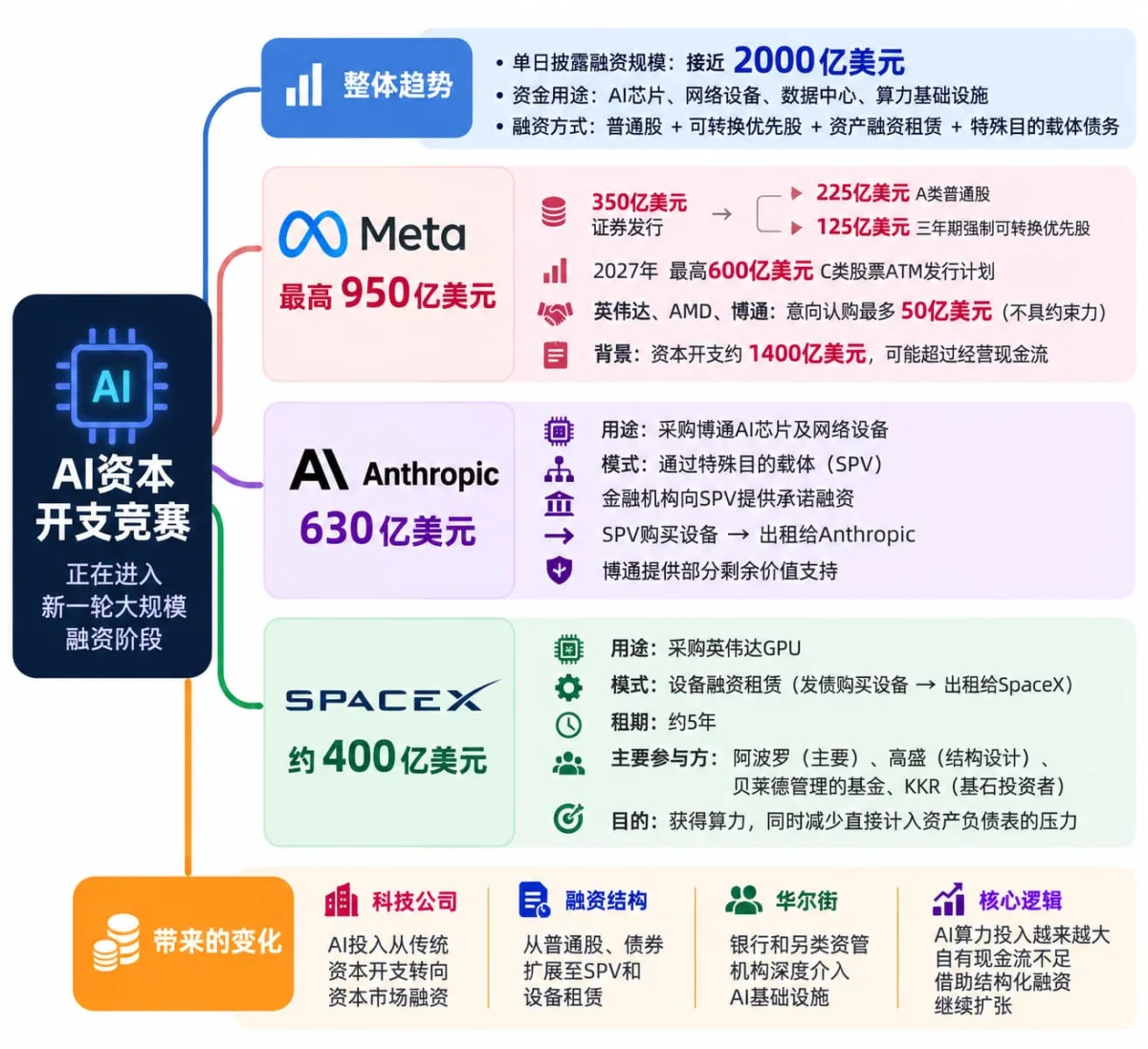
Together, the three deals show that companies are finding new ways to pay for AI infrastructure instead of relying only on their usual capital spending. They are making greater use of financial markets and specially designed financing arrangements. Meta is raising money directly from shareholders, Anthropic is leasing Broadcom equipment through special-purpose companies, and SpaceX is using equipment leasing and financing that keeps the related debt off its own balance sheet. Each company is choosing a different approach based on its financial position and cash flow.
Wall Street has become a key middleman in this wave of spending. Bloomberg reported that, based on information released on Monday, Goldman Sachs was involved in deals worth at least $210 billion linked to $Meta Platforms (META.US)$ share sales, $SpaceX (SPCX.US)$ chip financing, and $Anthropic (ANT.US)$ plans for an initial public offering (IPO). In the first nine months of this year, the five largest U.S. financial institutions earned nearly $19 billion from underwriting deals. Revenue from underwriting equity deals rose 48% compared with the same period last year, while revenue from underwriting debt deals increased 13%.