
Nomura: The global robotics 'ChatGPT moment' is imminent
The robotics industry is about to experience a wave of important developments that could speed up its growth.
Recently, humanoid robots have continued to benefit from positive developments. Unitree Robotics even saw its share price rise by 20% at one point, drawing much more attention to the robotics industry.
Nomura recently published a research report on the global robotics industry. Its view was careful but important: the real "ChatGPT moment" for robotics will not come from one product launch. Instead, it will become clear when real-world performance measures improve and robots use data from their work to make themselves better over time.

In other words, robotics is close to a major breakthrough, but this will not happen all at once. It is more like a long race. The industry is moving away from competition based mainly on AI models and toward better data collection, more standardized hardware, and proof that robots can work reliably in real-world settings.
01 From AlexNet to GPT-2: Where Robot Brains Really Stand
The report's main comparison is that robotics is following a path similar to that of large language models, but robotics is at an earlier stage.
Large language models, or LLMs, have developed through three stages: training on huge amounts of data, fine-tuning to follow instructions, and reinforcement learning, where they improve through trial and error. Robots are expected to follow a similar path. NVIDIA scientists believe robot training will also move from broad learning to training for specific tasks, followed by further improvement through trial and error.
But today's robot brains have not yet reached the GPT-2 stage.
Early versions of general-purpose robot AI are already being developed in laboratories, but no model is yet ready to meet the needs of practical, everyday use.
General Artificial Intelligence Company's 1.5 model can learn a task in just 3 to 12 seconds during a demonstration. Across ten tests, it achieved a 59% success rate without extra training. After just five minutes of fine-tuning with data, its success rate rose to 83%. Skild AI's S1 learns how to make coffee by watching videos of people doing it. Ant Group's Robbyant has developed Zero-WAM, which achieved a 47.0% success rate in simulated settings across seven tasks it had not seen before. This was 29.5 percentage points higher than the best reported results for similar methods.
These results show some signs of GPT-3-style learning from only a few examples. However, all of them come from companies' internal tests, using short tasks or simulated settings. Skild AI's CEO has also said clearly that S1 is not yet ready for use in homes.
For these reasons, Nomura still places robot brains at the GPT-2 level or below.
Where is a real breakthrough most likely to come from? Nomura believes the leading candidates are large AI research labs and Tesla, rather than startups that focus only on robot brains.
Large AI labs have computing power, skilled researchers, and general-purpose AI models. Tesla has a closed-loop data system, factories where robots can be tested, and a fleet of robots that can be used in real-world operations.
Google launched Gemini Robotics 2 in July 2026. It achieved a 91.3% success rate on complex tasks involving several steps and showed full-body robot control about one year ahead of its Chinese competitors.
OpenAI expects to release a model designed specifically for physical AI between December and January. Sam Altman expects OpenAI's robots to deliver "spectacular demonstrations" by 2027.
Wang Xingxing revealed that Unitree has already tested GPT-6 on its robots and seen very promising results. He believes GPT-7 could help overcome key challenges in embodied AI next year.
There are many promising developments, but new models have only moved robot AI from below GPT-2 to around the GPT-2 level. A truly major breakthrough is still some way off.
02 Three Main Approaches: VLA, World Models, and Reinforcement Learning in Simulation
AI research for robots is now moving along three main paths: vision-language-action models, world models, and reinforcement learning in simulated environments.
A vision-language-action model, or VLA, looks at its surroundings, receives instructions, and produces actions. These actions are usually passed to lower-level controllers that guide the robot's movements. A VLA model running on a robot typically has about 2 billion to 7 billion parameters. Its chip and memory system cost around RMB 30,000 to RMB 40,000.
A world model tries to predict what will happen after a robot takes an action.
Under Li Feifei's framework, a world model includes a renderer, a simulator, and a planner. World Labs' Atlas has 100 billion to 200 billion parameters. Building a world model that can generate complete videos requires three to ten times as much computing power. A smaller version that works with compressed internal representations needs only an additional 30% to 100% of computing power.
By 2027, world models are expected to run in the cloud, where they will help train robots and create data. Smaller VLA and reinforcement learning models will run directly on the robots.
The third approach uses reinforcement learning in a physics simulator. The robot learns what works through trial and error in a virtual environment. Boston Dynamics' four-legged robot is a well-known example. Skills learned entirely in simulation have already proved useful when transferred to real hardware.
These three approaches do not have to replace one another. Instead, they are competing to become the main "brain" that guides a robot.
The report explains that early VLA models, such as π0 and GROOT, devoted most of their capacity to language. This helped them identify objects but did not teach them well enough to predict how those objects would move. WAM takes a different approach by using video generation as its model of the physical world. By predicting video frames one at a time, it can learn ideas such as gravity, buoyancy, and light. This helps it predict what will happen next and choose suitable robot actions, even in unfamiliar scenes, without extra training for each new setting.
Dream Dojo takes this idea further by replacing traditional physics engines with video models. This allows robots to practise in many simulated environments at the same time.
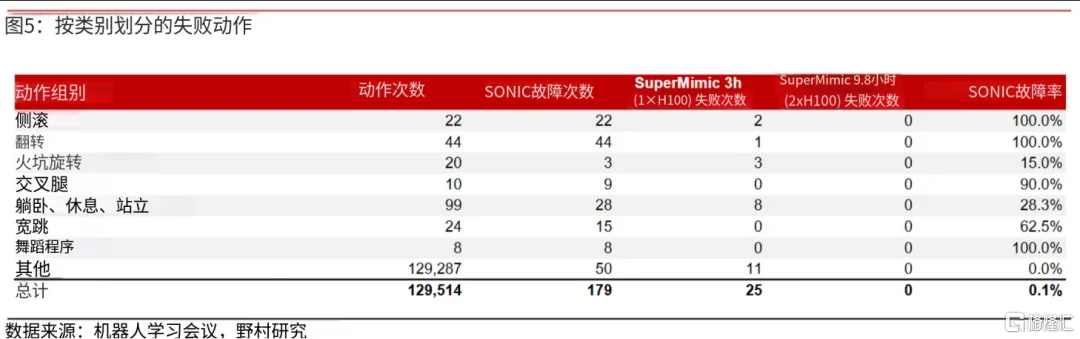
The SuperMimic research paper shows how much training methods can improve. The model ran on a single GPU for only three hours and performed better than an older model trained on 128 GPUs for seven days. This cut the computing resources needed by more than a thousand times. Across 129,514 action tests, the old method failed 179 times, while the new model had only 25 failures after three hours. After running for 9.8 hours on two GPUs, the new model recorded no failures.
These results suggest that robots may learn more effectively by training inside a model that has learned how the world works, rather than relying on a traditional simulator. They also suggest that using more motion data to train one controller could be a better approach.
However, the report stresses that pre-training is only half the job. To keep improving, models also need new data collected by robots working in the real world.
03 The Data Flywheel: The One-Million-Hour Turning Point and the Video Scaling Law
A lack of data is one of the biggest problems holding back robotics.
Language models can learn from huge amounts of text available across the internet. Robots do not have an equally large and useful source of training data.
Teleoperation allows people to control robots remotely to collect training data, but it is expensive and slow. The data is also tied to a particular robot design. If a robot changes from legs to wheels, much of the data collected for the earlier design may no longer be useful.
The report identifies about one million hours of data as an important turning point. That amount is roughly equal to the total number of hours accumulated over a lifetime. So far, only about 100,000 hours of usable data have been collected in a standardized format. Even leading companies have only several hundred thousand hours of high-quality data. Tesla's Optimus has just passed 500,000 hours.
Training a model requires 10 million hours of data, while long-term deployment requires more than 100 million hours. Yet the entire industry has collected only a few million hours so far.
An even bigger problem is that much of the recorded data cannot be used. At Yushu, only about one-quarter of the recorded time is useful. In other words, only one hour out of every four hours of recording contains valid data.
The structure of the data collection market also shows where the main problem lies.
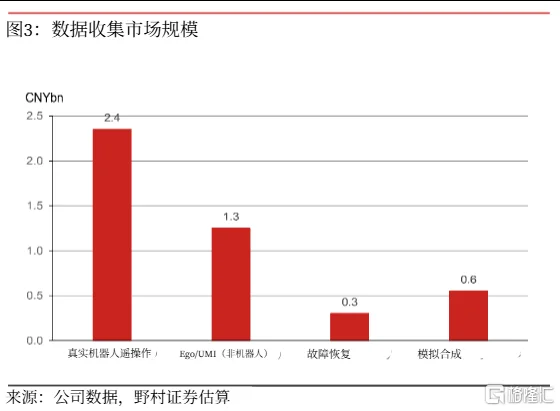
Nomura estimates that China's data collection market will be worth about RMB 4 billion to RMB 5 billion in 2026. Of this amount, remote control of physical robots will account for about RMB 2.4 billion. First-person-view video and UMI will contribute around RMB 1.3 billion, simulation will account for about RMB 600 million, and recovery from failed actions will account for around RMB 300 million.
In terms of cost, teleoperation data costs about RMB 700 per hour. UMI costs between RMB 100 and RMB 300 per hour, first-person video costs about RMB 300 to RMB 350 per hour, and simulation costs around RMB 120 per hour. Teleoperation is the most expensive option, and its data is tied to specific robot designs. First-person video and UMI are more affordable, and video recordings can be reused across different generations of robots. Simulation is the cheapest option, but it accounts for no more than 20% of the data used for real-world perception tasks.
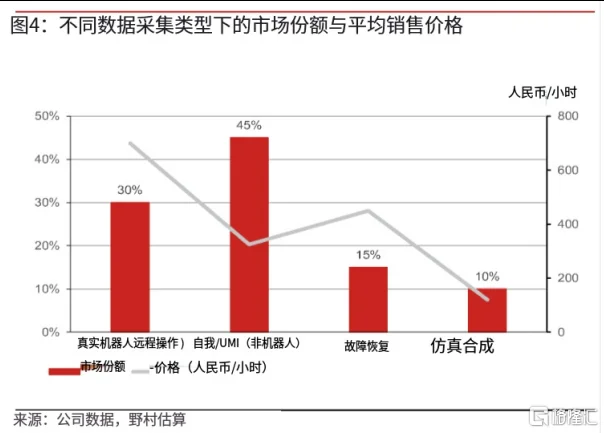
This is why the industry is turning toward video. A typical mix of training data today consists of 60% first-person video, 30% UMI, and 10% data from real-world robots.
NVIDIA's EgoScale is first trained on more than 21,000 hours of everyday first-person videos. It is then fine-tuned using a small amount of teleoperation and motion-capture data. For tasks involving hand movements, using more computing power during pre-training leads to steady and predictable improvements. This follows the same scaling laws that have helped large language models improve.
If videos recorded by people become the main source of training data, the companies with the best data-processing systems and the most computing power will have the biggest advantage. This makes large AI research labs even more important and reduces the long-term value of teleoperation data tied to specific robot designs.
But the real ChatGPT moment will come when a positive feedback loop begins. Robots working in real workplaces will collect data. That data will improve the AI model, and the better model will then be used in more robots.
Tesla plans to collect one million hours of valid data by the end of 2026. It aims to do this by training robots at about 10,000 of its own facilities. Between the second and third quarters of 2026, the cost of data for Optimus fell by about 18.1%.
China's deployment of humanoid robots is much smaller. The seven largest express delivery companies in China are expected to buy fewer than 500 humanoid robots in 2026. By 2027, the total is expected to reach only about 1,000 units.
The report therefore concludes that the positive feedback loop will begin first at companies that own both robots and AI models.
From September 2025 to August–September 2026, OpenAI bought about 10 million hours of data, accounting for around 70% of the U.S. supply. DeepMind bought about 20% of the supply, equal to one-third of the amount purchased by OpenAI.
Independent data collection companies still have about three years to gather data. However, Chinese data is facing more export restrictions, and AI companies are increasingly collecting their own data. As a result, the number of data providers is expected to fall by the end of 2027.
In other words, the main barrier to building a data flywheel is not simply whether a company has data. It is whether the company can keep collecting high-quality data at a low cost and use it to improve its models in a continuous cycle.
04 More Skillful Hands and Consistent Manufacturing: The iPhone Moment for Hardware
Once the main path for AI models becomes clearer, humanoid robot designs are expected to settle around a small number of standard designs. The report calls this the hardware industry's "iPhone moment." The biggest challenge will be making each robot in the same way, or in a very similar way.
Humanoid robots have more than 20 joints. Even small differences in how different robots move can mean that a control system trained on one robot works on only a limited number of others.
As a result, the companies most likely to succeed are those that can improve their products quickly while keeping costs under control. These include Unitree Robotics, automakers, and major suppliers of key components.
For mass production, the report estimates that a robot measuring 1.7 meters tall will cost between RMB 150,000 and RMB 200,000. A robot measuring 1.3 meters tall will cost between RMB 30,000 and RMB 40,000. Actuators, which include motors and gearboxes, account for 50% to 75% of the total component cost.
Unitree currently develops about 80% to 90% of the items listed in its bill of materials in-house. It handles about 50% of production itself, while third-party modules account for 10% to 15%. As production grows, the company expects to outsource a larger share of its work while keeping costs low and maintaining quality.
Robotic hands with more flexible fingers are expected to benefit first. More powerful AI is helping solve the shortage of training data that has long made it difficult for robots to use advanced grippers and hands.
In the past, many robots used simple grippers because there was not enough training data for tasks that required human-like hand movements. More powerful foundation models can transfer skills learned with two- or three-finger grippers to five-finger hands. This can expand the range of things robots can grasp while lowering costs.
Nomura expects shipments of dexterous robotic hands to grow by 80% to 120% year over year in 2026, driven by technology that allows more independent movements. It also expects 30% to 50% of factory fixtures to be replaced this year.
Prices are falling across different robotic hand technologies, including linkages, cable drives, and direct drives. However, shipments of hands that can make many different movements are growing faster. The rapid growth of the hardware market is not just about replacing simple grippers with robotic arms. AI improvements are changing which hardware parts provide the most value, shifting attention toward dexterous hands, actuators, and other key components.
05 Five Measures of Real-World Performance: The Threshold for Rapid Growth
Nomura has set out five measures to determine whether robotics has reached its "ChatGPT moment." At present, robots are still far from meeting these targets.
First, how long can a robot work before a person needs to step in? Even the most advanced robots can currently operate for only a few hours. Factories need robots that can work continuously for a full week without human help.
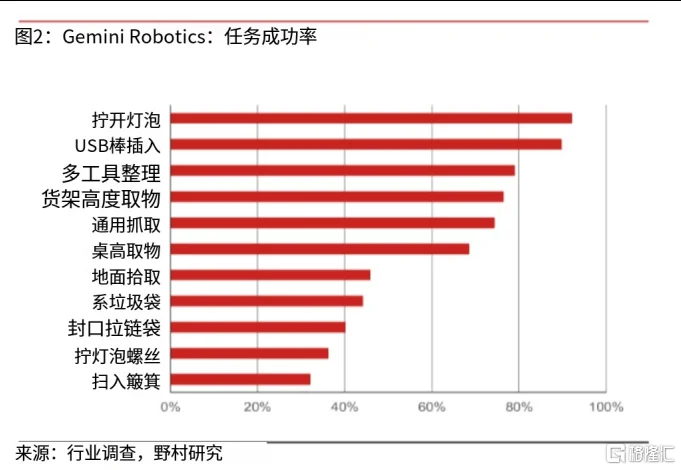
Second, how well can a robot perform delicate hand tasks? The Apollo 2 robot, fitted with the Sharpa Wave hand used with Gemini Robotics 2, succeeds in sealing bags only 44% of the time. Its success rate for sweeping rubbish into a dustpan is just 32%.
Third, how quickly can an AI model adapt to a new robot design? Google needs about seven to eight hours, while more advanced Chinese manufacturers take around two weeks.
Fourth, how many demonstrations does a robot need before it can perform a new task? In laboratory tests, this number has fallen to just one or two demonstrations.
Fifth, how accurately can robots work in factories? Current industry tests show accuracy of only about 60%, while the industry standard requires more than 98%. Nomura estimates that closing this gap will take three to five years. The report sees the first and fifth measures as the most important because they determine whether customers will pay for robots from their operating budgets rather than their research and development budgets.
These five measures set the minimum requirements for a true breakthrough. New models, impressive demonstration videos, and examples of robots learning from just a few demonstrations may create excitement. But robots will move from trial projects to everyday business operations only when they can work for a full week, achieve more than 98% accuracy in factories, adapt quickly to different robot designs, and learn new tasks with very few demonstrations.
For this reason, Nomura sees the current period as a time of acceleration, after the "AlexNet moment" but before the GPT-2 stage, rather than the ChatGPT moment itself. The real turning point will come when the data flywheel, AI model capabilities, and hardware standardization all reach their required levels at the same time.
06 Conclusion
The robotics industry is seeing many important developments. These include OpenAI's physics-based AI model, new models from ByteDance and DeepSeek, a planned demonstration of OpenAI's humanoid robots, and the expected arrival of GPT-7 in 2027.
However, Nomura's research suggests that these developments are more likely to raise AI capabilities from below GPT-2 toward the GPT-2 level than to bring about a full "ChatGPT moment."
A true breakthrough requires three things to come together: the computing power and data feedback systems of major AI labs or companies like Tesla; a data flywheel built around video and world models; and consistent hardware manufacturing supported by dexterous hands and standardized actuators. In the end, the winners are likely to be companies that have strong computing capabilities, systems for collecting and reusing data, and robots already working in real-world settings.
Robotics is approaching a major turning point. It will not happen because one new model suddenly amazes the world on a particular day. Instead, robots will steadily collect useful data while working, that data will help improve their models, and the improved models will allow even more robots to be put to work. This will create a cycle of continuous improvement.
The moment may arrive without much public attention, but its impact will be clear in the numbers that measure how well robots perform in real-world work.