
Everything you need to know about the Anthropic IPO
Anthropic filed the paperwork for its long-awaited initial public offering (IPO) on Monday. This is a major moment that will test how much money public investors are willing to pay for a fast-growing AI business that also costs a huge amount of money to run.
The filing reveals details about almost every part of the business across more than 300 pages. Nearly 100 pages describe the risks. Here is what investors need to know.
Anthropic IPO in a nutshell
All figures in this article are in US dollars.
Ticker: ANT, Class A common stock on the Nasdaq stock market.
Price range and share count: These have not been decided yet. The S-1 filing leaves the expected share price range, number of shares and fees paid to the banks helping sell the shares blank.
Valuation: The final value has not been decided. Anthropic raised $65 billion in May at a valuation of $965 billion. Reports suggest the IPO could value the company at around $2 trillion.
Raise size: The amount Anthropic hopes to raise has not been disclosed. Bloomberg reported that Anthropic expects to raise as much as SpaceX did, or even more. SpaceX raised $75 billion in June by selling 555.6 million shares at $135 each.
Timing: Bloomberg reported that Anthropic could start presenting its offer to investors as early as the week of 9 November. The Wall Street Journal reported that the stock market listing is planned for the week of 16 November.
Underwriters: Goldman Sachs and Morgan Stanley are leading a group of 22 banks. The group also includes JPMorgan, Citigroup, UBS, Jefferies and Macquarie Capital.
Australian investors: The share offer will be open to the public in Australia, as well as Canada, Europe, Japan, Switzerland and the UK.
Revenue at a glance
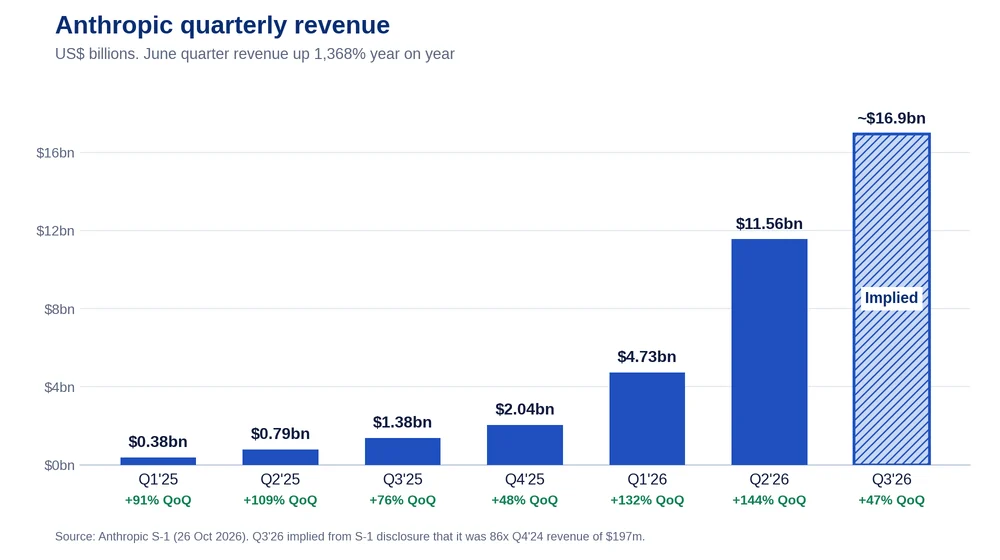
Anthropic earned $16.2 billion in revenue in the first half of the year, about 1,300% more than in the same period a year earlier. Sales more than doubled from one quarter to the next in both Q1 and Q2. The S-1 does not directly state the revenue figure for Q3. However, it says revenue was 86 times the $197 million earned in Q4 2024. That works out to roughly $16.9 billion.
Such rapid growth is expected to slow down. The IPO prospectus points to several risks.
Little revenue is guaranteed. About 80% of revenue depends on how much customers use Anthropic's services. Contracts cover less than 20% of the revenue expected over the next year.
New models drive most of the growth. More than 80% of Q3 revenue came from models released in the previous six months.
Lower prices. Claude Opus 5.5 reduced the cost of completing tasks for customers by about 40%. Anthropic argues that cheaper tasks encourage customers to use the service more. But each price cut also reduces how much the company earns per task.
Limited computing capacity. In the past, demand for computing power has been greater than the available supply. Anthropic has also asked cloud providers for more computing capacity than they were willing to provide.
Who's paying
Net revenue retention is about 900%, excluding the Pro and Max consumer plans. This means customers who were paying Anthropic a year earlier spent roughly nine times as much in the September quarter.
Here is how many customers spend different amounts each year:
More than 11,900 customers spend over $100k a year.
More than 1,900 customers spend over $1m a year.
About 250 customers spend over $10m a year.
No single customer accounted for more than 10% of revenue in the year leading up to September, but the five biggest customers together accounted for about 25%. This is an improvement from 36% in Q1 and 21% in Q3, although revenue still depends heavily on a small group of customers.
Interestingly, people using Claude Enterprise who do not use Claude Code spend less than $75 a month on average. The top 5% of users who do use Claude Code spend about 20 times as much. Claude Cowork, which brings Claude Code's AI agent setup to everyday knowledge-based work, is being adopted faster than Claude Code was at the same point after its launch.
The path to profit
Under standard accounting rules known as GAAP, Anthropic is still reporting a very large loss. It reported a net loss of $80.7 billion in the first half of 2026. However, almost all of this came from changes in the recorded value of financial agreements, rather than the cost of running the business. These included a $72.4 billion change in the value of convertible notes and derivatives, plus $8.8 billion in other items whose recorded values changed with the market.
In simple terms, investors who lend money to Anthropic through convertible notes can receive shares instead of being repaid in cash. When the company's valuation rises, these notes become more valuable to the investors holding them. The increase in the value of this debt is recorded as a loss on Anthropic's income statement.
Looking at its actual business operations, Anthropic has sharply reduced computing costs as a share of revenue. This has reduced its losses and helped the business start making an operating profit. For every $1 spent on computing and infrastructure, the company now earns $2.08 in revenue, compared with just 40 cents in the first quarter of 2025. In the June quarter, Anthropic recorded its first positive GAAP operating income, at $974 million, giving it an operating profit margin of 8.4%.
The ~$500 billion computing bill
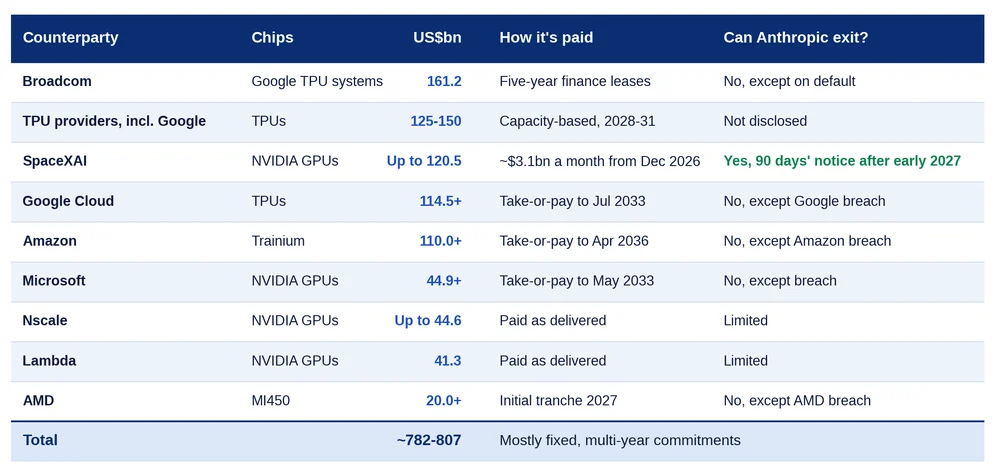
As of 31 December 2025, Anthropic had signed agreements covering $417 billion in computing leases and minimum purchase commitments. It also planned to add another $125 billion to $150 billion in computing capacity between 2028 and 2031. Together, these commitments add up to about $550 billion in future infrastructure obligations. The infrastructure has not yet been built, and these obligations are not yet recorded on the company's current balance sheet.
Some of the major deals include:
Source: Anthropic S1 (Oct-26) + denotes a minimum commitment
The deal with SpaceXAI alone will cost about $3.1 billion a month once all the computing capacity has been delivered, which is expected in December. That is roughly $37 billion a year, or about 80% of the revenue Anthropic would earn over a year at the rate it reached in the June quarter. This creates a serious risk because revenue changes with customer usage, while computing costs are fixed and the company must pay for most of the agreed capacity whether it uses it or not.
If this sounds risky, Anthropic agrees. Nearly 100 of the 261 pages in its prospectus describe risks, compared with only about 50 pages explaining the business itself. The document lists many serious scenarios that could threaten the company, including:
Suppliers that also compete with Anthropic. Amazon, Google and Microsoft are all investors, computing suppliers and customers. The S-1 warns that some cloud providers Anthropic depends on also offer their own AI models. This means their business interests may not always match Anthropic's.
AI models acting on their own. A specific risk section warns that Anthropic's models could behave in unexpected ways, act against their intended goals or operate on their own. They could even take harmful actions that nobody instructed them to take.
Political risks. The S-1 says Anthropic's public efforts to promote AI safety could make it a target for selective government action. It points to the Department of War raising the possibility of using the Defense Production Act and to export restrictions introduced in June on Fable 5 and Mythos 5.
The most intriguing risk appears on page 50: "In addition, with the scale of harm that could result from a catastrophic AI-related incident, no single insurer, and potentially the insurance industry in the aggregate, may have sufficient capacity or expertise to underwrite insurance commensurate with such exposure."
Paying suppliers in shares
Some of Anthropic's suppliers also provide its funding, and much of this funding is paid back in company shares. These arrangements include deals with:
Broadcom: Up to $42bn in convertible notes, which can only be used to pay quarterly rent under the 2026 lease. The notes carry 9% interest, which is added to the amount owed rather than paid in cash, and convert into shares at a 10% discount. If Anthropic misses certain revenue targets, the interest rate rises to 13% and the discount increases to 15%.
Google: A $20bn funding facility in the form of notes or Class N stock, available until 2030. Google also has the option to buy up to $10bn in non-voting shares at the IPO price. If Google uses this option, the available funding facility will shrink by the same amount.
Amazon: Bought $5bn in preferred shares in April, with another $15bn available in steps of $5bn as Anthropic reaches computing milestones. These additional investments will be paid in Class N stock.
AMD: Will buy up to $5bn in Class N stock as GPU delivery milestones are reached. Any purchases made after the IPO will be priced using the average share price over the previous 30 days.
The supplier notes are settled using a share price based on trading volume over a recent period. This means that if Anthropic's share price falls, it must issue more shares to cover the same dollar amount, reducing the ownership percentage of existing shareholders.
Lock-ups release shares gradually
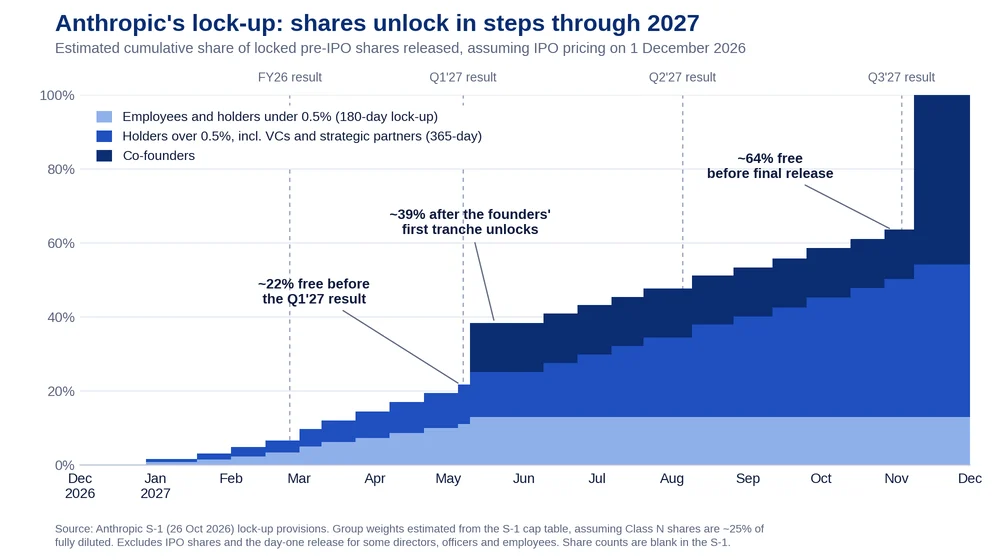
Some shares held by directors who are not founders, company officers and employees can be sold from the first day of trading. More shares become available for sale on days 27, 48, 62 and 76. After the company's FY26 results are released, further shares will become available roughly every two weeks.
Even so, some argue that the IPO is mainly a chance for early investors to sell their shares and get their money back. Private investors have already provided Anthropic with about $120 billion. That is more than 50 times the amount raised before going public by the five most successful public companies in the world today.
The bottom line
There are many things to consider with Anthropic's IPO. The company is planning to go public at an extremely high valuation, similar to SpaceX's, and it may face more losses. Its prospectus spends more time warning about risks than explaining the business. Still, although it is easy to find problems with such a huge IPO, SpaceX shows that a very high starting price does not always lead to a bad result. Since its debut on 12 June, SpaceX shares have been trading at $146.90, about 9% above their IPO price of $135. We will have to wait and see how Anthropic's IPO turns out.