
Why Are AI Crypto Tokens Down? Anthropic’s S-1 Filing Exposes an $80.7 Billion Loss

AI crypto tokens fell on October 26 for a reason that had nothing to do with how their own networks work. Anthropic publicly filed an S-1 registration statement with the U.S. Securities and Exchange Commission (SEC). The document revealed a huge number: an $80.7 billion net loss in the first half of 2026. Bittensor ($TAO) fell 1.1% to $250.50, $NEAR dropped 1.5% to $4.48, and Fetch.ai (FET) lost 0.5% to $0.174. Meanwhile, Bitcoin stayed almost flat near $80,000. The filing does not change how any AI token works, but it makes traders face a question they have been asking all month: if the biggest AI company loses $80.7 billion in six months, how much is an AI token really worth?
This is the second time in one week that worries about AI spending have affected crypto. On October 22, we pointed to similar concerns when Bitcoin fell below $82,000 because of fears about AI spending. Today, those worries moved away from the wider market and focused directly on coins linked to artificial intelligence.
What the S-1 Actually Says
Anthropic's own announcement is short and clear. The company wrote, “Today, Anthropic, PBC filed a registration statement on Form S-1 with the U.S. Securities and Exchange Commission relating to its proposed initial public offering of its Class A common stock.” It also said that “Anthropic intends to list its Class A common stock on the Nasdaq Global Select Market under the symbol ‘ANT.'” Goldman Sachs and Morgan Stanley are leading a group of 22 banks involved in the offering.
What the announcement does not include is the stock price. Anthropic said, “The number of shares of Class A common stock to be offered and the price range for the proposed offering have not yet been determined.” This means all the company valuations being discussed today come from media reports, not from the filing itself. Reports have suggested a value of around $1.5 trillion to $1.75 trillion, down from earlier estimates of $2 trillion. In May, the company was valued at about $965 billion in private markets.
The S-1 contains the financial figures that matter. Revenue reached $16.29 billion in the first half of 2026, up from $1.16 billion in the same period a year earlier. That is more than a thirteenfold increase. But the company also reported an $80.7 billion net loss for those six months, compared with a $12.9 billion loss in the first half of 2025. The key detail is that about $72.4 billion of the loss, or roughly 89.6%, came from changes in the reported value of convertible notes, derivative liabilities and SAFEs. These are financial instruments linked to the company's rising private valuation. The loss from running the business itself was much smaller, at about $693 million.
One important detail can get lost in the headline: Anthropic earned more revenue in the second quarter alone, $11.56 billion, than it earned in all of 2023, 2024 and 2025 combined. This shows how quickly the company is growing. But its costs are also real. Spending on computing power and infrastructure came close to $9 billion in the first half of the year.
How AI Tokens Are Performing, Coin by Coin
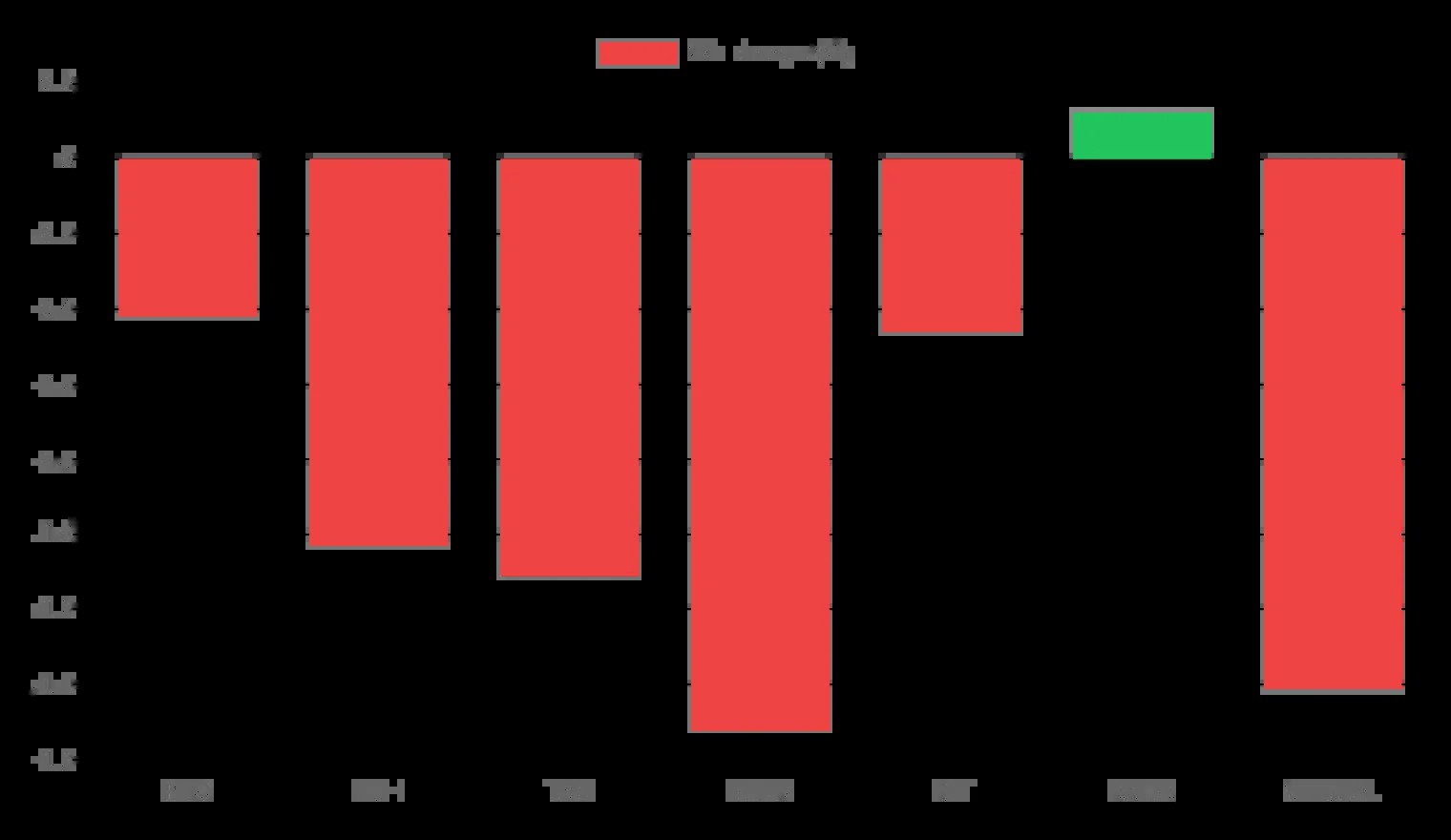
The price changes over the past 24 hours show how the market is reacting to Anthropic's news. The figures were taken from Binance at around 21:45 UTC on October 26. Bittensor's $TAO had the biggest drop among the major AI tokens, falling 1.11% to $250.50. $NEAR followed, dropping 1.52% to $4.48. Virtuals Protocol (VIRTUAL) fell 1.41% to $0.614. Fetch.ai dropped 0.46% to $0.174, while Render (RNDR) was the only one to rise, gaining 0.12% to $1.72. Bitcoin fell just 0.42% to around $80,132, and Ether dropped 1.03% to around $2,317. This means the AI tokens performed worse than the two major cryptocurrencies that serve as market benchmarks.
The one-day price changes do not show the full decline. Bittensor and $NEAR have both fallen roughly 20% over the past two weeks, while Bitcoin has dropped about 4%. This difference closely matches the recent loss of excitement around AI. $TAO is now about 67% below its all-time high of $757.60. To return to that peak, its price would need to roughly triple.
The Numbers That Should Worry AI-Token Holders
Comparing market values makes the gap hard to ignore. Bittensor has a market value of around $3 billion, while $NEAR is worth around $6.3 billion. Together, these two leading AI tokens are worth a little more than $9 billion. Anthropic's $80.7 billion loss for half a year is nearly nine times their combined value and roughly 27 times Bittensor's entire market value. Even if we remove the $72.4 billion in non-cash accounting charges and focus on the operating loss of about $693 million, the main point remains: one AI company can spend almost as much on real infrastructure as the entire AI-token sector is worth to investors.
This is a basic problem for AI-related crypto investments. It is also the same warning Arthur Hayes gave in June, when he argued that a peak in the AI trade could push crypto markets down. Investors who want to invest in AI can now buy shares in a registered, audited company that earned $16.29 billion in six months. That is an alternative to buying a token whose value depends on the idea that decentralized computing will succeed, something that still needs to prove itself.
The Non-Cash Loss and Why It Matters
It would be wrong to assume that Anthropic spent $80.7 billion in cash. Most of the loss comes from accounting changes. As Anthropic's private valuation rose, the reported value of the convertible notes and SAFEs on its books also changed. Accounting rules count this increase in value as a loss. The company did not write checks totaling $80.7 billion to chipmakers. Its operating loss of about $693 million is a better measure of how the main business performed during the first half of the year.
However, the fact that most of the loss was non-cash cuts both ways. If Anthropic's valuation turns out to be lower than the values built into those financial instruments, the same accounting process could work in the opposite direction. For AI tokens, the main lesson is simpler: investors can now see the AI economy through public-market filings, and its headline figures, even those that do not involve cash, will affect confidence across the entire AI sector, including crypto.
What to Watch Next
Three things could help determine what happens to AI tokens next. First, watch Anthropic's IPO pricing. Once the S-1 registration statement becomes effective and the company sets a price range, investors will have a firm reference point instead of media estimates. Second, watch how tokens respond to important price levels. Market commentary has identified $245 as a key support level for $TAO. Staying above it could mean the price is testing support without entering a deeper decline. Falling below it could lead to a drop toward the September low near $215. The 50-day moving average, near $273, is a price level that could limit gains. Third, watch whether AI tokens continue to perform worse than Bitcoin. If they do, that would suggest investors are moving away from AI tokens rather than simply selling across the whole market.
There is also a clear argument in favor of AI tokens. An investment of $1,000 in $TAO at $250.50 would buy 3.99 $TAO. If the price returned to its all-time high of $757.60, that holding would be worth about $3,023. The ideas of decentralized computing and AI agents that helped these tokens rise during 2025 have not been disproved. An IPO filing for a traditional company does not make AI calculations performed on blockchain-based networks any less real. But it does make competition tougher. AI tokens now compete for investor interest with a public company whose growth figures are explained in a government filing. Until the tokens can show revenue of their own, they are likely to remain a riskier investment that reacts more strongly to changes in confidence about AI.
Anthropic's standard legal statement makes the current situation clear: “These securities may not be sold, nor may offers to buy be accepted, prior to the time the registration statement becomes effective.” The public stock offering has not even begun yet. How AI tokens perform between now and Anthropic's stock market debut may reveal more about the sector than the price change on any single day.
Frequently Asked Questions
On October 26, Anthropic filed an S-1 registration statement with the SEC, reporting an $80.7 billion net loss for the first half of the year. The filing increased existing worries about the cost of developing AI. AI-linked tokens such as Bittensor ($TAO) and $NEAR fell by around 1–2%, while Bitcoin stayed roughly flat.
Is Anthropic's $80.7 billion loss a real cash loss?Mostly, no. About $72.4 billion, or 89.6% of the loss, came from non-cash changes in the reported value of convertible notes and SAFEs linked to Anthropic's rising private valuation. The company's operating loss was closer to $693 million, while revenue reached $16.29 billion in the first half of 2026.
What is Anthropic's stock ticker?Anthropic plans to list its Class A common stock on the Nasdaq Global Select Market under the ticker symbol “ANT.” The number of shares to be offered and the price range have not yet been decided.
Is the AI coin trade over?Not necessarily, but AI tokens now face tougher competition. Investors can compare them with a public company that reported $16.29 billion in revenue over six months. Bittensor and $NEAR remain important indicators of the sector's performance. A lasting fall below $TAO's $245 support level could signal a deeper move away from AI tokens, while a rise back above $273 could help momentum return.
Should I buy Bittensor ($TAO) or $NEAR now?This is not investment advice. Both tokens have fallen roughly 20% over two weeks, while Bitcoin has dropped about 4%. Their prices are highly sensitive to changes in confidence about AI. Anyone considering an investment should account for the risk that interest in AI could keep falling, rather than relying on the hope that prices will return to their all-time highs.
Data: Binance (AI token and BTC/ETH prices, October 26, 2026), Anthropic S-1 filing via SEC EDGAR.
This article is not intended as financial advice. It is for educational purposes only.