
Anthropic I.P.O.: A.I. Critics Accuse Founders of a Power Grab
The prospectus has only just been released, but criticism is already growing. The super PAC Guardrails Alliance and the campaign Stop Funding Billionaires have strongly attacked Anthropic's planned initial public offering (IPO), which is when a company first sells its shares to the public. "Decisions with such big consequences cannot be left to billionaire executives who are openly willing to gamble with the future of humanity to make themselves richer," Shaunna Thomas, executive director of the Guardrails Alliance, said in a statement sent to Trending Topics.
The Guardrails Alliance's Accusations
Anthropic filed its prospectus with the Securities and Exchange Commission on Monday. The Guardrails Alliance has three main concerns:
- Oversight: Going public used to mean that a company had to be open about its actions and answer to its shareholders and the public, Thomas said. But efforts backed by Silicon Valley to weaken investor protections have made it possible for companies such as SpaceX and Anthropic to raise money from the public without the level of scrutiny that once came with it.
- Voting rights: Anthropic's proposed share system gives its founders most of the voting power. Thomas called this a "power grab, in politics and governance."
- Politics and Musk: The A.I. industry is spending record amounts of money on elections so it can shape the rules that govern it, she argued. According to the group, Elon Musk has spent more than $442 million on the midterm elections. Meanwhile, Anthropic has signed computing agreements with SpaceX worth up to $3.1 billion a month.
The Guardrails Alliance was founded in June by Democratic strategists Shaunna Thomas and Leah Hunt-Hendrix. TechCrunch reports that the super PAC gets money from technology workers and labor unions. It had about $5 million when it launched and wants stronger rules for A.I. Its main opponent is Leading the Future, a super PAC that has received more than $100 million from technology leaders, including OpenAI president Greg Brockman. Leading the Future is fighting against A.I. regulation.
How the Founders' Majority Works
The founders own only a small part of Anthropic's total shares, although that part is worth an enormous amount of money. According to the prospectus, each of the seven co-founders, including siblings Dario and Daniela Amodei, owns between 231 million and 244 million shares. Their holdings are almost the same size. If Anthropic is valued at $1.5 trillion to $2 trillion in its IPO, as recent media reports say the company hopes, each founder's stake would be worth about $21 billion to $30 billion (roughly €18.7 billion to €26.8 billion). Together, the seven founders could hold shares worth as much as $200 billion (about €178 billion). However, each founder would own only about 1.5 percent of all shares. Even so, a special system of different share types gives them most of the voting power:
- Class A: These shares are traded on the stock market and each has one vote. Investors and index funds can buy them.
- Class N: These shares are held by strategic partners and have no voting rights. They become voting Class A shares only when sold to an independent third party.
- Class F: A company owned by the seven co-founders, called the "Founder LLC," holds one share of this type. It gives the holder no right to a share of the company's financial value, but it always carries exactly 50.1 percent of all votes, no matter how many other shares exist.
- Class T: The Long-Term Benefit Trust holds one share of this type. It uses the share to choose most of the board members.
- Class E: Employees hold these shares. They can vote only on a small number of specific matters.
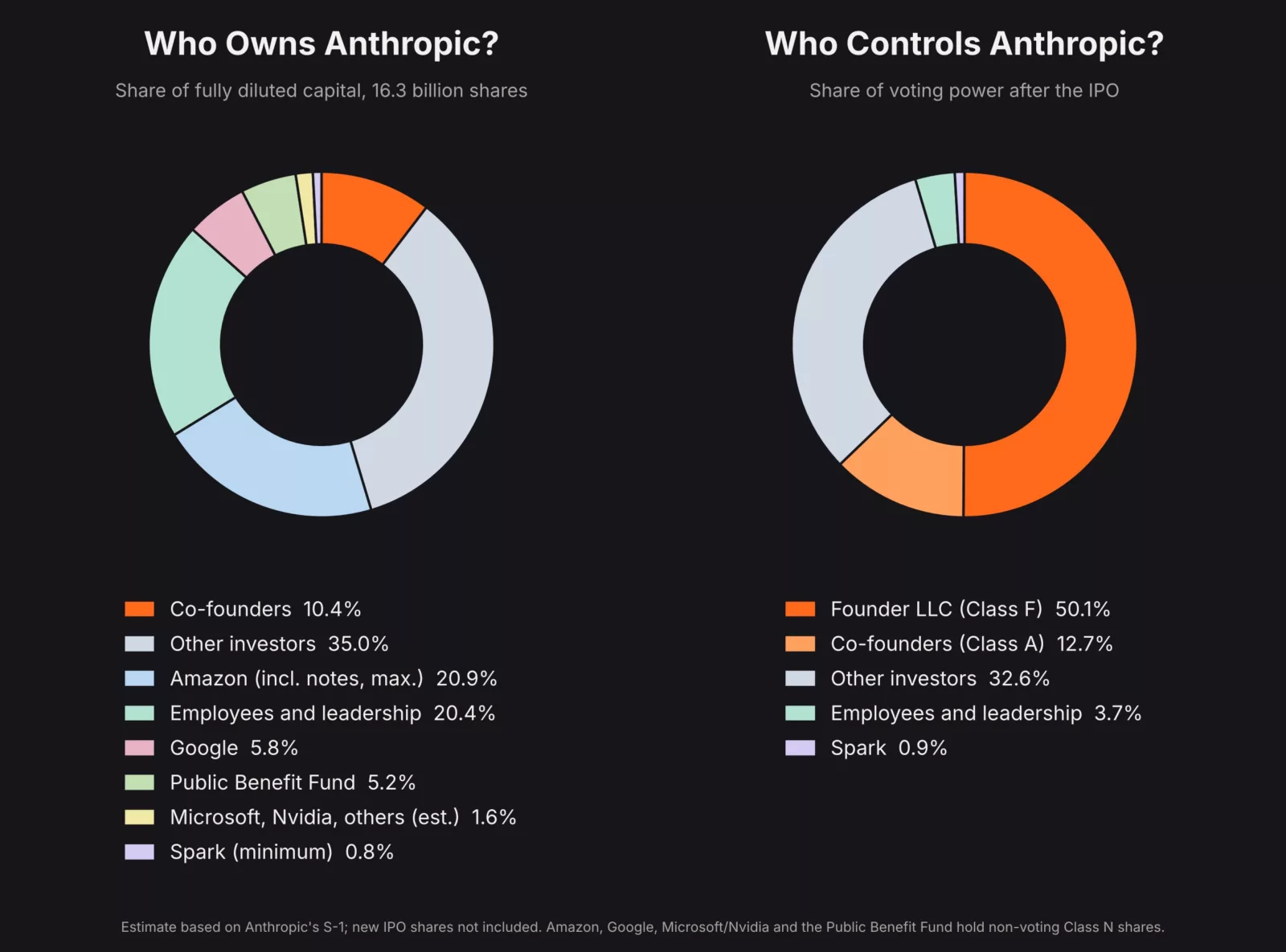
The most important part of this system is the Class F share. Its voting power does not depend on how much of the company its owners hold. It always represents 50.1 percent of the votes. The founders decide together how to use this share, and each founder gets one vote in their internal decision. If they cannot agree, the share votes in the same proportions as the Class A shareholders. For some decisions, a larger number of founders must agree. Otherwise, the share automatically votes against the proposal.
This has a clear effect on investors. Anthropic itself lists it as a risk in the prospectus: people who own Class A shares "generally will not be able to affect the outcome" of shareholder votes or the choice of directors, no matter how they vote. Under Nasdaq rules, this makes Anthropic a "controlled company," which means it faces fewer governance requirements. Together, the Founder LLC and the trust can choose every member of the board.
There is an important detail: Each founder has promised to give 80 percent of their ownership stake to charitable causes. As they give away their shares, their financial ownership will become even smaller. But their voting power will remain unchanged as long as they meet a minimum ownership requirement. Anthropic also lists this arrangement as a risk because the founders' interests may no longer match those of other shareholders.
The special voting system can eventually end. If a founder dies or becomes unable to act, a replacement can join the Founder LLC during the first 10 years after the IPO. However, if fewer than three founders remain active for 90 days in a row, a 450-day transition period begins. After that period, the Class F share is cancelled without payment, and its special voting rights end.
The SpaceX Deal
The agreement with SpaceX, which the Guardrails Alliance criticizes, is also described in Anthropic's prospectus. Anthropic confirms that it has agreements with SpaceX subsidiary SpaceXAI worth up to $120.5 billion (about €107.5 billion) through 2029. Once all the promised computing capacity is available, which is expected in December, the cost will be about $3.1 billion (about €2.8 billion) per month.
Unions Sound the Alarm on Pensions
Elizabeth Parisian of the American Association of University Professors, who leads the Stop Funding Billionaires campaign, also strongly criticized Anthropic. She called it "deplorable" that the company was moving ahead with its filing despite many concerns raised by policymakers, people responsible for managing money, unions, climate groups and workers. She added that some Anthropic employees had even resigned because of their concerns about the company.
Her biggest concern is workers' retirement money. Parisian said Wall Street has changed financial rules to make it easier to put workers' pension funds and 401(k) retirement savings into A.I. IPOs, as it did with SpaceX. Early investors and company insiders can sell their shares and take their money out, but ordinary workers' retirement savings held in index funds could suffer losses later. Parisian compared the situation with the dot-com bubble and the 2008 financial crisis. She also pointed to local communities that oppose new data centers because of their effects on the climate.
Critics have also received support from New York. Mark Levine, the New York City comptroller, helps oversee the city's pension funds, which hold more than $325 billion in assets. He recently wrote to Anthropic chief executive Dario Amodei and urged him to delay the IPO because of safety concerns. Levine and Anthropic have since started talks, but they have not agreed to delay the offering.
Anthropic's Rationale
Anthropic gives a different reason for giving its founders most of the voting power. The prospectus says the seven co-founders are "distinctly equipped to be stewards of our mission," meaning they are especially suited to protect the company's purpose. A Long-Term Benefit Trust, made up of five trustees who have no financial interest in the company and have expertise in A.I. safety, national security and public policy, is also supposed to choose most of the board. As a public benefit corporation, Anthropic must legally consider the public interest as well as the interests of its shareholders. When the company goes public, 5 percent of its shares will go to a special fund dedicated to public benefit.
Anthropic is also involved in politics. According to TechCrunch, the company supports Public First Action, a super PAC that backs A.I. laws. During the summer, this group supported the same candidate as the Guardrails Alliance.