
Anthropic: Models Under 6 Months Old Made 80%+ of Q3 Revenue
Anthropic filed its S-1 registration statement with the U.S. Securities and Exchange Commission (SEC) on 26 October 2026. The filing says that model versions released in the six months ending 30 September 2026 brought in more than 80% of the company's revenue in the three months ending 30 September 2026. The filing says that regularly releasing new, overlapping versions of its models is a necessary part of staying at the leading edge of AI.
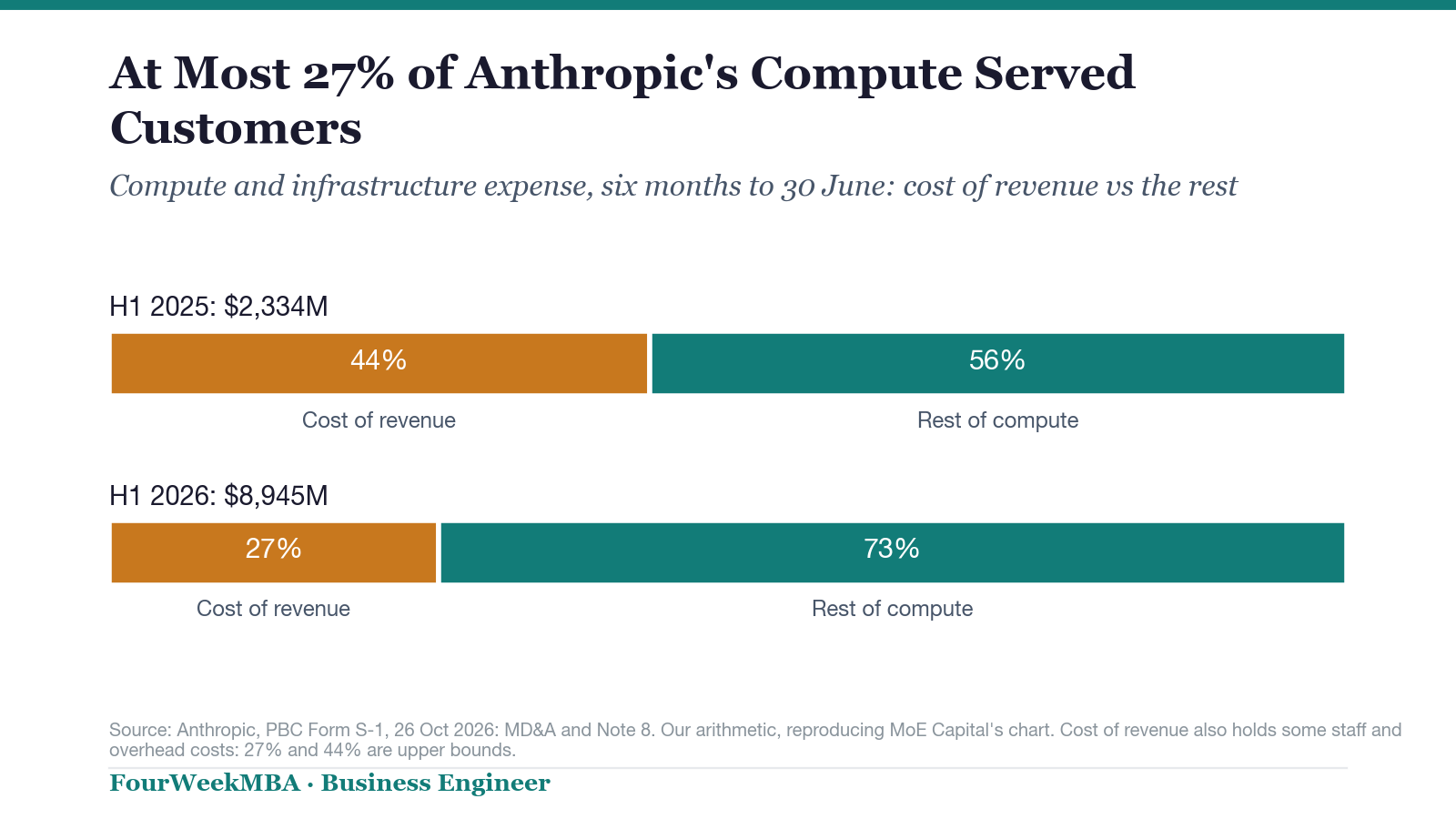
The same filing shows how much Anthropic spent on computing and infrastructure. Cost of revenue, which the S-1 says mainly covers computing used to serve customers, was $2,380 million in the first half of 2026. Total computing and infrastructure costs were $8,945 million. Based on our calculations, cost of revenue was no more than 27% of that total, down from no more than 44% a year earlier. A chart by MoE Capital, shared with us on 27 October, shows the same figures. We recreated the chart using the filing.
This 16:9 video explains Anthropic's S-1 filing and its model-release cycle. It is narrated using the published text of this article and four related FourWeekMBA articles.
The key point: Two figures in the S-1 help explain Anthropic's business. Model versions released in the previous six months brought in more than 80% of third-quarter revenue. Meanwhile, cost of revenue was no more than 27% of total computing costs in the first half of the year, based on our calculations.
What the Filing Says About Model Releases
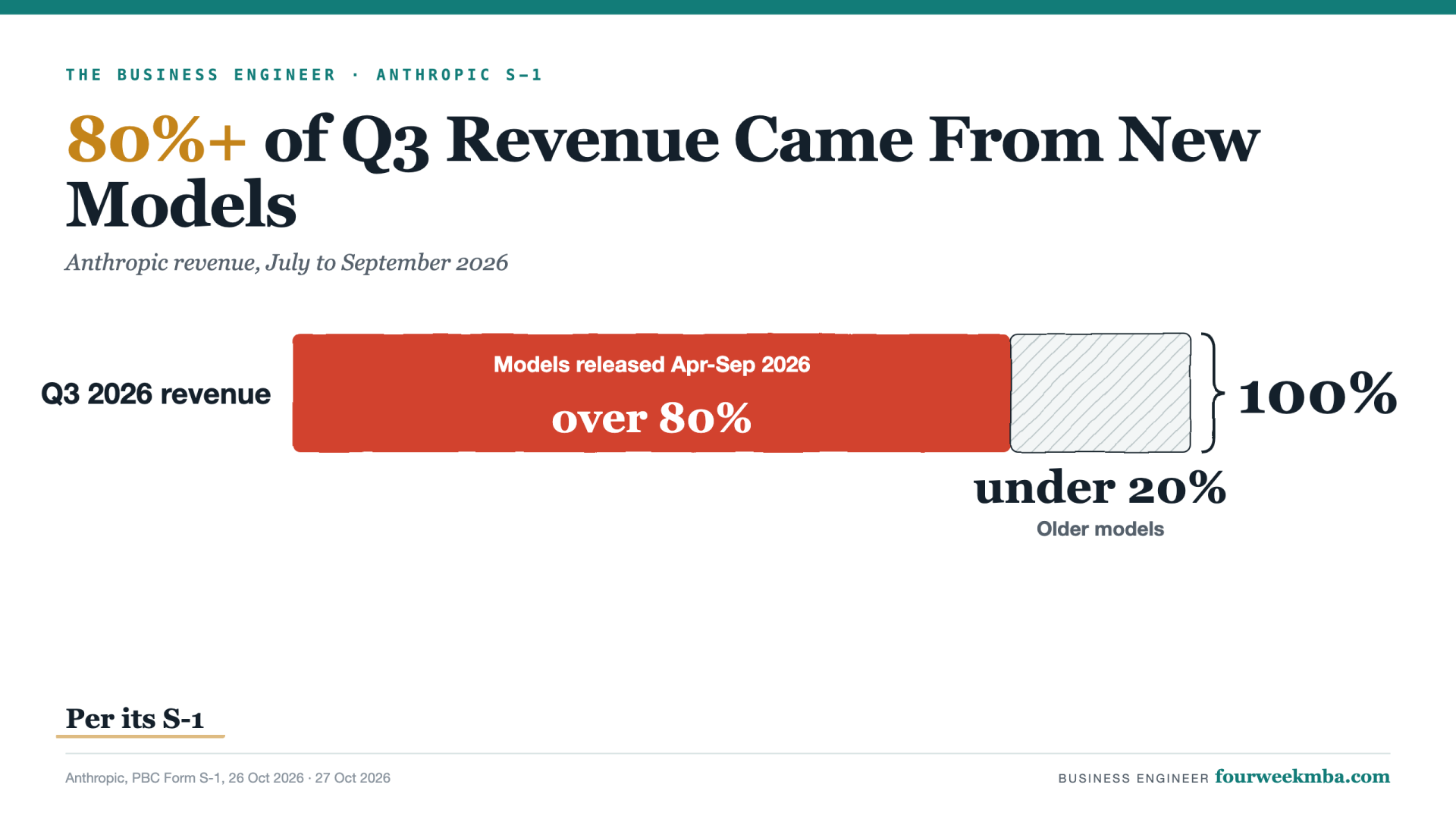
The S-1 says that revenue depends on how often new model versions are released and how capable they are. It also says that, as Anthropic has released newer versions of Claude, its revenue has continued to grow because new features allow people to use the models for more tasks.
The filing describes a repeating cycle. Computing power used to develop models leads to models that are more capable and efficient. When models become more efficient, some computing power is freed up to handle more customer work. The figure showing that more than 80% of third-quarter revenue came from models released in the previous six months is an example of this cycle, according to the filing. However, the filing does not identify which specific model versions produced that revenue.
Where the Computing Costs Went
Anthropic's S-1 says computing and infrastructure costs reached $8,945 million in the six months ending 30 June 2026, up from $2,334 million in the same period a year earlier. A note to the financial statements groups these costs by business function. It shows that cost of revenue was $2,380 million, compared with $1,019 million a year earlier.
The note says that almost all cost of revenue comes from computing and infrastructure used for customer tasks. But this cost category also includes some staff costs and a share of general overhead. Therefore, dividing $2,380 million by $8,945 million gives 26.6%, which is an upper limit on the share spent serving customers, based on our calculations. A year earlier, this figure was 43.7%.
MoE Capital's chart labels the remaining 73% as research and training. Anthropic's S-1 reports $9,741 million in research and development costs for the first half of 2026. It says these costs mainly cover computing and infrastructure used to develop models, carry out research, and run internal workloads. Sales and marketing costs also include computing used to provide free access to Anthropic's AI service. The remaining computing costs are spread across these expense categories.
The Margin Shown in the Chart
The S-1 reports that revenue was $16,286 million in the first half of 2026. Subtracting $2,380 million in cost of revenue leaves 85.4% of revenue. This is based on our calculations. In the same period a year earlier, the equivalent figure was 12.4%, based on $1,163 million in revenue. MoE Capital's chart shows 85% and notes that the figure is before fees charged by cloud marketplaces.
Anthropic's S-1 no longer reports gross margin directly. The filing says Anthropic changed how it presented its financial results during 2025. It explains that cost of revenue, gross profit or loss, research and development, sales and marketing, and general and administrative expenses are no longer shown as separate lines in its consolidated income statements.
The chart compares the 85% figure with a range of 40% to 50% for cloud providers that run open models and provide computing for AI responses. MoE Capital based this comparison on published figures from Cerebras and its own estimates for Fireworks and Together. These comparison figures come from MoE Capital and were not independently checked by us.
How This Fits With Earlier Reports
On 26 October, we reported that Anthropic classified $2.4 billion of its $8.9 billion in computing costs as cost of revenue, using the same note in its filing. We also reported that Anthropic manages its computing resources as one shared pool, with total computing costs equal to 48% of revenue. Earlier that day, we reported that Anthropic's computing costs had fallen to 48% of revenue from 251% across the quarters covered by the filing.
Today, we reported that Anthropic had $321.4 billion in computing leases that had not yet started as of 30 June. These leases represent computing capacity that future models could use.
What the Numbers Mean for the Business
In our reading, the statement that more than 80% of revenue came from recent models is the filing's own measure of how quickly revenue shifts to new model versions. In a single quarter, models released during the previous six months brought in most of the revenue.
In our reading, 27% is an upper limit, not an estimate of the exact share of computing used to serve customers. Cost of revenue includes some staff and overhead costs. Computing used for free access to Claude and for Anthropic's internal work is recorded under other expense categories. As a result, the S-1 does not directly show how much computing is used to serve customers compared with how much is used for training.
In our reading, the 85.4% figure in MoE Capital's chart represents revenue minus cost of revenue as a share of revenue. Anthropic stopped reporting this measure directly in 2025. The calculation also leaves out computing costs recorded under research and development.
Anthropic, PBC, Form S-1, Management's Discussion and Analysis (MD&A), filed 26 October 2026
“We operate an iterative cycle in which compute deployed to model development yields more capable and efficient models”
Three Important Implications
FOR INVESTORS READING THE S-1 The filing reports cost of revenue in a note to its financial statements. It no longer reports gross profit as a separate figure. This means any gross margin, including MoE Capital's 85% figure, must be calculated from the information in that note.
FOR MODEL BUYERS The S-1 says that model versions released in the previous six months brought in more than 80% of third-quarter revenue. This shows that the mix of models customers paid to use changed within a few months, based on the filing's own example.
FOR COMPUTING PROVIDERS The S-1 says Anthropic plans computing capacity as one total pool rather than assigning it to individual tasks. This means customer services and model development use the same committed computing capacity.
The Business Engineer Perspective
This story relates to the Business Engineer framework, The State of The Inference Economy.
The framework states its basic idea this way: “Training was a cost center: episodic, concentrated among roughly twenty frontier model labs, amortizable across trillions of tokens.” In other words, model training used to be a cost paid at certain times by a small group of leading AI labs, with that cost spread across enormous numbers of model uses.
In our reading, the S-1 adds figures from a leading AI lab to this discussion. The filing says that more than 80% of third-quarter revenue came from model versions released in the previous six months. The framework was published in March 2026 and does not discuss this filing.
What the Filing Does Not Prove
The S-1 says Anthropic plans computing capacity “on a total basis rather than by individual workload”. In the sections we reviewed, it does not directly divide computing use between serving customers and training models. The 27% and 44% figures are upper limits calculated from the expense categories in the filing. The filing also does not name the model versions responsible for the more-than-80% revenue figure. We could not find MoE Capital's original post containing the chart.
The Bottom Line
Anthropic's S-1 says that model versions released in the six months ending 30 September 2026 generated more than 80% of third-quarter revenue. It also shows that cost of revenue was no more than 27% of total computing and infrastructure costs in the first half of 2026, down from 44% a year earlier, based on our calculations reproducing MoE Capital's chart.
A note on sources: All figures come from Anthropic, PBC's Form S-1, filed with the SEC on 26 October 2026. We read the filing on EDGAR on 27 October 2026, using its Management's Discussion and Analysis and Note 8, which provides additional operating expense information. We calculated the percentages ourselves while recreating a chart by MoE Capital that was shared with us on 27 October. The comparisons with other AI computing providers come from MoE Capital and were not checked by us. Earlier reports are covered in the articles linked above. This is not investment advice. We did not contact Anthropic or MoE Capital.