
Anthropic Pays On-Site Gas Costs With No Cap, Its S-1 Says
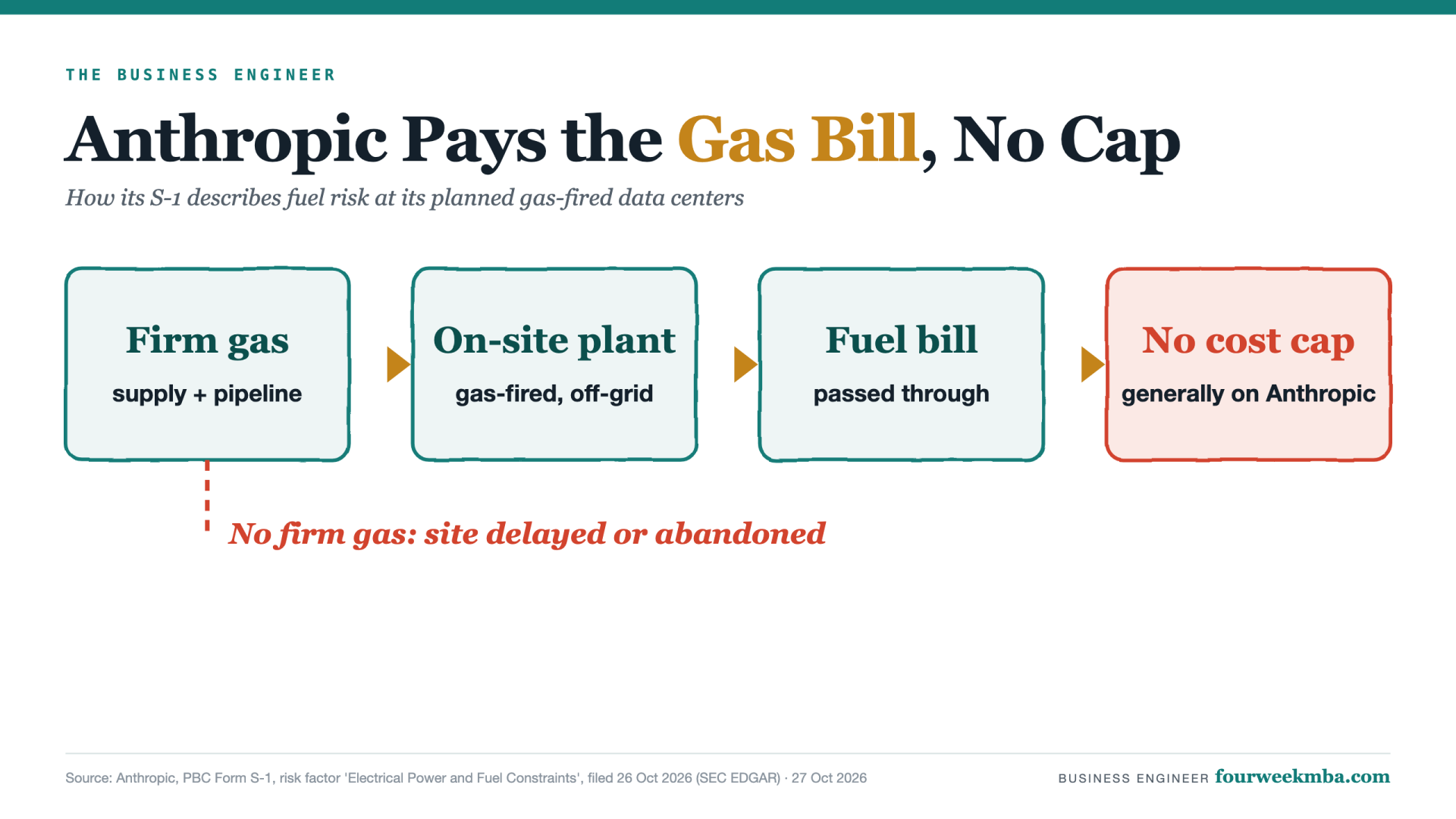
Anthropic filed its S-1 with the SEC on 26 October 2026. The filing says that some of its planned data centers will use their own natural gas power plants instead of relying only on the electricity grid. It also says that Anthropic generally pays for the fuel and related costs directly, with no limit on how high those costs can go. This means the fuel bills are passed on to Anthropic, which must pay them.
This statement appears in the S-1's list of risks, under the heading “Electrical Power and Fuel Constraints.” The same section says Anthropic “may be unable to secure firm gas supply and transportation during the development of a facility, causing a planned site to be delayed or abandoned”.
Video explainer · Anthropic’s S-1 on power
This 16:9 video explains the story using the published headlines from this article and three related FourWeekMBA articles.
The key point: Our reading of the S-1 is that Anthropic takes on the risk of changing fuel prices at its planned gas-powered sites. Its agreements generally make Anthropic pay fuel and related costs without a limit on those costs.
What the S-1 Says About Gas
The filing describes how more data centers are moving beyond the electricity grid. It says: “In addition to, or sometimes in lieu of, grid-based electricity, an increasing share of data centers are being developed with dedicated on-site power generation capacity that supplies electricity directly to the facility independent of any utility-operated electric grid.” In simple terms, more data centers are building their own power sources rather than depending entirely on local utilities.
The filing then explains Anthropic's own risk. Some of its planned data centers will use on-site natural gas power plants. According to the S-1, this exposes Anthropic to changing fuel prices and supply problems that it cannot control. It adds: “These facilities are also subject to constraints on pipeline capacity and firm fuel transportation necessary to deliver natural gas.” This means there may not be enough pipeline space or reliable delivery service to bring the gas to the site.
The S-1 expects competition for gas to increase. Building power plants on-site is possible only in some areas, it says. In those places, “we expect increased competition among users for the same natural gas supply and pipeline capacity in those areas.” The filing warns that this competition “could drive up the price of natural gas in such areas”.
The filing identifies three connected risks. A planned site could be delayed or abandoned if Anthropic cannot secure a reliable gas supply. An operating site could face supply or delivery problems. And Anthropic could have to pay higher fuel bills without a limit on those costs. As the filing puts it, “we remain exposed to increases in the cost of natural gas and its transportation.”
What Was Posted on X
Interesting sections on energy in Anthropic’s S1 filing!
— Aniruddh Mohan (@aniruddh_mohan) Oct 26 14:58
There’s been speculation on how data centers are managing fuel price risk from gas offtake, whether off-grid data centers will happen at scale
– ‘an increasing share of data centers being developed with dedicated onsite generation independent of the grid’
– ANT exposed to fuel price volatility as they bear cost on a pass-through basis, no cap on fuel costs
– Lack of firm gas supply can delay facilities
– For grid connected assets, ANT discusses ‘investing in curtailment systems’ to reduce strain during peak periods
– Cooling needs may increase over time for data centers due to changing climate
– Notes risk that utilities may reallocate capacity required by ANT data centers
Aniruddh Mohan highlighted the energy-related parts of the S-1. These cover power generation away from the grid, fuel costs that Anthropic pays without a cap, and the risk that a lack of reliable gas supplies could delay new facilities. He also pointed to systems that reduce electricity use during peak periods, rising cooling needs, and the possibility that utilities could reassign power capacity.
What It Says About the Grid
The S-1 says that queues for connecting large new electricity users to the grid have grown longer in many regions. It warns that “Utility providers and regulators may also reallocate previously committed capacity that our data center facilities may require”. In other words, power capacity that Anthropic expects to receive might be given to someone else. The filing also says that in many areas, “a single utility provider has substantial control over the terms, timing, and cost of the service”.
The filing also repeats a public promise from Anthropic: “We have publicly committed to covering the cost of electricity price increases to consumers caused by our data centers, including both the cost of electricity itself and the infrastructure necessary to deliver it.” This means Anthropic has publicly said it will pay for increases in electricity prices that its data centers cause for consumers, including the cost of the power and the systems needed to deliver it.
The filing discusses water separately. It says: “Our facilities separately depend on access to reliable water for cooling, which in some regions is scarce, subject to use restrictions, or increasingly costly.”
What an Electricity-Industry Analyst Flagged
Aniruddh Mohan, whose X profile says he works in the electricity industry, posted on 26 October that the filing had “Interesting sections on energy”. His post noted that people have been discussing how data centers handle the risk of changing gas prices and whether data centers that operate without the grid can be built at scale. He highlighted the agreement to pass fuel costs on to Anthropic without a cap, the need for a reliable gas supply, and the risk that utilities could reassign electricity capacity.
Update, 27 Oct: the suppliers of on-site power. Wärtsilä, a company that makes gas engines for power plants, reported on 27 October that orders received between July and September rose 33% to EUR 2,368 million, or 41% when measured on an organic basis, in its interim report. Reuters reported that orders were higher than analysts had expected, helped by demand for power from data centers.
In the report, CEO Håkan Agnevall said: “Interest from the data centre segment also remained strong, with a dynamic pipeline of opportunities.” Agnevall also pointed to an order received in the third quarter “to supply a 282 MW onsite power solution for a data centre project in the United States”. The project will use 15 Wärtsilä 50SG engines. He said it “demonstrates the growing need for fast-deployable, reliable, and scalable power solutions as AI-driven electricity demand grows and grid connection timelines remain lengthy.”
Agnevall added that, “considering the strong Energy order intake, lead times for our engines continue to increase.” The report does not name the data center customer and does not mention Anthropic.
Connecting the Coverage
On 26 October, we reported that Anthropic's S-1 gives the company the right to exit about $206 billion in GPU cloud deals. An update to that article added details from the filing about Anthropic's voluntary commitments to local communities, including systems that reduce electricity use during peak periods. The filing says these systems increase its operating costs. On 27 October, we reported that Anthropic had signed $321.4 billion in computing leases that had not yet started.
On 24 October, SemiAnalysis reported that six data center campuses in Texas planned to build their own on-site power systems, with a combined capacity of 8.7 GW. These projects need air permits under the Texas permit freeze. In August, TechCrunch reported that SpaceX's Terafab would use its own natural gas power plants. The new detail in this article is that Anthropic's S-1 explains who generally pays the fuel bills at its planned gas-powered sites: Anthropic itself.
The Structural Read
Our reading is that building power plants on-site replaces one problem with another. The S-1 says this approach can reduce reliance on the utility grid, but it still requires a reliable gas supply and enough pipeline capacity. Other data center operators in the same areas may be competing for those resources.
Our reading is that these risks can arise both before and after a site starts operating. The S-1 says a lack of reliable gas during development can delay or end a planned project. Once a facility is running, problems with gas supplies or deliveries could also affect it.
Our reading is that using the grid brings its own risks. The S-1 says utilities and regulators may reassign electricity capacity that had already been promised. It also says that in many areas, one utility controls the terms, timing and cost of providing power.
Anthropic, PBC, Form S-1, risk factors, filed 26 October 2026
“we remain exposed to increases in the cost of natural gas and its transportation”
Three Implications
FOR IPO BUYERS The S-1 does not say which planned facilities will use on-site gas or how much Anthropic might have to pay for fuel. The risk section explains the type of risk, but not how large the financial impact could be.
FOR GAS AND PIPELINE SUPPLIERS The S-1 says Anthropic expects more competition for natural gas supplies and pipeline capacity in places where companies can build their own power systems.
FOR UTILITIES AND REGULATORS The S-1 says regulators may set conditions, charge fees for keeping power available, or impose other requirements if Anthropic's efforts to secure electricity are seen as affecting other utility customers.
The Business Engineer Lens
This story can be viewed through the Business Engineer framework The AI Supercycle.
The framework describes “a layered industrial stack of nine layers, running from energy at the bedrock to governance at the ceiling.” In other words, it presents the AI industry as a system with nine levels, starting with energy and ending with governance.
Our reading is that this part of the S-1 relates to the bottom layer: energy. Before a model can be trained, someone must secure the gas, the pipeline and the power plant. Anthropic says it generally pays the fuel costs. The framework was not written specifically about this filing.
What Is Not Established
The S-1 does not identify which planned facilities will use on-site gas, how much power they will produce, how much gas has been contracted, or what prices Anthropic will pay. It does not estimate the total amount Anthropic could spend on fuel. It says its agreements “generally” pass fuel costs on to Anthropic without caps, which does not mean that every agreement works this way. These statements describe possible risks, not events that have already happened.
The Bottom Line
Anthropic's S-1 says that some of its planned data centers will generate their own electricity using natural gas. It also says Anthropic generally pays the fuel and related costs without a limit on those costs. If Anthropic cannot secure a reliable gas supply, a planned site could be delayed or abandoned.
A note on sources. The S-1 statements come from Anthropic, PBC's Form S-1, filed with the SEC on 26 October 2026. They appear in the risk factor titled “Electrical Power and Fuel Constraints”, which was read on EDGAR on 27 October 2026. Risk factors describe possible outcomes, not events that have already happened. Aniruddh Mohan's comments come from his public X post dated 26 October 2026. Earlier reports are described in the articles linked above. This is not investment advice. We did not contact Anthropic.
Sources: Anthropic, PBC Form S-1, filed 26 Oct 2026 (SEC EDGAR): risk factor “Electrical Power and Fuel Constraints” · Aniruddh Mohan on X, 26 Oct 2026