
I Asked Anthropic's Own AI Model Whether I Should Buy the IPO. Claude's Answer Shocked Me.
One of the most eagerly awaited stock market launches in recent years is finally taking shape. On Oct. 26, Anthropic, the artificial intelligence (AI) company behind the popular Claude chatbot, publicly filed a registration document called an S-1 with the Securities and Exchange Commission (SEC). The company plans to list its shares on the Nasdaq stock exchange under the ticker symbol ANT.
With so much excitement around Anthropic's IPO, I decided to try an experiment. I gave Claude Anthropic's S-1 filing and asked whether I should buy Anthropic stock when it becomes available to the public.
I was surprised by Claude's answer. Instead of strongly recommending its own creator, it gave a careful, balanced view of Anthropic's value, financial commitments, and protections for shareholders. Here's what I learned.
Image source: Getty Images.
Anthropic's financial results are unbelievable
Anthropic makes money by selling access to its AI models. Businesses pay to use Claude for jobs such as writing software, doing research, and handling office tasks automatically. Its main products include Claude Code and Claude Cowork. Customers can also use its models through cloud services run by Amazon (AMZN +0.44%), Microsoft (MSFT +1.54%), and Alphabet (GOOGL -1.06%) (GOOG -0.97%).
According to its S-1 filing, Anthropic made $16.3 billion in revenue during the first six months of 2026. That was almost 1,300% more than in the same period a year earlier. But the company's profits and losses need a closer look.
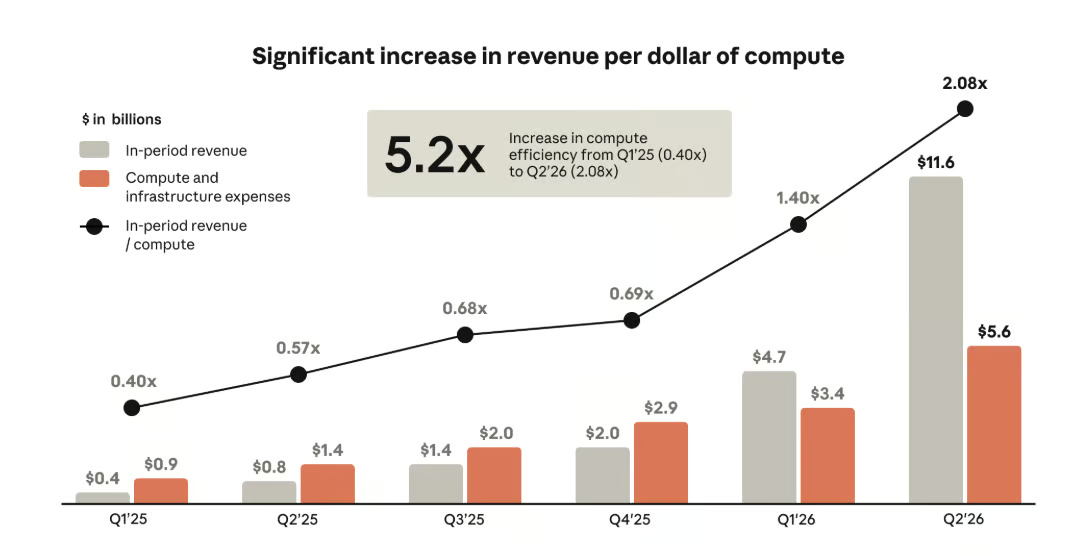
Image source: Anthropic S-1 Filing.
Anthropic reported a net loss of $80.7 billion in the first six months of 2026. At first, such a large loss might make investors wonder whether its business can last. But Claude pointed out an important detail in Anthropic's income statement, which shows a company's earnings and expenses.
About $72.4 billion of that loss came from changes in the accounting value of convertible securities and other financial instruments. Most of these charges did not involve actual cash payments. They were linked to changes in Anthropic's valuation, rather than money actually spent on engineering.
A more useful way to judge Anthropic's business performance is to look at operating income. This measures how much money a company makes or loses from its main business before certain financing costs and other items. Anthropic reported an operating loss of about $693 million. That was smaller than its $2.1 billion operating loss in the first half of 2025.
What are the risks of the Anthropic IPO?
Claude pointed out several concerns that could make Anthropic a less attractive investment over the long term.
The first concern is the cost of computing power for AI. Building and running advanced AI models requires huge amounts of computing power. Anthropic gets much of this capacity through agreements with cloud service providers. Claude noted that some of these agreements last until 2045. This matters because Anthropic might still have to pay for computing capacity even if demand falls or newer technology makes existing equipment less cost-effective.
Another concern is competition from large cloud service companies. Anthropic depends on Amazon Web Services (AWS) and Google Cloud for custom chips, training its models, and getting its products to customers. But these companies are also building their own AI products. This means that some of Anthropic's most important partners are also its competitors.
Claude also raised concerns about shareholders' voting rights. According to Anthropic's S-1 filing, the company's seven co-founders, especially CEO Dario Amodei, will keep 50.1% of the voting power through a special share structure.
Should you buy the Anthropic IPO?
The most interesting part of my experiment came when Claude looked at Anthropic under three possible company valuations: $500 billion, $1 trillion, and $2 trillion.
Anthropic's $16.3 billion in revenue during the first half of 2026 works out to about $32.6 billion for a full year if the first-half amount is simply doubled. This is only an annualized figure, not an official prediction of the company's full-year revenue. At a valuation of $500 billion, Anthropic would have a price-to-sales (P/S) ratio of 15. This ratio compares a company's value with its revenue. Claude said a small, speculative investment might make sense at this price.
At a $1 trillion valuation, Anthropic's P/S ratio in this example would rise to 31. Claude recommended avoiding the IPO at that price because investors would be paying for many years of very strong growth in advance. From Claude's point of view, a $2 trillion IPO with a P/S ratio of 61 would clearly be too expensive.
It's important to remember that these are hypothetical examples, not the actual price range for Anthropic's IPO. The company has not yet set its offering price or final number of shares.
In the end, Claude's answer supports one of the most important rules of investing: A great company is not always a great stock at every price. For investors thinking about buying shares in the upcoming IPO, Claude's advice was simple: Wait for the final prospectus, understand the details of the company's financial commitments, and don't mistake excitement about a new AI stock for a good reason to rush in and pay too much. Otherwise, investors who don't understand the risks could end up holding the bag, meaning they are left with an investment that has lost value.