
Who Pays for AI’s Inputs?
AI companies pay for computing power and skilled workers. Bill Gross wants to know why content is the only thing they get for free.
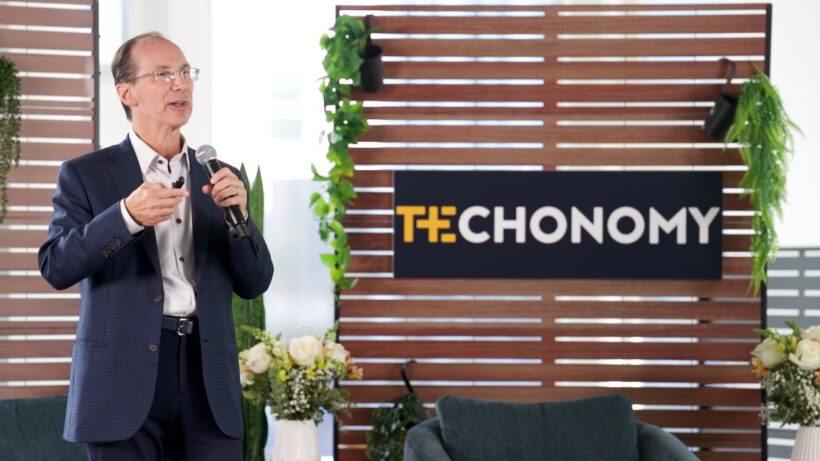
Bill Gross began his talk at Techonomy 26 by asking everyone to remember Napster. Then he explained when his own version of that story began. “It was December 27th of 2023, almost three years ago, and when the New York Times sued OpenAI for copyright theft of their content, I started thinking that this was very much like that Napster moment for music.”
Gross founded ProRata, a company designed to make AI companies pay publishers whenever their work appears in an answer. His argument is based on numbers. Ten years ago, Google visited a website twice for every visitor it sent back to that site. Last year, Gross said, it visited six times for every visitor. “But the AI search engines crawl your site 1,000 times for every visitor.”
The number may sound extreme, but Cloudflare Radar's July 2026 figures show that OpenAI visited websites 251 times for every referral it sent, Perplexity did so 289 times, and Anthropic did so 1,917 times. Google did so 4.7 times. Chartbeat's 2026 Publisher Playbook measured how much traffic publishers received in return. Referrals from Google Search fell 40.2% between July 2025 and July 2026, following a 21.9% drop the year before. AI chatbots sent publishers just 0.01% of their traffic.
Gross says that even though major cloud and AI companies are worth huge amounts and have attracted large investments, they do not want to pay for the content they use. “They have a huge expense on compute, and they pay that expense. They have a huge expense on people, and they pay that expense. And then they have content for which they pay zero.”
Gross says companies give three reasons for not paying: they cannot afford it, they should not have to, or they do not know how to do it. ProRata aims to solve the third problem.
Gross showed a prototype that answers a question, such as “What did Dario say in his essay?” The answer shows what percentage came from each source it used. He says 1,650 publications have agreed to split the money equally, with 50% going to each side. He was careful to explain what he wanted to achieve. “I don’t even care if they use our system. I’m not trying to make our system be the standard. I just want to show that there’s a way.”
Then Gross made a prediction that is worth examining. “I think it’s going to be in somewhat like this order: Apple, Google, Microsoft, Anthropic, OpenAI, last.” He believes one company will start paying for each use of content, and the others will follow. Because his prediction gives a specific order, it can be checked against what happens. So I tested it.
Apple Will Be the First Domino
Gross's reasoning is that Apple News already splits subscription revenue 50/50, so Apple is “used to being ethical in the sharing of revenue with publications.” The timing supports his idea. On August 12, the Wall Street Journal reported that Apple was discussing multiyear deals to pay news publishers each time Siri uses their reporting. The budget could reach hundreds of millions of dollars. This is the kind of payment system Gross supports, and Apple was considering it in Cupertino before he made his prediction on stage.
There are two important things to consider. First, Apple has not explained what counts as a “use,” even though that definition determines how much publishers could earn. Second, the 50/50 split for Apple News was not something publishers negotiated. In 2019, Apple told publishers it would keep half of every subscription payment, and publishers were angry. Apple's usual approach is not to share revenue willingly. It is to take 50%.
Google will probably be next, but it may not follow the same payment model. On October 16, its AI news pilot included more than 400 publications, adding CNN, the Financial Times, and Reach. But these partners receive fixed payments, whose amounts have not been made public, for a specific set of arrangements. Google also has the least reason to start charging by each use of content. It sends 4.7 visitors back to websites for every time it crawls them, so it still brings publishers traffic. If Google paid per use, it would have to pay for something it currently gets for a fixed price. Google is the company most likely to pay publishers, but the least likely to pay for each use.
Microsoft is another important company to watch. Gross said the “Microsoft CEO has already said under oath that they really feel like they stole a lot of stuff.” But court documents tell a different story about who made the statement. Brent Hecht, a Microsoft director of applied science, described the development of AI as the “largest theft of labor in human history.” The quote appeared in a New York Times court filing that was made public in September. Hecht was not the CEO, and reports do not show that he made the statement under oath. Even so, the statement could hurt Microsoft's argument in a legal fight over whether its use of copyrighted work is allowed under fair use. Gross's second point also makes sense: Microsoft reported $15.2 billion in search advertising revenue in fiscal 2026, about 5% of its total revenue. Microsoft can afford to pay for content.
Anthropic's plans may become more complicated as it prepares for a possible initial public offering, but Gross believes it will also join the group. He said Anthropic “already lost a 1.5 billion dollar lawsuit for books.” The company actually settled the case, and it won the fair-use part of the dispute. In 2025, Judge William Alsup ruled that training Claude on books was fair use. However, Anthropic could not defend its decision to download more than seven million pirated copies to build its book collection. The settlement, approved on July 20, requires payments of about $3,000 per work across 482,460 titles. This result weakens Gross's prediction that companies will follow one another into paying for every use. The case put a price on piracy, not on AI training. If an AI company buys a book, it may not have to pay anything more.
OpenAI Will Be Last
In Gross's predicted order, OpenAI comes last because it has the most to lose and has spent years saying it lacks money. “When they cried poor two years ago, they didn’t have revenues. But now they have a billion users, and many of them are paying $20 a month and $200 a month.” In late September, Axios estimated that OpenAI's annual revenue rate was close to $70 billion. USA Today Co. sued OpenAI on October 9, seeking $250 million. The owners of about 400 local newspapers had also sued in June. OpenAI has signed agreements with publishers including News Corp, Axel Springer, the Times of India, and Village Media. It already pays some publishers through fixed-fee deals, especially those large enough to sue.
The problem with Gross's plan is that payment for each use may not cover enough publishers. Fixed payments go to a few hundred major publishers, while everyone else faces a referral rate of just 0.01%. Gross says 1,650 publishers have signed up for ProRata, but that is only a small share of all content creators. At the FIPP Congress in Madrid last week, a ProRata representative could not name a single publisher making a meaningful amount of money through the system.
Payment systems worked in music and video. Spotify paid out $11 billion in 2025 and remained profitable. YouTube reached a deal with NBC to share revenue instead of removing its content. But those industries gained payment systems because a platform wanted the content badly enough to track and count its use. Right now, AI companies already have the content.
Gross admitted that the larger problem had already begun. “The horse is already out of the barn. There’s no question that there’s already a huge amount of content that’s already been crawled. The damage to creators is already real.”
About the Author
By Dan Costa
Dan Costa is Chief Content Officer of Worth Media. From 2011 to 2021, he was Editor-in-Chief of PCMag.com and Senior Vice President of Content for Ziff Davis. During that time, he managed the editorial work of PCMag.com, AskMen.com, ExtremeTech.com, and Geek.com. While he was in charge, PCMag's audience grew to more than three times its earlier size, and its revenue grew to more than five times its earlier level.
He has spoken about technology and innovation around the world and has served as a cultural attaché to the U.S. State Department since 2015. During these assignments, he gave talks to professional and academic audiences in Hong Kong, Oman, Uruguay, Portugal, and Taiwan about AI, 5G, digital privacy, big data, and wider technology trends that affect business and society.
View Profile