
First AI Game Index: Claude Dominates Game Development, but OpenAI Captures the Players
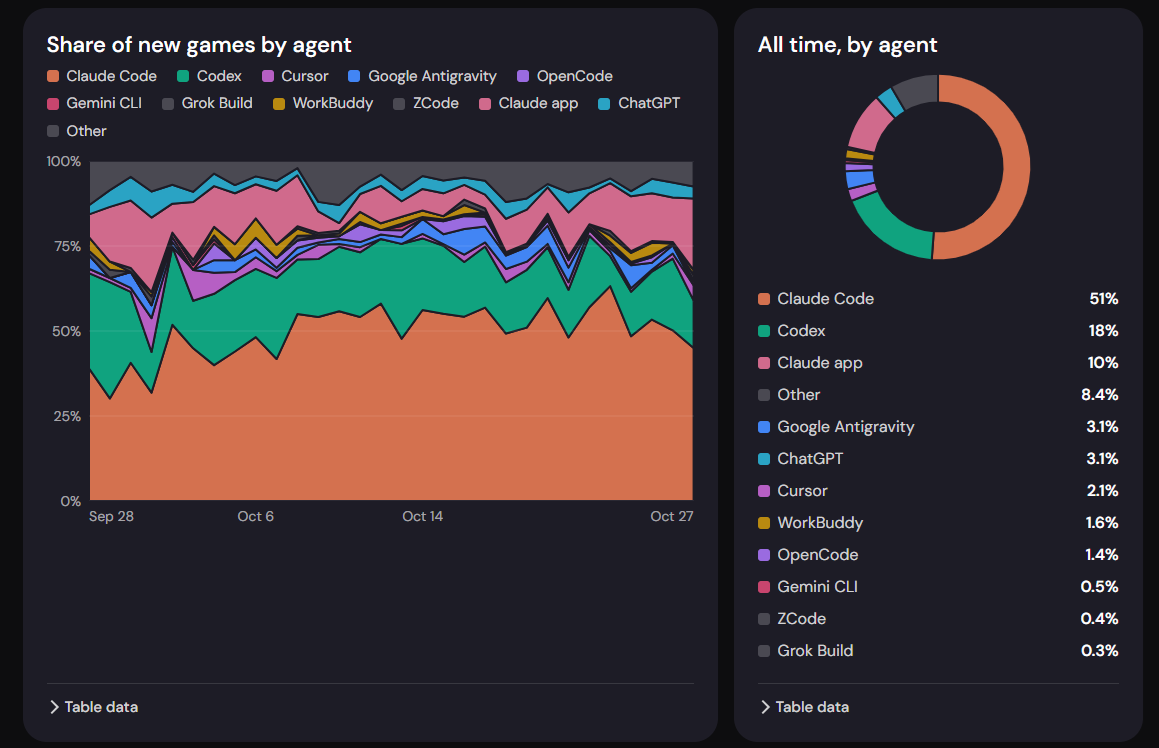
Image Credit: Playgama
According to an industry-first study of more than 4,200 AI-made games and 1.1 million game launches, developers clearly prefer Anthropic's Claude Opus. It is now used to create 54% of new games. But players seem to prefer something else: games made with OpenAI's Astra and Sol get up to 58% more likes for each play.
New data from the Playgama AI Game Index shows that Anthropic's Claude is leading in the number of AI-made games, while OpenAI's models are winning over players. The index ranks AI coding agents and large language models (LLMs) each day by measuring how real players respond to the games they create.
The index uses live data from Playgama Sandbox, a platform for games made with AI. Instead of relying on code tests or computer-generated test results, it tracks what people actually do. It compares leading AI models using measures such as time spent playing, player likes, and each model's share of published games. This lets real gameplay data show how well the models perform.
Unlike traditional tests or competitions judged by people, the index measures real players' reactions using data collected inside games. It does not rely on surveys or human judges. The evaluation lasted one month and included 506,000 users.
Key findings
1) Claude took over the market in four weeks. Since Claude Opus 5.5 launched on September 22, it has quickly become the most-used model for AI-made games. It powered 54% of new games and reached 62% last week, while OpenAI Sol's share fell to 8%.
2) The most-used model is not the most-liked. Claude Opus ranks sixth out of eight models that were rated, with 39 likes for every 1,000 plays. OpenAI Astra gets 65 likes per 1,000 plays, and OpenAI Sol gets 58. The same pattern appears in coding tools. The middle game by likes built with Codex gets 65 likes per 1,000 plays, compared with 43 for a game built with Claude Code. These figures are based on the median game, so a single very popular game cannot make an entire model look better than it usually performs.
3) OpenAI Astra gets the most likes, but it is becoming too expensive for builders. Astra leads the index with 65 likes per 1,000 plays and a median playtime of 4 minutes and 58 seconds. However, its share of new games fell from 11–17% in late September to just 4% in October.
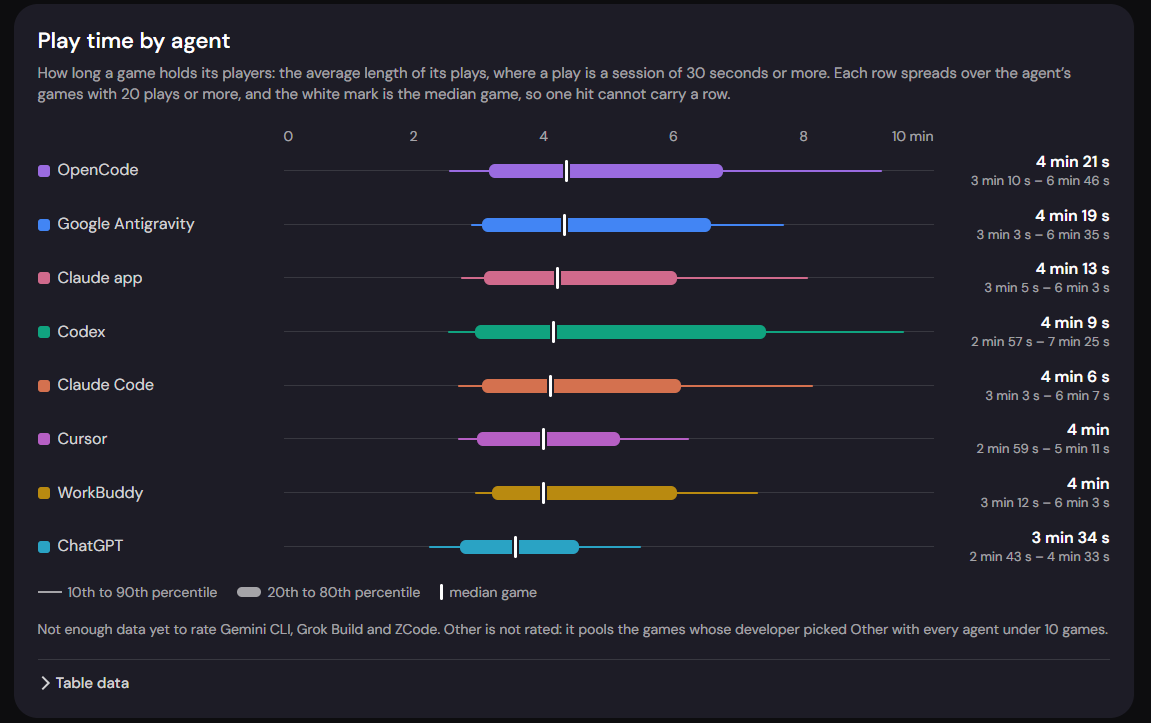
4) DeepSeek and OpenCode keep players playing longer than major competitors. DeepSeek accounts for only 1.6% of the index, but players spend a median of 4 minutes and 32 seconds on games made with it. Only OpenAI Astra does better. Among coding tools, the open-source agent OpenCode is used for 1.6% of games but has the longest median playtime of all rated tools, at 5 minutes and 14 seconds.
“Think of the index as a thermometer, not a judge. A year ago, making a game took a team and months of work. Now, one person can build a game with an AI agent in one evening,” said Dmitry Kachmar, founder of Playgama. “What surprises me most is how quickly things change. Sol replaced Astra in just two weeks. A model that nobody used in September is leading the rankings in October. Every AI lab keeps releasing updates, and I expect the next release to change the rankings again. That's why we update the data every day.”
What comes next
Model versions change every few weeks, and the index will show each change the day after it happens.
“AI can help you release games that become huge hits, but it can just as easily help you make something nobody plays. AI makes development faster and easier. For a professional, it naturally makes attention to detail even more important. But success does not depend on the model or agent. It depends on the creator improving the game until it works. Making a game is no longer the main obstacle. The winners will be creators who can test games quickly and tell the difference between games people actually play and games that simply exist. They will use real player behavior rather than judging panels or code tests to make that decision,” explained Dmitry Kachmar.
The index updates every day and gives a live picture of how leading AI models perform when making games. It tracks real player engagement, game performance, and player feedback. Creators who build games with AI can join the index by publishing their games on Playgama Sandbox and labeling the model and agent they used. Games count toward overall market share as soon as they are published. They enter the playtime and likes rankings once they have received 20 plays.
About the company
Playgama connects web game developers, publishers, advertisers, and players. More than 4,000 game developers rely on its main services. In 2026, the company launched a set of tools that allow AI agents to analyze, improve, and update games on their own. It also launched Playgama Sandbox, a new place to build and run AI-made games. Data from this platform powers the AI Game Index.
Playgama was founded in 2023 and raised $3 million in venture funding in 2024. In 2025, it became a finalist in the Pocket Gamer Mobile Games Awards and the MENA Games Industry Awards. In 2026, it was named to Deloitte's Technology Fast 50 Rising Star list.