
Anthropic’s IPO Filing Shows How Its Trust Could Lose Power
The Information said on 28 October 2026 that Anthropic’s IPO filing shows that shareholders could take away the Long-Term Benefit Trust’s power over the company’s board. Anthropic filed the S-1 on 26 October. The filing explains how this could happen: the trust’s rules and the share that lets it choose board members can be changed, or that share can be taken back “for no consideration”, through a set of votes called the Trust Amendment Threshold.
In simple terms, an independent trust chooses four of Anthropic’s seven board members. The filing explains how this power could be changed. One way requires the trustees to agree. The other ways do not. While the founders’ special share still exists, changes require approval from the co-founders, employees and ordinary shareholders. After that share is gone, a very large majority of ordinary shareholders can approve a change.
The key insight: In our reading, the S-1 makes the trust’s power over the board long-lasting, but not permanent. The Class T share has no end date, and the filing lists three ways to change it without a vote from the trustees.
Who Elects Anthropic’s Board
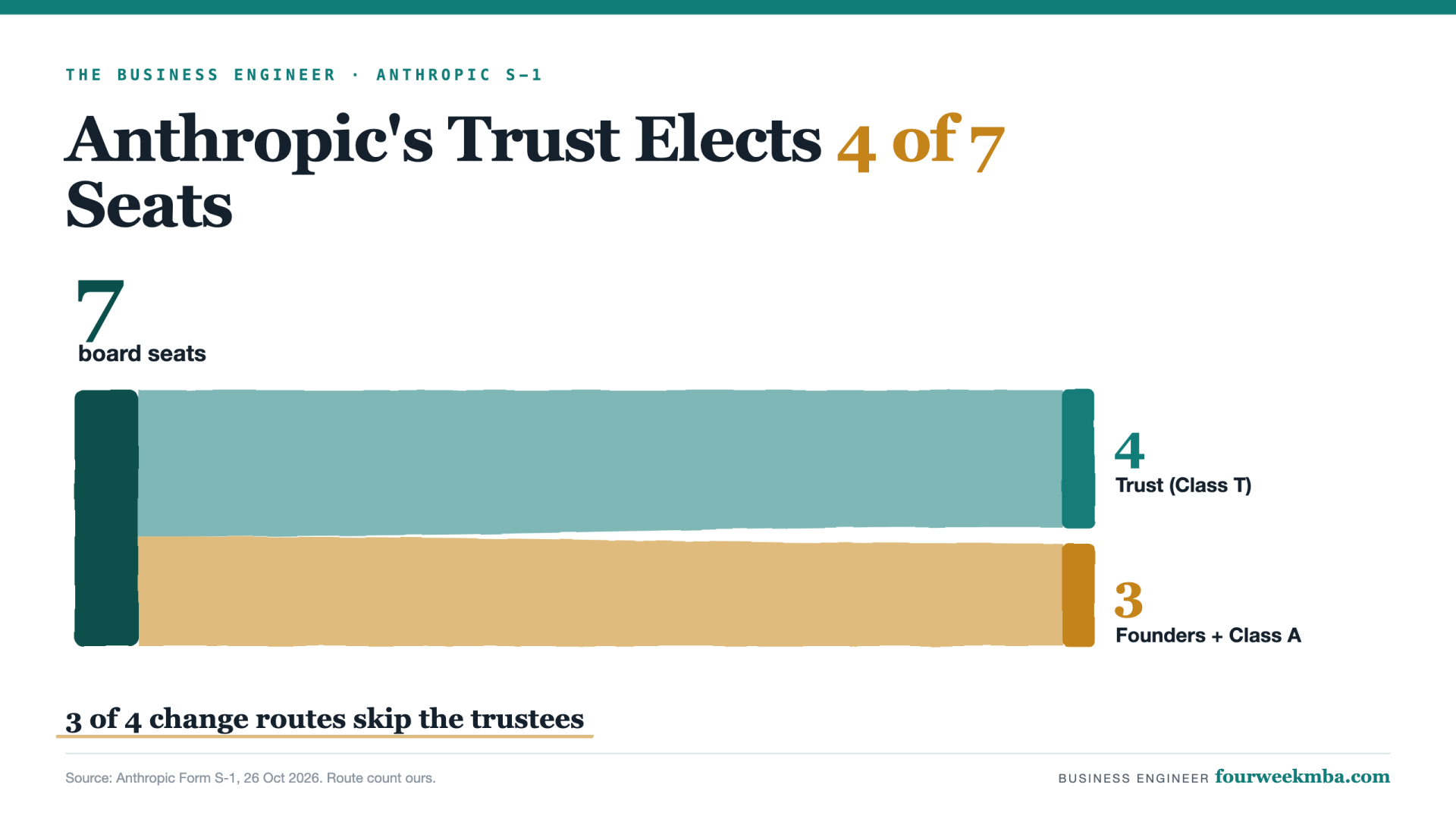
- Seven board seats. The S-1 says that when the offering is complete, the board “will consist of seven authorized directors”.
- Four seats: the trust. The S-1 says the Long-Term Benefit Trust, as the only holder of Class T stock, will generally choose and remove the four Class T directors. The filing names Mr. Hastings, Dr. Narasimhan, Mr. Liddell and one vacant seat.
- Three seats: founders and shareholders. Holders of Class F and Class A stock, voting together, will choose the other three directors. The filing initially names Dr. Amodei, Ms. Amodei and Ms. Razavi for these seats.
- The founders’ 50.1% voting power. The S-1 says Anthropic will issue one share of Class F stock to an LLC whose first members will be its seven co-founders. This share will carry votes equal to 50.1% of all voting power on matters put to shareholders in general.
- Employees. The filing says Anthropic will issue new Class E stock to employees, excluding the co-founders. This stock will give employees voting rights on only certain matters and no right to financial benefits from ownership.
The S-1 describes the expected result this way: “we expect that the LTBT and the Founder LLC will collectively have the ability to elect all members of our board of directors”. Our guide to Anthropic’s ownership explains the different share classes in more detail.
The Ways to Change the Trust
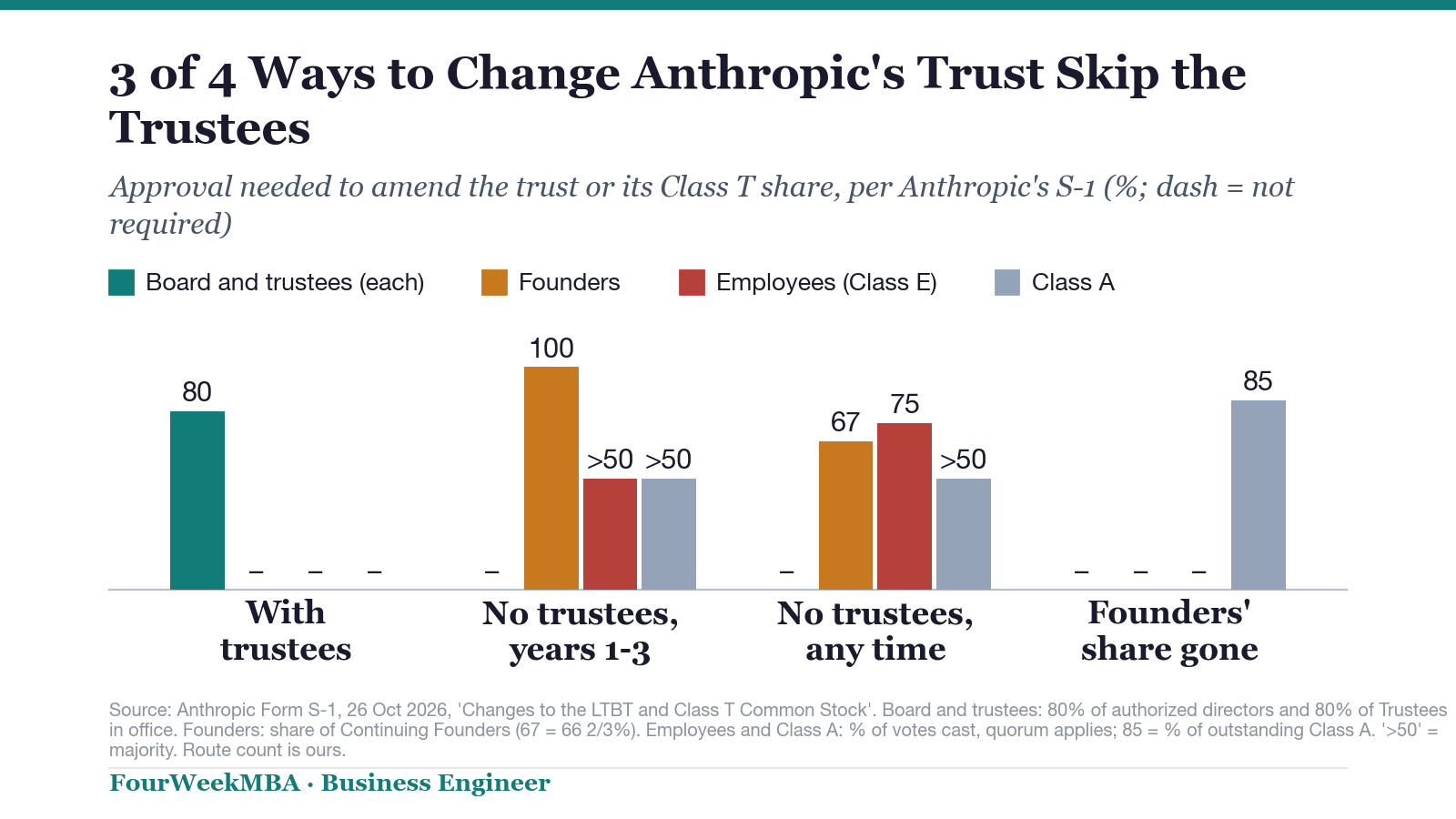
The filing lists the approvals needed to change the trust’s rules or the rights attached to the Class T share:
- With the trustees. If the trustees agree to the change, it also needs “80% of the authorized members of our board of directors and 80% of the Trustees then in office”.
- Without the trustees, during the first three years. While Class F stock still exists and until the third anniversary of the offering, a change needs Class F stock approval based on “the unanimous approval of the Continuing Founders”. It also needs a majority of votes cast by Class E stock holders, with at least 40% of Class E shares represented, and a majority of votes cast by Class A stock holders, with at least a majority of Class A shares represented.
- Without the trustees, at any time. While Class F stock still exists, a change can also be approved through Class F stock if 66 2/3% of the Continuing Founders agree, along with “75% of the votes cast by our Class E common stock” and a majority of the votes cast by Class A stock holders.
- After the founders’ share is gone. If no Class F stock remains and the trustees do not agree, the change needs “approval of 85% of our outstanding shares of Class A common stock”.
The filing says the Class T share can also be taken back by the company “for no consideration” if the same approval requirements are met. The share can be transferred without restrictions once the same approvals required to change, end or redeem it have been received.
No End Date, and a Reason for the Rules
The S-1 says the Class T share “will remain outstanding indefinitely”, unless the required approvals are given. It explains the company’s reason: “We intentionally structured the Class T common stock in this manner to preserve long-term flexibility if circumstances change.”
The filing also says that if the share were transferred to someone who was not connected to the trust, all directors would still have to follow Delaware law and the company’s governing documents for as long as Anthropic remained a public benefit corporation. This includes the rules about the company’s public benefit purpose.
How Employees Can Weigh In on One Trust Seat
The filing gives employees a role in decisions about one trust-appointed board member, called the “Specified Class T Director”. That director is Mr. Liddell. The trust needs the board’s nominating committee to agree before it can nominate this director, remove the director without giving a reason, or change which seat has this designation. The S-1 says the committee will have one Class T director and two other directors.
If the committee does not agree within 15 days of receiving notice, the S-1 says, “the matter will be submitted to a vote of the holders of our Class E common stock unless the LTBT elects to withdraw the notice.” A majority of the Class E votes cast will then decide the matter.
How This Fits with Other Reports
Our guide to the Long-Term Benefit Trust, published on 27 October, explains how the trustees are chosen and paid. Our article about the founders, published on 26 October, explains how each co-founder can rank possible successors within the founders’ LLC. Our article about the benefit fund, published on 27 October, covers the fund that holds more shares than any single co-founder. The new point in this report is The Information’s focus, on 28 October, on how the trust’s power can be changed. The S-1 shows that three of the four listed routes do not require the trustees to vote.
That same week, our article about risk factors reported on the Wall Street Journal’s account that Senator Elizabeth Warren had asked Anthropic to answer four pages of questions by 3 November.
What the Structure Means
In our reading, all the routes that do not require the trustees’ approval still need more than a shareholder vote while the founders’ share exists. The co-founders and employees must also approve the change.
In our reading, the S-1 gives employees two roles in this structure. They can vote on changes to the trust. They can also vote on the one trust-appointed board seat if the nominating committee disagrees with the trust within 15 days.
The filing explains the reason for this structure in its own words: “to preserve long-term flexibility if circumstances change”. It also says that directors must continue to follow the company’s public benefit purpose for as long as Anthropic remains a public benefit corporation.
Anthropic, Form S-1, 26 October 2026
“We intentionally structured the Class T common stock in this manner to preserve long-term flexibility if circumstances change.”
Three Main Effects
FOR IPO INVESTORS Under the S-1, Class A shareholders can vote on changes to the trust. While the founders’ share exists, those changes also need approval from the co-founders and a Class E employee vote.
FOR ANTHROPIC EMPLOYEES The S-1 says Class E stock will be issued to employees, excluding the co-founders. These employees can vote on changes to the trust and on one trust-appointed board seat if there is a disagreement.
FOR AI GOVERNANCE The S-1 gives the trust four of the seven board seats without setting an end date. We count four ways to change the trust, three of which do not require the trustees’ approval.
The Business Engineer View
This story connects with the Business Engineer framework Inside Anthropic’s Permission Layer.
The framework says of Anthropic: “It is becoming the first major AI lab actively attempting to define the governance layer of the AI stack.”
In our reading, the trust, its Class T share and the approval rules in the S-1 are one practical example of that governance layer. The framework was published before the S-1 and does not discuss the Trust Amendment Threshold.
What Has Not Been Established
The S-1 describes the rules, not anyone’s plans. It does not say that the founders, employees or shareholders intend to change the trust. We could read only The Information’s post on X, not its full article. The filing does not state the co-founders’ total voting power. We did not contact Anthropic.
The Bottom Line
Anthropic’s S-1 gives its trust four of the company’s seven board seats, with no end date. It lists four ways to change this arrangement. One requires approval from 80% of the board and 80% of the trustees. The other three do not require the trustees’ approval. If the founders’ share no longer exists, holders of 85% of the outstanding Class A shares can approve a change without the trustees.
A note on sources: The board structure, voting rights and all approval requirements are quoted or summarized from Anthropic’s S-1, filed with the SEC on 26 October 2026, using the text of the filing itself. The Information’s statements come from its post on X on 28 October; we did not read its full article. We counted the approval routes ourselves. We did not contact Anthropic.
Sources: Anthropic, PBC Form S-1 (SEC, filed 26 October 2026) · The Information on X, 28 October 2026