
Google Deepmind releases Gemini 4 Carbon just two weeks after Argon with gains across the board
Google DeepMind released Gemini 4 Carbon just two weeks after Argon. The new model now ranks first on the Artificial Analysis Intelligence Index.
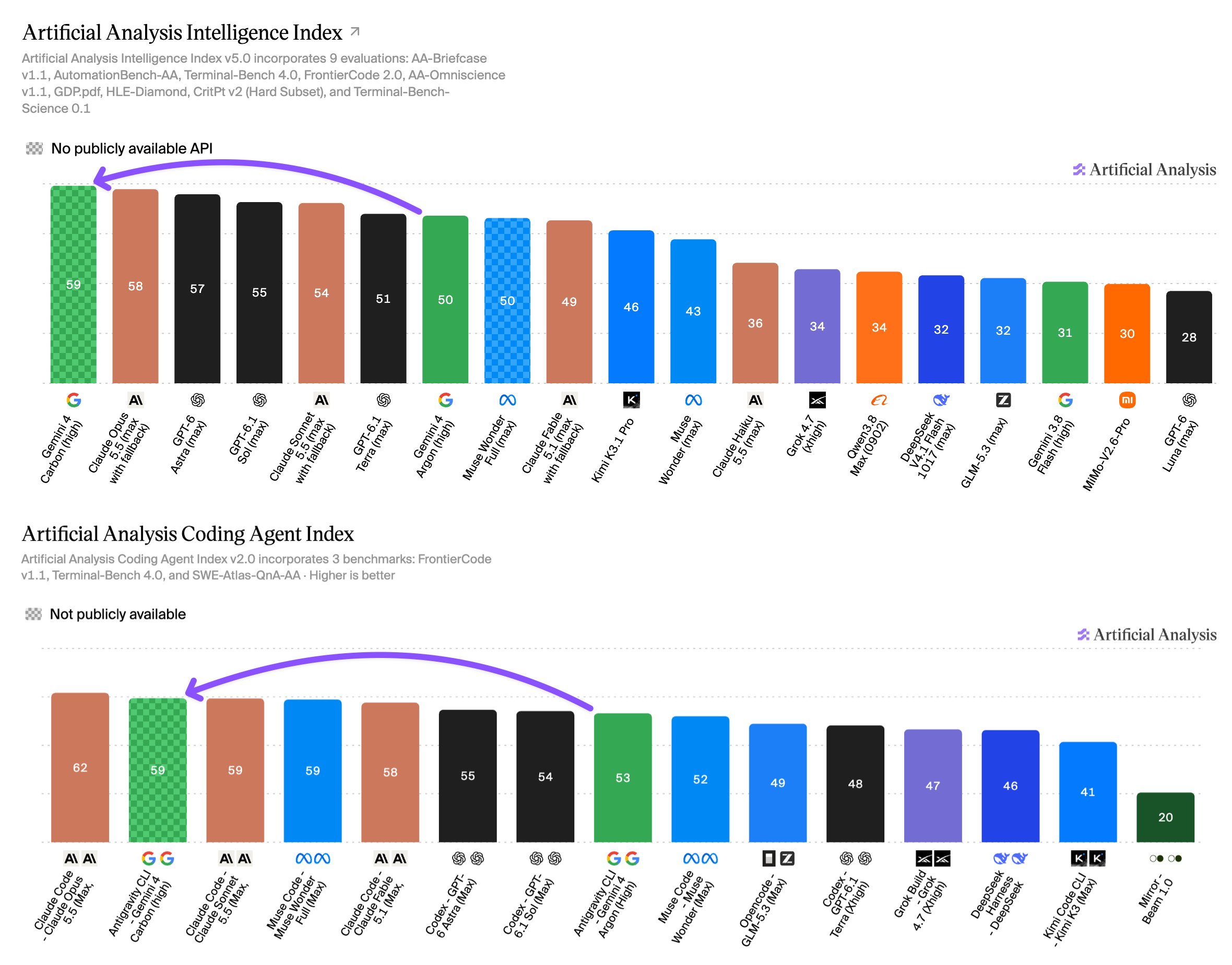
Carbon scores 59 points on the latest version 5.0 of the Artificial Analysis Intelligence Index, while its predecessor, Argon, scores 50. Carbon also performs better in tasks that involve working independently and writing code. Google highlights its abilities across the full cybersecurity process, from finding and checking security weaknesses to fixing them.
Designed for coding sessions that last several days
Google DeepMind says it built Carbon to handle "much harder, long-horizon engineering problems" that require AI agents to keep working over long periods. Google's internal teams ran the model for several days at a time. According to Google, Carbon found its own way past dead ends and completed difficult tasks with many steps, such as finding the root causes of problems and fixing hard-to-spot bugs in large software projects and low-level code.
Google also reports improvements in scientific reasoning, understanding different types of information, and building complete web applications, based on user feedback. Better results and higher-quality work in web development helped Carbon gain 89 Elo points on the WebDev Arena. It now ranks fourth with 1,769 points.
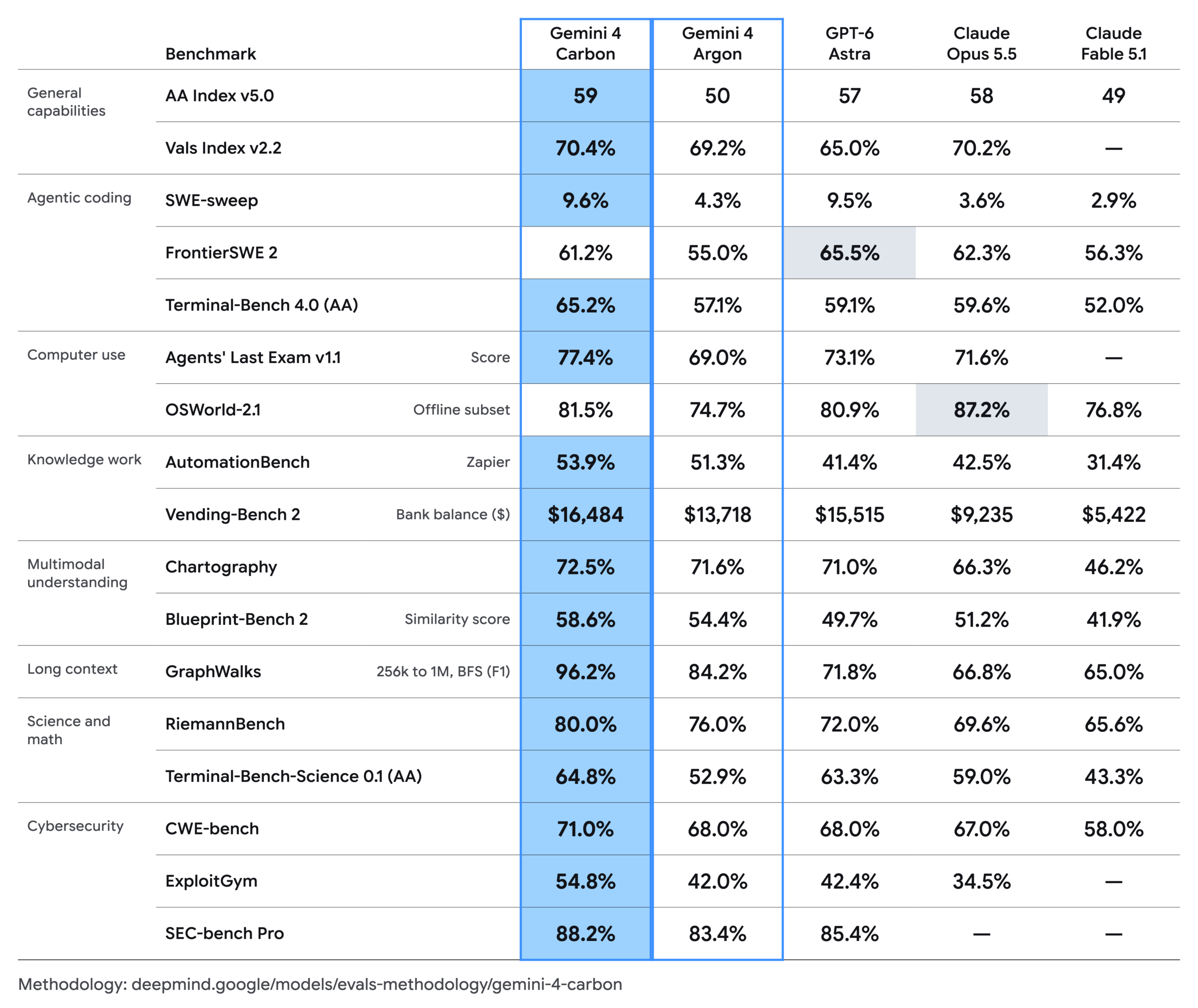
In Gray Swan's test of indirect prompt injection, Carbon reduced the attack success rate from 0.7 percent with Argon to 0.0 percent. Google says Carbon blocked every manipulation attempt tested. This does not mean prompt injection has been solved, but the test appears to have reached its limit, with no successful attacks recorded.
Independent tests support Google's results
Artificial Analysis reports that Carbon, using its highest reasoning setting called "high," leads the Intelligence Index v5 mainly because of strong results in complex reasoning, finding relevant knowledge, and scientific tasks. It ranks first in four of the index's nine individual tests.
In agent-based coding on Antigravity, Carbon still scores three points below Claude Code with Opus 5.5, even though it has improved from 53 points with Argon to 59. In agent-based knowledge work on AA-Briefcase, Carbon (high) gains 126 points over Argon (high), which scored 1,483 Elo, reaching 1,609 Elo. This improvement comes mainly from better presentation quality, up 293 Elo points to 1,598, and analytical quality, up 120 points to 1,671. Carbon still ranks below Kimi K3.1 Pro (1,678 Elo), Muse Wonder (max, 1,659 Elo), and Grok 4.7 (xhigh, 1,638 Elo).
Carbon's answer accuracy rises from 48 percent with Argon to 58 percent. However, its hallucination rate, which measures how often it produces incorrect information as if it were true, also rises from four percent to 11 percent. Despite this increase, its rate is still the second-lowest in the ranking. Claude Opus 5.5 (max) and GPT-6 Astra (max) both score 50 percent for answer accuracy.
The Vals AI evaluation platform ranks Carbon second, with 70.36 percent accuracy. Claude Sonnet 5.5 leads with 70.85 percent, followed by Carbon, Claude Opus 5.5 at 70.18 percent, and Argon in fourth place at 69.24 percent. All these models cost less to run than some alternatives.
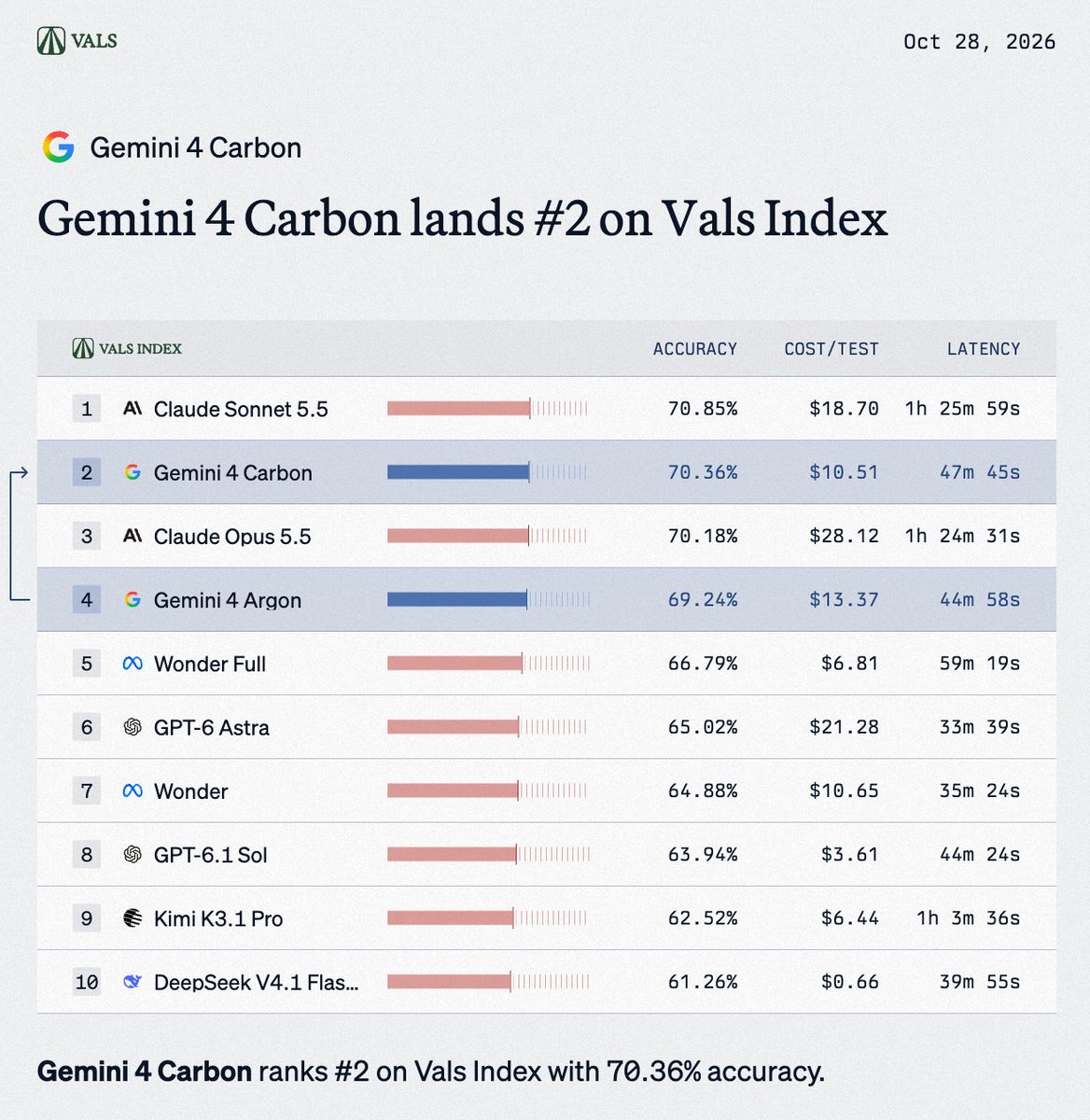
On Vals.ai, Carbon also ranks first in both the Finance Index and the Legal Research test. In legal research, Vals AI found that Carbon cited about 45 percent more sources than Argon, used tools more often, and produced longer answers.
However, Carbon takes more than twice as long as Argon to complete tasks in the Finance and Tax Agent test. In Legal Research, it takes an average of more than 50 minutes per task. Carbon generates 2.3 times as many reasoning tokens and 64 percent more output tokens than Argon. Even so, its output token count is still less than half that of Sonnet 5.5 and Opus 5.5.
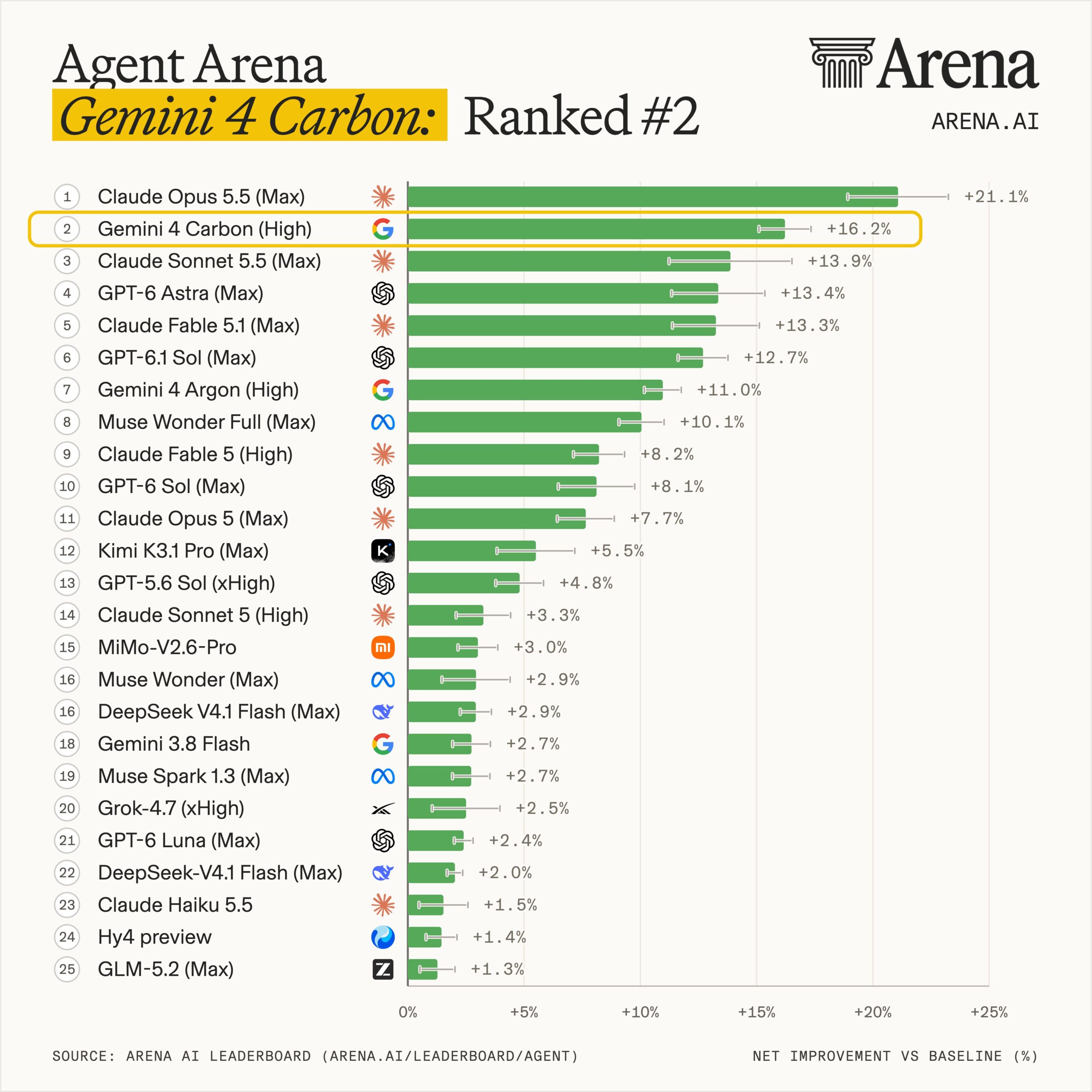
On Arena.ai, Gemini 4 Carbon (High) ranks first in Text Arena with 1,528 points, just ahead of Argon at 1,520. In Agent Arena, Carbon ranks second based on more than 21,900 real-world sessions. It performs better than GPT-6 Astra and Fable-5.1, with a net improvement of 16.2 percent and the highest steerability score, at +18.6 percent. Steerability measures how well a model follows a user's directions. Carbon's median task cost is $1.80, which is 72 percent lower than that of first-place Claude Opus 5.5 (Max).
In the WebDev section of Code Arena, Carbon scores 1,768 points, 89 points more than Argon, which ranks eleventh. Carbon ranks fourth overall, just two points behind Claude Sonnet 5.5 (xHigh), which scores 1,770. This places Carbon on the Pareto curve across all three areas.
Carbon leads cybersecurity tests without safety guardrails
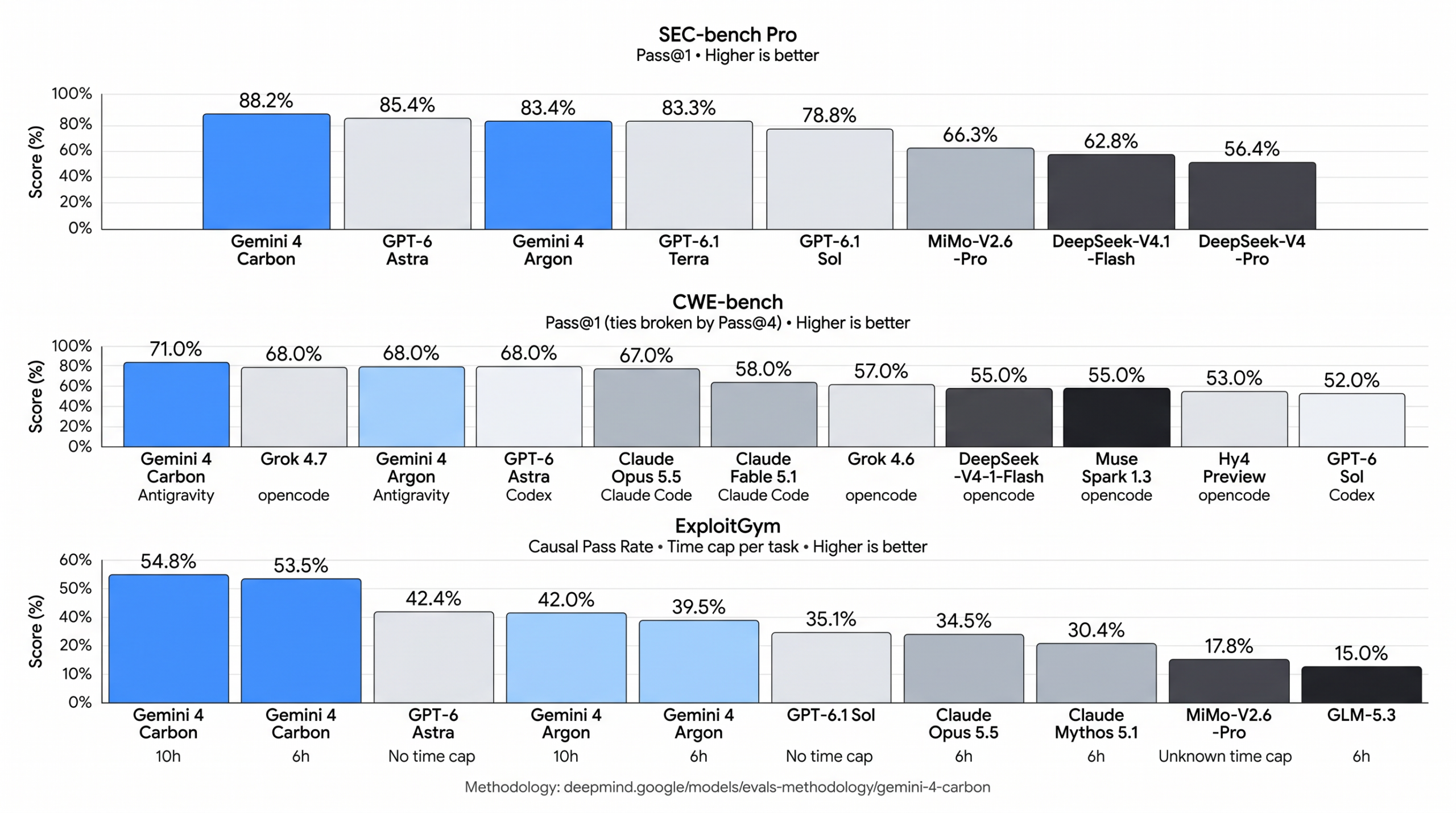
Google ran Carbon without safety guardrails in several cybersecurity tests. On SEC-bench Pro, which measures how well a model can find security weaknesses in real software on its own, Carbon scores 88.2 percent, the highest score among the models tested. On ExploitGym, which tests whether a system can turn discovered weaknesses into working exploits, Carbon scores 54.8 percent. It also leads by a wide margin in tests of its ability to write fixes on CWE-Bench.
Google also reports results from its own tests that cannot be independently checked. In internal tests, Carbon reportedly produces secure code more than twice as often as Argon. Tests by Google's Chrome team also found that Carbon was more than ten times better at writing security patches than the leading model from an unnamed competitor.
Cybersecurity experts will get access first
Google is making Carbon available gradually and taking part in the U.S. government's testing process before public release. The company says this is because of Carbon's advanced cybersecurity abilities. Selected cybersecurity experts will get access first, starting this week. Through Google DeepMind's Fairwind Program, access will later expand to more trusted partners.
Google plans to make the model available to developers, businesses, and everyday users through its products after gathering more feedback and adjusting its safety guardrails.
Gemini 4 Carbon launches at the same introductory price as Argon: $2 for every million input tokens and $10 for every million output tokens. Cached input tokens receive a 95 percent discount compared with the regular input price.
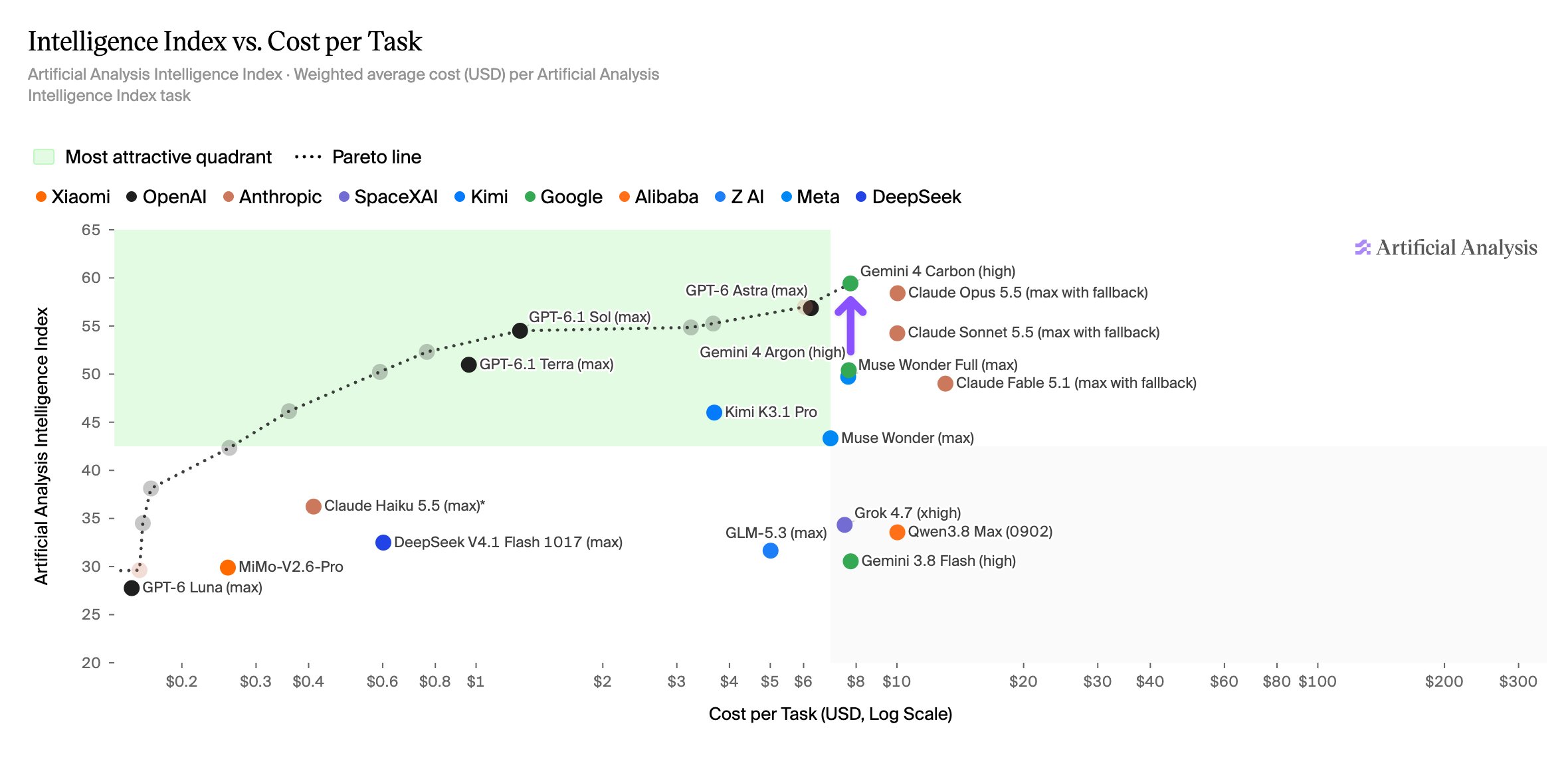
Carbon costs $7.76 per task in the Artificial Analysis Intelligence Index. This is about 23 percent less than Claude Opus 5.5 (max), at $10.04, and about 1.2 times the cost of GPT-6 Astra (max), at $6.25. Carbon uses an average of 123,000 output tokens per task, 29 percent fewer than the Anthropic model's 173,000 tokens. Its cost is almost the same as Argon's, at $7.68 per task.
Artificial Analysis calculates these costs using the regular listed prices of $4 per million input tokens and $20 per million output tokens, plus $0.20 for cached input tokens. It does not include the current 50 percent introductory discount, which lasts until the end of 2026.