
Suit Targets OpenAI Georgia Deal Carrying $900M Tax Break
The Effingham Herald reported on 28 October 2026 that people challenging OpenAI’s planned Project Camellia data center in Effingham County, Georgia, have asked Superior Court Judge Michael Muldrew to decide the case in their favor without a trial. Their request, filed on 27 October, asks the judge to cancel agreements connected to the project.
According to the plaintiffs’ filing, as described by the Herald, one of the agreements offered nearly $900 million in tax breaks in return for promises to invest money and create jobs. The Herald describes the campus as a $20 billion project. OpenAI says it has an agreement with Georgia Power to provide 3.2 gigawatts of electricity.
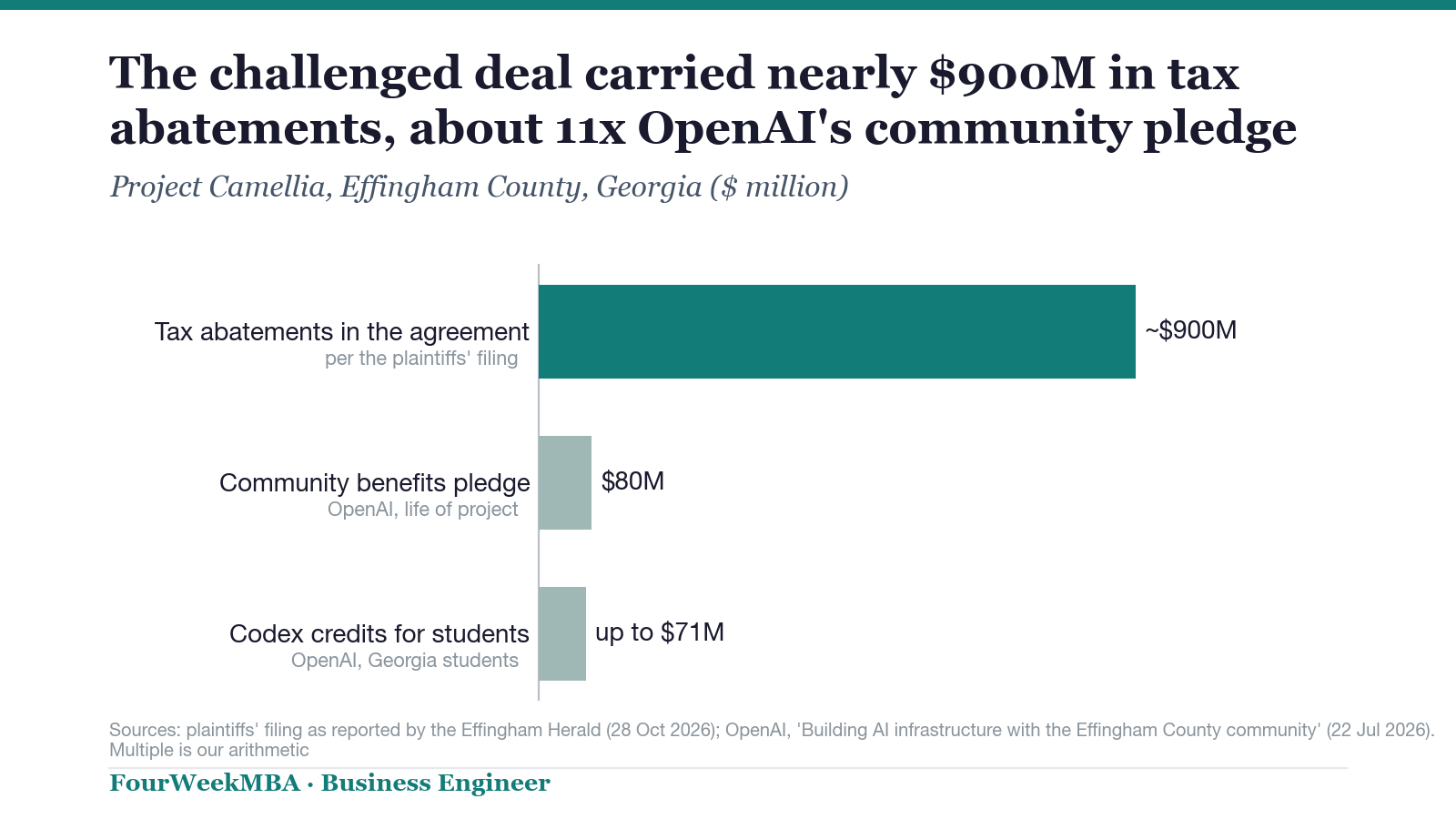
The main point: According to the plaintiffs’ filing, as reported by the Effingham Herald, the challenged agreement for OpenAI’s Project Camellia included nearly $900 million in tax breaks. Based on our calculations, that works out to just under $2.25 million for each of the 400 permanent jobs planned for the site at the start.
What the Motion Asks
The plaintiffs are One Hundred Miles Inc. and five individuals. The Effingham Herald reports that William Snow of the Southern Environmental Law Center represents them. They say the Effingham County Industrial Development Authority broke Georgia’s Open Meetings Act and Open Records Act. They want the judge to declare that agreements connected to the land sale and the data center project are legally invalid.
The motion asks for summary judgment, which means a judge can decide a case without holding a trial. The Herald points out that the filing presents the plaintiffs’ claims, not a court ruling. Filing the motion does not automatically stop the data center project or cancel other approvals.
The Herald says it asked the authority and Oliver Maner LLP, the law firm representing Octans GA LLC, an OpenAI affiliate named as a defendant, for comment. Neither had responded by the time the report was published.
The Notice and the Closed Session
According to the plaintiffs’ filing, as reported by the Herald, the authority had scheduled its regular meeting for 16 July but moved it to 21 July. The plaintiffs say the updated meeting notice was posted only five days before the meeting. Georgia law requires regular meeting schedules to be posted at least one week in advance.
The plaintiffs also say the meeting agenda did not tell the public that the authority would discuss the OpenAI project. The filing says the project was listed under the code name “Project Gateway.” According to the filing, the authority discussed the agreement in a closed meeting for more than an hour. The plaintiffs argue that the legal exception allowing private discussions about real estate did not apply because the agreement itself was not a contract to buy, sell or lease property.
“The Georgia Open Meetings Act sets very clear requirements for the amount of time that must be provided for notice before a public meeting,” Snow told the Herald.
The Land and the Records
The lawsuit also challenges how agreements for the project’s roughly 1,440 acres of land were handled. According to the filing, land-sale agreements were signed on 14 May and 7 July through Savannah Industrial Development LLC, which acted on behalf of the authority. The property was transferred on 24 July.
The plaintiffs say their lawyers requested the land-sale agreements on 18, 26 and 31 August. According to the filing, the authority said the documents were held by its private representative, which refused to provide them. The plaintiffs are asking the court to order the authority to release the agreements.
The Money in the Deal
When the project was announced on 22 July, the Herald reported that the authority’s board had approved a package of financial incentives for OpenAI. The package included a 50% reduction in property taxes for 15 years, with the company’s tax calculation fixed at the 2026 millage rate. According to the Herald, OpenAI officials said the site would start with about 400 permanent workers and could eventually employ as many as 1,000.
In its own post about the project, OpenAI said the planned 3.2 gigawatts of electricity would be supplied in stages between 2028 and 2032. The company also said it would pay the full cost of the infrastructure and electricity services needed for the site. The post promised $80 million in community benefits over the project’s lifetime and up to $71 million in Codex credits for eligible students in Georgia. OpenAI said the project would be funded entirely by private money.
Based on our calculations, nearly $900 million in tax breaks divided among the 400 permanent jobs planned at the start would equal just under $2.25 million per job. If the site eventually employs 1,000 people, the figure would be just under $900,000 per job. The tax-break figure is also about 11 times the $80 million promised for community benefits, based on our calculations.
What Happens Next
The authority and Octans GA LLC can respond to the motion. Snow told the Herald that the defendants had received an extension until 12 November to respond to the original complaint. That deadline is separate from the deadline for responding to the request for summary judgment.
The Herald reports that this is the second lawsuit in Effingham County Superior Court involving actions connected to Project Camellia. In September, three county residents sued to overturn a zoning rule approved on 4 August that allows data centers in industrial areas.
Connecting the Coverage
This month, we have followed other local disputes over AI data centers, including a unanimous 7-0 vote, a refusal and a threat of a lawsuit, Oklahoma City’s approval of a data center with a 55-decibel noise limit while other towns pause their plans, Amazon’s offer to pay the costs of a 960-megawatt power plant as towns object, and a real estate agent’s account that xAI aims to buy 418 homes near its gas plant.
The Structural Read
Our reading of the Herald’s report is that the motion challenges how the agreements were handled, rather than directly challenging the data center project itself. The plaintiffs point to Georgia’s laws on open meetings and public records. The Herald notes that the motion does not automatically stop the data center or cancel other approvals.
In its 22 July post, OpenAI publicly described its side of the agreement. The company says it will pay the full cost of the required infrastructure and electricity service. It also lists $80 million in community benefits and up to $71 million in Codex credits for eligible Georgia students.
The Herald says this is the second lawsuit connected to Project Camellia. The first was filed in September by three residents who challenged a zoning rule approved on 4 August that allows data centers in industrial areas.
William Snow, Southern Environmental Law Center, speaking to the Effingham Herald on 28 October 2026
“Really all that the plaintiffs are asking for is that the development authority be held accountable for not doing the public’s business out before the public’s eye”
Three Implications
FOR OPENAI The Herald says it asked Oliver Maner LLP, which represents OpenAI affiliate Octans GA LLC, for comment. The firm had not responded by the time the report was published.
FOR THE AUTHORITY Snow told the Herald that the defendants have until 12 November to respond to the original complaint. This deadline is separate from their response to the motion asking for a decision without a trial.
FOR THE POWER PLAN OpenAI says Georgia Power will supply 3.2 gigawatts of electricity to the site in stages between 2028 and 2032.
The Business Engineer Lens
This story relates to the Business Engineer framework The State of AI Data Centers.
The framework argues that the main obstacle is not computing power but access to electricity. It describes an expected gap between the amount of electricity new data centers will need and the capacity available on the power grid.
Project Camellia shows how this problem can affect local communities. The 3.2 gigawatts of power that OpenAI says it has arranged depend on land, zoning and financial incentive agreements. Two lawsuits in Effingham County Superior Court now challenge actions connected to the project. The framework itself does not discuss Project Camellia.
What Is Not Established
We have not read the motion or the court records. Our account of the filing is based on the Effingham Herald’s report. The nearly $900 million figure comes from the plaintiffs’ description of the agreement, as reported by the Herald. OpenAI’s post does not state a dollar amount for the project or its tax breaks. Neither defendant had responded to the Herald by the time the report was published.
The Bottom Line
People represented by the Southern Environmental Law Center have asked a Georgia judge to rule, without a trial, that agreements connected to the land deal for OpenAI’s Project Camellia are legally invalid. They say the state’s laws on open meetings and public records were violated. According to their filing, one of the agreements included nearly $900 million in tax breaks. The defendants have until 12 November to respond to the original complaint.
A note on sources. The account of the plaintiffs’ motion comes from the Effingham Herald’s report dated 28 October 2026. We have not read the court filing or the court records. Details of the project come from the Herald’s reports dated 22 July and 21 September 2026 and from OpenAI’s post dated 22 July 2026. The calculations for tax breaks per job and the comparison with community benefits are our own. The linked earlier articles include their own sources.
Sources: Effingham Herald, OpenAI Data Center Plaintiffs Ask Judge to Void Land Deal (28 Oct 2026) · OpenAI, Building AI infrastructure with the Effingham County community (22 Jul 2026) · Effingham Herald, Second Lawsuit Targets Effingham IDA Over OpenAI Data Center (21 Sep 2026) · Effingham Herald, OpenAI Plans $20B Data Center in Effingham County (22 Jul 2026)