
How Microsoft Makes Money Now, With $10B From OpenAI
On 28 October 2026, Microsoft said its revenue rose 19% to $92.3 billion in the three months ending 30 September. This was the first quarter of its 2027 financial year. Its quarterly report, released on the same day, says Microsoft earned $10.0 billion from business deals with OpenAI.
This article explains how Microsoft makes money today, using only the company's results announcement and its Form 10-Q quarterly report. All percentages and calculations described as our arithmetic were calculated from those figures.
The key point: Our calculations show that the Agents and Infra segment brought in 83.2% of Microsoft's revenue for the quarter. Azure accounted for 73.8% of the increase in revenue compared with a year earlier. OpenAI accounted for 10.8% of Microsoft's total revenue.
Two New Segments
Microsoft now reports its business in two segments: Agents and Infra, and Devices and Consumer. The company's results announcement says: “We have recast certain prior period amounts to conform to the way we internally manage and monitor our business, which reflects the fiscal year 2027 changes to our segments announced in September 2026”. In other words, Microsoft changed how it groups and reports its business so the figures match its new internal structure.
Agents and Infra brought in $76.8 billion in revenue, an increase of 25%, and earned $40.6 billion in operating income. Devices and Consumer brought in $15.5 billion in revenue, down 3%, and earned $5.4 billion in operating income. Our calculations show that Agents and Infra made up 83.2% of Microsoft's total revenue and 88.3% of its operating income.
Azure Is the Largest Product Line
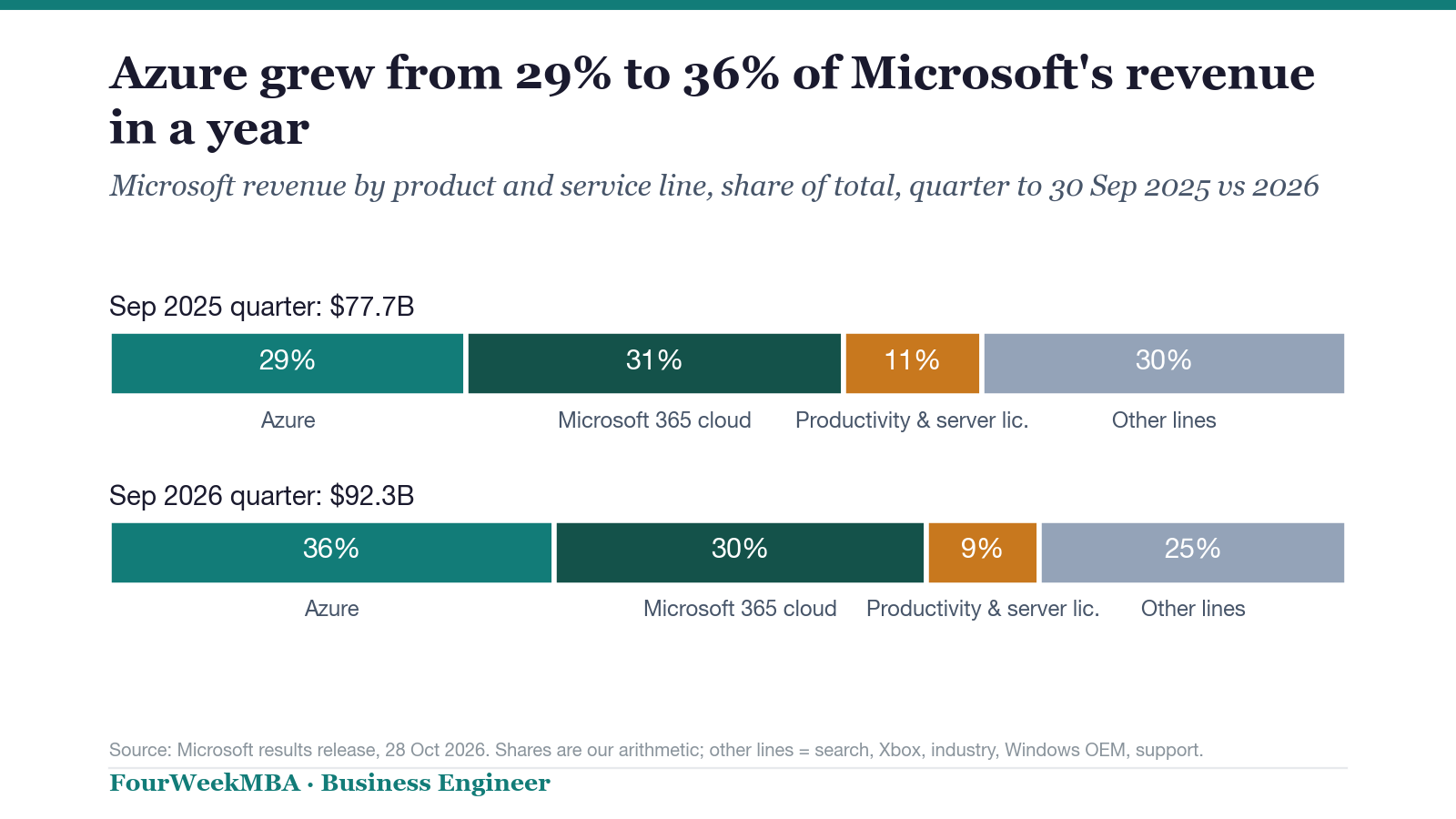
Microsoft's results announcement breaks revenue down by product and service. Azure brought in $33.2 billion, up from $22.4 billion a year earlier. Microsoft 365 cloud services brought in $27.8 billion. Productivity and server licences brought in $8.4 billion, search and advertising brought in $6.6 billion, and XBOX brought in $5.4 billion.
Our calculations show that Azure accounted for 35.9% of Microsoft's total revenue, compared with 28.8% a year earlier. Azure's revenue grew by $10.8 billion, which represented 73.8% of the company's total revenue increase of $14.6 billion. Microsoft also reported $63.9 billion in Microsoft Cloud revenue, a broader measure that rose 30%.
OpenAI Is a Customer and an Investment
Microsoft's Form 10-Q says it has an investment in OpenAI that is accounted for using the equity method. The investment represents “an approximate 24 % interest on an as-converted basis”. Because Microsoft has this relationship with OpenAI, it classifies OpenAI as a related party and reports details of their business transactions.
The filing says: “For the three months ended September 30, 2026, we recorded revenue from commercial arrangements with OpenAI, inclusive of revenue-sharing payments, of $ 10.0 billion”. Our calculations show that this was 10.8% of Microsoft's total revenue for the quarter. Microsoft was owed $7.2 billion by OpenAI. Of a $13.0 billion funding commitment, $12.0 billion had been provided.
Contracted Revenue Still to Come
Microsoft's results announcement says the value of its commercial remaining performance obligations rose 73% to $677 billion. This is money from commercial contracts that Microsoft expects to earn but has not yet recorded as revenue. The figure shows the value of work and services still to be delivered under these contracts.
Where the Cash Went
Microsoft's cash flow statement shows that it generated $58.0 billion in net cash from its operations during the quarter. It spent $39.4 billion adding property and equipment, compared with $19.4 billion a year earlier. Our calculation shows that the difference between operating cash and these additions was $18.6 billion.
The results announcement says Microsoft “returned $10.2 billion to shareholders in the form of dividends and share repurchases”. Its cash flow statement lists $6.8 billion paid as dividends on common stock, $4.4 billion spent buying back common stock, and $4.9 billion used to repay debt.
Leases and Depreciation
Microsoft's Form 10-Q says that, as of 30 September, it had signed additional leases worth $364.6 billion that had not yet started. These leases were mainly for data centers and were due to begin between the 2027 and 2034 financial years. Microsoft's cash, cash equivalents and short-term investments totalled $64.5 billion, down from $76.8 billion on 30 June.
The filing says depreciation expense was $11.1 billion for the quarter, compared with $7.1 billion a year earlier. Depreciation records the cost of long-lasting assets over time as they are used. The filing also says Microsoft's Cloud gross margin percentage “decreased to 66% driven by sales mix shift to Azure”. This means the gross margin fell to 66% partly because Azure made up a larger share of sales.
The Structural Read
Our reading of Microsoft's results announcement suggests that the new Agents and Infra segment includes Azure, Microsoft 365 cloud services and other commercial cloud businesses. This helps explain why its revenue grew by 25% while revenue from Devices and Consumer fell by 3%.
Microsoft's Form 10-Q reports figures for OpenAI because OpenAI is an investment accounted for using the equity method and is therefore a related party. The filing reports $10.0 billion in revenue from commercial arrangements with OpenAI and $7.2 billion owed by OpenAI as of 30 September.
Our calculations show that spending on property and equipment was equal to 67.9% of the net cash Microsoft generated from operations during the quarter: $39.4 billion compared with $58.0 billion.
Microsoft Form 10-Q, quarter ended 30 September 2026
“primarily for datacenters, that had not yet commenced of $ 364.6 billion”
Three Implications
FOR AZURE Azure's revenue rose to $33.2 billion from $22.4 billion. The filing says Microsoft's Cloud gross margin percentage fell to 66%, partly because Azure made up a larger share of sales.
FOR OPENAI OpenAI is both a Microsoft customer, bringing in $10.0 billion in revenue for the quarter, and a company in which Microsoft has an investment. According to the filing, Microsoft's ownership interest is about 24% on an as-converted basis.
FOR THE BALANCE SHEET Microsoft's cash, cash equivalents and short-term investments totalled $64.5 billion on 30 September, down from $76.8 billion on 30 June. Depreciation expense rose to $11.1 billion from $7.1 billion a year earlier.
The Business Engineer Lens
This article connects with the Business Engineer framework Enterprise AI: From Software to Substrate.
The framework argues that software for large companies is changing from a tool that customers buy into infrastructure that becomes part of how they work. It describes this idea with the words: “The product is the interconnection.”
Microsoft's results announcement and Form 10-Q, both dated 28 October, show a company now organised around an Agents and Infra segment, with OpenAI serving as both a customer and an investment. The framework itself does not discuss these financial figures.
What Is Not Established
Microsoft's filing does not explain how the $10.0 billion in revenue from OpenAI is divided between Azure services and revenue-sharing payments. It also does not provide a separate figure for revenue from AI. Microsoft said it would share its outlook during the earnings call, but that information is not included here.
The Bottom Line
Microsoft's results announcement and quarterly filing show a company now reported in two business segments. Our calculations show that Agents and Infra generated 83.2% of total revenue, while Azure accounted for 73.8% of the year-on-year increase. OpenAI contributed $10.0 billion of Microsoft's revenue for the quarter. At the same time, Microsoft spent $39.4 billion on property and equipment and had $364.6 billion in leases that had not yet started.
A note on sources: All figures come from Microsoft's results announcement for the first quarter of fiscal 2027, filed as SEC Form 8-K, Exhibit 99.1, and its Form 10-Q for the quarter ended 30 September 2026. Both documents are dated 28 October 2026. Shares, differences and percentage changes are our calculations. Earlier articles linked in the original piece use their own sources.
Sources: Microsoft FY27 Q1 results announcement (SEC Form 8-K, 28 October 2026) · Microsoft Form 10-Q for the quarter ended 30 September 2026 (SEC EDGAR)