
Google finds AI agent writing and launching exploits with no human in the loop

Attackers have started using AI agents to carry out entire stages of real cyberattacks. Google Threat Intelligence Group (GTIG) and Mandiant report that, in at least one operation, no human was needed to turn a newly released software patch into a working attack.
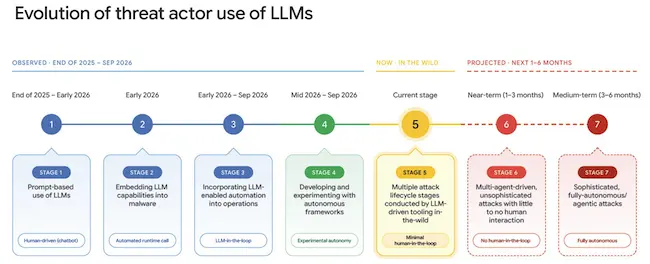
Timeline showing how large language models (LLMs) have developed (Source: Google)
Google wrote: “The basic methods used in these attacks have not changed. Attackers still use stolen login details and target systems that have not been updated. However, automated tools can now exploit these known weaknesses much faster and on a much larger scale. This creates a new challenge for security teams.”
Tools made for security testing are now being used against victims
Google's researchers found several groups using open-source AI-powered security testing tools during real attacks. ARTEX has attracted the most attention, leading the FBI to issue a warning. In an alert published on November 13, the FBI said that attackers had been using ARTEX against organizations since at least August 2026. The affected sectors include financial services, government, technology, defense, healthcare, energy and others.
Attackers are also using other tools, including CAIRN, CyberStrikeAI, PentAGI and HexStrike AI. Some have also tested tools they built themselves. These systems can find and take advantage of basic security weaknesses. They can also change their approach based on the results they receive from a target.
The groups testing these tools include criminals seeking financial gain and suspected espionage groups linked to China. GTIG also found evidence that one group linked to the People's Republic of China (PRC) was building its own automated attack system, probably for spying.
For now, GTIG says these tools are choosing speed over secrecy. Their network activity and code leave traces that can make them easier to detect.
Researchers said: “As these tools and the large language models behind them become more advanced, we expect people to become less involved in these operations. We also expect the attacks to become harder to detect and more sophisticated.”
AI writes and launches attacks without a person controlling the process
GTIG says that during the previous three months, it saw attackers use large language model (LLM) systems to find security weaknesses and exploit them automatically, “without a human in the loop for the first time.”
The evidence came from an exposed staging server. It hosted a system called exploit_agent, which used several AI agents connected to advanced commercial and locally run LLMs. The system compared the code of popular web applications before and after security patches were announced. It then looked for the weakness, created an exploit and tested it.
The server also contained data stolen from victims, along with scripts for trying many passwords, installing webshells and removing webshells placed by other attackers. A webshell is a tool that can give an attacker remote access to a compromised website. Comments in a configuration file were written in Russian. One comment described the LLM API keys as being “for auto-exploitation (exploit_agent pilot).” Information collected from victims suggests that the operator was interested in French websites connected to media, entertainment and education.
In its September analysis of security vulnerability data, GTIG found that the number of vulnerability disclosures and related exploits nearly doubled between January and August 2026. The number of zero-day exploits also rose to 22 in August, compared with an average of 8 per month in 2025. A zero-day exploit takes advantage of a security weakness before a fix is available or before defenders have had time to apply it.
Security teams must also deal with a large number of “LLM-generated exploits that are claimed to work but don't.” After official patches for two PHP security flaws (CVE-2026-109618 and CVE-2026-109619) were released on October 21, hundreds of proof-of-concept examples appeared online. However, they did not work. Security experts had to examine them one by one.
Stolen access to AI services is being sold
Mandiant investigated several LLMJacking incidents in 2026. In these attacks, criminals broke into cloud accounts and used the victims' computing resources and LLM usage limits. In some cases, the fake charges went above $100,000 in a single day. In the worst cases, the total reached $1 million before the abuse was stopped.
In one incident, a network of infected computers used stolen login details to “generated millions of LLM API calls in approximately 24 hours before the credentials were revoked.” The stolen access is also being sold through underground online shops that GTIG calls “LLM Mixers.” These shops offer access to advanced and jailbroken AI models for prices ranging from $0.10 to $25 per million tokens.
A coding assistant is used to install a backdoor
For North Korea's fake IT workers, AI tools have become a way to help find jobs. They use them to write resumes and prepare for interviews with Western companies, making themselves sound more believable.
GTIG has seen North Korean attack methods change during 2026. AI is now also being used to break into the companies themselves. In attacks against cryptocurrency organizations in North America and Europe, a suspected group tracked as MIDNIGHT NEPTUNE created fake recruiter profiles. The profile pictures had SynthID watermarks, which confirmed that the images were AI-generated. The fake recruiters directed their targets to fraudulent meeting websites. There, ClickFix tricks encouraged people to run scripts presented as diagnostic tools.
After gaining access, the attackers moved into the companies' internal code repositories. They changed .claude/settings.json files so that starting Claude Code would “would automatically trigger the download of the SOMBERMEME backdoor.” A backdoor is malicious software that gives an attacker a way to access a system again. To make their activity look normal while moving through company systems, the attackers gave the GitHub Personal Access Tokens they created names based on Microsoft Copilot.
Fake online identities designed to look like real people
GTIG is highly confident that groups running influence campaigns have moved beyond simply testing large language models. They are now using these tools regularly. In August 2026, GTIG investigated a platform designed to automate entire influence campaigns about regional political issues in Europe and the Middle East. Its instructions told AI models to copy local accents, dialects and slang. They were also asked to include “intentional typos to avoid sounding like an automated tool.” The system added grain and uneven lighting to generated images so they would look like photographs taken with smartphones.
A different contractor was developing a platform designed to manage more than 100,000 accounts using groups of cloud-based phones. New accounts went through an automated waiting period, called “aging.” During this time, AI models acted as if they were ordinary users, scrolling through content and browsing websites. Only after this period did the accounts begin sharing campaign messages. The instructions showed that the contractor planned to sell the platform to its own government and to customers in other countries.
Researchers concluded: “The use of these frameworks by attackers marks a major change. Attacks are increasingly happening at machine speed, and automated systems can connect complex attack steps together, allowing operations to grow much larger.”