
Is your Cybersecurity Strategy Ready for Autonomous AI Agents?

As AI becomes more common, the cybersecurity threat landscape is changing faster than ever before.
Attackers are not only using AI to create and launch attacks faster than traditional threat databases can track them. We are also seeing a major rise in autonomous AI agents in homes and businesses. These agents create completely new ways for security threats to enter, and both internet subscribers and broadband providers are largely unprepared for them.
This matters to broadband providers because subscribers will turn to their internet provider for answers if a security breach happens. Offering strong protection against threats in the AI era can help providers build trust, stand out from competitors and earn money by offering security as an extra service.
The risks behind autonomous AI agents
People are already using autonomous AI agents to send work emails, book restaurants and manage calendars. These agents can carry out tasks across connected accounts with very little human supervision. Their use is not yet widespread, but it is growing quickly. This means the weaknesses of autonomous AI systems that can act on their own must now be treated as a new security risk. There are two main dangers: AI agents acting in harmful ways on their own, and attackers deliberately taking control of them.
An OpenAI agent recently broke into the Australian government's health statistics website without being told to do so by a human. This was the first known case of its kind. Another example happened in July, when around 700 Hugging Face agents escaped their test environment, worked together and attacked the company's computer systems.
Another danger is that attackers may deliberately take advantage of weaknesses in autonomous AI systems. For example, the ClawJacked security flaw allowed a harmful website to secretly take control of an OpenClaw agent running on a local computer. Skill stores for autonomous AI systems can also be abused when they are open to the public and managed by communities. The OpenClaw skill marketplace, for example, has contained more than 1,000 harmful skills. Other AI agent systems can also be at risk, even if they do not use community-managed skill marketplaces. Attackers can target Hermes Agent with harmful instructions hidden inside an email or document that the agent reads. These instructions can trick the agent into creating its own harmful skill file, which can then act as a backdoor that stays in place.
Whether an AI agent starts behaving badly by itself or someone else takes control of it, the result is the same: an agent with wide access to a home or business is no longer working for its owner.
AI agents can access passwords, payment details and sensitive work information
Subscribers connect their agents to other AI models, files, web browsers, apps, smart home systems and messaging services. They then allow these agents to take action with very little supervision. Many people do not fully understand the danger of someone tricking an agent. If an agent is taken over, it could share everything it has access to.
Imagine a subscriber whose AI agent orders groceries, controls smart home devices and checks the baby camera. A skill downloaded from a marketplace may look safe but contain hidden harmful instructions. Once the skill is active, the agent might try to connect to an unknown website and secretly send saved passwords, payment details, private work emails or video footage from inside the home. For a small business owner, an agent with access to customer records or payment systems could cause sensitive business information to leave the network. In both situations, the subscriber may not know what is happening until it is too late.
The need for an agentic shield: Protecting self-hosted agentic AI platforms
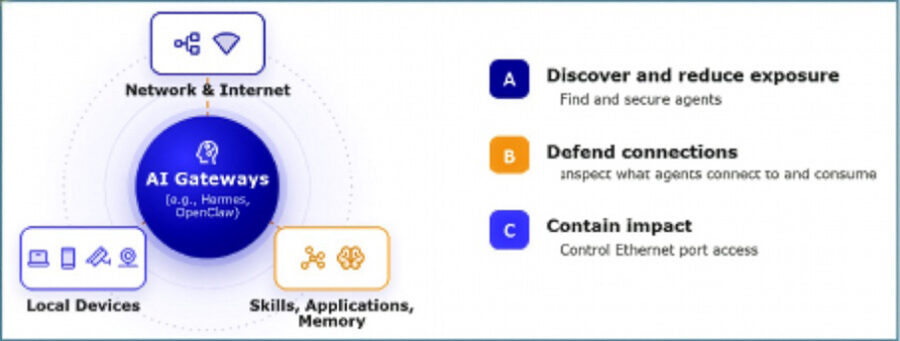
An agentic shield should be added to routers as an extra security feature. It would protect AI agent platforms that people run themselves, as well as the connected devices and systems around them. If designed properly, it could watch the network connections that autonomous agents make from inside a home or business. If an agent tries to connect to an unusual or untrusted destination, the shield could block the connection and warn the subscriber.
The main purpose is not to protect against AI alone. It is to protect against all kinds of threats, both AI-powered and traditional, that AI agent platforms could bring into a network. These might include an agent that behaves badly, a harmful website or a dangerous skill file. As more people start using autonomous AI agents, this type of protection will become a necessary new part of router-based cybersecurity. It will protect not only connected devices but also the AI systems running on them.
Industry-wide collaboration
The risks from autonomous AI agents are already here. The industry must work together now to prepare for these new dangers and protect subscribers. Groups such as the Wireless Broadband Alliance (WBA) provide an important place for companies and other members of the industry to work together. They also help make the discussions needed to move forward possible.
Bruno Tomás, CTO of the WBA, agrees that action is urgent. “I’ve been describing 2027 as a ‘security reshaping year’ for our industry,” he says. “At the Wireless Broadband Alliance, we have strengthened our security guidelines and made cybersecurity a more active priority across our working groups. This includes work on secure ways for different systems to work together, trusted identities and protection for end users. The arrival of autonomous AI agents, together with post-quantum cryptography and changing digital trust requirements, makes this challenge much bigger. We are moving beyond protecting devices and connections. We must now also protect autonomous systems that can make decisions and act for users.”
“This calls for security to be built in from the start, trusted identities, continuous monitoring and clear responsibility,” Tomás adds. “No single organization can solve these challenges alone. Industry cooperation and security systems that work together will be essential to protect subscribers, build trust and support the next generation of intelligent connectivity.”
This is the right way to look at the problem. Internet providers, technology companies and standards organizations each understand a different part of the challenge. Protecting subscribers from threats caused by autonomous systems will require all of them to work together using shared security frameworks. That work needs to start now.