
Rivian Was a Blockbuster IPO and Lost Most of Its Value. What Its Fall Tells Anthropic Buyers.

Few planned stock market listings have excited Wall Street as much as Anthropic's upcoming IPO. But history shows that buying shares in a highly popular IPO does not always lead to big gains. On October 26, 2026, Anthropic, the company that makes Claude, filed paperwork for a proposed initial public offering. The company later said it plans to offer 825 million Class A shares on the Nasdaq Global Select Market. Its planned stock symbol is “ANT,” and its expected share price is $70.00 to $78.00. But Wall Street has seen exciting IPOs lose much of their value before. One important example still trades on the same exchange and is part of the technology-heavy Nasdaq Composite.
Rivian Shows How Quickly Paper Wealth Can Disappear
Rivian Automotive (NASDAQ:RIVN | RIVN Price Prediction) set its IPO price at $78 per share in November 2021. For a short time, the company was worth more than $150 billion. Its shares closed at $100.73 on its first day of trading, November 10, 2021. Today, they sell for about $12. That is an 88.1% drop from their first closing price and has brought the company's market value down to about $17.6 billion. The stock has continued to fall. It is down 18.6% over the past year and 37.7% so far in 2026. Last year, when Rivian shares fell 91% from their highest price, 24/7 Wall St. said they could fall further. That is what happened.
RIVN
Key Data−
Rivian's share price fell because its market value was much higher than what its business could support. In 2020, the year before its IPO, Rivian had no revenue but lost $1.02 billion. Its net losses grew to $4.69 billion in 2021 and $6.75 billion in 2022. The company also had negative gross profit every year through 2024. Rivian has lost money every year since 2019. In 2025, it lost $3.65 billion while bringing in $5.39 billion in revenue.
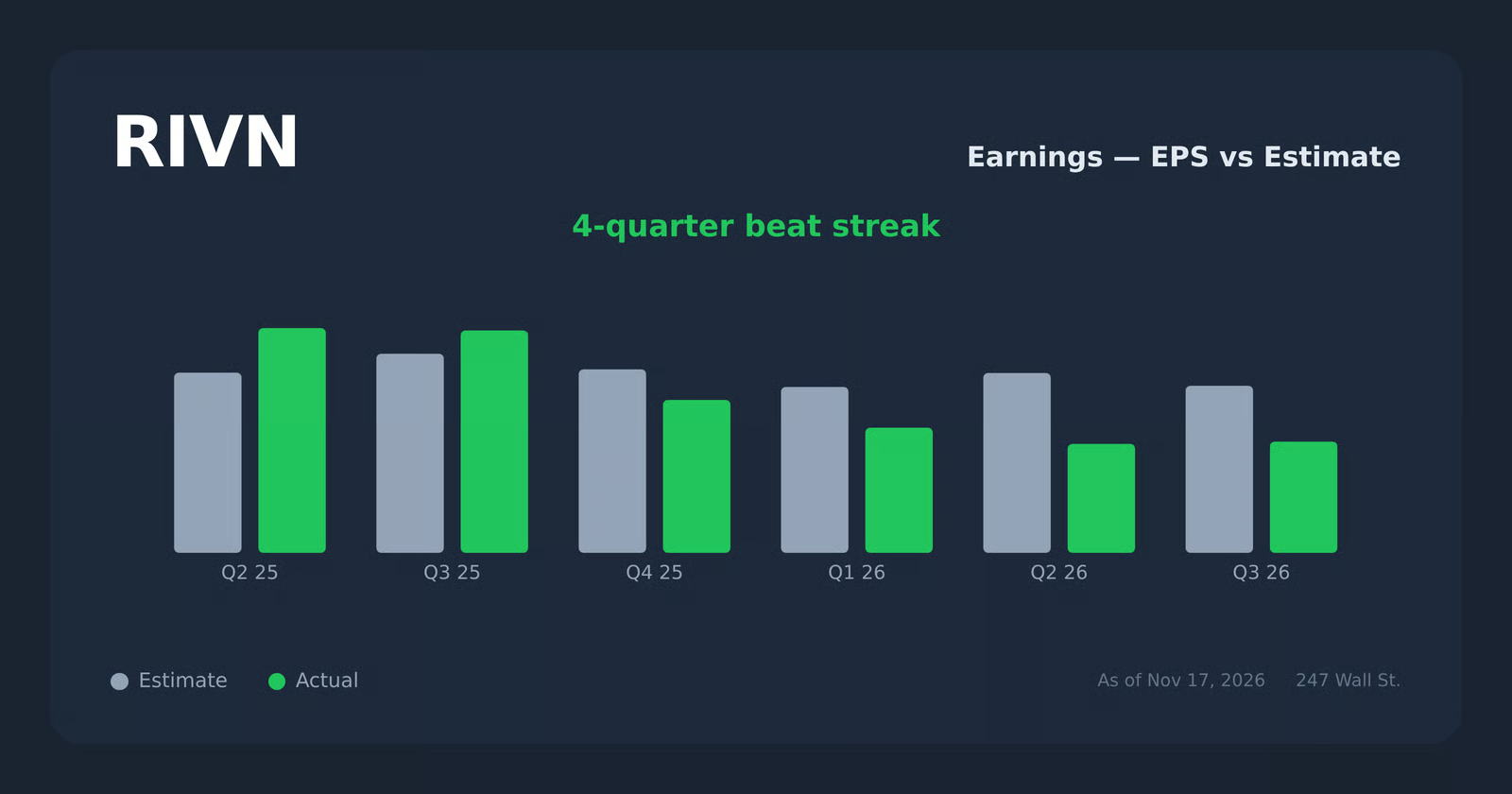
The business has made progress. In the third quarter, revenue increased 38.3%[1] to $2.16 billion. Deliveries increased 46% to 19,248 vehicles. Its adjusted loss was $0.48 per share, which was better than the average analyst prediction of a $0.721 loss per share. Even so, Rivian lost $913 million[1] during the quarter. It also expects an adjusted EBITDA loss of $1.75 billion to $1.85 billion for the full year. Founder and CEO RJ Scaringe explained the problem during an October 29[2] call: “We can only ramp as fast as our slowest-ramping supplier.” This means the company cannot increase production faster than its slowest supplier can provide parts. Wall Street now values Rivian at about 2.7 times its sales over the past 12 months, which were $6.48 billion. That lower valuation reflects five years of difficult lessons.
Meta's Difficult Start Shows That an IPO Can Recover
Not every popular IPO ends badly. Some companies recover after a weak start. Meta Platforms (NASDAQ:META), which was then called Facebook, began trading in June 2012 at $28.89 per share. Its share price later fell to a monthly low of $17.55 in September 2012. On November 16, 2026, the stock closed at $626.41. That is about 3,469% higher than its low. Investors who held on through the early drop made large gains because the company's business grew enough to support its value. Rivian, on the other hand, continued to lose more money than it brought in through sales.
META
Key Data−
Anthropic's Financial Filing Looks Very Different From Rivian's
Anthropic's financial results at the time of its IPO are very different from Rivian's. Its revenue grew from $41 million in 2023 to $386 million in 2024 and $4.585 billion in 2025. It then jumped to $16.286 billion in just the first six months of 2026, compared with $1.163 billion during the same period a year earlier. In the three months ending in June 2026, Anthropic reported operating income of $974 million on revenue of $11.555 billion. Its operating loss for the full six-month period fell to $693 million. The number of customers who generated at least $100,000 in revenue over the previous 12 months increased from more than 950 to more than 11,900 in the year ending September 30, 2026. The filing also reports a net revenue retention rate of about 900%.
Anthropic reported a headline net loss of $80.748 billion for the first half of 2026. Most of this loss came from a $72.4 billion accounting charge related to the higher estimated value of its convertible notes. The company says this change was mainly caused by an increase in its estimated business value. This accounting charge reflects the same rising company valuation that new investors will be paying for when they buy shares. Anthropic's need for large amounts of money to grow is the closest connection to Rivian's situation. Anthropic expects its spending on buildings, equipment, and other capital projects to rise sharply as it builds more computing capacity. Some of its data center contracts have starting terms of 20 years. These contracts include take-or-pay rules. This means the company must buy a minimum amount of service or pay a penalty if it uses less than that amount. It must meet these obligations even if it does not use all the computing capacity. By comparison, Rivian has about $13 billion[2] in available cash and investments and has set future funding goals to pay for its expansion.
One Important Sign Separates Anthropic From Rivian
Based on the information in its filing, Anthropic looks more like a company that can recover from an IPO than one that could suffer a Rivian-style collapse. It already earns billions of dollars in revenue and has reported a quarterly operating profit. Rivian did not have either of these things when it went public. The biggest risk is the price investors will pay for Anthropic shares. If the IPO values the company far above what its revenue can support, history shows that even a strong business can give its first public investors years of poor returns. One important thing to watch is Anthropic's operating income in its first quarterly earnings reports as a public company. If it remains positive after the company reported $974 million in operating income in the June 2026 quarter, the comparison with Meta becomes stronger. If the cost of computing pushes the company back into losses, the comparison with Rivian becomes more convincing. Over time, Wall Street tends to reward companies whose revenue grows enough to support their market value. Anthropic's financial filing shows that it has a head start that Rivian did not have.