
China's Large Language Model Pricing Explained: Insights from Anthropic's Listing Bell-Ringing Ceremony
Anthropic's stock market listing is more like a major test for the entire AI industry.
Written by Wei Linhua
Edited by Liu Junhong
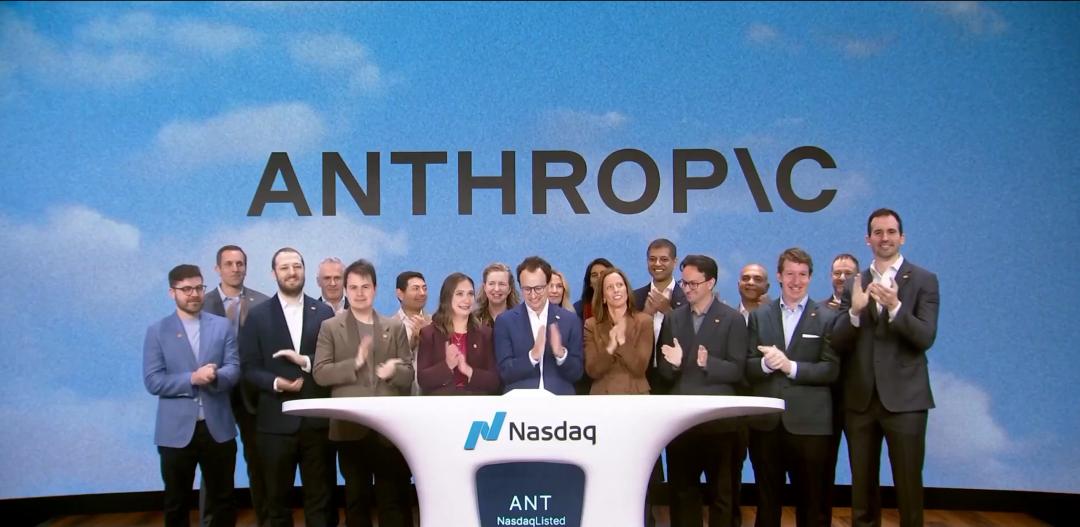
At 11:48 a.m. Eastern Time on November 19, Anthropic (stock symbol: ANT) officially began trading on the Nasdaq. It arrived with the promise of becoming "the largest IPO in human history."
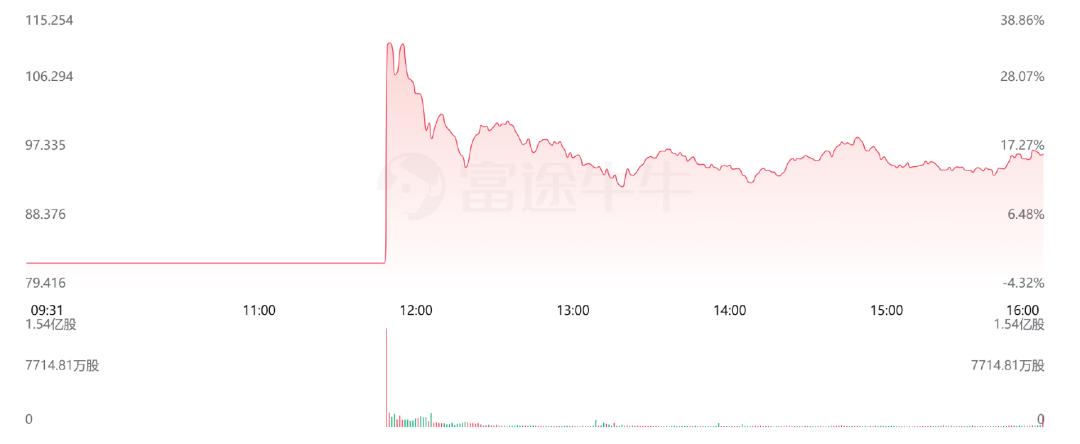
Anthropic's final offering price was $83 per share, but its opening price jumped to $111.50, a 34.3% increase. During the trading day, the price reached a high of $115.10. Based on the total number of shares that could eventually exist, Anthropic's highest valuation reached $2.02 trillion. This meant it passed SpaceX, which went public in June this year.
But the excitement after trading began lasted less than half an hour. By the end of the day, Anthropic's market value had gone through a dramatic rise and fall.
From the afternoon onwards, Anthropic's share price kept falling. It reached a low of $92.72 before closing at $97.17. This was still 17.07% above the offering price of $83. However, compared with its highest price during the day, Anthropic lost about $3.244 trillion in market value by the close. Based on the total number of shares that could eventually exist, its valuation fell from $2 trillion to around $1.76 trillion.
While the listing bell rang on the other side of the world, almost all the founders of major Chinese AI model companies, investors, and stock market analysts stayed up late to watch. They were not just following Anthropic's share price. They wanted to answer a bigger question: Now that the global AI industry's main guide for company valuations has entered the public stock market, how should China's large AI model companies be valued?
After all, Anthropic's valuation had already faced several changes before its listing. Investment firms first put its value at $2 trillion. Then its valuation was lowered during its third-quarter roadshow. Concerns about the US midterm elections and Nvidia's sudden change in leadership also affected its market value, pushing it down again and again.
For Anthropic, going public at this moment is more like a major test for the entire AI industry.
Anthropic's listing is not simply a story about whether the company is expensive. It is about how investors calculate its value.
The new standards Wall Street is using to judge Anthropic will also be applied to Chinese large model companies.
Anthropic's valuation has risen
But much of the extra value has already been removed
As a model for large AI companies around the world, Anthropic's 17% share price gain on its first trading day is not unusual.
Investors are still eager to buy its shares. According to Bloomberg, the number of shares investors wanted to buy was about six to seven times the number available. Most of these orders came from large institutional investors.
This strong demand gave Anthropic confidence to raise its offering price. It also planned to take advantage of the good market conditions to raise more money and build up its financial resources.
On November 18, Anthropic finally raised its offering price range from $70–78 to $83. It also increased the number of shares it planned to sell by 19%. The number of shares rose from the original plan of 825 million to 980 million, allowing the company to raise nearly $200 billion in cash.
With fewer shares available than investors wanted, Anthropic also received strong support from major companies that supply computing power:
Just before the listing, a group of major technology companies, described as the "all-stars" of global computing power, agreed to buy $260 billion worth of Anthropic shares. The group included Nvidia, Google, Microsoft, AMD, Broadcom, Micron, and partners of TSMC. Google and Nvidia made the largest commitments, with each contributing $100 billion.
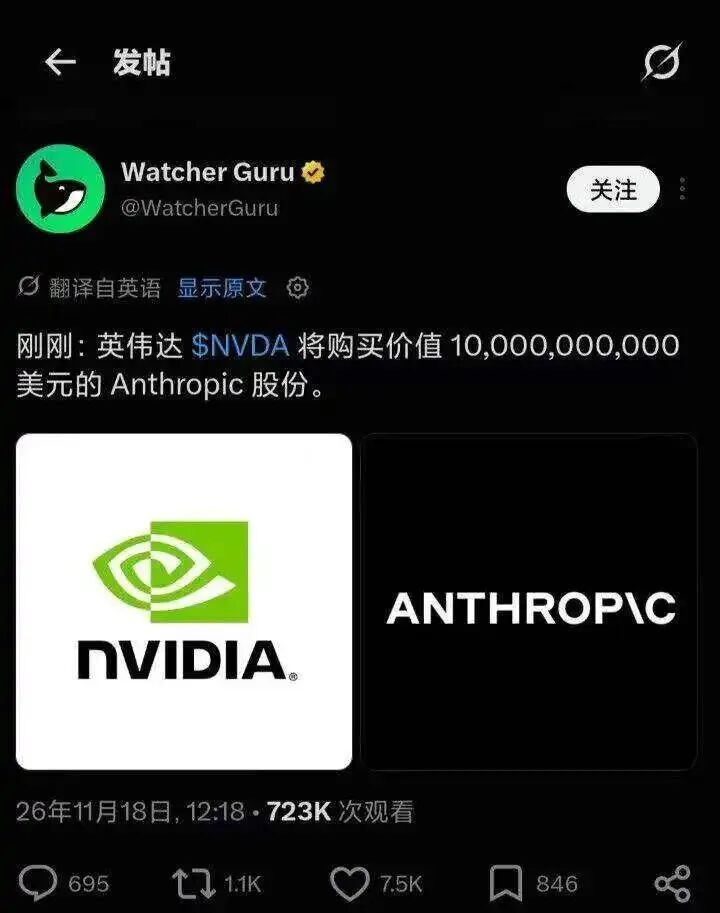
These companies that supply computing power and cloud services are now closely connected to Anthropic. Their investments also help secure future orders for their products and services.
The $260 billion investment is more like a strategic payment that helps secure future business. Anthropic can use this money to expand quickly and train its next generation of AI models. Later, much of that money may return to the investors through purchase orders and contracts. It could be spent on Nvidia chips, Broadcom servers, and data centers run by major cloud companies.
Who are the largest shareholders behind Anthropic? The answer is Amazon and Google. According to information released by Anthropic, Amazon owns 14.7% of the company, while Google owns 13.7%.
Although Anthropic's market value finally settled at around $1.76 trillion, its rise and fall on listing day had actually been developing for about three months.
In August this year, investors were still confidently giving Anthropic a valuation of $2 trillion. At the time, the way they calculated its value was simple: as long as its AI models kept improving and its revenue kept growing quickly, they believed the company's potential value could keep rising.
But things did not go as expected. Starting in October, Anthropic faced several rounds of valuation cuts:
First, its revenue growth was slower than investors expected, so investment firms began to look more carefully at its value. During its October roadshow, Anthropic revealed that its quarter-on-quarter revenue growth had fallen from 144% in the second quarter to 47% in the third quarter. Investment firms responded by removing some of the extra value they had added to the company. They lowered its valuation to $1.5 trillion.
These earlier changes were mainly caused by doubts about Anthropic itself. The next fall in its valuation was driven more by concerns about the future of the entire AI industry.
After the US midterm elections, investors became worried that stricter rules for data centers would slow the industry down. This led to another fall in US AI stocks. On November 6, the Nasdaq fell 5.52%, while the Philadelphia Semiconductor Index dropped by about 12%.
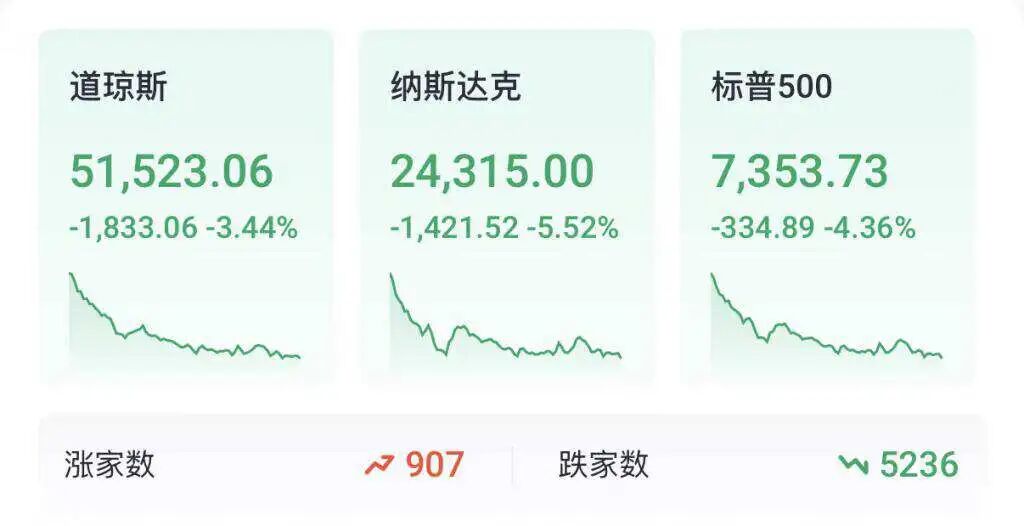
During this process, what disappeared from Anthropic's market value was mainly the extra value based on investors' hopes for the future.
There is another reason for investors to be careful. Large technology companies are supporting Anthropic and investing in its computing power. But investors may wonder how much of the company's impressive financing and fast revenue growth comes from real customer demand, and how much comes from a cycle in which large companies invest money in Anthropic with one hand and sell it computing power with the other.
Anthropic has total spending commitments under purchasing agreements and lease contracts of as much as $9.009 trillion. At the same time, Jensen Huang, who had led Nvidia for 33 years, suddenly resigned. New signals from CFO Colette Kress after she took over as CEO also added to investor concerns. Together, these changes weakened one of the most important supports behind the AI industry's computing power financing system.

During Nvidia's earnings call, Kress publicly explained the company's new rules. Nvidia will carefully check companies that receive financial support in the future. It will only provide guarantees for data centers after they have actually been built and are ready to operate. It will not provide guarantees while they are still being built. If construction is delayed, Nvidia's guarantee will no longer apply.
Over the past two years, Nvidia has not only sold the tools needed to build AI infrastructure. It has also acted as a major financial backer for the entire industry. By the end of October this year, Nvidia's total exposure to financial guarantees for outside AI infrastructure projects had grown to $118 billion.
In the past, investors were willing to give companies like Anthropic very high valuations partly because these companies had close ties to computing power suppliers. They believed Nvidia would support them and step in if problems arose. Now, Nvidia's leadership has changed, and the new leadership is taking away the promise of open-ended financial support. It is natural that investors have become more worried.
Without this financial backing, investors must take another look at whether Anthropic can meet its future growth targets and how much of that growth it can actually achieve.
The same situation applies to China.
Over the past two years, many Chinese large model companies have relied on cloud computing resources from major technology companies and strategic investments from those companies to support their high valuations. But Anthropic's experience has already shown what may happen next. Once these companies enter the public stock market, investors will eventually separate the benefits they receive from subsidies and support by major companies from their actual business results. They will calculate the two separately.
Anthropic's listing has sent a clear message to Chinese large model companies: the time when a simple story about fast growth was enough to win over stock market investors is over.
Watching Anthropic fall from its $2 trillion high back toward a valuation of $1.5 trillion naturally raises concerns about the future of Chinese large model companies. If their valuations also depend heavily on rising revenue, what will happen to them next?
Valuation bubbles are shrinking, but demand remains strong
How should Chinese large model companies be valued?
To understand the value of Chinese large model companies, we first need to look at what has happened to Anthropic. The company itself has not suddenly changed. What has changed is the way investors in the capital market calculate its value.
In fact, compared with Wall Street, which has only now started removing extra value from Anthropic's valuation, Chinese large model companies have already reached a more reasonable level.
Two examples are Zhipu AI and MiniMax, which are already listed on the stock market. Long before Anthropic rang its listing bell, these two companies had already shown how the valuation bubble in the large model industry could shrink.
When Zhipu AI and MiniMax listed on the Hong Kong Stock Exchange in January this year, they were extremely popular. Zhipu AI even reached a market value of one trillion yuan. Why were investors willing to value them so highly at the time? The main reasons were limited share supply and strong expectations for their future annual recurring revenue, or ARR.
When MiniMax went public, only about 17.07 million shares were available for trading on the Hong Kong stock market. This was less than 6% of all its shares. Even so, about 420,000 investors applied to buy shares, and demand was 1,837.17 times greater than the number of shares available. Zhipu AI also received applications 1,159.46 times greater than its available share supply.
But just a few months later, the market values of both companies had fallen by more than 80% from their highest levels. Their business revenue was still growing quickly. However, as the date approached when restricted shares could be sold, the extra value created by the small number of shares available for trading quickly disappeared.
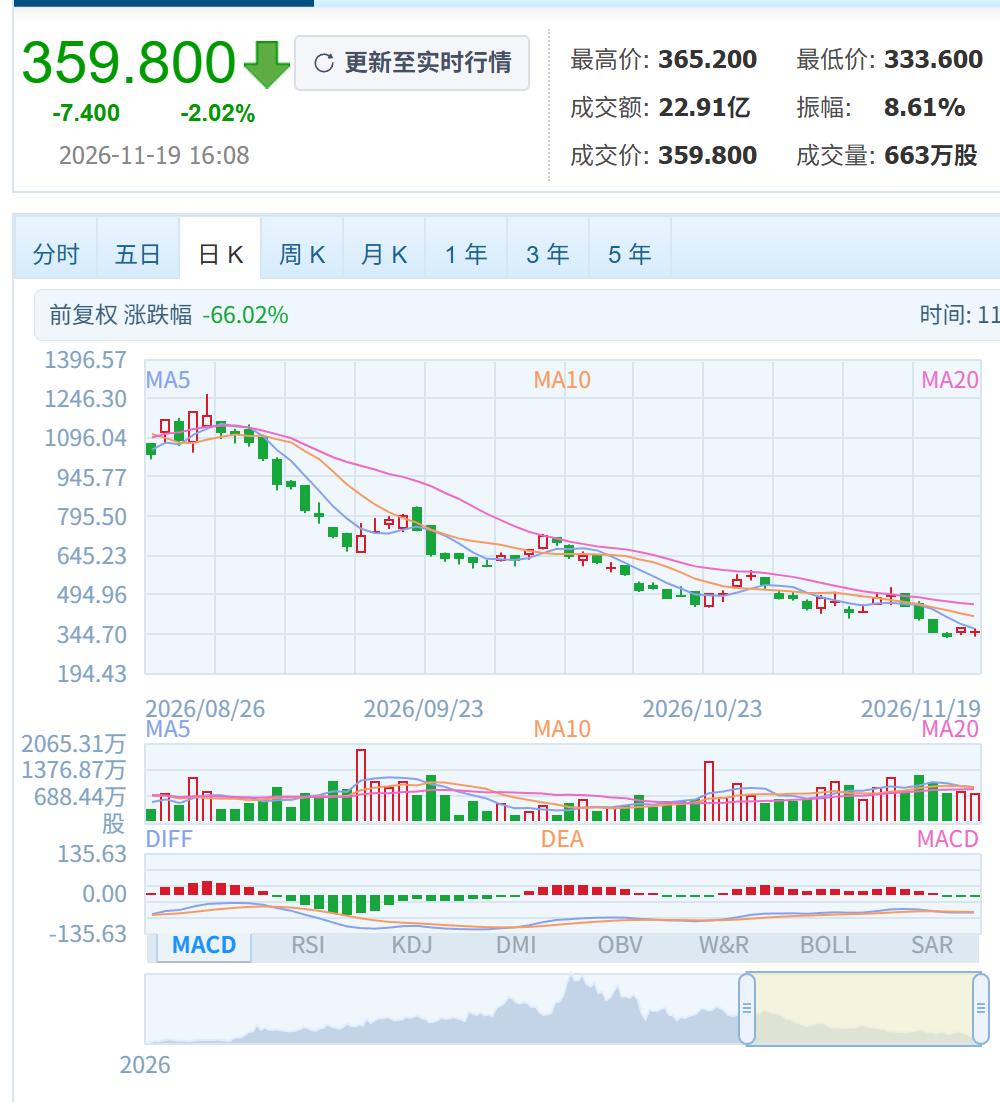
Market value of Zhipu AI
What is even more worrying is the situation facing large model companies that have not yet gone public. The negative mood in the public stock market is likely to spread back to the market where private companies raise money.
Overseas, OpenAI is also trying to raise more money before Anthropic's listing. It has recently been pushing ahead with a new round of financing. OpenAI originally hoped to raise $300 billion at a valuation of $1.4 trillion, but investors were clearly not willing to offer that much.
In the end, the valuation for this funding round was cut from $1.4 trillion to $1.25 trillion. This was a reduction of $150 billion, or 10.7%. The first payment of the funds it received also fell to around $150 billion. Even OpenAI cannot avoid price cuts when investors examine its business closely.
If even OpenAI has to accept a lower valuation, how much more room will unlisted Chinese large model companies have to raise their valuations in the future?
Once the extra value from market excitement has been removed, the worth of Chinese large model companies will no longer depend on promises about what they might achieve. It will depend on how well they can actually turn their products into paying businesses.
However, if we look at the global AI industry as a whole, there is still plenty of room for growth in real demand for AI from other industries, even as investors work hard to remove extra value from AI company valuations.
In reality, demand for AI applications has not only remained strong. It is also expected to enter a period of much wider growth.
Over the past two years, China's AI industry has been worried about how to make large models profitable. Revenue from model-as-a-service (MaaS) products sold to businesses has been limited. On the consumer side, companies have also struggled to produce a truly popular product.
By 2026, the rapid growth of AI coding tools and the rising demand for AI agents have started to push up Token prices.
According to the report "Large Model Token Service Performance Monitoring Report (2026)," released by the China Academy of Information and Communications Technology, the average normalized price in China during the second half of 2025 was 6.8 yuan. The average price since the beginning of this year is